Showing posts with label Kiribati. Show all posts

Friday, 22 July 2016

Kiribati has lost 80 % of its live corals in 10 months

El Nino is Basically Over — But this Global Coral Bleaching Event Just Won’t End


21 July, 2016

Back in 2014, an unsuspecting world was on the verge of a major global temperature increase. But despite warnings from scientists like Dr. Kevin Trenberth that deep ocean warming had sped up and would eventually result in rapid surface warming, the big media meme at the time was that global warming had ‘paused.’ Originating in The Economist, and swiftly spreading to numerous other news outlets, this particular blast of bad information fed the public a big helping of false sense of security.

In 2014 through 2016, maximum global temperatures jumped from around 0.65 degrees Celsius to around 1 C above the 20th-century average. In just three years’ time, the whole of the Earth’s surface had warmed by about 0.35 C. This is like cramming all of the warming from 1880 to 1980 into the three-year 2014-to-2016 period. Never before in all of the global climate record starting in the late 19th century has the Earth warmed so much in so short a time.
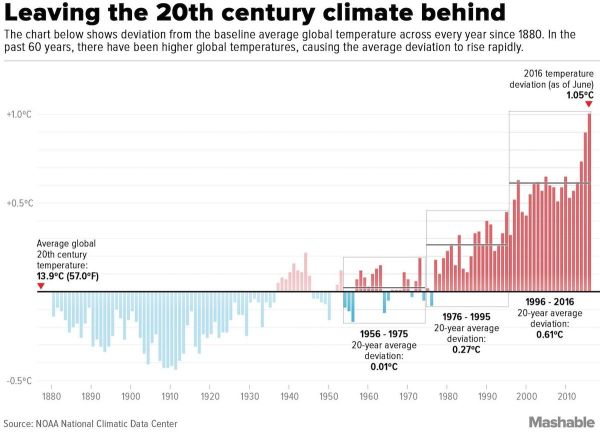
Leaving 20th Century Climate Behind
(Huge jump in global temperatures over the past three years has probably passed a number of climate thresholds — including temperature thresholds for key sea creatures like corals. Data Source: NOAA. Image source: Mashable.)

Global warming hadn’t paused at all. It was just getting ready to hit the accelerator.
Global Heat Spurs Bleaching, Mass Coral Mortality

All this newly-added surface heat represents a big step up into much warmer conditions for the global climate. What this means is that even the coolest months now will probably approximate the warmest months during the big super El Niño of 1998. Such a large temperature increase in so short a period means that the world has likely hit a number of tipping points for geophysical and ecological harm. One of the most visible of these tipping points involves an ongoing ecological crisis — a global coral bleaching event.
Perhaps the most vivid and heart-wrenching example of what is a very wide-ranging coral mortality situation is the bleaching-related damage to Australia’s Great Barrier Reef. In a terrible blow to one of the world’s most stunning natural wonders, about a quarter of the Great Barrier Reef’s corals have already been killed off — an event that some scientists say may eventually lead to 100 percent mortality of the Reef’s corals. (see a related report in The Guardian).

American Samoa Bleaching
(Coral bleaching events like this one in American Samoa during 2015 have been happening around the world since 2014. It’s a global event that’s still ongoing despite a turn toward La Niña conditions in the Pacific. This is the longest global coral bleaching event ever recorded, and one that could continue into 2017 or beyond. Image source: Nature.)

The Great Barrier Reef is not the only reef system to suffer. In fact, the added heat due to human-forced warming of the atmosphere and oceans has generated bleaching-induced heat stress and mass coral mortality the world over. And some of the world’s other great reef systems, including Kiribati, which lost 80 percent of its live corals in 10 months, have been hit so hard it’s doubtful they’ll ever recover.
The Seemingly Never-Ending Global Coral Bleaching Event

At issue is the fact that all this added global heat is creating a situation where reefs bleach year after year and, in some cases (as was the case with parts of the Great Barrier Reef this year) even bleach during winter. It’s a coral mass mortality that falls under the definition of a global bleaching event. But it’s also happening with an intensity, persistence, and duration that we’ve never seen before.
Beginning in 2014 with the big warm-up that preceded the 2015-2016 El Niño, the present global coral bleaching event is now, according to NOAA, the longest-running and the most extensive such event to have occurred in the modern record. NOAA notes:
the current global coral bleaching event is the longest ever recorded. It has affected more reefs than any previous global bleaching event and has been worse in some locales (e.g., Great Barrier Reef, Kiribati). Thermal stress during this event also has caused mass bleaching in several reefs that never bleached before (e.g., northernmost Great Barrier Reef).
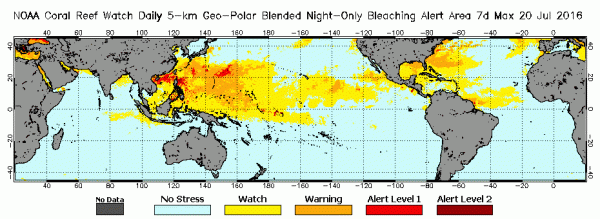
Global coral bleaching event continues
(Global coral bleaching event extent as of July 20 according to NOAA. Note that sections of bleaching watch and warning conditions now extend across the northern edges of NOAA’s map, an indication that latitudinal extent of bleaching is expanding beyond typical ranges even as bleaching due to rising ocean temperatures appears to be becoming a near-constant issue for world corals. Image source: NOAA.)

NOAA had initially forecast that this very-long-duration bleaching event would end sometime in 2016 as El Niño faded out. However, with sea-surface temperatures in the equatorial Pacific hitting the cool side of natural climate variability in the form of La Niña-like conditions during recent weeks, and the current global coral bleaching event still going strong, one has to wonder if oceans have now become hot enough to spur widespread bleaching at almost any time.

NOAA now predicts a possible end to the current global bleaching event in 2017, giving the event a four-year duration. But with global temperatures continuing to warm, what we may be seeing is the start of an unbroken or nearly unbroken period of expanding coral bleaching, a time when global stress to corals due to high ocean temperatures is practically continuous.
Links/Attribution/Statements

Hat tip to June
Hat tip to Colorado Bob
Hat tip to DT Lange


Sunday, 17 July 2016

Climate change and rising seas in the Pacific

Insight: Fighting the Pacific's Rising Seas


Chris Bramwell, Deputy Political Editor @chrisbramwell


17 July, 2016


People living on the tiny Pacific islands of Kiribati and Tuvalu are fighting against rising seas for their very existence. How should the region prepare for its uncertain future, and what can be done to help?

Beach and traditional hut surrounded by wall of tyres
A man in Eita Village carries freshwater to his home, protected from the sea by tyre walls. Photo: RNZ / Chris Bramwell


The tiny village of Eita sits on the coast of the main island of Kiribati.
Surrounded by mangroves and depressions in the land, the villagers eke out their existence by constantly lifting the level of their floors above the ever-encroaching king tides.

Pastor stands in front of thatched traditional village meeting hall
Eita church pastor Eria Maerere says he used to think rising seas were just a story. Photo: RNZ / Chris Bramwell

The senior pastor of the village church, Eria Maerere, says when the community first arrived there in 1980, the king tides were never a problem, but now they regularly inundate their homes.

"When we first heard about the rise of the sea-level, we thought that somebody made up a story, but at the beginning of the year 2000, that's when we begin to realise that it is not a fiction, it is a true story.

"Sometime around the year 2000 we had the first big king tide, where the water swept in and all the floors of the houses were breached with the water.
"All the families had to get up early in the morning because all the water had washed their mats, their pillows and all that."

The United Nations warns that if sea-level rise continues at the current rate, the Pacific atolls of Kiribati and Tuvalu could be completely submerged within decades.


child walks along  unsealed road
A child walks along the main road into Eita Village. Photo: RNZ / Chris Bramwell

Professor James Renwick from Victoria University of Wellington says sea levels in the Western tropical Pacific have risen faster than just about anywhere on Earth.

"As the sea-level rises even by a few centimetres, a king tide or a storm surge can come much further inland."

It is very hard to predict at what point the low-lying atolls will become uninhabitable, Prof Renwick says.

"One of the things about the way some of these physical systems work in the tropics, the strengthening of trade winds and so on, can actually lead to the accretion of sand on some of the atolls, and some of the islands in the Pacific have actually been observed to be getting bigger.

"So it's a complicated story, but as the sea-level continues to rise and if we don't limit greenhouse gas emissions soon and the rising sea-level accelerates ... then the low-lying atolls could become uninhabitable by the end of the century at the very latest."

Basic local concrete block hospital
Even the local hospital has been inundated by big tides. Photo: RNZ / Chris Bramwell

Betio Hospital on Kiribati's main island of Tarawa provides emergency and general medical care, as well as maternity, pharmacy and dental services.
The tiny hospital has suffered flooding from king tides more frequently in the past 10 years, but last February a particularly high tide destroyed its maternity ward, toilet block and part of the sea-wall built to protect it.

Nurse stands smiling in white uniform
Betio Hospital nurse Teri Eromanga says she's worried for her patients. Photo: RNZ / Chris Bramwell

A nurse at the hospital, Teri Eromanga, says while staff do get advance notice of when the sea is likely to inundate the wards, she worries for her patients.

"It floods right into the wards, flooded the patients on the floor - we try to lift them onto something, but all their things are wet with the sea.
"We are safe now because we have a sea-wall, but I am worried because the tides get stronger and stronger, that is my worry."

Labour MP S'ua William Sio, who visited Kiribati and Tuvalu earlier this year, says the rising sea is affecting more than just people's homes or commercial property.

"You can't grow food crops properly, or have a fully-functioning agriculture industry, the seawater is [intruding] into the underground freshwater aquifers."
But Mr Sio says the people of Kiribati and Tuvalu are resilient.

MP in selfie on coast line with houses in the background
Labour's S'ua William Sio in Betio Village, Kiribati, earlier in 2016. Photo: Supplied

"They're doing the best they can despite the overwhelming weight that is obviously on the leadership of the country.

"You can sense and feel that weight, they are fighting for the very survival of their countries, they are fighting for the very survival of their people."

Taking the land back

New Zealand's Ministry of Foreign Affairs and Trade (MFAT) is working on a major project on Kiribati: the Temaiku Bight reclamation.

If it goes ahead, it will reclaim 327 hectares, lifting land in the area to 2m above current levels.

The early estimates are that it will cost $88 million and can be completed by 2020, but MFAT needs other international partners to help fund the project.

View of tidal inlet
The Temaiku Bight: Part of the area that could be reclaimed if the NZ Aid project goes ahead. Photo:RNZ / Chris Bramwell

In Tuvalu, south of Kiribati, the New Zealand government has also been involved in the filling of huge 'borrow pits' on the main island of Funafuti, which were dug by American troops during World War II.

The pits have filled with water, becoming very polluted, affecting groundwater and the quality of life for residents.

Photo looking down rectangular rubbish dump with palms on either side
Rubbish dumps have, in the past, led to the contamination of drinking water. Photo: RNZ / Chris Bramwell

New Zealand paid for the rubbish to be compacted and the pits filled, which has resulted in an 8 percent increase in usable land on the island.
Raising the level of the land by a few metres, however, is an interim solution if current sea-level rise projections are correct.


Labour's S'ua William Sio says government representatives in the Pacific have also told him that migration is a last resort, but that they know they have to think outside the box.

Climate change refugees might not be a serious issue right now, he says - but they will become one, and countries like New Zealand should start preparing for that time.

Islands under threat: Watch Chris Bramwell's video report on Friday for Checkpoint with John Campbell