Showing posts with label monsoon. Show all posts

Friday, 24 June 2016

Wet bulb termparatures in India

The Increasingly Dangerous Hothouse — Local Reports Show It Felt Like 160 F (71 C) in India on June 13th, 2016


23 June, 2016
The climate change induced delay of India’s monsoon is a pretty big deal. Not only does it reduce the amount of moisture — necessary for the provision of life-giving crops for this country of 1.2 billion — provided by the annual rains, it also increases the potential for life threatening heatwave conditions. And according to local reports, some of the highest heat index values ever recorded on the face of the Earth were seen in Bhubaneswar, India during a period of record heat and high humidity as the Asian Monsoon struggled to advance.
*****
The Indian province of Odisha sweltered under high heat and humidity that may well have represented the most miserable conditions ever recorded on Earth at any time or place on June 12th and 13th of 2016. Cooling monsoonal rains should have arrived over this eastern section along the Bay of Bengal by that time. But this year, the rains were delayed by about a week and were still about 5 days away. The heat was firmly entrenched. A great wall that seemed to fend the monsoon off.
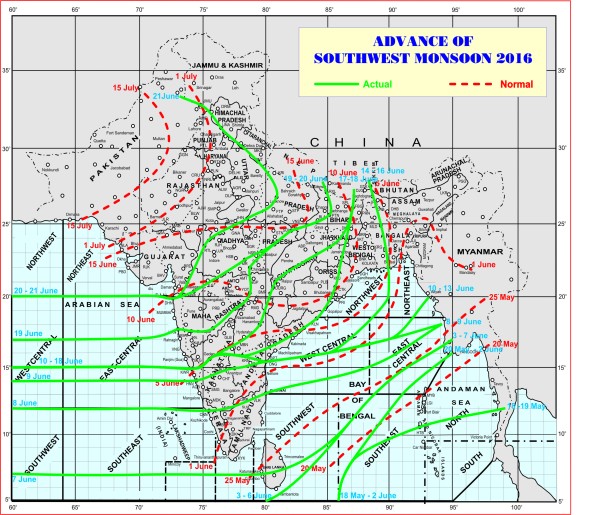
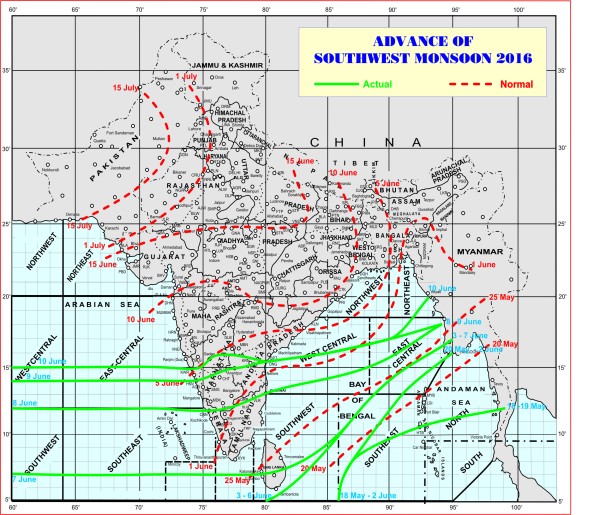
India Monsoon 2016
(The India Monsoon is finally starting to catch up. After being delayed by 1-2 weeks during early June, the monsoon is now on time for some locations even as it still delayed by 5-7 days for parts of western India. The early June delay, however, has probably lowered overall moisture content of the monsoon even as it contributed to record heat index and wet bulb readings for sections of Odisha on June 12 to 13. Image source: India Meteorological Department.)

As the frontal edge of the monsoonal flow began to run into a region of high temperatures over Odisha, humidity levels spiked even as temperatures remained high. On the 12th and 13th of June, 2016, thermometers topped out at between 101 F (38 C) and 109 F (43 C) even as humidity levels rose. This combination generated a spike in what is called the Misery Index (or an indicator of how hot if felt to be outside). And it also, apparently, pushed wet bulb temperatures in some areas to record levels for any place on Earth.
Wet Bulb at 38 C?

For an unconfirmed report out of Bhubaneswar indicates that temperatures on June 13th hit 103.5 F (39.7 C) even as relative humidity readings were at 87 percent. That’s a wet bulb reading of 37.6 C. And if this report is true, that means it felt like 160 degrees Fahrenheit or 71 degrees Celsius for a brief period in Bhubaneswar that day. If so, this would be near the highest Misery Index value ever recorded on the planet — just a hair below last year’s peak measure in Iraq of a 163 F or 73 C heat index (38.4 C wet bulb) reading. And outright crushing periods during 2015 when India’s wet bulb measures in Andhra Pradesh hit 30 C.

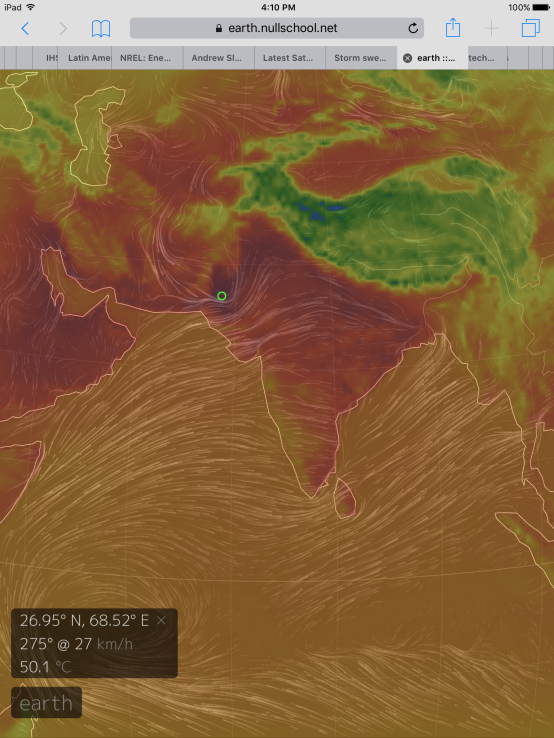
image
(According to Earth Nullschool, it felt like 41 to 54 C [104 to 127 F] outside over Eastern India on June 12th and 13th of 2016 due to combined high levels of heat and humidity. Local reports from Bhubaneswar indicate that this Misery Index hit a stunning 71 C [160 F] on June 13th. Image source: Earth Nullschool.)

A wet bulb measure is a kind of thermometer for latent heat in the atmosphere. It uses a wet bladder to measure the temperature of a membrane at the point at which water evaporates. It’s meant to simulate the lowest temperature the human skin can reach through evaporative cooling as the body sweats. The higher the combined heat and humidity, the higher the wet bulb temperature and the hotter it feels. We’ve all experienced this when stepping outside on a day during which both the temperature and humidity are high. And we intuitively know that it’s the combination of heat and atmospheric moisture that makes hot days feel even more oppressive.

It’s a combo that’s also dangerous to human health. At a certain point, the human body becomes unable to cool itself by sweating. And this level of latent heat at which the human body becomes incapable of transporting heat away from the skin is a wet bulb reading of 35 degrees Celsius.
Wet bulb readings do not need to hit 35 C to risk loss of life and heat injury. Wet bulbs above 25 C are considered dangerous and readings for extended periods near 30 C have resulted in mass injury and loss of life in places like Europe during the early 2000s, in Chicago during 1995 and in India during 2015 and 2016. However, exceeding wet bulb readings of 35 C over extended periods of time is an extraordinarily dangerous event. It’s also a new hazard related to human caused climate change. For last year was the first time a wet bulb reading above 35 C was ever recorded on the face of the Earth. And the 2016 37.6 C wet bulb reading for Bhubaneswar, if it bears out, is an extraordinary measure.

Readings this high over large regions over any extended period would make staying outdoors without access to cool water or climate controlled environments unlivable for human beings. And a human forced warming of the world by fossil fuel burning appears to now be in the process of bringing those conditions about. A condition of dangerous added latent heat to the atmosphere that has caused some scientists to sound the alarm that a global hothouse emergency is already upon us. And that unless a massive curtailment of fossil fuel burning takes place soon — large sections of the Earth’s surface will be rendered uninhabitable to human beings due to atmospheric latent heat content alone.


For as ocean surface temperatures rise, more moisture is pumped into the atmosphere in the form of humidity. This extra humidity hits regions of airs that have already been warmed to much higher readings by the over-burden of heat trapping gasses, like CO2, in the atmosphere. The result is a higher latent heat content of the airs of the Earth, and the breaching of wet bulb readings that are deadly to human beings who lack access to climate controlled environments.
UPDATED 11:00 PM EST, June 21
Links:
Hat tip to Wili
Hat tip to Colorado Bob
Hat tip to Scott


Saturday, 11 June 2016

Third delay of monsoon in India in a row

India’s Monsoon is Delayed For Third Year in a Row — Climate Change is Likely Cause


It has been observed that since 2001, places in northern India, especially in Rajasthan, are witnessing a rising temperature trend every year. The main reason is the excessive … emission of carbon dioxide.”
 — Laxman Singh Rathore, the director general of the India Meteorological Department.
*****
10 June, 2016

The reduction in India’s monsoon rains is a big deal. It generates systemic drought, creates a prevalence for heatwaves, and locally amplifies the impacts of human-caused climate change. For three years now, the Indian monsoon has been delayed. India is experiencing its worst heatwaves ever recorded and water shortages across the country are growing dire. The monsoonal rains are coming, again late. And people across India — residents as well as weather and climate experts — are beginning to wonder if the endemic drought and heat stress will ever end.

Historically, there was only one climate condition known to bring about a delay in India’s Monsoon — El Nino. And last year, a strong El Nino is thought to have contributed both to the Monsoon’s late arrival and to a very severe drought that is now gripping the state. What the 2015 El Nino cannot also account for is the 2014 delay and weakening of monsoonal rains. And during 2016, as India’s monsoon has again been held back by 1-2 weeks, and El Nino is now but a memory, it’s beginning to become quite clear that there’s something else involved in the weakening of India’s annual rains.
Indian Monsoon Delayed Third Year in a Row

India's Monsoon is Delayed Yet Again
(Onset of the Indian Monsoon has been delayed for three years in a row now. A condition likely caused by a human-forced warming of the world and one that is worsening an extreme drought and heatwave situation across the country. Image source: The India Meteorological Department.)

As of today, the eastern edge of the Southeast Asian monsoon had only advanced to the middle of Myanmar. This late progress is two weeks behind the typical advance of the monsoon in this part of the world at this time of year. Further west, the monsoon has extended somewhat futher — only trailing the typical monsoon’s advance by 5 days along the western coast of India.
With La Nina blooming in the Eastern Pacific, there’s no other climatological excuse for this delay. The El Nino influence is mostly gone. And all that’s left is a global climate context in which temperatures have now risen to around 1.3 C hotter than 1880s averages.
Climate Change is Likely Cause

Scientific studies modeling the impacts of human-forced warming have long found that heating the Earth atmosphere resulted in an eventual delay and weakening of the Indian monsoon. A study published last year in Geoscience Frontiers continued this line of study. Global Circulation Model (GCM) runs found that the Indian monsoon was expected to be delayed by 15 days on average during the 21st Century due to human caused climate change. That the amount of precipitation provided by the monsoon would be reduced by about 70 percent. And that the eastern section of the monsoon would tend to be subject to greater delays than the west.

image
(Extreme heat in the range of 45 to 51 degrees Celsius [113 to 124 degrees Fahrenheit] is expected to continue to impact a broad region of Northern India and Eastern Pakistan tomorrow. These temperatures are in record ranges and threaten to again break the all-time hottest temperatures ever recorded in India this week. By now, the onset of monsoonal rains should be taking the edge off a good portion of this heat. But a monsoon apparently delayed by a human forced warming of the world still holds back its cooling loads of moisture. Image source: Earth Nullschool.)

Delays in the Indian Monsoon result in a loss of precipitation due to the fact that the duration of the event is greatly reduced. Rainfall has to therefore be more intense over a shorter period of time in order to make up for losses. Increasing drought prevalence results in further moisture losses due to a kind of atmospheric heat and dryness barrier that tends to sap storms of precipitation even as they start to form. The net result for India is a prediction of severe moisture loss due to human-caused climate change.

This year’s India monsoonal delay — as with the delay during 2014 — falls into that pattern. And the massive drought that India is now experiencing as a result appears to be emerging from a set of atmospheric conditions that are consistent with human-caused climate change. India’s risk for continued drought and increasingly extreme heatwaves over the coming years is therefore on the rise. 
And it is yet to be seen if this year’s monsoon will deliver the hoped-for and desperately-needed relief. Already, the rain-bearing storm system is lagging. And that’s not a good sign.
Links:

Wednesday, 5 August 2015

1.2 Million People Displaced by floods in India

Worst Flood in 200 Years — 1.2 Million People Displaced by Rising Waters in India


4 August, 2015

When you’re rolling with loaded climate dice the situation, as Indian disaster relief officials stated earlier today, is indeed grim.
*   *   *   *   *
The Earth has been warmed by 1 degree Celsius over the past 135 years due to hundreds of billions of tons of fossil fuels burned. That’s a pace of warming more than 10 times faster than at the end of the last ice age. And with that one degree Celsius of global temperature increase, we get a 7 percent increase in the rate of evaporation and precipitation. Unfortunately, that heat-driven alteration in the hydrological cycle is not even. In some places, where the heat piles high into great atmospheric domes and ridges, we see excessive drought. In other places, the moisture finds a weak spot in the heat and then we see inundation. The ridiculous country-spanning floods that have now become all-too-common.

Komen Monsoon India August 4
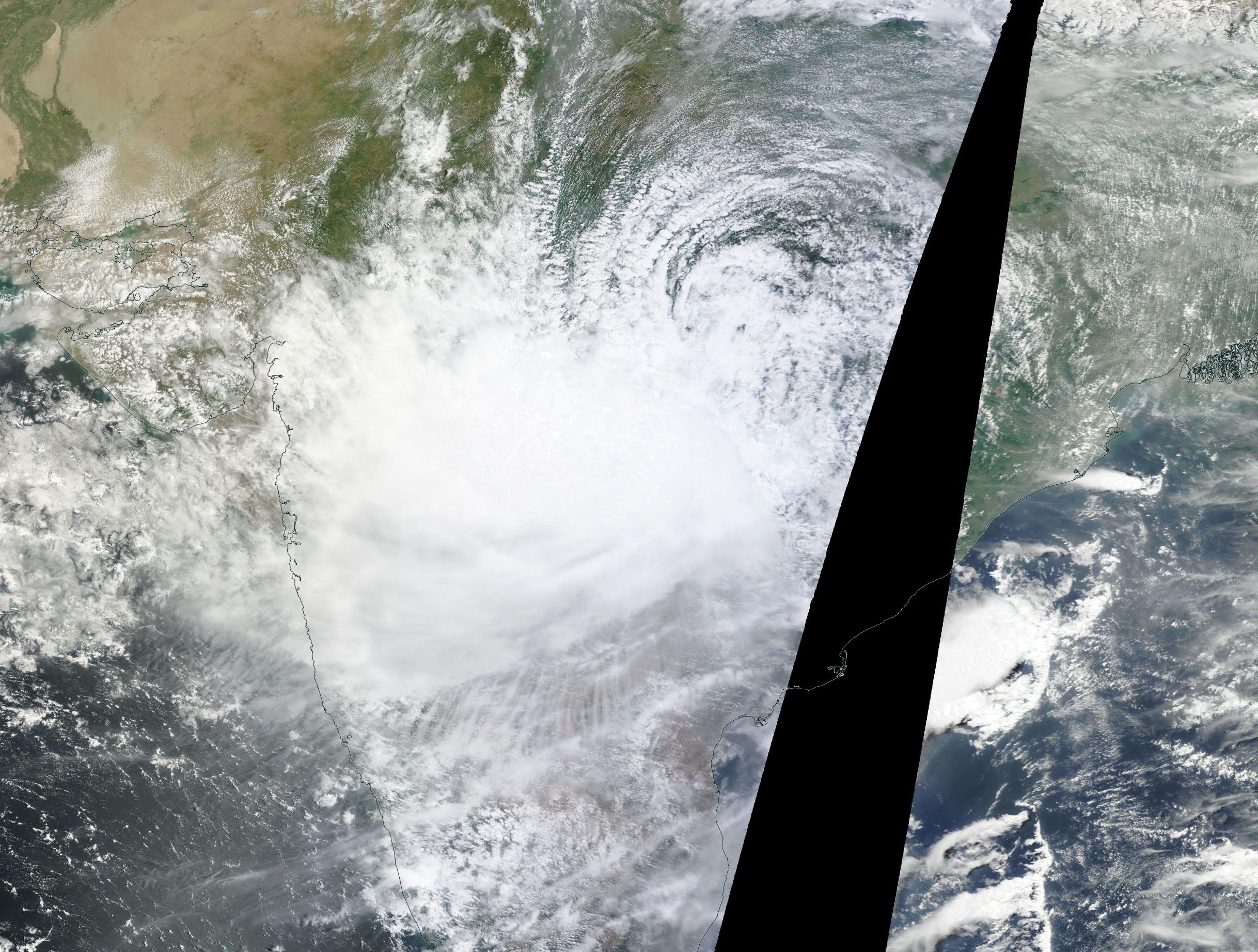
(The remnants of tropical cylcone Komen combine with a monsoonal flow over India to produce severe storms over Central and Western India on August 4, 2015. Image source:LANCE-MODIS.)

Droughts and floods of a severity that we are not at all used to and that have greatly contributed to increasing extreme weather events worldwide. Events that over the past seven years displaced nearly 158 million souls. Sadly, that dread toll of displacement, loss of homes, and loss of lives continued this week in South Asia as a flood of Biblical scale devoured an enormous swath of and.

Drought, Heat Mass Casualties, then Food

For this summer, the situation in India, Bangladesh and Myanmar has been one of drought and flood combined. Earlier this year, the arrival of monsoonal moisture was delayed by the influence of a powerful heat dome crouched over the region. In India, the high temperatures and humidity were so intense that tens of thousands were hospitalized and thousands lost their lives due to heat stroke

Official reports from the region indicated that a precipitation deficit of 10 to 30 percent or more was in the offing. But that was before the skies, super-charged with moisture through an unprecedented rate of evaporation, opened up.

Last week, a frail but rainfall dense tropical cyclone Komen slammed into the coast of Bangladesh. This storm combined with the heavy load of monsoonal moisture building over the region. These conjoined systems have since dumped from 300 to 1300 millimeters of rainfall (more than four feet of rain for some locations) over a broad region including Bangladesh, Myanmar, and the Bengali state of India. It’s a rainfall amount that measures not in inches and millimeters, but in feet and meters. And when you get that much rain there’s going to be some severe hell to pay.

Worst Flood in 200 Years, 13,000 Villages Under Water, 1.2 Million People Displaced

Heavy monsoonal rains are ‘normal’ for India during this time of year. And, as is typical with media outlets who seem mentally incapable of reporting on the impacts of human-caused climate change and related extreme weather these days, many are attempting to claim that the current epic rainfall in India is somehow part of a typical pattern. Nothing could be further from the truth. For by August 1 (two days before the Bengal rains began to shift westward) the day-on-day piling up of water had amounted to the worst flood experienced in all of 200 years of record keeping for the hardest hit regions.

It’s a media silence that pervaded in the earlier stages of this unfolding disaster. One in which only a trickle of reports hit the net or presses. A silence that led one minor local media outlet to issue this irate statement:
Chandra says media has completely ignored this flooding, including the state’s print media and television news channels. The media are mainly based in the state capital, Imphal. The state government is in total chaos and is completely unprepared to tackle the situation. No higher zone is left within the districts, and people are taking shelter in nearby hill stations.

In other words, the only solution for Bengalis during the first few days of this 200 year or worse flood event was to run to the hills.
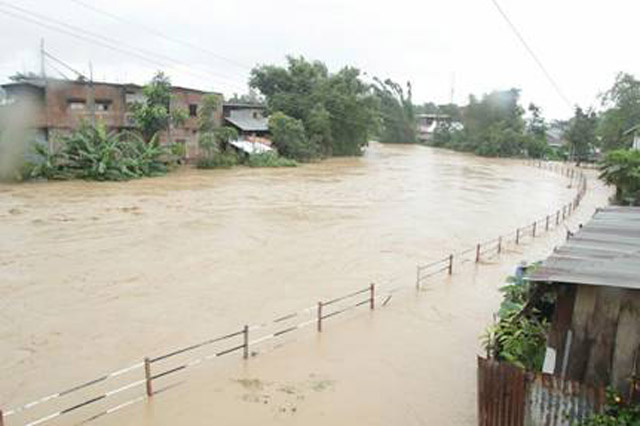
manipur-flooding
(By Saturday, August 1, flood waters had already surged over river banks and inundated communities like Manipur. Now, more than 13,000 villages and in excess of 10 million people have been impacted. Image source: Blaze.)

Since that time, government and mainstream media response has been more widespread, even if most reports have not set the current extreme event in its proper climate change related extreme event context. Irregardless of this widespread failure, yesterday, as reports rolled in that more than 11,000 villages had been buried by water in Bengal, the extreme nature of the situation began to settle in. Sparse news coverage indicated that at least a million people had been impacted and that flood refugees were beginning to pour into disaster shelters. By this morning, a more accurate assessment of the full scope of this disaster had been taken. Over 13,000 villages had been flooded out, more than 10 million persons had been impacted, and the official government count for persons huddling in disaster shelters had climbed to 1.2 million souls.

Rivers in 13 districts are flowing over their danger marks. The situation is grim,” noted disaster management minister Javed Ahmad Khan to AFP.

Lives lost from the flooding have steadily and ominously increased to over 180. But with so many roads and bridges washed out. With so many villages still under water, it will takes weeks before a full account is made of this year’s excessively severe flooding.
India rains
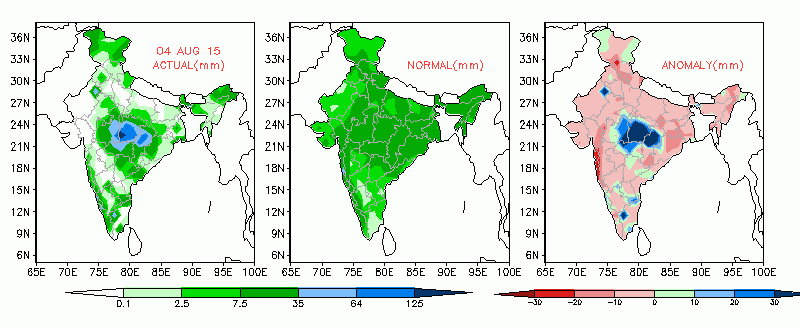
(Heavy rainfall is now focused over Central India with 125 mm [5 inches] or locally higher amounts centered east of Mumbai and southeast of Dehli. Image source: Monsoon of India.)

Severe rains have since shifted to central portions of India so the hard-hit Bengal regionshould be able to start picking up the pieces. Now it’s Central India that’s falling under the gun as monsoonal moisture is pumped up into towering thunderstorms by Komen’s circulation and southerly outflow.

Storm Heading Toward Mountains

Over the next few days, the most intense storms associated with Komen’s monsoonal interaction are expected to shift north and west, eventually stalling out over the mountainous regions of Northern India and Pakistan. Such a storm track risks increased rates of rainfall over high mountain glaciers. A weather situation that can dramatically increase  glacial ice loss and spike the potential for dangerous glacier outburst flood events.

Links:
Hothouse Rains Destroy 17,000 Homes in Myanmar
Hat Tip to Colorado Bob


Sunday, 5 July 2015

India - the failed monsson

India: No rains, farmers worried about another crop loss

Migrant workers in India
3 July, 2015

All eyes are set on the sky, but there are no signs of relief for the farmers, especially the paddy growers who are worried as the state is heading towards drought-like conditions in absence of rains.

Even as 20 days have passed since the paddy transplantation started officially, but huge chunks of land in Rohtak, Jhajjar, Sonepat, Jind and Bhiwani remain unsown and the farmers are waiting for the rainfall to go in for transplantation.
"We have not grown paddy as the fields are dry. Heavy rainfall is required to prepare the fields for the transplantation. If there are no rains, we have to keep our fields unsown as there are no alternative resources of water in the area", said Devender Sharma, a worried farmer of Ladaut village of Rohtak. "This will be the third crop loss in a row if our fields remain unsown". 
Another reason of worry for the farmers is that paddy saplings are getting matured as they fail to transplant these in time.
"Paddy saplings get ready for transplantation in 30 days and we had sowed them around May 15, so that it could get ready by June 15. But there were no rains by that time and we are waiting for the mercy of rain gods for the past 20 days. The saplings are getting matured. These would not remain worthy of transplantation if another week passes without rains", he added.
FARMERS ALLEGE POOR GOVT MANAGEMENT
Amid the poor monsoon, farmers are also complaining about the government's poor management to deal with the crisis. "Four days of July have passed, but there is no water in the Baloth branch yet. We have heard that the water will not come in this drain in the next 15 days. It will be difficult for us to protect our crop for another 15 days", said Narender, another farmer of the district. 
Similar problems are being faced by farmers in Sonepat district. "There is no water in Butana distributory this time  even as we had raised this issue with the local officers at Gohana several times. They did not take steps to clean the drain. Also, the government has not released the water in these drains adding to the woes of the farmers", said Satyawrat of Kathura village of Sonepat. 
COSTLY DIESEL ADDING TO FARMERS' WOES
The hike in diesel price has added to the woes of the farmers , who have to spend more to pump out ground water with diesel pumps. "We don't have electricity connections on our tubewells. In the lack of rains, we are totally dependent on the diesel pumps. As the diesel price has increased, we have to spend `60 per hour to run diesel pump and it takes 4-5 hours to irrigate one acre every day", said Narender.
"We cannot nurture our crops with diesel pumps, we are spending to protect the crop from heat till the rain comes", he added
Large tracts of farmland remain unsown
A poor rainfall will not only affect the farmers, but it will also affect the rice production in the state, as a considerable fall in the acreage under paddy is likely.  According to the figures given by state agriculture department, the acreage under paddy may fall to 11.50 lakh hectare this year, against the target of 12 lakh hectare set by the state agriculture department as large tracts of farmland remain unsown. Last year, the paddy acreage in the state was 12.28 lakh hectare.
"More than 80% farmers of our region depend on the Butana distributory, but there is not even a single drop of water in this drain this year. Our fields will remain unsown if the ongoing conditions persist for few more days", said Suraj Bhan, another farmer of the region.
ALTERNATIVES NOT PROFITABLE
Though the government is spending crores of rupees to encourage farmers to go for alternate crops by breaking  the traditional wheat-paddy cycle, but the farmers are not ready to adopt the alternatives as they say, "Bajra and Jowar are the only alternatives of the paddy, but these crops are not profitable as they yield `8000 to Rs 10000 per acre while the production cost is between Rs 4000 and RS 5000.

Wednesday, 3 June 2015

Monsoon delayes in India affected by heatwave

Human Hothouse Death Toll Climbs to 2300 in India, Monsoon Suppressed, Delayed

The fifth deadliest heatwave in the global record continues to claim lives in India.


June, 2015

As of earlier today 2300 souls were accounted lost due to oppressive May and early June heat preceding a delayed onset of a substantially weakened annual summer Monsoon. Temperatures across India have ranged from the middle 90s to as high as 114 degrees (Fahrenheit) over recent days with readings remaining in heatwave ranges even throughout the night.

indiaheatwave
(May 25 India Heatwave Map provided by NOAA.)


The above May 25 temperature map by NOAA displays an extreme heat pattern that has remained in place now for weeks over India, with 40 degree Celsius (104 degrees Fahrenheit) temperatures covering a greater portion of the country. Andhra Pradesh, at the center of this hot zone, has seen the most impact with more than 1700 souls lost there as of this morning.
As with most heatwaves, the elderly, the poor, and those who work outdoors have shown the highest losses. In this heatwave, field workers, who survive on daily wages, have been particularly hard-hit. The choice for them has been a brutal one of brave the blazing heat and risk life or stay home in the shade and risk livelihood.
Monsoon Delayed, Weak

A smattering of rain showers has started to infiltrate sections of India as of today, bringing isolated relief. But, overall, the larger Indian Monsoon continues to hold off, delayed at its gates in the Bay of Bengal.
India monsoon
(Monsoon again delayed as heatwave conditions remain entrenched over India. Image source: India’s Monsoon Information Page.)

As of June 2, Monsoonal advance had only proceeded to the typical May 25 line — more than a one week delay. A cruel tardiness for poor, sweltering India.
Adding insult to an already bad climate state for India, as of this morning the Government had also downgraded the expected strength of the monsoon to 88 percent of a typical year. The 12 percent loss of water from the farm-feeding rains would increase risk of an agriculture-disrupting drought in many of India’s states. Such a drought could hit the 50% of India’s non-irrigated farms quite hard while also adding stress to water supplies feeding the irrigated facilities.

A Heatwave that was Almost Certainly Caused by Climate Change

Human-forced warming of the oceans through fossil fuel burning has almost certainly had an impact on this year’s drought and monsoon delay for India. The warming has added about 0.6 C of heat to a now strengthening El Nino over the Equatorial Pacific. In the past, only strong El Ninos provided enough atmospheric heat forcing to delay monsoons, spark powerful heatwaves, and spur droughts across India. Now, even weak to moderate events are having this effect with last year seeing a mere shift toward El Nino conditions delaying monsoonal progress and reducing rainfalls across the region.

In addition, recent studies have found that 75 percent of heatwaves are now caused by climate change globally. So, as with the Texas floods of  the past few weeks, when we are looking at instances of freakishly extreme weather, we are also looking at the growing impact of human-caused climate change.

Unfortunately, due to the delayed monsoon and extreme heat deeply entrenched throughout many regions of India, we can expect a high risk for loss of life to continue for at least the next few days as a weakened and delayed monsoon fights to gain ground. This is an instance of yet another early, easy outlier of the very extreme climate change related weather that will follow, with locked-in conditions worsening so long as we continue burning fossil fuels.
Links: