Showing posts with label wet-bulb termperature. Show all posts

Friday, 3 August 2018

Unrelenting Heat, Humidity Will Soon Make Regions UNINHABITABLE

Peaks Matter

3 August, 2018

When calculating how much warmer we can expect, climate models typically use linear projections based on temperature averages, such as annual global average temperatures, daily temperatures that are averages between day and night, etc. The problem is that this downplays the danger, as average temperatures are unlikely to kill people. When lives are at stake, peaks matter!

 
Local maximum temperatures can be good indicators for the maximum heat stress that can be expected in the area.

The image on the right shows that on August 2, 2018, the sea surface near Svalbard was 19.5°C or 67.1°F at the green circle, 14.1°C or 25.4°F warmer than 1981-2011.

This high sea surface temperature is an indicator of the temperature of the water below the surface, which in turn is an indicator of the amount of ocean heat that is entering the Arctic Ocean from the Atlantic Ocean.

Ocean heat is carried by the Gulf Stream from the coast of North America toward the Arctic Ocean, as illustrated by the image below.

Warming of the Arctic Ocean comes with the danger of methane releases from sediments that hold huge amounts of methane in the form of hydrates and free gas. 
The image above illustrates the danger, showing high methane levels at Barrow, Alaska, in July 2018.

When making projections of heat stress, it is important to look at all potential warming elements, including albedo changes, changes to jet streams and sea currents, higher levels of methane, high levels of water vapor, etc.

Next to temperature, humidity is of vital importance. A combination of high temperatures and high humidity is devastating.

recent study shows that the risk of deadly heat waves is significantly increased because of intensive irrigation in specific regions. The study points at a relatively dry but highly fertile region, known as the North China Plain — a region whose role in that country is comparable to that of the Midwest in the U.S. That increased vulnerability to heat arises because the irrigation exposes more water to evaporation, leading to higher humidity in the air than would otherwise be present and exacerbating the physiological stresses of the temperature.

The image below shows perceived temperature in China on July 27, 2018. 

Cyclones can increase humidity, making conditions worse. Above image shows two cyclones in the Pacific Ocean. The high sea surface temperature anomalies that are common in the East Pacific contribute to stronger cyclones carrying more moisture toward Asia.

There are further factors that can contribute to make specific areas virtually uninhabitable. The urban heat effect is such a factor. El NiƱo is another one. As temperatures keep rising, heat waves can be expected to intensify, while their duration can be extended due to jet stream blocking.

Below, 
Paul Beckwith warns that parts of the world 'will soon be rendered uninhabitable'.



Video: Unrelenting Heat, Humidity Will Soon Make Regions UNINHABITABLE

Paul Beckwith"How hot can it actually get? What is in store for us? When you combine the heat domes sitting over many countries with high humidity, many areas around the planet will soon reach the deadly 35°C (95°F) 100% humidity (wet bulb temperature) or equivalent situation whereby a perfectly healthy person outside, in a well ventilated area, in the shade will die from the heat in 6 hours."
"Most people, like the very young, the elderly, and the rest of us won’t last anywhere as long, at even lower temperatures. I discuss the latest peer-reviewed science on how parts of high-risk regions in the North China Plains, Middle East, and South Asia will soon be rendered uninhabitable by combined heat and humidity."


Friday, 24 June 2016

Wet bulb termparatures in India

The Increasingly Dangerous Hothouse — Local Reports Show It Felt Like 160 F (71 C) in India on June 13th, 2016


23 June, 2016
The climate change induced delay of India’s monsoon is a pretty big deal. Not only does it reduce the amount of moisture — necessary for the provision of life-giving crops for this country of 1.2 billion — provided by the annual rains, it also increases the potential for life threatening heatwave conditions. And according to local reports, some of the highest heat index values ever recorded on the face of the Earth were seen in Bhubaneswar, India during a period of record heat and high humidity as the Asian Monsoon struggled to advance.
*****
The Indian province of Odisha sweltered under high heat and humidity that may well have represented the most miserable conditions ever recorded on Earth at any time or place on June 12th and 13th of 2016. Cooling monsoonal rains should have arrived over this eastern section along the Bay of Bengal by that time. But this year, the rains were delayed by about a week and were still about 5 days away. The heat was firmly entrenched. A great wall that seemed to fend the monsoon off.
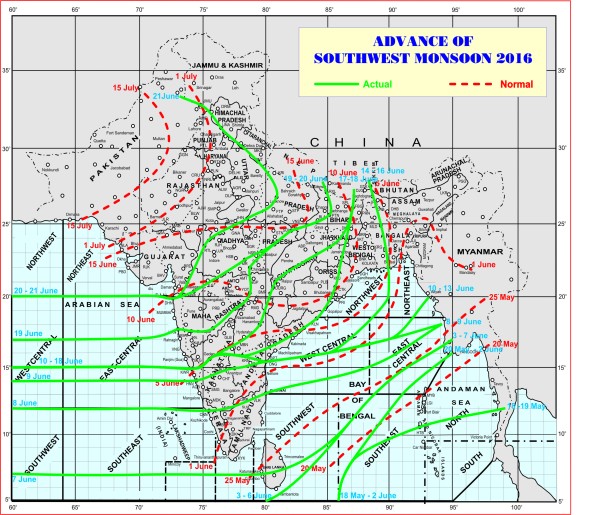
India Monsoon 2016
(The India Monsoon is finally starting to catch up. After being delayed by 1-2 weeks during early June, the monsoon is now on time for some locations even as it still delayed by 5-7 days for parts of western India. The early June delay, however, has probably lowered overall moisture content of the monsoon even as it contributed to record heat index and wet bulb readings for sections of Odisha on June 12 to 13. Image source: India Meteorological Department.)

As the frontal edge of the monsoonal flow began to run into a region of high temperatures over Odisha, humidity levels spiked even as temperatures remained high. On the 12th and 13th of June, 2016, thermometers topped out at between 101 F (38 C) and 109 F (43 C) even as humidity levels rose. This combination generated a spike in what is called the Misery Index (or an indicator of how hot if felt to be outside). And it also, apparently, pushed wet bulb temperatures in some areas to record levels for any place on Earth.
Wet Bulb at 38 C?

For an unconfirmed report out of Bhubaneswar indicates that temperatures on June 13th hit 103.5 F (39.7 C) even as relative humidity readings were at 87 percent. That’s a wet bulb reading of 37.6 C. And if this report is true, that means it felt like 160 degrees Fahrenheit or 71 degrees Celsius for a brief period in Bhubaneswar that day. If so, this would be near the highest Misery Index value ever recorded on the planet — just a hair below last year’s peak measure in Iraq of a 163 F or 73 C heat index (38.4 C wet bulb) reading. And outright crushing periods during 2015 when India’s wet bulb measures in Andhra Pradesh hit 30 C.

image
(According to Earth Nullschool, it felt like 41 to 54 C [104 to 127 F] outside over Eastern India on June 12th and 13th of 2016 due to combined high levels of heat and humidity. Local reports from Bhubaneswar indicate that this Misery Index hit a stunning 71 C [160 F] on June 13th. Image source: Earth Nullschool.)

A wet bulb measure is a kind of thermometer for latent heat in the atmosphere. It uses a wet bladder to measure the temperature of a membrane at the point at which water evaporates. It’s meant to simulate the lowest temperature the human skin can reach through evaporative cooling as the body sweats. The higher the combined heat and humidity, the higher the wet bulb temperature and the hotter it feels. We’ve all experienced this when stepping outside on a day during which both the temperature and humidity are high. And we intuitively know that it’s the combination of heat and atmospheric moisture that makes hot days feel even more oppressive.

It’s a combo that’s also dangerous to human health. At a certain point, the human body becomes unable to cool itself by sweating. And this level of latent heat at which the human body becomes incapable of transporting heat away from the skin is a wet bulb reading of 35 degrees Celsius.
Wet bulb readings do not need to hit 35 C to risk loss of life and heat injury. Wet bulbs above 25 C are considered dangerous and readings for extended periods near 30 C have resulted in mass injury and loss of life in places like Europe during the early 2000s, in Chicago during 1995 and in India during 2015 and 2016. However, exceeding wet bulb readings of 35 C over extended periods of time is an extraordinarily dangerous event. It’s also a new hazard related to human caused climate change. For last year was the first time a wet bulb reading above 35 C was ever recorded on the face of the Earth. And the 2016 37.6 C wet bulb reading for Bhubaneswar, if it bears out, is an extraordinary measure.

Readings this high over large regions over any extended period would make staying outdoors without access to cool water or climate controlled environments unlivable for human beings. And a human forced warming of the world by fossil fuel burning appears to now be in the process of bringing those conditions about. A condition of dangerous added latent heat to the atmosphere that has caused some scientists to sound the alarm that a global hothouse emergency is already upon us. And that unless a massive curtailment of fossil fuel burning takes place soon — large sections of the Earth’s surface will be rendered uninhabitable to human beings due to atmospheric latent heat content alone.


For as ocean surface temperatures rise, more moisture is pumped into the atmosphere in the form of humidity. This extra humidity hits regions of airs that have already been warmed to much higher readings by the over-burden of heat trapping gasses, like CO2, in the atmosphere. The result is a higher latent heat content of the airs of the Earth, and the breaching of wet bulb readings that are deadly to human beings who lack access to climate controlled environments.
UPDATED 11:00 PM EST, June 21
Links:
Hat tip to Wili
Hat tip to Colorado Bob
Hat tip to Scott


Saturday, 21 May 2016

Never-Before-Seen High Temperatures in India

Wet Bulb Near 35 C — Heatwave Mass Casualties Strike India Amidst Never-Before-Seen High Temperatures


20 May, 2016

Never-before-seen high temperatures and high humidity are resulting in thousands of heat injuries and hundreds of heat deaths across India. In some places, wet bulb readings appear to be approaching 35 C — a level of latent heat never endured by humans before fossil fuel burning forced global temperatures to rapidly warm. A reading widely-recognized as the limit of human physical endurance and one whose more frequent excession would commit the human race to enduring an increasing number of episodes of killing heat. A boundary that scientists like Dr. James Hansen warned would be exceeded if a human-forced warming of the world was not halted.

*****
And it is in this newly dangerous climate context that temperatures near 125 degrees Fahrenheit settled in over India’s border region with Pakistan yesterday. 

A blistering wave of crippling heat hitting never-before-seen readings over that highly-populated nation. In Phalodi, India, the mercury rocketed to 123.8 degrees Fahrenheit (51 degrees Celsius). This reading exceeded India’s previous all-time record high for any location which stood at 123.1 degrees Fahrenheit (50.6 degrees Celsius) set on May 25, 1886. Across the border in Pakistan, temperatures crossed “critical” thresholds this week, hitting 124.7 degrees Fahrenheit (51.5 degrees Celsius) Thursday in the city of Jacobabad as officials in that state issued health warnings to the public.

image
(Temperatures rocketed to 123-125 F along India’s border with Pakistan on Thursday. These are the hottest temperatures ever recorded for this region of the world. Image source: Earth Nullschool.)

Closer to the coast, temperatures rose as high as 107 degrees Fahrenheit (42 C). In the city of Surat, hospitals were strained by an influx of people suffering from heat injuries. People afflicted with giddiness, unconsciousness, dehydration, a bloody nose, abdominal pain, chest pain, and other heat related injuries flooded local health care facilities with emergency calls. As of Thursday, SMIMER hospital had reported 1,226 calls related to heat casualties since the start of May.
Local Surat weather services reported periods when temperatures spiked to 38-42 C and humidity — supplied by moisture flooding off the heating Arabian Sea — remained near 65 percent. These are wet bulb readings in the range of 32 to 34.4 C — a combination of heat and humidity that is very dangerous to anyone exposed for even brief periods.
340 Heat Deaths in Delhi

Across India, the story of heat casualties was much the same. Though no official national estimate of heat related injuries or deaths has yet been given, the current heatwave and related drought is far worse than that experienced during 2015 when 2500 people lost their lives in the excessive heat. But it’s reasonable to assume that heat injuries across India now number in the tens of thousands with tragic heat deaths likely now numbering in the hundreds to thousands.

In the capital city of Delhi, reports were coming in that the homeless population — swelled by farmers who lost their livelihoods due to a crippling three-year-drought — was suffering hundreds of heat-related deaths. As of Thursday, official estimates identified 340 total heat deaths among this increasingly vulnerable population.
Severe Drought and Record Heat — Conditions Consistent with Human-Caused Climate Change

Heat building into extreme record ranges and mounting heat casualties come as India suffers what is likely its worst drought on record. Last month, international water monitors identified 330 million people suffering from water shortages across India. As a result, the government has been forced to resort to extreme measures — posting guards at dwindling reservoirs, sending water trains to provide people in hard-hit regions with a life-saving ration of water, and planning to divert water from the greatly shrunken Ganges to aid parched regions.

Extreme heat of this kind, wet bulb temperatures approaching 35 C, heatwave mass casualties, and a never-before-seen drought are all conditions related to a human-forced warming of the globe. Though El Nino, during the 20th Century, brought with it a cyclical heat, a potential monsoonal weakening, and an increased risk of drought, the severity of the crisis now afflicting India is too great to be pinned on El Nino alone. India has now suffered three years of delayed monsoons — delays which began before the current El Nino took hold. Water levels in the Himalayas are low due to a decadal warming that has forced snow packs to retreat which has, in its turn, left India’s rivers increasingly vulnerable to drying. And global temperatures hitting in the range of 1.3 C above 1880s levels are absolutely adding intensity to the current heatwave and dryness.
Links:
Hat Tip to DT Lange
Hat Tip to Colorado Bob

Wednesday, 18 May 2016

The Dying Earth - news from the Indian subcontinent and Sri Lanka

It feels like 60C (140F) Indian temperatures hits deadly limit as high humidity increases danger


Photo hindustantimes.com
16 May, 2016

Delhi is scorching hot.

The maximum temperature recorded on Sunday was 44 degrees Celsius, breaking all records - and the coming days will offer no relief to locals.

According to the MeT department, the temperature is going to stay at a sweltering 44 degrees till Wednesday.

"The heat waves will continue to haunt the residents for few more days.
The mercury might drop a little by the end of this weekend," a senior official from the MeT department said.

With the rise in humidity levels, cases of viral fever, diarrhoea, heat stroke and chicken pox have also increased.

Graph Wikipedia Click on image

For example, if the air temperature is 96 °F / 36 °C and the relative humidity is 65%, the heat index is 121 °F / 49 °C.

Various hospitals in the city are witnessing a sudden spike in the number of patients.

Acute diarrhoea is usually caused by a bacterial, viral, or parasitic infection.
Diarrhoea can cause dehydration, which is harmful to many key bodily functions including muscle activity.

Dr AK Shukla, senior consultant, internal medicine, Kailash Hospital, Sector 27, Noida, said of the increase in patients:

"Most of them are diagnosed with serious conditions.


Low blood pressure, watery stool, severe vomiting and dehydrations are some of the symptoms.

In one of the cases, a patient also suffered from kidney dehydration.

Doctors are advising people to avoid eating stale food and maintain proper hygiene in order to stay protected from water-borne diseчase.

"Around two-three patients diagnosed with diarrhoea require admission daily.
It is advisable not to consume any food from outside, people should eat homemade food and drink only boiled water in this season," said Dr Ajay Aggarwal, head of department, internal medicine, Fortis hospital, Sector 62, Noida.

Doctors have warned that this weather will continue for at least a month, so people should not take any symptoms lightly.

The onset of the monsoon over Kerala is likely to be delayed by six days beyond its scheduled date of June 1, the Indian Meteorological Department (IMD) said on Sunday.

This is expected to delay monsoon in other parts of the country as well.
"Forecast suggests that monsoon onset over Kerala this year is likely to be slightly delayed.

The Southwest monsoon is likely to set over Kerala on June 7 with a model error of plus or minus four days," the IMD said in its onset forecast for monsoon, released on Sunday. June 1 is the official onset date of the monsoon in India, when it is expected to hit Kerala.

The forecast of the monsoon's onset has proved to be correct during the past 11 years (from 2005-2015), except in 2015.

This includes the error margin of plus or minus 4 days.

IMD director general Laxman Singh Rathore said the delay in the monsoon was not an unusual phenomenon.

However, he said there would be some relief to South Indian states from the intense heat as there could be some rainfall in the coming days.

"Currently there is a low pressure area in the Bay of Bengal which will become a depression and hit Tamil Nadu coast by tonight.

This will bring good amount of rainfall to the state, parts of South Interior Karnataka and parts of Kerala," Rathore said.

Skymet, a private forecasting agency,had forecast that the monsoon would hit Kerala between May 28 and 30.

The IMD has already made a forecast that the monsoon will be above normal this year.

The monsoon season delivers 70 per cent of India's annual rainfall, which is crucial for agriculture and economic growth that has been hampered by back-to-back droughts.

The meteorological department in April had forecast an above-average monsoon for the year.


Wet Bulb Temperature and the threat it poses in a time of Abrupt Climate Change

In a recent study with Matt Huber, we showed that it doesn't take that many degrees of global warming to permit peak heat summertime heat stress to (occasionally) become unsurvivable, in many parts of the world that are currently highly populated.

We came to this conclusion by considering a meteorological quantity called the wet-bulb temperature. You measure this quantity with a normal thermometer that has a damp cloth covering the bulb. It is always lower than the usual or "dry-bulb" temperature; how much lower depends on the humidity. At 100% humidity (in a cloud or fog) they match. In Sydney and Melbourne, even during the hottest weather, the wet-bulb usually peaks in the low 20's C. The highest values in the world are about 30-31C, during the worst heat/humidity events in India, the Amazon, and a few other very humid places. 


Sri Lanka landslide buries three villages; death toll unknown

17 May, 2016

A landslide in Sri Lanka, triggered by more than three days of rain, buried three villages in a central district and the death toll is yet to be determined, government officials and area residents said on Tuesday.

Torrential rains have forced more than 137,000 people from their homes so far and killed at least 11.

Rohan Dias, a deputy police inspector, said rescue operations at the villages in the central district of Kegalle was continuing in the night.

"There were about 150 families in those villages and we don't know how many survived," Dias told Reuters.

"There are about 800 people gathered in the nearby temples including the people from the neighboring villages fearing their villages could also be affected. There are another 400 people in the roads who have come to see their relatives."

W.M. Abeywickrema, Kegalle district secretary, told a local private channel that around 400 people had been rescued so far.

"I saw a whole rock came down and buried many houses. There are people inside," one middle-aged woman told the channel.

Military Spokesman Jayanath Jayaweera said 174 service personnel and 8 army officers had been deployed to the rescue area in Aranayaka in Kegalle district.

Troops also have launched rescue operations in inundated areas of the Indian Ocean island, with boats and helicopters pulling more than 200 people trapped in the northwestern coastal district of Puttalam to safety, officials said.

"This is the worst torrential rain we have seen since 2010," said Pradeep Kodippili, a spokesman for the disaster management center. Nineteen of Sri Lanka's 25 districts have been hit.

Heavy rains have also struck the neighboring Indian states of Tamil Nadu and Kerala. More than 100 houses were damaged in coastal Kerala and about 50 families had been shifted to a relief camp in the state capital, Thiruvananthapuram, a state official said.

The weather department has forecast heavy rains across Tamil Nadu over the next two days and warned fishermen not to go out to sea.


Flooded roads and fallen trees led to traffic jams in the Sri Lankan capital, Colombo. Trains were halted as water submerged railway tracks, officials said.

Flooding and drought are cyclical in Sri Lanka, which is battered by a southern monsoon between May and September, while a northeastern monsoon runs from December to February


17 People Killed, 4 Missing in Western Indonesia Floods


ABC News,
16 May, 2016

Rescuers on Monday found the bodies of 17 people who were among 20 university students and two guides who went missing in rain-triggered floods and landslides at a popular waterfall in western Indonesia, an official said.

One student was found alive and was being treated at a hospital, said Darwin Surbakti, an official from the local Disaster Management Agency. The search for the four people still missing was to be resumed Tuesday.

"Rescuers have discovered 17 bodies, of which 14 have been recovered while three others are still under the rubble," Surbakti said.

The disaster occurred Sunday as more than 70 students were visiting the Dua Warna waterfall in Sibolangit in North Sumatra province.

Six bodies were found about 3 kilometers (2 miles) downstream from the waterfall, Surbakti said.

In Jakarta, Sutopo Purwo Nugroho, spokesman for the National Disaster Management Agency, said 300 rescuers including soldiers, police and teams from the National Search and Rescue Agency had been mobilized to search for the victims.

Seasonal rains often cause flooding and landslides in Indonesia, a chain of 17,000 islands where millions of people live in mountainous areas or flood-prone plains close to rivers

Heart wrenching’: India’s coral reefs experiencing widespread bleaching, scientist says


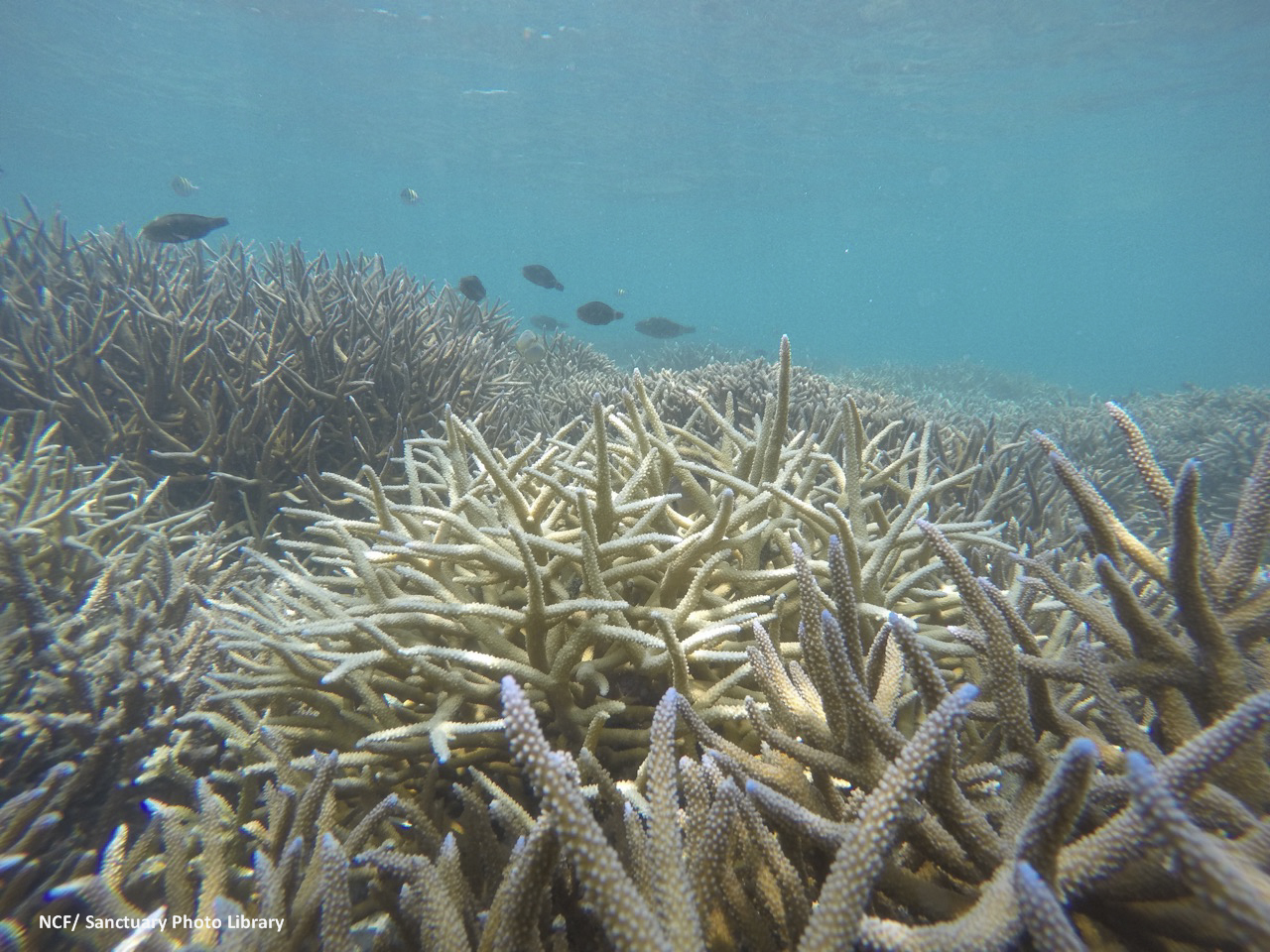
The record-breaking surface temperatures turn shallow reefs ghostly pale as they bleach. Photo courtesy of NCF.

11 May, 2016

Last month, scientists reported that Australia’s Great Barrier Reef corals were experiencing “the worst mass bleaching event in its history”. Of the 500 coral reefs they observed while flying over 4,000 kilometers (~2,485 miles) of the Great Barrier Reef, only four reefs did not show any sign of bleaching. Terry Hughes, convenor of Australia’s National Coral Bleaching Taskforce, called it the “saddest research trip” of his life.

Other scientists have called the underwater sight of widespread bleaching “catastrophic”.

In other parts of the world too, similar “catastrophic” scenes are playing out. Off the south-western coast of India, the lesser-known coral reefs of the Lakshadweep Archipelago in northern Indian Ocean are struggling to survive.

A small team of six field biologists from the Nature Conservation Foundation in India, have observed soaring sea surface temperatures and widespread coral bleaching this year. In every reef that the team has surveyed in 2016 so far, corals are turning white or pale. Moreover, the heat stress has already killed many corals in the region, the team said in a statement.

Lakshadweep’s corals are not new to bleaching. In 1998 and 2010, similar El NiƱo events have had calamitous impacts on the reefs. While the Lakshadweep reefs recovered from the 1998 event, recovery following the 2010 event has been slower. And with the ongoing El NiƱo event, scientists are seriously concerned.

We are currently halfway through a mixed recovery from the 2010 El NiƱo event, and we were only now beginning to see the first signs of regrowth in some areas,” Rohan Arthur, who heads NCF’s reef program, told Mongabay. “This makes the present El NiƱo even more heart wrenching since it has hit the Lakshadweep before these reefs have had the ability to recover completely from the last catastrophic disturbance.”

But Arthur is also hopeful. He said that Lakshadweep’s reefs have recovered in the past (following the 1998 El NiƱo event), and the reefs could show resilience once again.

Mongabay spoke with Arthur about the state of coral reefs in the Lakshadweep Archipelago and their ability to bounce back.


Beyond India: There's drought on five continents and it's breaking records

As 2016 continues to break all temperature records, taps and wells around the world are running dry


Sctoll,in

16 May, 2016

India is in the grip of a drought that in some parts of the country has been going on for five consecutive years. Scientists attribute the successively weaker monsoons to the El NiƱo effect, a warming of temperatures in the Pacific Ocean, off the coast of South America, that skews wind and pressure systems around the world.

With the El NiƱo finally on the wane since January, researchers now suggest that it will be followed by a La Nina phenomenon, characterised instead by cooling Pacific temperatures and for India, more rain.

But the weather formation's impact has not been limited just to the Indian monsoon. It is also among the reasons that every month since May 2015 has broken temperature record highs and why severe floods and droughts have been recorded around the world.

Acute water distress of any kind triggers migrations. The longer the drought, as the example of Syria shows, the worse the exodus and resulting violence. As this daily drought risk map by El Dorado Weather shows, pretty much every single continent apart from the poles has regions facing crippling droughts.
World Wide Daily Drought Risk Map. Photo credit: El Dorado WeatherWorld Wide Daily Drought Risk Map. Photo credit: El Dorado Weather

AfricaOn Wednesday, Kenya announced that it would shut down refugee camps in Dadaab, near its Somalia border. A severe drought in Somalia has left close to one million people, or nearly one in 12 people, struggling to meet their food needs, according to a United Nations reports. Tens of thousands have fled the country to the Dadaab camp.

Lesotho, Malawi, Mozambique, Swaziland and Zimbabwe in southern Africa are so near the brink that they have declared national drought disasters. Ethiopia, further north and the worst affected in terms of food, also happens to be in the middle of deep political turmoil. More than 36 million people are threatened by hunger across that part of the continent.

Namibia, on Africa’s south western coast has also been suffering from a huge rainfall deficit. On Thursday, Coca Cola announced that it would stop all canned drink production in the country. Instead, to meet Namibia’s demand, it will import these from neighbouring South Africa. Many parts of South Africa have not had rain for three consecutive years.

AsiaThe heat waves that swept across India in March and April also affected South East Asia. Cambodia, Laos and Thailand, which all recorded temperatures up to 44.6 degrees centigrade. All countries have suffered agricultural losses, citizens are struggling to find water, and wild animals are dying of dehydration.

The situation there is so bad that China released water from one of six dams on the upper Mekong river in April. These dams are thought to have caused a water shortage in the downstream region in the first place. China itself has not been immune to droughts, with at least 110 cities reportedly facing severe water shortages.

Australia

The worst recorded drought in Australia’s living memory finally broke after rain in January eased water stress in parts of Queensland. In May, rain finally brought relief to the country's northern region.

Researchers, however are concerned that Australia has underestimated just how bad its weather extremes can get. A recent study of an ice core in New South Wales has revealed that in the last millennium, the region had droughts lasting up to 12 years and periods of wet weather for 10. The longest drought recorded by humans in Australia was only eight years, during World War II, and the rest of the century too had seen milder extremes than there had been in the long term.

North America

Scientists found similar results by examining tree ring data in British Columbia in Canada as well. They found 16 droughts worse than the standards scientists use today to declare droughts in Canada. While current standards are based on around 50 years of meteorological information, the tree ring study went back 350 years.

A massive forest fire that caused more than 80,000 residents of Fort McMurray to flee their homes early in May is still raging in Alberta, Canada. The cause of the fire was unusually dry and warm conditions triggered by the El NiƱo. 

Temperatures were almost 100% above normal. In 2015, Canada got only 65% of its long-term average rainfall. Contrast that with India’s southwest monsoon, which ended in October at 86% of the long-term average.

The worst drought in the history of California in the United States has only just about broken its grip, with snow finally falling in its Sierra Nevada mountains. State administration, however, has no plans of easing water restrictions and instead made some of its emergency water cuts permanent in an announcement on May 9.

South America

A two-year drought in south east Brazil just ended after heavy rain in January finally replenished reservoirs there. The drought, which was Brazil’s worst in 80 years, led to severe water shortages in SĆ£o Paulo and Rio de Janeiro, two of the largest cities of the southern hemisphere.

Like India, large parts of Venezuela have been drought-hit for three consecutive years. As it happens, Venezuela is also one of the worst affected by the Zika virus in its surroundings, as an article in The Atlanticpoints out. How does the virus spread? Through mosquitoes that breed in stored water – being used to slake thirst.

In January, Venezuelan water minister Ernesto Paiva announced an “extraordinary plan” to tackle the water shortage. These "extraordinary" measures include rationing water, preventing pipeline leaks and ending illegal water use. There is no indication of how well they have worked