Showing posts with label sulphur dioxide. Show all posts

Monday, 22 July 2019

Margo has a message about sulphur dioxide


Sulfur Dioxide Releases 

Connected to Earthquake 

Activity – 

Warning for North America (July 21, 2019) 


21 July, 2017


I’ve been studying Abrupt Climate Change closely for the last 1 1/2 years and have been reporting my findings from various sources on a regular basis. I’ve noticed a high release of sulfur dioxide to be a pre-cursor to earthquake activity and also evidence of volcanic activity. This last week, I saw alarming amounts of sulfur dioxide being released from the west coast of the United States all the way across half of the country, along with releases off the west coast of North America and other hot spots in the Pacific Ocean.


Very high releases of sulfur dioxide began in late June with the eruption of the Raikoke Volcano that sent two 43,000 foot blasts into the atmosphere after being dormant for 95 years. I’ve been monitoring these releases on CAMS on a daily basis and reporting frequently. The sulfur dioxide release I saw from that volcano was the most I’ve ever seen. This week as that large sulfur dioxide cloud was finally dissipating enough to see other activity, I saw what I described above. I reported my findings in the following video that has been posted on SubscribeStar for my private members. However, this is so important, I want others to know of the situation. I’m not posting this information on YouTube because of the censorship and attacks that could result.

Many geologists are saying the Cascadia subduction zone or the Northwest part of the United States will be hit with “The Big One” any time now. Many say that could lead to a Yellowstone eruption. There are also thousands of earthquakes swarming in the Southern California area where the ground is literally splitting apart for miles and miles. I’ve been reporting on this activity in daily earthquake updates since December.

The above described activity could indicate the crust is moving and magma is getting closer and closer to the surface. I’ve had visions of what is to come. What I’ve seen is that when things happen, it will be all at once and the whole earth will be affected, but especially the west coast of the United States. It’s probably too late for people to move and I’m not sure there will be safe places to move to. I’ve also seen high increases in methane levels and unprecedented melting of the Arctic Sea Ice in my daily observations. In light of all of this, I believe time is very short. If you’ve not given your life to Jesus Christ, it’s almost too late. This is a spiritual war for the souls. 

 God bless you. 

 I’m praying for everyone.


Friday, 19 July 2019

How erupting African volcanoes impact the Amazon’s atmosphere

Geosciences Column: How erupting African volcanoes impact the Amazon’s atmosphere

Geosciences Column: How erupting African volcanoes impact the Amazon̢۪s atmosphere

EGU,
17 July, 2019


When volcanoes erupt, they can release into the atmosphere a number of different gases initially stored in their magma, such as carbon dioxide, hydrogen sulfide, and sulfur dioxide. These kinds of gases can have a big influence on Earth’s atmosphere, even at distances hundreds to thousands of kilometres away.

A team of researchers have found evidence that sulfur emissions from volcanic eruptions in Africa can be observed as far as South America, even creating an impact on the Amazon rainforest’s atmosphere. The results of their study were published last year in the EGU journal Atmospheric Chemistry and Physics.


In September 2014, the Amazon rainforest’s atmosphere experienced an unusually sharp spike in the concentration of sulfate aerosols. During this period, the Amazon Tall Tower Observatory (ATTO) based in Brazil reported levels of sulfate never recorded before in the Amazon Basin.

Sulfate aerosols are particles that take form naturally from sulfur dioxide compounds in the atmosphere. When sulfate aerosols spread throughout the atmosphere, the particles often get in the way of the sun’s rays, reflecting the sunlight’s energy back to space. These aerosols can also help clouds take shape. Through these processes, the particles can create a cooling effect on Earth’s climate. Sulfate aerosols can also facilitate chemical reactions that degrade Earth’s ozone layer.

Fossil fuel and biomass burning have been known cause an increase in atmospheric sulfate, but researchers involved in the study found that neither human activity increased the level of sulfate in the atmosphere significantly. Instead, they examined whether a volcanic eruption could be responsible.

Scientists have suggested for some time that sulfur emissions in the Amazon could come from African volcanoes, but until now they’ve lacked proof to properly justify this idea.


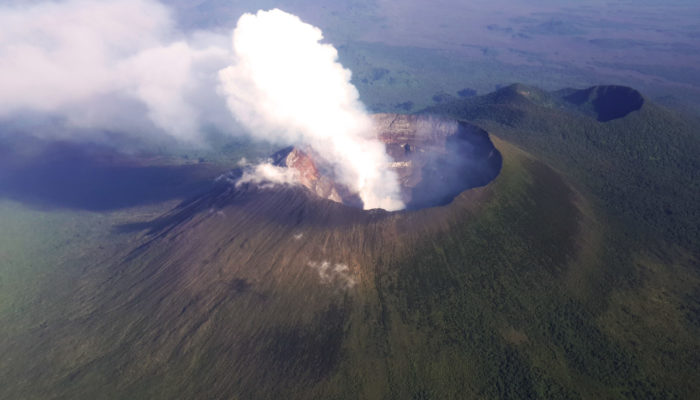
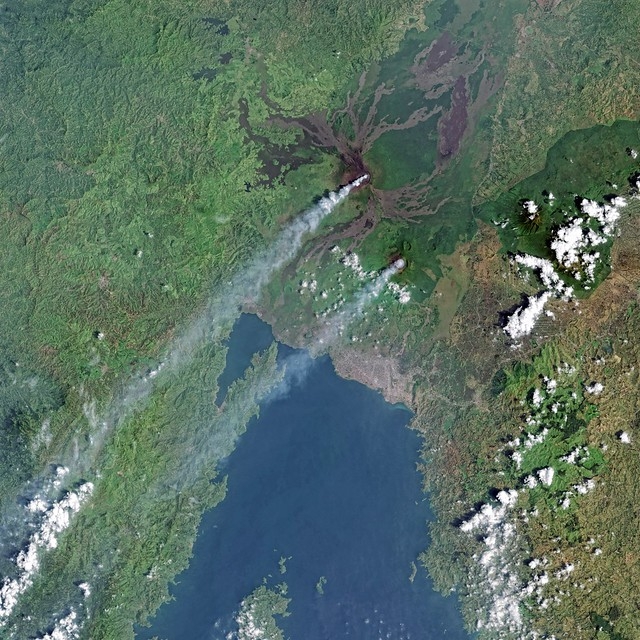
However, in this study the research team involved caught volcanic pair in the act. By analysing satellite images and aerosol measurements, the researchers found evidence that in 2014, emissions from the neighboring Nyiragongo-Nyamuragira volcano complex in the Democratic Republic of the Congo, central Africa, increased the level of sulfate particles in the Amazon rainforest’s atmosphere.

Satellite observations revealed that volcanoes experienced two explosive events in September 2014, releasing sulfur emissions into the atmosphere. During that year, the volcanic complex was reportedly subject to frequent eruptive events, sending on average 14,400 tonnes of sulfur dioxide into the atmosphere a day during such occasions. This amount of gas would weigh more than London’s supertall Shard skyscraper.


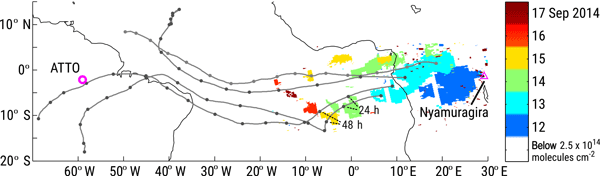
Map of SO2 plumes with VCD > 2.5 × 10¹⁴ molecules cm−2 color-coded by date of observation. The 15-day forward trajectories started at 4 km (above mean sea level, a.m.s.l.) at four locations within the plume detected on 13 September 2014 (light blue) are indicated by black lines with markers at 24 h intervals. (Credit: Jorge Saturno et al.)


Map of SO2 plumes with VCD > 2.5 × 10¹⁴ molecules cm−2 color-coded by date of observation. The 15-day forward trajectories started at 4 km (above mean sea level, a.m.s.l.) at four locations within the plume detected on 13 September 2014 (light blue) are indicated by black lines with markers at 24 h intervals. (Credit: Jorge Saturno et al.)


The images further show that these emissions were transported across the South Atlantic Ocean to South America. The sulfate particles created from the emissions were then eventually picked up by an airborne atmospheric survey campaign and the ATTO in the Amazon.

The researchers of the study suggest that these observations indicate that African volcanoes can have an effect on the Amazon Basin’s atmosphere, though more research is needed to understand the full extent of this impact.

By Olivia Trani, EGU Communications Officer

References and further reading
Saturno, J., Ditas, F., Penning de Vries, M., Holanda, B. A., Pöhlker, M. L., Carbone, S., Walter, D., Bobrowski, N., Brito, J., Chi, X., Gutmann, A., Hrabe de Angelis, I., Machado, L. A. T., Moran-Zuloaga, D., Rüdiger, J., Schneider, J., Schulz, C., Wang, Q., Wendisch, M., Artaxo, P., Wagner, T., Pöschl, U., Andreae, M. O. and Pöhlker, C.: African volcanic emissions influencing atmospheric aerosols over the Amazon rain forest, Atmospheric Chemistry and Physics, 18(14), 10391–10405, doi:10.5194/acp-18-10391-2018, 2018.


Tuesday, 16 July 2019

Large amounts of sulphur dioxide inthe Arctic atmosphere - what does it mean?

My intention was to do a video on this. 

However, from the moment I switched my computer nothing would work. First, the software for showing the pictures (Preview) would not open; then Quicktime, which I use to record the movies would not open and when I did would not allow me to save or export my file in any form onto the desktop.


Large amounts of sulphur 

dioxide in the Arctic while 

methane levels in the mid-

atmosphere appear to have 

reduced

Some may see it as a "solution" to climate change but it is another sign of the growing human predicament


Seemorerocks


Today, I came across a posting from Harold Hensell on Facebook in which he posted this picture of methane levels at 500 hHz.


He contrasted it with this from mid-January where, as you can see there are humungous amounts of methane at that altitude.


He posted this with the following comments which seem to be a tad myopic to me.


" I don't have an explanation for the decrease but whatever it is, I hope it keeps doing it"

---Harold H.Hensell


As can be seen from this methane report from a few days ago there is no lack of methane coming from the surface


Something else has to be at play here.

Thanks to Margo's regular monitoring we know of two volcanic eruptions...

One was from on one of the Kuril islands at the base of the Kamchatka Pensinsula in the Russian Far East...


And in New Guinea.


Margo has been covering this on a regular basis. Just from this (from 25 June) you can see the spread of sulphur dioxide in the Arctic and Pacific region.


And going forward a few days.


Now, looking at the global total column you can get a further sense of what is happening.

And in the Arctic...


Looking at the global view at 500 hPa one can see that the biggest concentrations of sulphur dioxide are in the higher latitudes of the Northern Hemisphere.


Here is global view of surface level sulphur dioxide.

One might expect that one might get an indication of high levels of sulphur dioxide where the volcanoes are situated.

This appears not to be the case but there are prodigious quantities of sulphur dioxide in the Arctic and this has had an effect on methane higher in the atmosphere but not at the surface

The question that no one appears to be even asking having failed to notice this.


Once again we have people making superficial observations and failing to look any deeper or asking why this might be.

That takes time and effort.


LINKS:


P.S. I have no idea what the effects of trace amounts of sulphur dioxide in the atmosphere coming down when it rains - acid rain?


But there is this...

What is sulfur dioxide?

Sulfur dioxide (SO2) is a colorless, reactive air pollutant with a strong odor. This gas can be a threat to human health, animal health, and plant life.

The main sources of sulfur dioxide emissions are from fossil fuel combustion and natural volcanic activity. Hawai'i Volcanoes National Park (NP) is unique in the national park system because it sometimes has extremely high concentrations of sulfur dioxide — far higher than any other national park, or even most urban areas.
How can sulfur dioxide affect your health?

Sulfur dioxide irritates the skin and mucous membranes of the eyes, nose, throat, and lungs. High concentrations of SO2 can cause inflammation and irritation of the respiratory system, especially during heavy physical activity. The resulting symptoms can include pain when taking a deep breath, coughing, throat irritation, and breathing difficulties. High concentrations of SO2 can affect lung function, worsen asthma attacks, and worsen existing heart disease in sensitive groups. This gas can also react with other chemicals in the air and change to a small particle that can get into the lungs and cause similar health effects

https://www.nps.gov/subjects/air/humanhealth-sulfur.htm


And seen in relation to climate change

When faced with the crises of irreversible and extreme climate change, scientists have proposed harnessing sulfur dioxide to cool off the planet. Scientists have also urged for multiple countries to work in tandem to significantly reduce dangerous gas emissions caused by industry and transit.


According to Science Direct, humans have known of sulfur's dangers to health and environment for centuries. During an incident in London during 1880, over 1,000 people perished as a result of contact with toxic sulphuric gasses released from combustion of coal.


When sulfur compounds reach the atmosphere, it is when they come into contact with air and water that they become transformed into more lethal and deleterious substances.
sulfur oxide: acid rain diagram


Chiefly, sulfur compounds readily become sulfuric acid, acid rain, and cause corrosion to human structures. Also, animals and plants can meet a fatal end when making contact with sulfuric compounds.


One reason sulfuric oxides are so detrimental is that they are hard to remove from the air, soil, and water. Additionally, when there is acid rain present, the inability of natural surroundings to stay alkaline or neutral for optimal health becomes nearly impossible.....


...Volcanoes may be a naturally occurring source of these sulfur-based dioxides. However, when it comes to human-created emissions, the burning of coal at power plants, oil, and natural gas used in vehicles is largely to blame for air pollution and environmental problems….


...Acid rain is created when dioxides come into contact with rain clouds, creating sulfuric rain that is damaging to lakes, rivers, and trees. Aquatic-based wildlife can quickly succumb to a fatality or defects brought on by acidification of their watery environment.


.When fossil fuels are burned to create energy to power cities, transportation, and manufacturing processes in industry, one of the more significant greenhouse gasses that are emitted is sulfur dioxide.


The problem with greenhouse gas emissions is that it not only gets trapped in the atmosphere with no escape, but it amplifies and reflects heat causing temperatures to soar.


When humans and wildlife are faced with inescapable heat that lasts for long stretches, it can be fatal. Additionally, extreme temperatures put a strain on current crumbling infrastructure for electricity, heating, and cooling.

https://theglobalclimate.net/sulfur-dioxide-impact/


I remember there was a lot of talk about acid rain in the early 1980's and it was supposed to be behind us.

Looks as if it is back!

Doesn't sound like a "solution", does it?

Imagine what acid rain means for the Arctic ice.

Sunday, 12 May 2019

The source of sulphur dioxide emissions in the Siberian Traps has been identified


MAJOR UNREPORTED GEOLOGICAL EVENT TAKING PLACE RIGHT NOW


Following on from his own video and from reports from both Margo and myself Dave (Nostrodoomus) has done some fantastic sleuthing and has been able to find coordinates as to where the huge emissions of sulphur dioxide (SO2) are coming from.
69.50° N, 88.40° E

Here is his video:

This shows the place of origin of the emissions relative to Noril'sk.
And zooming in to get a better look at the region in which it can be seen how it differes from the surrounding area with thermokast lakes.


This region is still under snow

This is from today. You can see that eruptions from other areas such as Hawaii or Popocatépetl in Mexico are insignificant compared from these Siberian emissions.


In addition to CAMS he has found that Nullschool is an excellent source for monitoring this.
This comes from today:

And focusing in you can see the position relative to Novaya Zemlya and the Yamal peninsula (site of the the huge craters that have been shown to be due to methane eruptions).
These eruptions are not a one-off. Dave goes right back and identifies other major eruptions, some of which I have caught on screenshots.

1 May, 2019
16 April, 2019
22 March, 2019

2 February, 2019

Having identified the co-ordinates Dave has been able to show on NASA Worldview where he thinks that the emissions may be coming from.
You will have to play through the video to see this more clearly. If you look carefully you can see signs of SO2 emissions on NASA Worldview.


Listen to Nostrodoomus' conclusion here

Thursday, 9 May 2019

Follow-up on Sulfur Dioxide Release in Russia

Margo follows up on her earlier video and on my article from yesterday:


Follow-up on Sulfur Dioxide Release in Russia & EQ Report with Margo (May 8, 2019)

Margo goes over Robin Westenra’s blog post regarding the recent high sulfur dioxide releases from Russia and goes over recent earthquakes worldwide. 

CAMS is releasing new data on methane at very sporadic times. I’m doing a detailed report every time I observe new methane data. Those reports are available, along with other items for my subscribers for $5 per month on my Subscribe Star page. https://www.subscribestar.com/margo 

Show Links: https://robinwestenra.blogspot.com/20…


Wednesday, 8 May 2019

Sulphur dioxide emissions in Siberia: a sign of the coming extinction?


This is an illustration that CO2 may not be the ONLY player in abrupt heating on the planet and the rush to mass extinction.


Noril'sk, the most polluted city on the planet, large emissions of sulphur dioxide and the Permian mass extinction


I am most grateful to Dave (Nostrodoomus) and Margo who have done stellar work on picking up and researching something that has seemingly not been picked up by anyone else


Here is the video made yesterday by Dave that goes into this. It is also discussed by Margo in her May 4 video which I have posted at the bottom of the article.


What they picked up was very, very large emissions of sulphur dioxide in Western Siberia.

Sulphur dioxide is usually associated with earthquakes and volcanoes and is therefore usually associated with areas (such as currently, Mexico) where there is such activity.

It is highly irregular to have such levels of sulphur dioxide where there is no such activity.


According to my research sulphur dioxide (SO2) is an INDIRECT greenhouse gas "because it contributes to aerosol formation which can either warm (through absorption of solar radiation on dark particles) or cool (from forming cloud droplets and reflecting radiation) the atmosphere."
http://naei.beis.gov.uk/overview/ghg-overview


High SO2 emissions last week

The following demonstrates the high levels of emissions.

500 hPa (5,500 meters altitude)

Friday, 3 May - 7 May , 2019 Sulphur dioxide - total column


These emission levels are right at the top of the scale
Total column


Surface


Friday, 3 - 7 May, 2019 Sulphur dioxide - total column

Noril'sk, the most polluted city in the world

Davie and Margo managed to narrow down the source of the SO2 to the area shown in the map.  You can see Novaya Zemlya and the Yamal Peninsula, which we are familiar with to the west.

What is here is the city of Noril'sk, a mining center since the 1920's and site of one of Stalin's concentration camp centers.
The following confirms that sulphur dioxide emissions are associated with the mining of nickel in Noril'sk.


https://www.nornickel.com/news-and-media/press-releases-and-news/dangerous-sulfur-dioxide-levels-at-kola-nickel-plant-are-dropping-cheering-environmentalists/


This photo (from Google Earth) shows the city of Norilsk and its environs


And some very polluted ponds with a proliferation of thermokarst lakes, formed by melting permafrost

Zooming in....

Here is some articles which discusses the city:


The city’s origins lie in the end of 1920, when it was decided to build a metallurgic complex for extraction of the rich resources of the region. The city was built by Soviet Gulag prisoners and became the the center of a Gulag prisoner camp in 1935 which reached its highest peak of (mostly political) prisoners in 1951, having as many as 75.000 estimated prisoners. Later in the 1950s these same prisoners were abused in the plan of Joseph Stalin to connect the city to the South-East of the Soviet-Union and ultimately to Moscow itself with a railroad. The project was never finished, as the arctic climate proved to be a large burden, but at the cost of thousands of prisoners. For this reason the city is only accessible through air or the infamous Russian road system.

Norilsk is currently a so called ‘closed city’ since 2001, as it is for strategic reasons closed to foreigners. It is believed that these reasons are the huge mineral reserves and mining operations and the IBM-missile depots which are situated in the vicinity of the city. The closed city is a follow up of the ‘secret city’ concept which existed during Soviet times. These were cities which were not on any map, roadsign or listed as a destination for public transport. These cities were mainly cities which were regarded ‘Atomgrads’, cities with nuclear research activities or weapon depots. Currently access to these former closed cities is only possible with an invitation and a long application procedure.

Here is a documentary made by a team that managed to get into the area.


The Siberian Traps and the Permian extinction


(Many thanks to Rosemary Hill)

The Siberian Traps that geographically coincide with the area we are discussing have been associated with "the Great Dying" 252 million years ago.


Figure Caption: Western Siberia showing the location of the main outcrops of the Siberian Traps on the Siberian craton The approximate extent of the craton is indicated in blue. Extensive subcrops of basalt occur beneath the West Siberian Basin, but are not shown on this map.

According to one theory the extinction was associated with the release of sulphur dioxide (SO2), carbon dioxide (CO2) and presumably methane (CH4) 


About 252 million years ago, the world came very close to ending when the vast majority of species on the planet winked out of existence in an event known euphemistically as "The Great Dying." Somehow, very violently, the period known to scientists as the Permian ended and the Triassic began, ushered in by a bang.

Recently, scientists have argued that the bang in question was the violent release of lava over a huge stretch of Russian land known as the Siberian Traps during a flood basalt eruption—a class of eruption which pours out 200 billion gallons of molten rock, at a bare minimum.

"We're looking for something catastrophic," Michael Rampino, a geologist at New York University, told Newsweek, noting that whatever caused the extinction seems to have happened quickly. The Siberian Traps, which is the largest stretch of land on the planet that can host flood basalt eruptions, certainly fit that description. But although scientists had established that they erupted at just about the time of the Permian extinction, they hadn't found a fingerprint of the eruption in rock around the world.


https://www.le.ac.uk/gl/ads/SiberianTraps/PDF%20Files/The%20Siberian%20Traps%20and%20the%20End-Permian%20mass.pdf?fbclid=IwAR1trqcU4zIBWB6MPLHnwb7kyqt3vXQfOAEB1QACwwFK5MtvPp_faZBppZk

What is giving rise to such high emissions?

Whilst sulphur dioxide emissions are definitely associated with pollution from the mining of nickel these emissions that Dave and Margo have observed are far too extensive for this to be more than a partial explanation.

It is simply much too large.

Also of interest, the emissions are intermittent just as methane emissions are.
One very reasonable hypothesis is that there have been geological changes which is leading to magma coming to the surface much as it did in the Permian extinction.

Clearly, this is something that has to be watched. 

Here is Margo's report on this: