Showing posts with label rivers. Show all posts

Sunday, 17 February 2019

More dire warnings about rivers in the Wellington region

This report appeared on the 5 am news on Radio New Zealand never to be repeated. None of the media (except for scoop.co.nz which might qualify as "alternative' media) has covered it.

In addition Pam was alerted via Facebook that a friend is in Auckland hospital for surgery after an amoeba got into one of her eyes after swimming in one of our rivers.


Toxic algae in Waingawa and Otaki rivers at extreme levels
Thursday, 14 February 2019, 3:04 pm
Press Release: Greater Wellington Regional Council
Scoop,
14 February, 2019

Kāpiti & Wairarapa river alert: Toxic algae in Waingawa and Otaki rivers at extreme levels

Kāpiti Coast District Council wants to let you know that Greater Wellington Regional Council is advising people and dogs to avoid going into the water at the Ōtaki and Waikanae Rivers.

Ōtaki River is at extreme levels of more than 50% riverbed cover. Detached mats of dried algae are widespread along the river margins. Mats have also been found in the Waikanae River at Jim Cooke Park.

This is the first time guideline levels have been exceeded in Ōtaki River. The affected area extends from Hautere all the way down to the river mouth. The stretch of the river below SH1 is particularly bad. Swimmers should avoid this reach as the risk is very high.

Caution is also advised when choosing a swimming spot in the Waikanae River downstream of SH1, due to the presence of detached mats.

For more up-to-date information about where to swim, go to http://www.gw.govt.nz/safeswim/
Here is our latest discussion on the matter

Wednesday, 19 December 2018

The lamentable state of Canterbury rivers down to disaster capitalism

When I was growing up these waters were pristine: we drank it, we swam in it

Kidney failure-causing pathogen found in Canterbury rivers


RNZ,
19 December, 2018


Scientific testing of three rivers in Canterbury has revealed strains of a severe pathogen which can cause kidney failure and, possibly for the first time, antibiotic resistant E. coli.
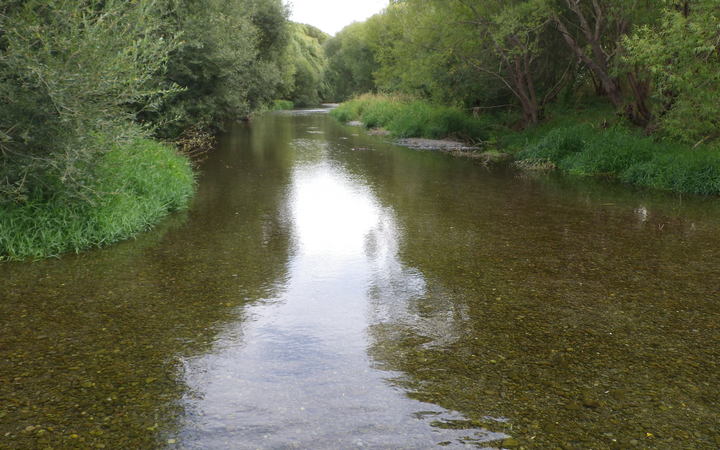
Selwyn River The Selwyn River was one of three tested in May and September. Photo: Green Ideas editor Greg Roughan

The independent testing commissioned by Fish and Game has raised red flags for public health officials who say that it needs more investigation.

Samples were collected from above and below the biggest farms - all dairy - on the Ashley, Selwyn and Rangitata rivers in May and September and independently tested by Massey University's Institute of Agriculture and Environment.

Fish and Game commissioned the testing after anglers started questioning whether they could get infected from the river pollution and large numbers of dairy cows in Canterbury.

The findings showed the presence of an antibiotic-resistant E. coli and another dangerous strain of the bacteria called Shiga toxin-producing E. coli (STEC).
The two most common E. coli found in the testing come only from ruminants such as cows.

Fish and Game chief executive Martin Taylor said the first tests were so alarming it commissioned a second round to confirm the findings.

It it showed the contamination of Canterbury waterways was primarily due to intensive dairy farming, he said.

"The results indicate swimming in these rivers could be like playing Russian roulette with the health of you and your family," he said.
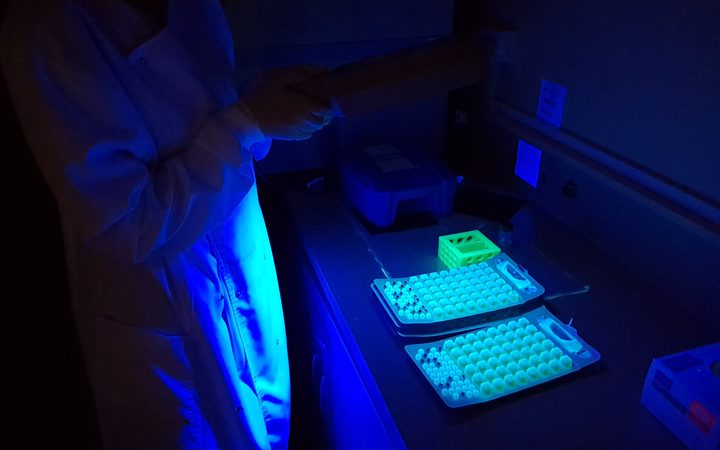
In this picture, a scientist uses to white light to test for E coli in samples. A scientist uses white light to test for E. coli in samples. Photo: RNZ/Kate Gudsell

University of Otago professor of public health Michael Baker said STEC produced a toxin which could make you ill even if you swallowed only a few organisms.

The bacteria was almost absent from New Zealand 25 years ago, but the number of cases had risen rapidly in the last three years. In the last 12 months around 750 people had become sick around the country, and Dr Baker said it was particularly common in young children living in rural areas.

"This is one of the most severe forms of diarrhoeal disease you can get in New Zealand."

He said the bacteria was a serious worry for New Zealand.

Dr Baker said about a quarter of people who got infected were hospitalised and about 10 percent would get haemolytic uraemic syndrome which damaged kidneys, particularly in children.

"Some of these children infected will need renal dialysis and it can have long-term effects," he said.

He is recommending people to take precautions if they go swimming, such as not putting their heads under water.

Canterbury District Health Board clinical microbiologist Josh Freeman said the tests raised some red flags.

"We know that these bacteria can cause infections in humans and the fact that they appear, on the face of it, to be so common in these waterways certainly raises concerns that people may obviously be exposed to these organisms and become sick."

He said to his knowledge, it was the first time antibiotic resistant genes had been found in water in New Zealand and this needed to be investigated further because they could spread and make their way into hospitals.

Mr Taylor said the proper authorities urgently needed to undertake more testing to establish the extent of the problem, along with action to ensure people were kept safe.

Canterbury Regional Council said it was committed to working with other organisations, including Fish and Game, to protect and improve water quality.
It said its weekly recreational water quality monitoring, which included sites on the Ashley and Selwyn rivers, showed they were safe to swim.

Environment Minister, David Parker, told Morning Report since last year's Havelock North Water Inquiry, the government has worked on upgrading the testing of drinking water.
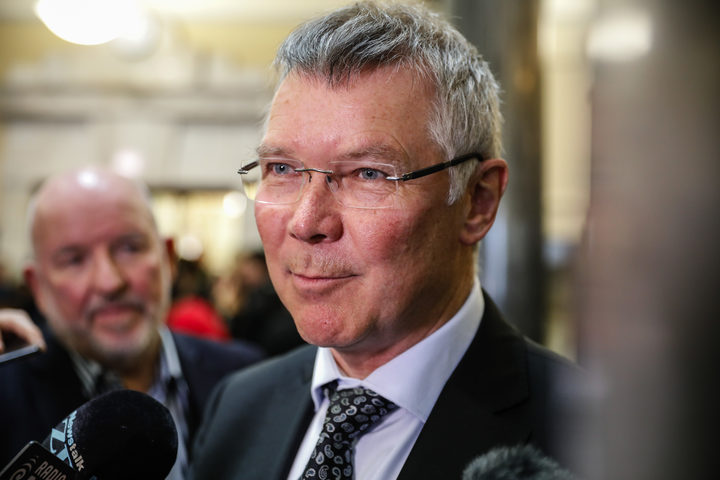
David Parker, Minister for Economic Development, Environment, and Trade and Export Growth.Environment Minister, David Parker says the ministry's Essential Freshwater Taskforce is working towards making a 'noticeable difference' in waterways. Photo: RNZ / Richard Tindiller

But he said dairy and beef cattle remain a significant part of the problem.
"In parts of New Zealand the level of intensity of farming in close proximity to waterways has gone too far and has caused these adverse effects.

"I was visiting a catchment where a group of farmers were coming together to try and help fix the problem, but I was told by the regional council that 90 percent of the farmers in the area were fully in compliance with their resource consents and plan rules, and despite that there were problems, which shows that tightening the rules is part of the answer."

Dr Parker said the ministry's Essential Freshwater Taskforce is working towards making a 'noticeable difference' in waterways.

"There'll be an updated national policy statement, plus a national environment standard which will have rules around some of the riskier practices.

"Part of the problems are some pretty aggressive farming practices in some parts of the country. Most farmers are up for improving these things, but there are some who are laggards and those laggards have to effectively be forced to comply with the law.

"[Just] changing the law doesn't fix the problem, you've actually got to have a change in land use practice on the land, which is causing the problem. On that I thought that the Fish and Game's (response) was of a different tone than it was a year ago, reflecting the fact that, a lot of the farm leaders, not all of the farm leaders, but a lot of the farm leaders have actually recognised that this problem has got too bad and they are up for the land use change."

Dr Parker said over time, he believes the type of land use near waterways will change.

"One of the ways we want to encourage that is to go to higher value land uses rather than cause the economy to tank, whilst meeting the environmental bottom line.

"In some parts of South Canterbury for example ... you will see, I think over time, movement back into mixed farming, including cropping, in some areas horticulture, which per hectare of land farmed are actually higher returning."


This is less than a week ago.

In 2010 (some months prior to the Christchurch earthquake) the National government sacked the democratically-elected ECan (which administers the province's water and replacced them with government-appointed commissioners to force through the corporate agenda of disaster capitalism.


22 April, 2010

 The Government has appointed a team of six men to take over the running of Environment Canterbury, handing them sweeping new powers that by-pass the Environment Court.

Environment Minister Nick Smith and Local Government Minister Rodney Hide have just announced six commissioners who will join commission chair-delegate and Government fix-it woman Dame Margaret Bazley in the ECan council chamber
P { margin-bottom: 0.21cm; }A:link {
ECan approves higher level of nitrates in Christchurch drinking water

13 December, 2018


Christchurch drinking water will be able to contain more nitrates from pollution for the next 50 to 100 years, Environment Canterbury (ECan) has decided.

The elevated level of 3.8 milligrams of nitrates per litre of water was proposed by the Waimakariri Water Zone Committee, due to polluted water flowing into aquifers from North Canterbury dairy farms.

ECan councillors Lan Pham​ and Iaean Cranwell voted against the proposal at Thursday afternoon's meeting.

A denitrification wall pilot trial is under way at the Silverstream Reserve, Clarkville. ESR groundwater scientist Lee Burbery is heading the project which aims to filter nitrates out of groundwater using a permeable barrier made from woodchip and gravel.

EMMA DANGERFIELD/STUFF
 
A denitrification wall pilot trial is under way at the Silverstream Reserve, Clarkville. ESR groundwater scientist Lee Burbery is heading the project which aims to filter nitrates out of groundwater using a permeable barrier made from woodchip and gravel.

Earlier in the day, the Christchurch City Council dropped its previous support for what were still then proposed new limits.


City council chief executive Karleen Edwards said the council wanted to withdraw a point in the council's submission that mentioned a limit of 3.8mg/l because it could affect Christchurch's aquifers.

"We've considered it's not appropriate to put another value in there."

The council would get another opportunity in mid-2019 to submit on the issue and it would provide a detailed submission on nitrate levels in Christchurch.

Under the 2008 government standards, the maximum allowable value of nitrates in drinking water is 11.3mg/l.

According to the 2017 National Policy Statement for Freshwater Management, the new level of 3.8mg/l protects 90 per cent of aquatic species from the chronic effects of nitrate toxicity.

The Waimakariri committee's proposal called the 3.8mg/l level "a precautionary limit" for "guiding nitrate reductions for the source area potentially associated with the Christchurch aquifer".

Pham said she could not support any such increased nitrate level.
"What we would be accepting here is not a precautionary limit, as it has been inappropriately and I feel somewhat misleadingly described.

"What we would be accepting is it would somehow be appropriate for the activities of a few private individuals and enterprises to put at risk the drinking water of a large metropolitan city.

"These implications prove a step too far for me to support."
Ngāi Tūāhuriri had also made it clear it did not support aspects of the proposal, she said.

Appointed councillor David Caygill said as individual councillors they had a responsibility to make their own judgements about such matters.

"But there is something I think unsatisfactory about setting up a committee, inviting them to work away on a very complex set of problems for three years or more. And then when they finally reach a set of conclusions, saying, 'well thanks, but I'm actually going to do my own thing'.

"There's something that sits very awkwardly for me with that."

Caygill voted for the new nitrate limit.

At the city council meeting, Cr Pauline Cotter said having pollutants entering the city's aquifers was unacceptable.

Cr Vicki Buck said nitrates were coming under the Waimakariri River and into the city's water.

It was a long slow process and she feared the nitrates in the water at the moment were from pre-industrial farming levels.

She was worried the situation was going to get worse.

"We need to make sure this will not impact the city's drinking water. "

She said ECan needed to act quickly and change the land use that was affecting Christchurch's drinking water.


Monday, 2 May 2016

Focus on Australia and the Murray-Darling Basin

The Murray-Darling - an Australian river system destroyed by civilisation

Seemorerocks


I woke up this morning to the  story from RT:

Australia to spend over $11mn to eradicate carps by releasing herpes virus into rivers


© David W Cerny
© David W Cerny / Reuters

Australia will spend more than US$11 million in a bid to exterminate European carp by releasing a virulent strain of herpes into the country’s largest waterway.

As much as 15 million Australian dollars will be spent on funding the clearing of the Murray-Darling Basin from the country’s worst freshwater feral pest. This will be included into Tuesday’s federal budget, Australian authorities said on Sunday.
Interestingly enough, the war on fish is to be waged by an unusual means – the water will be contaminated with a special type of herpes, known as koi herpes.

Commonwealth Scientific and Industrial Research Organisation (CSIRO) scientists have been carrying out various tests for nearly a decade on other animals including chickens, mice, frogs, turtles and water dragons “to determine the safety and suitability” of the virus in dealing with an excessive carp population.

The virus was proven to be harmless to humans and animals, but it causes kidney failure in carps, attacks their skin and kills the fish after sitting tight in its system for about seven days.

It causes high death rates in common carp and in the ornamental koi carp. No other species of fish, including goldfish, are known to be affected by the virus,” CSIRO official website says.

It affects the European carp by attacking their kidneys, their skin, their gills and stopping them breathing effectively,” Australian Science Minister Christopher Pyne said, according to ABC news.

They have the virus for a week before they show any symptoms and it suddenly kills them within 24 hours,” he dded.

It’s been calculated that the carp-control program planned to be launched in 2018 will kill 95 percent of the targeted fish over the next 30 years.

The project can’t be brought to life right away since it is still to be determined how to deal with dead bodies most effectively. A significant part of the budgeting is to be spent specifically on a clean-up program.

There’s obvious talk about whether the carp could be used for fertilizer, whether they could be used for pet food, whether they'll need to be buried in large graves and be allowed to dissipate back into the system,” Pyne noted.

Carps, that were described as the “rabbits of waterways” by Australia’s Agriculture and Water Resources Minister Barnaby Joyce for how quickly they breed and spread, have brought other populations of fish in the Murray River to the verge of extinction. Apart from that, every year Australia loses up to 500 million Australian dollars (more than US$ 380 million) due to the uncontrolled population of carps, he also said.

My response

My immediate response to the item was that it is a perfect response to the totally insanity of the human species in the midst of the predicament which is perfectly expressed by the expression "you can't have infinite growth on a finite planet"

In Australia's case it's a very finite planet.

It is an illustration of the usual response to problems caused by civilisation itself is to double down and to respond with more of the same.

I was aware of the Murray-Darling but only vaguely so.

This map was a revelation for me. 


The Murray-Darling Basin covers most to the most productive land in the country and is responsible for 50% of all crops


Take away the water of the Murray River and its tributaries and Australian "civilisation" is in deep trouble.

Add abrupt climate change to the mixture and you have disaster.

Most Australians (the ones that live in towns) will be blissfully (and often deliberately) ignorant of the extent to which their comfortable lifestyles are 100 percent dependant on the exploitation of this river system.

Most of the items they take for granted in the supermarket wouldn't be there were it not for the river.


The truth is that the Murray River hardly flows at all in parts and scarcely makes it to the sea.


If it wasn't for human intervention such as damming the river it would have completely dried up due to climate extremes and the rapacious exploitation by agriculture.

The dams have created colder water and the killing-off of native fish species has provided the perfect environment for introduced European species such as the carp. 

Hence the insanity of spending $11 million to introduce the herpes virus to kill off the car. 

I have to presume there are no native fish left to kill off because I doubt very much that the herpes virus will know the difference.

It is not difficult for those of us with our eyes open to join the dots about what this means for Australia.

A perfect storm of insane overexploitation of a resource in a country that cannot sustain more than a fraction of the actual population of Australia - combined with runaway climate change that will destroy the ability to grow food, especially in an already-dry continent.

I did find this documentary, More Than a River: the Murray-Darling Basin and its People which will be of particular interest to people like myself, living outside Australia.


And from the Wilderness Society of Australia

The Murray-Darling Basin is the largest river system in Australia and it is under threat. The science is telling us that we need to return a substantial amount of water to the system in order to ensure its long term health. Despite this, the Murray-Darling Basin Authority is gambling with the numbers, ignoring its own science and preparing to release a plan that will not only sell the river short, but the Australian people as well.

Finally...

I am sure that our friend Deejay Rebel,living in interior Victoria will have something to say about these official temperature averages - just as I do about figures I see here in New Zealand.


This March was the hottest on record for Australia, according to new data released by the Bureau of Meteorology (BoM).


The national mean temperature was 1.7°C above the historical March average, exceeding the previous record of 1.67°C set in 1986.

Thursday, 31 March 2016

NZ rivers going “down the gurgler”


Clean, Green” New Zealand’s Rivers in Crisis
Tony Orman* Journalist/Editor P O Box 939 BLENHEIM, 7240 New Zealand


*Pic: What legacy are tomorrow New Zealand citizens being left with increasingly depleted and polluted rivers?

26 March, 2016


New Zealand’s rivers are in a crisis stage with Government intent on using the water to set up corporate dairy farmers. Rivers are going “down the gurgler” in terms of flow and water quality.

Last Saturday (19 March) Christchurch-based “The Press” in the South Island featured a front page article about “trashed rivers.” North Canterbury Fish and Game chairman said the trout fishery had suffered years of environmental degradation. Declining river quality particularly close to Christchurch city has seen rivers suitable for swimming drop from 74 percent five years ago to 64 percent today.

Water is a public resource in New Zealand and trout fisheries by Act of Parliament are publicly owned. Rivers are valuable - indeed vital -  commercially recreationally and ecologically. But there is conflict because of New Zealand government bias towards converting low rainfall areas such as the Canterbury Plains and MacKenzie Basin near Mt Cook, into lush green pasture for corporate dairy farming. That grass growth in very low rainfall regions can only be achieved by irrigation from the underground aquifer or water on the surface in the form of rivers.

Dairying in mega-farm, monoculture style also causes nitrate pollution that leaches into aquifers and rivers.

The government obsessed push for massive dairying expansion is an avarice for money and export.

But ironically world dairy prices have plunged making dairying a much, much less attractive economic proposition. Dairy farmers, mostly the Kiwi family farm, are struggling with low returns and increasing debt levels. Corporates will survive and fears are overseas investors will snap up dairy farms as the traditional Kiwi farming families are forced to give up.

A key to government’s aim to increase dairying at the expense of rivers, is reforming the Resource Management Act to lower set standards for water quality. Government intends to “reform” freshwater management by amending the Resource Management Act and has been carrying out a roadshow programme for public meetings. But the itinerary shows government seems little interested in the concerns of a worried public.

Andi Cockcroft co-chairman of the Council of Outdoor Recreation Associations (CORANZ) described the itinerary as “underwhelming” with major cities such as Dunedin, Tauranga and New Plymouth left out.

Since freshwater is a publicly owned resource, the token consultation raises deep concern about government’s sincerity and questions about any likely ulterior motives,” he said.

Ken Sims spokesman for NZ Federation of Freshwater Anglers said the roadshow series of meetings seemed token consultation.

It’s going through-the-motions exercise without listening,” he said.

Reaction to the proposed reforms has not been supportive of government agenda. Even the Greater Wellington Regional council covering the district of the capital city Wellington and even government’s own environmental watchdog the Parliamentary Commissioner for the Environment Dr Jan Wright told New Zealand’s Parliament the Bill amending the Resource Management Act (RMA) went too far in stopping people having their say on important environmental matters.”  Proposed amendments include giving the Environment Minister extreme power to shut out certain voices and make changes to local council plans.

The PCE said the powers granted to the Minister were “too wide-ranging.” The RMA is now 25 years old and has been amended many times. Dr Wright also made the point that it may be time for a fundamental rethink about how to protect our environment and how to plan cities.

It is not just dairying that is a factor in declining river quality. A number of urban areas still have inadequate sewage disposal.

All in all however New Zealand’s “clean green” image vital to attracting international tourists and giving New Zealand food exports a “100 percent pure” brand is looking very tattered.

Freshwater ecologist Mike Joy of Massey University has long been a strong advocate for arresting the worsening state of rivers. as to government’s preoccupation with increasing dairying of the corporate kind, he challenges the sustainability of intensive dairy farming in New Zealand, and the myth that the Resource Management Act protects the environment.

“Nitrogen fertiliser use has risen 700 percent in a decade; nitrogen levels at 77 fresh water sites are up.”

Nitrates leaching into rivers and aquifers are a major pollutant.

Back in 2011 Prime Minister John Key was interviewed on BBC Hardtalk about the myth of the country’s “100 percent pure” claim relative to rivers.

John Key found himself having to defend New Zealand’s “100 percent Pure’ slogan as BBC journalist Stephen Sackur grilled him about whether New Zealand really is as clean and green as the tourism campaign suggested.

Stephen Sackur cited Mike Joy, a leading environmental scientist at Massey University, who had said “we (New Zealand government) are delusional about how green and clean we are”.

That might be Mike Joy’s view, but I don’t share that view,” said Mr Key when Mr Sackur presented him with the quote.

Stephen Sackur then pointed out that Mr Joy was a scientist and would have based his comments on research.

Mr Key replied: “Well he’s one academic, and like lawyers I can give you another one that will give a counterview.”

The Prime Minister said that in comparison to the rest of the world New Zealand is ‘100% Pure’, but Mr Sackur disagreed, saying; “100 percent is 100 percent and clearly you’re not 100 percent. You’ve clearly got problems with river pollution, you’ve clearly got problems with species facing extinction.”

Mr Sackur said Mr Joy blamed decades of poor New Zealand government policy.
That was 2011. Now five years later government seems still in a state of denial about the loss of rivers and the myth about “clean and green” and “100 percent pure.” And the public’s river are being sacrificed.

Tony Orman is a New Zealand journalist and author of outdoor books

When Nick Smith said making every river swimmable ‘was not practical’ did a little bit of you die?
By Martyn Bradbury 


13 March, 2016


Neither a rap nor bible verse could sway Environment Minister Nick Smith to consider making waterways swimmable.

Smith visited Palmerston North on Thursday as part the Government’s nationwide fresh water consultation, the night before a new five-year plan to clean up the Manawatu River was due to be released.


As the meeting turned over to the public for questions, a range were posed of the minister ranging from swimmable waterways and the Shannon wastewater treatment plant, to a protest rap, and a reading of a few verses from the book of Genesis.

Smith fielded several questions on why the Government was not aiming for swimmable waterways.

Each time, he responded that it simply was not “practical”.

I do not think a legal requirement for every water body in New Zealand to be swimmable is practical.”

After cheerleading for the dairy intensification that now sees many dairy farms drowning in debt, Nick says it’s not ‘practical’ to ensure our rivers can be swam in.
Did a little bit of you die when you read that NZ?

This is the NZ National voters have built.

The Greens seem to be missing in action here. The Head of Hufflepuff, James Shaw (aka Dr Invisible) looks like a possum stuck in the headlights most interviews. I don’t want to sound like a trolls troll but the Greens communications and political strategy looks as flat footed as a duck. The Wellington clique who are running the Green Party now are great at alienating people on twitter, but don’t seem to be so sharp when it comes to making political gains.

Meanwhile our rivers run brown with cow shit so National Party voters can drown in debt.

Great work NZ.