
 Posts
Posts


Intensifying Equatorial Rains: 3.3 Million Afflicted by Flooding in India and Bangladesh as Hundreds Lose Lives to Landslides from Sierra Leone to Nepal
16
August, 2017
There’s
something wrong with the rain these days. For many regions of the
globe, when the rain does fall, it more and more often comes with an
abnormally fierce intensity.
This
increasing severity of heavy rainfall events is just one aspect of
human-forced climate change through fossil fuel burning. For as the
Earth warms, both the rate of evaporation and precipitation
increases. And as atmospheric moisture loading and convection
increase coordinate with rising temperatures, so do the potential
peak intensities of the most powerful storms.
(Climate and extreme weather news August 13 through 15)
Sierra
Leone — More than 300 Dead, 600 Missing After Deadly Mudslide
This
past week, in Sierra Leone — already one of the wettest regions of
the globe at this time of year — a very heavy rainfall event
generated a severe mudslide that ripped a huge swath of devastation
through Freetown. 3,000 people were immediately rendered homeless by
the great rush of mud, rock, and soil. But more tragically in
excess of 300 people are feared dead with
600 still missing.
This single event represents the deadliest natural disaster on record for Sierra Leone — which also suffered a flood that killed 103 people in 2009. According to news reports, the region in which this disaster occurred has experienced 20 inches more rain than usual over the 30 day period from July 15 through August 15. A total amount of rainfall in a single month period that’s now in the range of 50 inches. Clearly, the surrounding lands could not maintain integrity under the force of such a prolonged deluge. And unfortunately one of the succumbing hillsides let loose into a valley settlement.
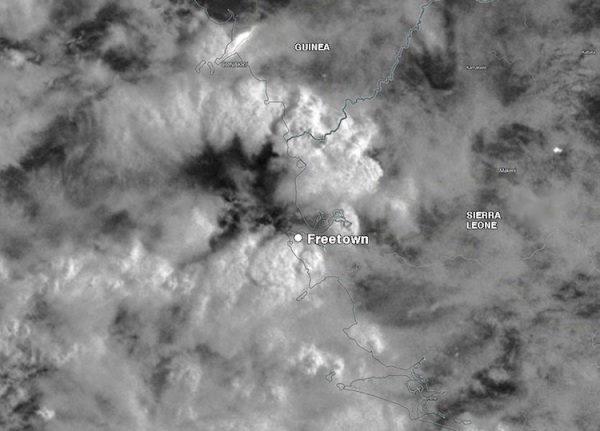
The heaviest downpours in many parts of the globe have become heavier in recent decades, a trend attributed to human-produced climate change and expected to continue. A study led by Christopher Taylor (UK Centre for Ecology and Hydrology), published this spring in the journal Nature, finds that the Sahel’s most intense mesoscale convective systems (organized clusters of thunderstorms) have tripled in frequency since 1982. The recovery of Sahel rainfall since the 1980s only explains a small part of this trend, according to the study authors. They argue that Saharan warming is helping to intensify convection within the MCSs through increased wind shear and changes to the Saharan air layer. “The meridional gradient is projected to strengthen throughout the twenty-first century, suggesting that the Sahel will experience particularly marked increases in extreme rain,” the study concludes.
Himachal Pradesh
and Nepal Landslides and Floods Kill Over 100 More
Severe
rains also on August 14th unleashed a mudslide in Pradesh India that
knocked two buses off a cliff — resulting in the tragic loss of 46
lives. The resulting landslide also injured 5 other passengers even
as it buried numerous homes along its path.
Across
the Bay of Bengal in Nepal flooding
and landslides resulted in the loss of 62 lives as 30 districts
reported severe conditions.
There, rains displaced 1,500 families, destroyed 305 homes, and
damaged more than 15,000 other dwellings. Dozens of Nepali roads have
been blocked, a school has collapsed, and an airport has been forced
to close as severe storms inundated the region.
In
India and Bangladesh, 3.3 Million People are Affected by Flooding
In the Indian state of Assam, 84 people have lost their lives due to a massive flood that has now affected 2 million people across 29 districts. 2,734 villages have flooded and 183,584 people have been forced to relocate to one of 700 refugee camps. Meanwhile, across the state, some 3,830 water rescues have occurred. Dozens of roads and bridges have been washed out as rivers rise from moderate to unprecedented flood stages.

Finally,
in Bangladesh, record rainfall has pushed rivers to some of the
highest levels ever recorded. The result has been the forced
displacement of 368,000 people to 970 temporary shelters as 1.3
million are afflicted by flooding.
Tragically, 27 Bangladeshis have also lost their lives due to the extreme flooding. Rainfall rates of up to ten inches per day are contributing to the severe flooding even as water from floods further upstream in India and Nepal are flowing into Bangladesh river systems.
Tragically, 27 Bangladeshis have also lost their lives due to the extreme flooding. Rainfall rates of up to ten inches per day are contributing to the severe flooding even as water from floods further upstream in India and Nepal are flowing into Bangladesh river systems.
Conditions
in Context — Very Severe Equatorial Rains
Overall,
these various events may appear to occur separately. However, they
are all associated with a very severe Equatorial rain pattern
developing from Africa through Southeast Asia and stretching into the
Atlantic inter-tropical-convergence zone during 2017. The apparently
increased thunderstorm activity is now impacting everything from the
intensity of monsoonal rains over Southeast Asia, the severity of
storms in the Sahel of Africa, and the early formation of tropical
cyclones off Cape Verde during August.
These
heavy rainfall features are arguably linked to the climate-change
based intensification of the hydrological cycle and, particularly, to
the increasing intensity of Equatorial thunderstorms. The overall
climate and weather trend for the larger region should thus be noted
and these various related events should not be viewed in isolation.
Links:
Hat
tip to Shawn Redmond
Hat
tip to Suzanne


