Showing posts with label thermohaline circulation. Show all posts

Tuesday, 24 April 2018

North Atlantic ocean circulation now the weakest its been in sixteen centuries.

Why a 15 Percent Slow-Down in North Atlantic Ocean Circulation is Seriously Bad News


We know somewhere out there is a tipping point where this current system is likely to break down. We still don’t know how far away or close to this tipping point we might be. … This is uncharted territory.”

*****
23 April, 2018

The North Atlantic ocean circulation (often called AMOC or the Great Ocean Conveyor) is now the weakest its been in sixteen centuries.

Increasing melt from Greenland due to human-forced warming of the atmosphere through the deep ocean is freshening the ocean surface of the far North Atlantic. To the south, higher ocean temperatures are increasing surface salt content through greater rates of evaporation. Fresh water prevents ocean water from sinking in the north and rising salt content generates increased sinking in the south. As a result, the rate at which waters move from the Equator toward the Pole is slowing down. Since the mid 20th Century, this critical ocean circulation has reduced in strength by 15 percent on decadal time-sales.

(Deep water formation in the North Atlantic is driven by the sinking of cold, salty water. Over recent years, this formation, which drives larger ocean circulation and atmospheric weather patterns, has been weakening due to increasing fresh water flows coming from a melting Greenland. Image source: Commons and the NASA Earth Observatory.)

Movement of warm Equatorial waters northward and their subsequent overturning and sinking in the North Atlantic drives a number of key weather and climate features. The first is that it tends to keep Europe warm during winter and to moderate European temperatures during summer. The second impact is that a fast moving current off the U.S. East Coast pulls water away from the shore keeping sea levels lower. The third is that warm water in the North Atlantic during winter time tends to keep the regional jet stream relatively flat. And the fourth is that a more rapid circulation keeps the ocean more highly oxygenated — allowing it to support more life.
A slowing down of ocean circulation in the North Atlantic therefore means that Europe will tend to cool during winter even as it heats up during summer. Sea level rise will accelerate faster for the U.S. East Coast relative to the rest of the world due to a slowing Gulf Stream combined with the effects of melting land glaciers and thermal ocean expansion. The North Atlantic jet stream will tend to become wavier — with deep troughs tending to form over Eastern North America and through parts of Europe. These trough zones will tend to generate far more intense fall and winter weather. Finally, a slowing ocean circulation will tend to increase the number of low-oxygen dead zones.
(Cool pool formation near Greenland juxtaposed by a warming and slowing of the Gulf Stream as it is forced southward is an early indication of ocean circulation slow-down. During recent years, this phenomena — which is related to larger human-forced climate change — has become a prevalent feature of North Atlantic Ocean climate and weather patterns. An indicator that climate change and ocean system changes for this region are already under way. Image source: Earth Nullschool.)

A 15 percent slow down in ocean circulation is not yet a catastrophic event. It is, however, enough to produce odd weather and climate signals. We have tended to see higher rates of sea level rise off the U.S. East Coast, we have tended to see more extreme winter weather across the North Atlantic basin. The long term trend for increasing ocean dead zones is well established. And European weather has become more and more extreme — with hot summers and severe winters.
With rates of Greenland melt increasing, there is a risk that the historic observed North Atlantic circulation weakening will increase further and more radically — producing still more profound results than we see today. In the event of large melt outflows coming from Greenland during abnormally warm summers or due to warming deep water melting glaciers from below — a possibility that rises with each 0.1 C of global temperature increase — we could see a very rapid weakening of ocean circulation above and beyond that which has already been recorded.

(Like Antarctica, Greenland features a number of below sea level locations directly beneath its largest ice masses. This feature makes Greenland more vulnerable to rapid ice loss and large melt outflows. Image source: NASA JPL.)

If such a tipping point event is breached — and there is increased risk for it as global temperatures enter a range of 1.5 to 2.5 C above 1880s averages during the 2020s through the 2040s — then we can expect far more profound weather and climate disruptions than those we have already experienced.


Tuesday, 10 January 2017

The collapsing Gulf Stream

I have been aware of this possibility since 2003

Ocean current sends out chilling warning

New research forecasts much colder weather in northern Europe if rising CO2 emissions continue to impact on the Atlantic ocean current.

8 January, 2017


LONDON, 8 January, 2017 – Here is the long-term weather forecast for the North Atlantic, in a world in which carbon dioxide concentrations in the atmosphere double: a powerful ocean current called the Atlantic Meridional Overturning Circulation (AMOC) will continue to weaken, and then collapse.

This is the ocean current that takes tropic heat northward, and then grows cold, dives to the ocean floor, and runs southward. And it is the current that delivers the heat that, for example, keeps the British Isles 5°C warmer than their latitude might dictate.

Carbon dioxide absorbs heat reflected from the rocks. And the more carbon dioxide in the atmosphere, the warmer the planet will become.

For two centuries, humans have been burning fossil fuels and putting ancient carbon back into the atmosphere. The average planetary temperatures, so far, have climbed about 1°C.

If CO2 levels double, temperatures will climb a lot higher. For the first 300 years after the carbon dioxide doubling, nothing much will happen. But then there will be a sweeping drop in temperatures over the north Atlantic.

New climate models

The rain belt will migrate south over the tropical ocean, the sea ice will expand to cover the waters to the south of Greenland, and around Iceland and Norway, and Britain and parts of northern Europe will become much colder.
That is what a new climate model predicts. Scientists from the Scripps Institution of Oceanography, US, and colleagues report in Science Advances journal that the outcome depends on just how computer simulations are framed.

At the moment, the standard climate models predict that the paradox of a colder Europe in a warmer world won’t happen. But the new analysis, the authors say, corrects for biases that predict only moderate changes in what climate scientists call the “Ocean Conveyor”.

Prominent cooling over the northern
North Atlantic and neighbouring areas . . .
has enormous implications for regional
and global climate change”


And their corrected version suggests a much more apocalyptic outcome: a slow-burning horror story of fire and ice.

In current models, AMOC is systematically biased to be in a stable regime,” says the study’s lead author, Wei Liu, a Yale University postdoctoral associate who began his research as a graduate student at the University of Wisconsin-Madison and continued it at Scripps Institution of Oceanography.

A bias-corrected model predicts a future AMOC collapse with prominent cooling over the northern North Atlantic and neighbouring areas. This has enormous implications for regional and global climate change.”

This is the scenario painted luridly in the 2004 disaster movie, The Day After Tomorrow. Although the film is science fiction, scientists have been worrying about the stability of the Ocean Conveyor for at least a decade. The Arctic is warming rapidly, and the consequences for the continents to the south may not be comfortable.

Ocean current weakening

Right now, outcomes remain speculative, and there are many more factors to be considered. Even in the worst case scenario, the Atlantic ocean current shutdown will not happen for several hundred years.

What the new research really says is that what the computer models predict depends very much on how the data are presented.

Or, in the words of the four authors: “Our results highlight the need to develop dynamical metrics to constrain models and the importance of reducing model biases in long-term climate projections.” – Climate News Network


Sunday, 19 June 2016

Update on Arctic sea ice extent

Ocean Heat Overwhelming North Atlantic

Arctic sea ice extent on June 16, 2016, was at a record low for the time of the year.

[ image from JAXA ]

17 June, 2016


Not only is Arctic sea ice extent at record low for time of year, the sea ice is also rapidly getting thinner, more fractured, lower in concentration and darker in color. Sea surface temperature near Svalbard was as high as 55°F (or 12.8°C, at the green circle) on June 14, 2016, an anomaly of 19.6 °F (or 10.9°C) from 1981-2011, as illustrated by the image below.


[ click on images to enlarge ]

Above image further shows that the cold lid that had been growing so prominently in extent over the North Atlantic over the past few years, has shrunk substantially. By comparison, the cold area over the North Pacific has grown larger.

Plenty of meltwater has run off from Greenland in 2016, as illustrated by the NSIDC.gov image on the right. The run-off from Alaska and Siberia into the Pacific seems less by comparison than the run-off into the North Atlantic. So, how could it be that the cold area in the North Pacific has grown larger than the cold area in the North Atlantic?

The image below gives another comparison, between June 1, 2015 (top), and June 1, 2016 (bottom), showing anomalies from 1961-1990.


The difference is striking, especially when considering the strength of the colder anomalies (from 1961-1990). Besides meltwater, something else must be influencing the size and strength of these anomalies in the North Atlantic and the North Pacific in different ways. Quite likely, the difference is caused by the Global Ocean Conveyor Belt (or thermohaline circulation), which is carrying warm water into the North Atlantic, while carrying cold water out of the North Atlantic. In the North Pacific, it is doing the opposite, i.e. carrying cold water in, while carrying warm water out of the North Pacific.

[ Note that this animation is a 2.3 MB file that make take some time to fully load ]

In conclusion, there are several issues that are influencing the situation, including the influence El Niño has had and the impact La Niña will have. Even if the Conveyor Belt may slow down, more important than its speed is how much heat it will carry into Arctic Ocean. The image below shows a trend pointing at the water on the Northern Hemisphere getting 2 degrees Celsius warmer well before the year 2030, compared to the 20th century average.


If such trends continue or even strengthen, ever warmer water will be carried from the North Atlantic into the Arctic Ocean. Since the Atlantic inflow is about 10 times greater in volume than the Pacific inflow, this will further speed up warming of the Arctic Ocean.

A warmer Arctic Ocean will speed up decline of the sea ice, causing more sunlight to be absorbed by the Arctic Ocean, as one of the feedbacks that are further accelerating warming of the Arctic Ocean. Feedback #14 refers to (latent) heat that previously went into melting. With the demise of the sea ice, an increasing proportion of the ocean heat gets absorbed by the Arctic Ocean.

As the sea ice heats up, 2.06 J/g of heat goes into every degree Celsius that the temperature of the ice rises. While the ice is melting, all energy (at 334J/g) goes into changing ice into water and the temperature remains at 0°C (273.15K, 32°F).

Once all ice has turned into water, all subsequent heat goes into heating up the water, at 4.18 J/g for every degree Celsius that the temperature of water rises.

The amount of energy absorbed by melting ice is as much as it takes to heat an equivalent mass of water from zero to 80°C.


The sea ice is in a bad shape, as also illustrated by the above concentration comparison, between June 24, 2012, and a forecast for June 24, 2016. 


As above comparison shows, the sea ice is now also much thinner than it was in 2012. Thick sea ice used to extend meters below the sea surface in the Arctic, where it could consume massive amounts of ocean heat through melting this ice into water. As such, thick sea ice acted as a buffer. Over the years, Arctic sea ice thickness has declined most dramatically. This means that the buffer that used to consume massive amounts of ocean heat carried by sea currents into the Arctic Ocean, has now largely gone.
Latent heat loss, feedback #14 on the Feedbacks page

The danger is that heat will reach the seafloor and will destabilize methane hydrates contained in sediments at the seafloor of the Arctic Ocean.

The situation is dire and calls for comprehensive and effective action as described at the 
Climate Plan.
Links

- NASA Study Finds Atlantic 'Conveyor Belt' Not Slowing (March 25, 2010)
http://www.jpl.nasa.gov/news/news.php?release=2010-101

- Arctic Ocean Circulation: Going Around At the Top Of the World, by Rebecca Woodgate (2013) 
http://www.nature.com/scitable/knowledge/library/arctic-ocean-circulation-going-around-at-the-102811553

- Feedbacks
http://arctic-news.blogspot.com/p/feedbacks.html

- Climate Plan 
http://arctic-news.blogspot.com/p/climateplan.html


This is definitely one of the best overviews on the melting Arctic and its effects on the Jetstream and the Gulf Stream.

HIGHLY recommended.

Melting Arctic and Effect on Gulf Stream


Paul Beckwith is one of the leading experts in abrupt climate change. In my view he is a genius at explaining very complex issues in an understandable way. Very fast changes in the Arctic lead to climate chaos and even to changes of ocean currents. What are the consequences for weather patterns in Western Europe?

Part 1 about the habitual way of thinking, introduction into abrupt climate change and changes of the Gulf Stream.


Thursday, 9 June 2016

The slowing of thermohaline circulation

The puzzlement of scientists perplexes me. I have known about the possibility of this phenomenon since about 2003.


Scientists puzzled by slowing of Atlantic conveyor belt, warn of abrupt climate change

Scientists are increasingly warning of the potential that a shutdown, or even significant slowdown, of the Atlantic conveyor belt could lead to abrupt climate change, a shift in Earth’s climate that can occur within as short a timeframe as a decade but persist for decades or centuries.

Mike Gaworecki


Mongabay,
27 May, 2016

Limited ocean measurements have shown that "the Atlantic conveyor belt" is far more capricious than models have previously suggested.
  • From 2009 to 2010, the average strength of key ocean currents in the North Atlantic dropped by about 30 percent, causing warmer waters to remain in the tropics rather than being carried northward.
  • The consequences included an unusually harsh European winter, a strong Atlantic Basin hurricane season, and — because a strong AMOC keeps water away from land — an extreme sea level rise of nearly 13 centimeters along the North American coast north of New York City,” according to Eric Hand, author of a Science article published this month.

Scientists in the Labrador Sea recently made the first retrieval of data from one of 53 lines moored to the sea floor and studded with instruments that have been monitoring the ocean’s circulatory system since 2014.
Held taut by submerged buoys, these moorings are arrayed from Labrador to Greenland and Scotland. In total, five research cruises are planned for this spring and summer to fetch the data the moorings are busy collecting.
The instrument array, known as the Overturning in the Subpolar North Atlantic Program (OSNAP), measures salinity, temperature, and current velocity of the surrounding water, data that is vital to understanding a set of powerful currents with far-reaching effects on the global climate. These currents are known as the Atlantic Meridional Overturning Circulation (AMOC) — or, more popularly, “the Atlantic conveyor belt” — and they have “mysteriously” slowed down over the past decade, according to Eric Hand, author of a Science article published this month.

Scientists are increasingly warning of the potential that a shutdown, or even significant slowdown, of the Atlantic conveyor belt could lead to abrupt climate change, a shift in Earth’s climate that can occur within as short a timeframe as a decade but persist for decades or centuries.
North Atlantic waters, such as the Greenland, Irminger, and Labrador Seas, are especially salty when compared with water in other parts of the world’s oceans. When AMOC currents, like the Gulf Stream, bring warmer waters from the south to the North Atlantic, the water cools down, releases its heat to the atmosphere, becomes colder, and sinks, since saltier water is denser than fresher water and cold water is denser than warm water.
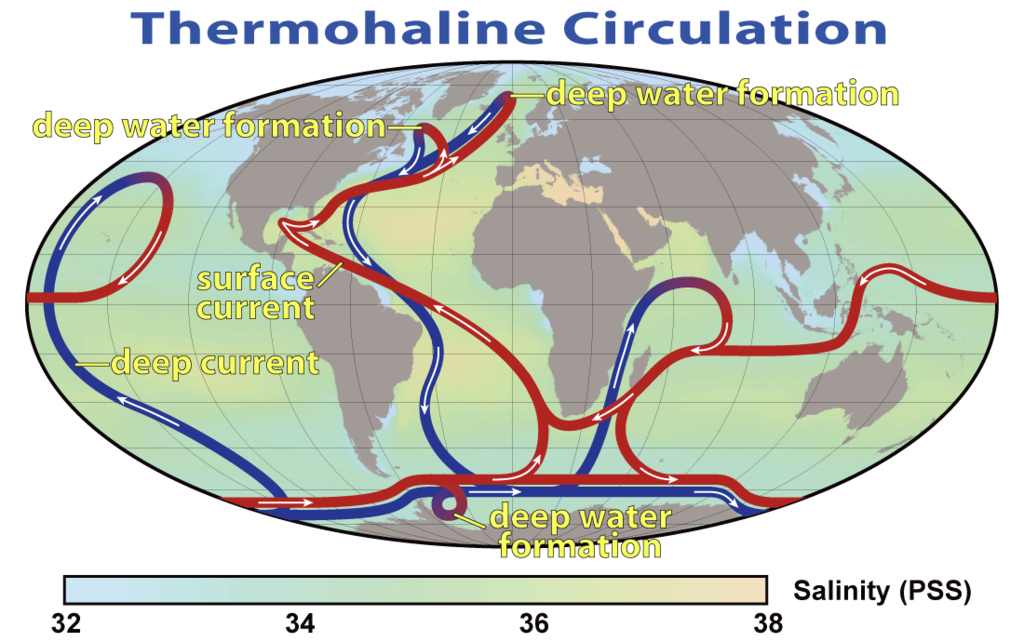
In a process called “thermohaline circulation” (“thermos” is the Greek word for heat, while “halos” is the word for salt), this cold, salty water then slowly flows back down into the South Atlantic and eventually makes its way throughout the world’s oceans. At the same time, warm, salty tropical surface waters are drawn northward, where they replace the sinking cold water.
1024px-Thermohaline_Circulation_2
This map shows the pattern of thermohaline circulation also known as “meridional overturning circulation”. This collection of currents is responsible for the large-scale exchange of water masses in the ocean, including providing oxygen to the deep ocean. The entire circulation pattern takes ~2000 years. Image viaclass="Apple-converted-space" Wikimedia Commons.
In other words, the dynamic at play in the North Atlantic seas are an important driver of the ocean’s circulation system, which is why the region was selected for the OSNAP instrument array. Two other arrays that have been deployed in different waters have already produced some strange results that scientists are eager to learn more about.
Models suggest that climate change should weaken the AMOC as warmer Arctic temperatures, combined with buoyant freshwater from Greenland’s melting ice cap, impede the formation of deep currents,” Hand wrote in the Science article. “But so far, limited ocean measurements show the AMOC to be far more capricious than the models have been able to capture.”
An array deployed in 2004 between Florida and the Canary Islands, for instance, showed “unexpectedly wild swings” in the strength of the AMOC currents from month to month, Hand reported. From 2009 to 2010, the average strength of the AMOC dropped by about 30 percent, causing warmer waters to remain in the tropics rather than being carried northward.
The consequences included an unusually harsh European winter, a strong Atlantic Basin hurricane season, and — because a strong AMOC keeps water away from land — an extreme sea level rise of nearly 13 centimeters along the North American coast north of New York City,” Hand said.
Over its first decade of operation, the Florida-to-Canary Islands subtropical array recorded a 25 percent decline in the AMOC’s average strength, which is an order of magnitude more than models suggested could occur due to the effects of climate change.
Meric Srokosz, an oceanographer at the UK’s University of Southampton and the science coordinator for the U.K.-funded portion of the array, told Hand that scientists suspect some natural variation is to blame in the dropoff of the AMOC’s strength, including the 60- to 70-year cycle of varying sea temperatures called the Atlantic Multidecadal Oscillation. Initial analysis of the latest, unpublished data from the array shows the AMOC’s average strength has leveled out, but is still well below where it started in 2004.
It will take another decade of measurements to separate the climate change effect from natural variability,” Hand wrote.

Threat of abrupt climate change

Models have suggested that there is a threshold below which the AMOC could suddenly shut down altogether — “the doomsday scenario of a frozen Europe exploited in the 2004 disaster movie The Day After Tomorrow,” as Hand put it. “Many climate models suggest that the AMOC should be stable over the long term in a warming world, but plenty of evidence from the recent geological past confirms that the conveyor belt can slow down significantly.”
As far back as 2003, Robert Gagosian, who was then the President and Director of the Woods Hole Oceanographic Institution (WHOI) in Woods Hole, Massachusetts (he’s now President Emeritus), warned that we ignore the threat of abrupt climate change induced by a slowing or shutdown of the AMOC at our own peril.
[T]he debate on global change has largely failed to factor in the inherently chaotic, sensitively balanced, and threshold-laden nature of Earth’s climate system and the increased likelihood of abrupt climate change,” he wrote in a post on the WHOI website.

Speculation about the future impacts of climate change focus on forecasts by the UN’s Intergovernmental Panel on Climate Change, which projects gradual global warming of 1.4 to 5.8-degree Celsius over the next century, Gagosian wrote at the time. That doesn’t appear to have significantly changed, as the Paris Climate Agreement signed in December of last year commits signatory countries to limiting warming to 2 degrees Celsius, with an aspirational goal of limiting it to 1.5 degrees Celsius — and there’s little to no mention of how the world will fend off the possibility of abrupt climate change.
But we’d be wise to include in our forecasts the potential for relatively sudden, possibly localized climate change induced by thermohaline shutdown, Gagosian argued. “Such a change could cool down selective areas of the globe by 3° to 5° Celsius, while simultaneously causing drought in many parts of the world.”
These abrupt changes could occur even while other regions of the globe continue to warm more gradually, Gagosian said, making it “critical to consider the economic and political ramifications of this geographically selective climate change. Specifically, the region most affected by a shutdown — the countries bordering the North Atlantic — is also one of the world’s most developed.”
CITATION


Tuesday, 12 April 2016

Extreme weather in Britain

I have observed that the Guardian reports on climate change very well but hardly ever reports extreme weather – as if the two are not connected?

UK weather: Homes flooded after enormous waves and 65mph winds strike the South West coast
Towering waves struck buildings and smashed windows in Cornwall today as severe weather coincided with a spring high tide.


10 April, 2016

Homes in the South West were flooded today after enormous waves and 65mph winds rocked the coast.

The waves struck buildings and smashed windows in Cornwall as severe weather coincided with a spring high tide.

The Ship and Castle Hotel in St Mawes was flooded, while at least three homes in Penzance were also affected, according to reports.

The waves also crashed over sea defences in Devon, resulting in a number of delays on trains out of the region.

Fire crews were called to deal with flooding, while the Met Office issued a severe weather warning for the South West.

Swanpool Road is closed due to the high seas. in attendance

This evening, the Environment Agency had 13 flood warnings in place across Devon and Cornwall, the Plymouth Herald reports.

Read more: Climber dies on Mount Snowdon after falling from 'knife edge' ridge

Elsewhere, parts of Britain were left covered in snow today - while other areas were bathed in glorious sunshine.

Some residents in Northumberland found themselves surrounded by deep snow this morning following overnight blizzards.


And two people in the region had to be rescued from a car after becoming stranded by the sea on a tidal causeway.

The rescue mission took place on the road that leads to the island of Lindisfarne, that sits around one mile off the Northumberland coast.

The couple were eventually saved by the coastguard and taken back to dry land.

Northumbria Police said they were 'safe and well' and the vehicle would remain on the causeway until it was safe to return.


Spring snow? Cumbria's landscape left wintery and frozen after overnight snowfall
VIDEO LOADING
Warning signs at either end of the road urge drivers to check the tide times, which explain when it is safe to cross each day.

Lindisfarne, also known as Holy Island, has a population of around 180 people.

Read more: UK weather: Snow in the north and 65mph winds in Cornwall - but the sun's out in London

Despite the poor weather in some regions today, London was drenched in sunshine, with people in the capital enjoying a lazy Sunday outside.

It comes just a week after the hottest weekend of the year saw the mercury push past the 17C (63F) mark.

PASome residents in Northumberland found themselves surrounded by deep snow this morningSome residents in Northumberland found themselves surrounded by deep snow this morning
Forecasters last week said it could be the end of the month before Brits can enjoy warm temperatures again.

Warm southerly air responsible for the brief burst of joy at the start of April is being shoved away by a bitter plume from the Arctic.

Met Office forecaster Nicola Maxey said last week: "It is going to turn wet and windy with temperatures much colder than the beginning of the week.

"Polar maritime air will move in while colder air aloft will be brought down by rain making it feel much colder.

"There is a chance of wintry showers and hail in the north over high ground with even some to lower levels.

"It will stay fairly changeable and will remain fairly cold over into the weekend and over the next few days."

The Met Office predicts a grim outlook for the rest of the month with gales, hill snow and below-average temperatures on the way.

PAForecasters last week said it could be the end of the month before Brits can enjoy warm temperatures againForecasters last week said it could be the end of the month before Brits can enjoy warm temperatures again
A spokesman said: "Showers could be heavy at times with a risk of thunder, mixed with some drier interludes, but possibly with some hill snow in the north.

"The rather unsettled pattern will continue, but with the southeast increasingly seeing the better of any drier spells.

"[It will be] windy with a risk of gales, more especially in the southwest.

"Winds will generally be moderate throughout, but strong along exposed coasts with a risk of gales in the southwest."

Gulf Stream is slowing down faster than ever, scientists say

Gulf Stream stops Britain from freezing over in Winter

24 March, 2014

The Gulf Stream that helps to keep Britain from freezing over in winter is slowing down faster now than at any time in the past millennium according to a study suggesting that major changes are taking place to the ocean currents of the North Atlantic.
Scientists believe that the huge volumes of freshwater flowing into the North Atlantic from the rapidly melting ice cap of Greenland have slowed down the ocean “engine” that drives the Gulf Stream from the Caribbean towards north-west Europe, bringing heat equivalent to the output of a million power stations.
Scientists believe that huge volumes of freshwater flowing into the North Atlantic from the rapidly melting ice cap of Greenland have slowed down the ocean “engine” that drives the Gulf Stream (Getty)
However, the researchers believe that Britain is still likely to become warmer due to climate change providing the Gulf Stream does not come to a complete halt – although they remain unsure how likely this is.
Calculations suggest that over the 20th century the North Atlantic meridional overturning circulation – the northward flow of warm surface water and the southward flow of deep, cold water – has slowed by between 15 and 20 per cent, said Professor Stefan Rahmstorf of the Potsdam Institute for Climate Impact Research in Germany.
There is more than a 99 per cent probability that this slowdown is unique over the period we looked at since 900 AD. We conclude that the slowdown many have described is in fact already underway and it is outside of any natural variation,” Professor Rahmstorf said.
The scientists calculated that some 8,000 cubic kilometres of freshwater has flowed from Greenland into the Atlantic between 1900 and 1970, and this rose significantly to 13,000 cubic kilometres between 1970 and 2000.
Freshwater is lighter than salty water which means that it tends to float on the surface of the ocean and in doing so disturbs the normal sinking of dense, cold saltwater to the ocean floor, which is the main driver of the Atlantic circulation.
An iceberg in Ilulissat, Greenland; researchers have been studying the phenomena of the melting glaciers and their long-term ramifications for the rest of the world (Getty)
In a study published in the journal Nature Climate Change, Professor Rahmstorf and colleagues point out that maps of global surface temperatures have consistently indicated an overall warming trend around the world, except for the region of the North Atlantic south of Greenland.
It is conspicuous that one specific area of the North Atlantic has been cooling in the past hundred years while the rest of the world heats up,” said Professor Rahmstorf, who added that previous research had indicated that a slowdown in ocean currents may be the explanation.
Now we have detected strong evidence that the global conveyor has indeed been weakening in the past hundred years, particularly since 1970,” he said.
The study used proxy measurements of the Atlantic currents, using ice cores, tree rings, coral growth and ocean and lake sediments, to estimate regional temperature variations and so assess how the Gulf Stream has changed over the past 1,000 years.
Machair, a grassy coastal habitat found only in north-west Scotland and the west coast of Ireland, is one of the several elements of the UK’s “cultural heritage” that is at risk from climate change (Getty)
Jason Box of the Geological Survey of Denmark and Greenland, who helped to calculate the amount of freshwater flowing into the Atlantic from melting ice caps, said that the slowdown can be linked to man-made climate change.
Now freshwater coming off the Greenland ice sheet is likely disturbing the circulation. So the human-caused mass loss of the Greenland ice sheet appears to be slowing down the Atlantic overturning, and this effect might increase if temperatures are allowed to rise further,” Dr Box said.
Michael Mann of Pennsylvania State University said: “Common climate models are underestimating the change we’re facing, wither because the Atlantic overturning is too stable in the models or because they don’t properly account for Greenland ice melt, or both.”