Showing posts with label the Guardian. Show all posts

Friday, 5 March 2021

The Guardian suggests Covid-like shutdowns every 2 years to meet Paris climate goals

 I have lots to say about this but no time to say it.


Carbon dioxide emissions must fall by the equivalent of a global lockdown roughly every two years for the next decade for the world to keep within safe limits of global heating, research has shown.

Lockdowns around the world led to an unprecedented fall in emissions of about 7% in 2020, or about 2.6bn tonnes of CO2, but reductions of between 1bn and 2bn tonnes are needed every year of the next decade to have a good chance of holding temperature rises to within 1.5C or 2C of pre-industrial levels, as required by the Paris agreement.

Research published on Wednesday shows that countries were beginning to slow their rates of greenhouse gas emissions before the Covid-19 pandemic struck, but not to the levels needed to avert climate breakdown. Since lockdowns were eased in many countries last year, there have been strong signs that emissions will rise again to above 2019 levels, severely damaging the prospects of fulfilling the Paris goals.

Corinne Le Quéré, lead author of the study, said the world stood at a crucial point as governments poured money into the global economy to cope with the impacts of the pandemic. “We need a cut in emissions of about the size of the fall [from the lockdowns] every two years, but by completely different methods,” she said.


https://www.theguardian.com/environment/2021/mar/03/global-lockdown-every-two-years-needed-to-meet-paris-co2-goals-study

Lockdowns or the planet gets 

it? Guardian ‘accidentally’ 

suggests Covid-like shutdowns 

every 2 years to meet Paris 

climate goals


The Guardian accidentally confirmed the suspicions of a whole lot of conspiracy theorists with an article suggesting a “global lockdown every two years” was needed to meet Paris climate goals. The title was quickly changed.

If carbon dioxide emissions don’t drop by the equivalent of a worldwide lockdown “roughly every two years” for the next decade, the earth will heat to apocalyptic levels, a team of researchers at the University of East Anglia warned in a Nature article published Wednesday.

This apparently so excited a certain strain of climate fanatic on the Guardian staff, that they originally posted the piece under the title “Global lockdown every two years needed to meet Paris CO2 goals – study.” After being dragged mercilessly for such fear porn, the headline was changed to “Equivalent of Covid emissions drop needed every two years – study” with an explainer that “experts say” that “equivalent falls in emissions over a decade” would be “required to keep safe limits of global heating.”

Despite calling for “completely different methods” to achieve and lock in the emissions drop from the pandemic, lead researcher Corinne Le Quéré nevertheless insisted that climate change couldn’t be a “side issue. It can’t be about one law or policy, it has to be put at the heart of all policy.”

Every strategy and every plan from every government must be consistent with tackling climate change.

While Le Quéré didn’t come out and suggest people be arbitrarily deprived of their liberties every two years in order to please a climate model, the other “strategic actions” she mentioned to keep some of the gains of the pandemic were already being implemented – and in many cases had been implemented for years. From city planning to incentivize “active transport” (walking and cycling) and growing public transportation, to promoting remote work where possible, her suggestions were not exactly new – and unlikely to convince anyone they were sufficient enough.


“There is a real contradiction between what governments are saying they are doing to do [to generate a green recovery], and what they are doing,” Le Quéré told the Guardian, calling the phenomenon “very worrisome.” 

Her co-researcher Glen Peters was more explicit in what latitude countries should have to move away from fossil fuels on their own time, calling for “structural changes” to move economies toward renewable energy.

Some on social media, seeing the “quiet part” said out loud on the first edition of the Guardian article, had an “I told you so” moment. The threat of ‘climate lockdowns’ has been alternately presented and “debunked” by mainstream media for months.

…others at first assumed it had to be satire, because no one would post something that on-the-nose –

…except maybe for the World Economic Forum, which actually posted in praise of what lockdowns had done to cities – presumably turned them into uninhabitable hives of snitches where one can’t even take in a Broadway show anymore – earlier this week, before removing its tweet under public pressure. 

The WEF had posted a video praising the “silence” and clearer air – and lack of humans, though they didn’t say that part out loud.


https://www.rt.com/news/516767-world-economic-forum-tweet-deleted/


Monday, 28 September 2020

The Guardian betrays Julian Assange and journalism

I recall reading Jonathon in the Guardian in the good old days.


The Guardian’s deceit-riddled 

new statement betrays both 

Julian Assange and 

journalism


Jonathon Cook 

Jonathon Cook

26 September, 2020


In my recent post on the current hearings at the Old Bailey over Julian Assange’s extradition to the United States, where he would almost certainly be locked away for the rest of his life for the crime of doing journalism, I made two main criticisms of the Guardian.

A decade ago, remember, the newspaper worked closely in collaboration with Assange and Wikileaks to publish the Iraq and Afghan war diaries, which are now the grounds on which the US is basing its case to lock Assange behind bars in a super-max jail.

My first criticism was that the paper had barely bothered to cover the hearing, even though it is the most concerted attack on press freedom in living memory. That position is unconscionably irresponsible, given its own role in publishing the war diaries. But sadly it is not inexplicable. In fact, it is all too easily explained by my second criticism.

That criticism was chiefly levelled at two leading journalists at the Guardian, former investigations editor David Leigh and reporter Luke Harding, who together wrote a book in 2011 that was the earliest example of what would rapidly become a genre among a section of the liberal media elite, most especially at the Guardian, of vilifying Assange.

In my earlier post I set out Leigh and Harding’s well-known animosity towards Assange – the reason why one senior investigative journalist, Nicky Hager, told the Old Bailey courtroom the pair’s 2011 book was “not a reliable source”. That was, in part, because Assange had refused to let them write his official biography, a likely big moneymaker. The hostility had intensified and grown mutual when Assange discovered that behind his back they were writing an unauthorised biography while working alongside him.

But the bad blood extended more generally to the Guardian, which, like Leigh and Harding, repeatedly betrayed confidences and manoeuvred against Wikileaks rather the cooperating with it. Assange was particularly incensed to discover that the paper had broken the terms of its written contract with Wikileaks by secretly sharing confidential documents with outsiders, including the New York Times.

Leigh and Harding’s book now lies at the heart of the US case for Assange’s extradition to the US on so-called “espionage” charges. The charges are based on Wikileaks’ publication of leaks provided by Chelsea Manning, then an army private, that revealed systematic war crimes committed by the US military.

Inversion of truth

Lawyers for the US have mined from the Guardian book claims by Leigh that Assange was recklessly indifferent to the safety of US informants named in leaked files published by Wikileaks.

Assange’s defence team have produced a raft of renowned journalists, and others who worked with Wikileaks, to counter Leigh’s claim and argue that this is actually an inversion of the truth. Assange was meticulous about redacting names in the documents. It was they – the journalists, including Leigh – who were pressuring Assange to publish without taking full precautions.

Of course, none of these corporate journalists – only Assange – is being put on trial, revealing clearly that this is a political trial to silence Assange and disable Wikileaks.

But to bolster its feeble claim against Assange – that he was reckless about redactions – the US has hoped to demonstrate that in September 2011, long after publication of the Iraq and Afghan diaries, Wikileaks did indeed release a trove of documents – official US cables – that Assange failed to redact.

This is true. But it only harms Assange’s defence if the US can successfully play a game of misdirection – and the Guardian has been crucial to that strategy’s success. Until now the US has locked the paper into collaborating in its war on Assange and journalism – if only through its silence – by effectively blackmailing the Guardian with a dark, profoundly embarrassing secret the paper would prefer was not exposed.

In fact, the story behind the September 2011 release by Wikileaks of those unredacted documents is entirely different from the story the court and public is being told. The Guardian has conspired in keeping quiet about the real version of events for one simple reason – because it, the Guardian, was the cause of that release.

Betrayal of Assange and journalism

Things have got substantially harder for the paper during the extradition proceedings, however, as its role has come under increasing scrutiny – both inside and outside the courtroom. Now the Guardian has been flushed out, goaded into publishing a statement in response to the criticisms.

It has finally broken its silence but has done so not to clarify what happened nine years ago. Rather it has deepened the deception and steeped the paper even further in betrayal both of Assange and of press freedom.

The February 2011 Guardian book the US keeps citing contained something in addition to the highly contentious and disputed claim from Leigh that Assange had a reckless attitude to redacting names. The book also disclosed a password – one Assange had given to Leigh on strict conditions it be kept secret – to the file containing the 250,000 encrypted cables. The Guardian book let the cat out of the bag. Once it gave away Assange’s password, the Old Bailey hearings have heard, there was no going back.

Any security service in the world could now unlock the file containing the cables. And as they homed in on where the file was hidden at the end of the summer, Assange was forced into a desperate damage limitation operation. In September 2011 he published the unredacted cables so that anyone named in them would have advance warning and could go into hiding – before any hostile security services came looking for them.

Yes, Assange published the cables unredacted but he did so – was forced to do so – by the unforgivable actions of Leigh and the Guardian.

But before we examine the paper’s deceitful statement of denial, we need to interject two further points.

First, it is important to remember that claims of the damage this all caused were intentionally and grossly inflated by the US to create a pretext to vilify Assange and later to justify his extradition and jailing. In fact, there is no evidence that any informant was ever harmed as a result of Wikileaks’ publications – something that was even admitted by a US official at Manning’s trial. If someone had been hurt or killed, you can be sure that the US would be clamouring about it at the Old Bailey hearings and offering details to the media.

Second, the editor of a US website, Cryptome, pointed out this week at the hearings that he had published the unredacted cables a day before Wikileaks did. He noted that US law enforcement agencies had shown zero interest in his publication of the file and had never asked him to take it down. The lack of concern makes explicit what was always implicit: the issue was never really about the files, redacted or not; it was always about finding a way to silence Assange and disable Wikileaks.

The Guardian’s deceptions

Every time the US cites Leigh and Harding’s book, it effectively recruits the Guardian against Assange and against freedom of the press. Hanging over the paper is effectively a threat that – should it not play ball with the US campaign to lock Assange away for life – the US could either embarrass it by publicly divulging its role or target the paper for treatment similar to that suffered by Assange.

And quite astoundingly, given the stakes for Assange and for journalism, the Guardian has been playing ball – by keeping quiet. Until this week, at least.

Under pressure, the Guardian finally published on Friday a short, sketchy and highly simplistic account of the past week’s hearings, and then used it as an opportunity to respond to the growing criticism of its role in publishing the password in the Leigh and Harding book.

The Guardian’s statement in its report of the extradition hearings is not only duplicitous in the extreme but sells Assange down the river by evading responsibility for publishing the password. It thereby leaves him even more vulnerable to the US campaign to lock him up.

Here is its statement:


Let’s highlight the deceptions:

1. The claim that the password was “temporary” is just that – a self-exculpatory claim by David Leigh. There is no evidence to back it up beyond Leigh’s statement that Assange said it. And the idea that Assange would say it defies all reason. Leigh himself states in the book that he had to bully Assange into letting him have the password precisely because Assange was worried that a tech neophyte like Leigh might do something foolish or reckless. Assange needed a great deal of persuading before he agreed. The idea that he was so concerned about the security of a password that was to have a life-span shorter than a mayfly is simply not credible.

2. Not only was the password not temporary, but it was based very obviously on a complex formula Assange used for all Wikileaks’ passwords to make them impossible for others to crack but easier for him to remember. By divulging the password, Leigh gave away Assange’s formula and offered every security service in the world the key to unlocking other encrypted files. The claim that Assange had suggested to Leigh that keeping the password secret was not of the most vital importance is again simply not credible.

3. But whether or not Leigh thought the password was temporary is beside the point. Leigh, as an experienced investigative journalist and one who had little understanding of the tech world, had a responsibility to check with Assange that it was okay to publish the password. Doing anything else was beyond reckless. This was a world Leigh knew absolutely nothing about, after all.

But there was a reason Leigh did not check with Assange: he and Harding wrote the book behind Assange’s back. Leigh had intentionally cut Assange out of the writing and publication process so that he and the Guardian could cash in on the Wikileak founder’s early fame. Not checking with Assange was the whole point of the exercise.

4. It is wrong to lay all the blame on Leigh, however. This was a Guardian project. I worked at the paper for years. Before any article is published, it is scrutinised by backbench editors, sub-editors, revise editors, page editors and, if necessary, lawyers and one of the chief editors. A Guardian book on the most contentious, incendiary publication of a secret cache of documents since the Pentagon Papers should have gone through at least the same level of scrutiny, if not more.

So how did no one in this chain of supervision pause to wonder whether it made sense to publish a password to a Wikileaks file of encrypted documents? The answer is that the Guardian was in a publishing race to get its account of the ground-shattering release of the Iraq and Afghan diaries out before any of its rivals, including the New York Times and Der Spiegel. It wanted to take as much glory as possible for itself in the hope of winning a Pulitzer. And it wanted to settle scores with Assange before his version of events was given an airing in either the New York Times or Der Spiegel books. Vanity and greed drove the Guardian’s decision to cut corners, even if it meant endangering lives.

5. Nauseatingly, however, the Guardian not only seeks to blame Assange for its own mistake but tells a glaring lie about the circumstances. Its statement says: “No concerns were expressed by Assange or WikiLeaks about security being compromised when the book was published in February 2011. WikiLeaks published the unredacted files in September 2011.”

It is simply not true that Assange and Wikileaks expressed no concern. They expressed a great deal of concern in private. But they did not do so publicly – and for very good reason.

Any public upbraiding of the Guardian for its horrendous error would have drawn attention to the fact that the password could be easily located in Leigh’s book. By this stage, there was no way to change the password or delete the file, as has been explained to the Old Bailey hearing by a computer professor, Christian Grothoff, of Bern University.  He has called Leigh a “bad faith actor”.

So Assange was forced to limit the damage quietly, behind the scenes, before word of the password’s publication got out and the file was located. Ultimately, six months later, when the clues became too numerous to go unnoticed, and Cryptome had published the unredacted file on its website, Assange had no choice but to follow suit.

This is the real story, the one the Guardian dare not tell. Despite the best efforts of the US lawyers and the judge at the Old Bailey hearings, the truth is finally starting to emerge. Now it is up to us to make sure the Guardian is not allowed to continue colluding in this crime against Assange and the press freedoms he represents.


Friday, 17 July 2020

The Guardian does it AGAIN


https://www.theguardian.com/world/2020/jul/16/russian-state-sponsored-hackers-target-covid-19-vaccine-researchers

The “Russian vaccine hack” is a 3-for-1 deal on propaganda

Apparently, that mean old Putin is stealing our magic vaccine to fight the “deadly virus”.

Kit Knightly


15 July, 2020

The Guardian, and all the other predictable voices, are currently reporting that Russian “state sponsored hackers” have been attempting to steal “medical secrets” from British pharmaceutical researchers.

At this stage they offer no substantiation, but it does serve as good teaching exercise in the techniques of modern propagandists.

First the lack of evidence. Observe the Guardian article, note the complete absence of sources or references. There’s not a link in sight. There’s no content there beyond the parroted words of UK government officials, whose honesty and/or competence is never interrogated.

Second, the lies by omission. They don’t mention, for example, the Vault 7 revelations from Wikileaks that the CIA/Pentagon have developed technology to make one of their own cyber-attacks appear to come from anywhere in the world, Russia obviously included. This is clearly vital information.

Third, the multitasking. When you splash a huge red lie on your front pages, it’s always best to make it serve several agendas at once. In fact, an unsupported statement which serves multiple state-backed narratives at the same time is one of the telltale signs of propaganda.

With this one completely unverified claim, the Guardian – or rather the people who tell the Guardian what to say – back up three narratives:
  1. The further demonisation of an “enemy”. Russia is portrayed as pursuing selfish interests with reckless behaviour”, whilst we (and our allies) are getting on with the hard work of finding a vaccine and protecting global health.”
  2. Promoting the vaccine. The vaccine is coming. It will likely be mandatory, it will certainly have been insufficiently tested, if tested at all. They need some pro-vaccine advertising, and nothing sells better than “our vaccine is so good, people are trying to steal it”.
  3. Most importantly – Enhancing the idea that Sars-Cov-2 is a unique global threat which puts us all in danger. The unspoken assumption is that Russia needs to steal our research because the virus is so dangerous we all need to be afraid of it…despite it beingharmless to the vast majority of people.
Whether it’s the (totally unsubstantiated) allegation that Russia put bounties on NATO servicemen in Afghanistan, or the (very predictable) “leak” that Russian interference” was backing Corbyn in the general election, it’s clear that any Globalist deal on the coronavirus is dead and buried, and it’s very much open season on Putin’s Russia again.

Nothing shows just how much the Guardian has become the voice of the Deep State more than its coverage of anything Russia-related. And nothing serves as a better exemplar of how modern propaganda works.

Friday, 13 September 2019

The decline of the Guardian


As a former (and avid) reader of the Guardian this is of interest to me. What happened?


How the UK Security 

Services neutralised the 

country’s leading liberal 

newspaper

Matt Kennard and Mark Curtis

Guardian Newspaper Building Stock Photos & Guardian ...
11 September, 2019

The UK security services targeted The Guardian after the newspaper started publishing the contents of secret US government documents leaked by National Security Agency contractor Edward Snowden in June 2013.
Snowden’s bombshell revelations continued for months and were the largest-ever leak of classified material covering the NSA and its UK equivalent, the Government Communications Headquarters. They revealed programmes of mass surveillance operated by both agencies.
According to minutes of meetings of the UK’s Defence and Security Media Advisory Committee, the revelations caused alarm in the British security services and Ministry of Defence.
This event was very concerning because at the outset The Guardian avoided engaging with the [committee] before publishing the first tranche of information,” state minutes of a 7 November 2013 meeting at the MOD.
The DSMA Committee, more commonly known as the D-Notice Committee, is run by the MOD, where it meets every six months. A small number of journalists are also invited to sit on the committee. Its statedpurpose is to “prevent inadvertent public disclosure of information that would compromise UK military and intelligence operations”. It can issue “notices” to the media to encourage them not to publish certain information.
The committee is currently chaired by the MOD’s director-general of security policy Dominic Wilson, who was previously director of security and intelligence in the British Cabinet Office. Its secretary is Brigadier Geoffrey Dodds OBE, who describes himself as an “accomplished, senior ex-military commander with extensive experience of operational level leadership”.
The D-Notice system describes itself as voluntary, placing no obligations on the media to comply with any notice issued. This means there should have been no need for the Guardian to consult the MOD before publishing the Snowden documents.
Yet committee minutes note the secretary saying: “The Guardian was obliged to seek … advice under the terms of the DA notice code.” The minutes add: “This failure to seek advice was a key source of concern and considerable efforts had been made to address it.”
Considerable efforts’
These “considerable efforts” included a D-Notice sent out by the committee on 7 June 2013 – the day after The Guardian published the first documents – to all major UK media editors, saying they should refrain from publishing information that would “jeopardise both national security and possibly UK personnel”. It was marked “private and confidential: not for publication, broadcast or use on social media”.
Clearly the committee did not want its issuing of the notice to be publicised, and it was nearly successful. Only the right-wing blog Guido Fawkes made it public.
At the time, according to the committee minutes, the “intelligence agencies in particular had continued to ask for more advisories [i.e. D-Notices] to be sent out”. Such D-Notices were clearly seen by the intelligence services not so much as a tool to advise the media but rather a way to threaten it not to publish further Snowden revelations.
One night, amidst the first Snowden stories being published, the D-Notice Committee’s then-secretary Air Vice-Marshal Andrew Vallance personally called Alan Rusbridger, then editor of The Guardian. Vallance “made clear his concern that The Guardian had failed to consult him in advance before telling the world”, according to a Guardian journalist who interviewed Rusbridger.
Later in the year, Prime Minister David Cameron again used the D-Notice system as a threat to the media.
I don’t want to have to use injunctions or D-Notices or the other tougher measures,” he said in a statement to MPs. “I think it’s much better to appeal to newspapers’ sense of social responsibility. But if they don’t demonstrate some social responsibility it would be very difficult for government to stand back and not to act.”
The threats worked. The Press Gazette reported at the time that “The FT [Financial Times] and The Times did not mention it [the initial Snowden revelations] … and the Telegraph published only a short”. It continued by noting that only The Independent “followed up the substantive allegations”. It added, “The BBC has also chosen to largely ignore the story.”
The Guardian, however, remained uncowed.
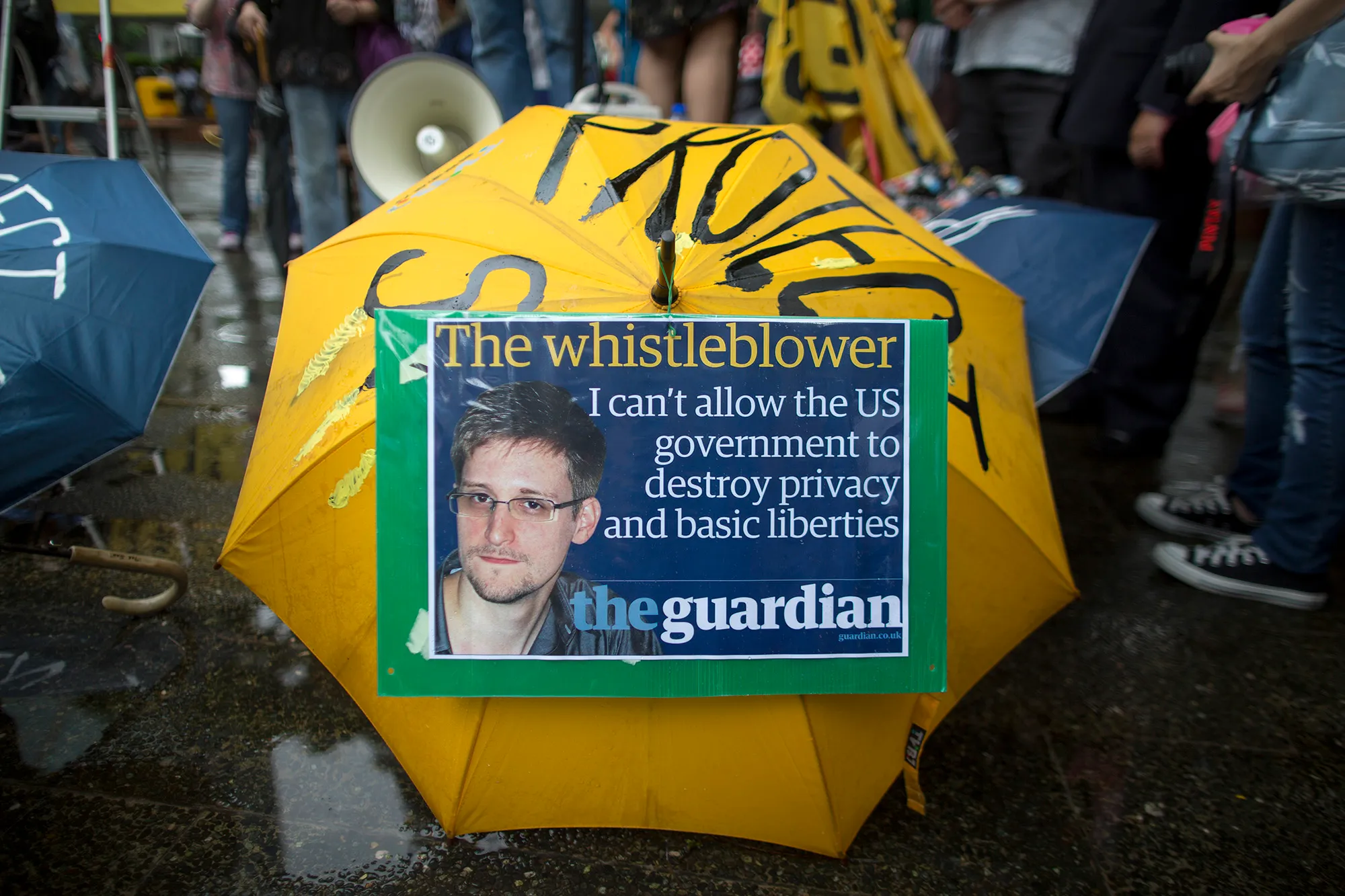
A poster showing a photograph of US whistleblower Edward Snowden is fixed to an umbrella during a pro-Snowden march in Hong Kong, China, 15 June 2013. EPA/JEROME FAVRE
According to the committee minutes, the fact The Guardian would not stop publishing “undoubtedly raised questions in some minds about the system’s future usefulness”. If the D-Notice system could not prevent The Guardian publishing GCHQ’s most sensitive secrets, what was it good for?
It was time to rein in The Guardian and make sure this never happened again.
GCHQ and laptops
The security services ratcheted up their “considerable efforts” to deal with the exposures.
On 20 July 2013, GCHQ officials entered The Guardian’s offices at King’s Cross in London, six weeks after the first Snowden-related article had been published.
At the request of the government and security services, Guardian deputy editor Paul Johnson, along with two others, spent three hours destroying the laptops containing the Snowden documents.
The Guardian staffers, according to one of the newspaper’s reporters, brought “angle-grinders, dremels – drills with revolving bits – and masks”. The reporter added, “The spy agency provided one piece of hi-tech equipment, a ‘degausser’, which destroys magnetic fields and erases data.”
Johnson claims that the destruction of the computers was “purely a symbolic act”, adding that “the government and GCHQ knew, because we had told them, that the material had been taken to the US to be shared with the New York Times. The reporting would go on. The episode hadn’t changed anything.”
Yet the episode did change something. As the D-Notice Committee minutes for November 2013 outlined: “Towards the end of July [as the computers were being destroyed], The Guardian had begun to seek and accept D-Notice advice not to publish certain highly sensitive details and since then the dialogue [with the committee] had been reasonable and improving.”
The British security services had carried out more than a “symbolic act”. It was both a show of strength and a clear threat. The Guardian was then the only major newspaper that could be relied upon by whistleblowers in the US and British security bodies to receive and cover their exposures, a situation which posed a challenge to security agencies.
The increasingly aggressive overtures made to The Guardian worked. The committee chair noted that after GCHQ had overseen the smashing up of the newspaper’s laptops “engagement … with The Guardian had continued to strengthen”.
Moreover, he added, there were now “regular dialogues between the secretary and deputy secretaries and Guardian journalists”. Rusbridger later testified to the Home Affairs Committee that Air Vice-Marshal Vallance of the D-Notice committee and himself “collaborated” in the aftermath of the Snowden affair and that Vallance had even “been at The Guardian offices to talk to all our reporters”.
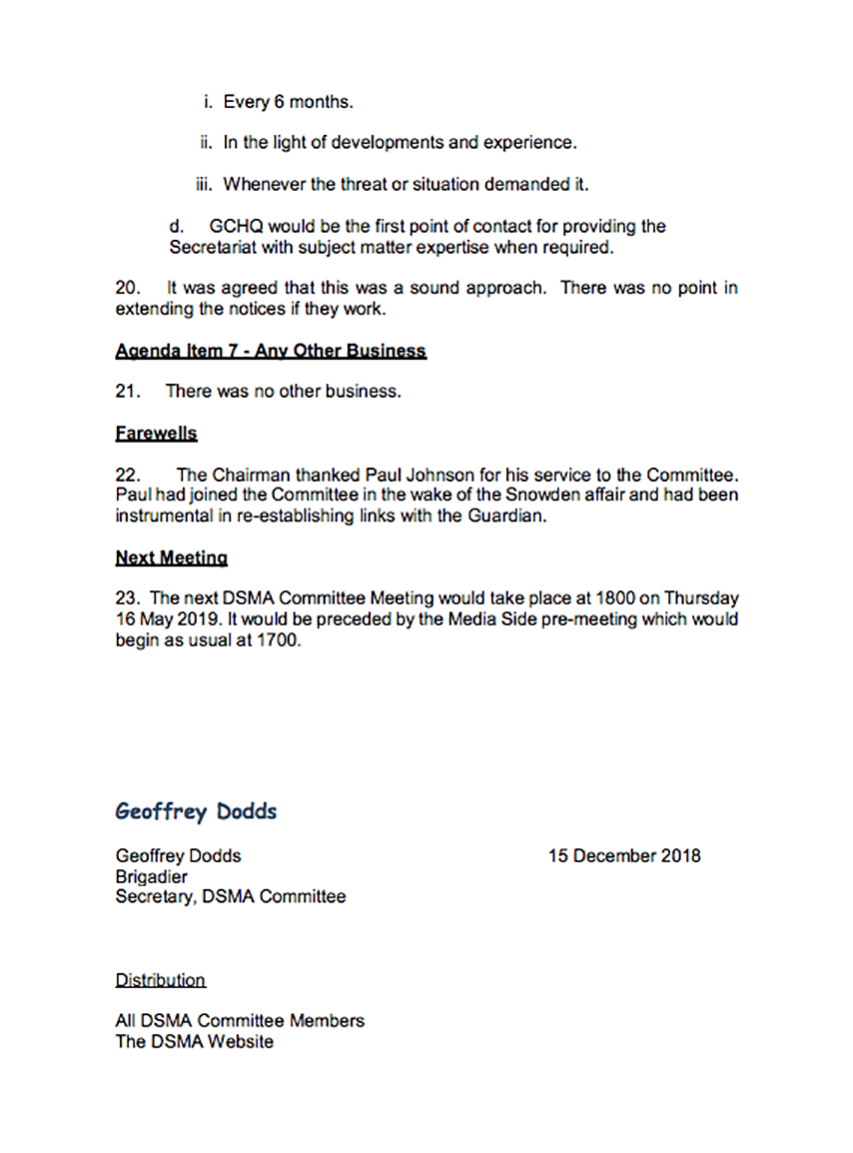
But the most important part of this charm and threat offensive was getting The Guardian to agree to take a seat on the D-Notice Committee itself. The committee minutes are explicit on this, noting that “the process had culminated by [sic] the appointment of Paul Johnson (deputy editor Guardian News and Media) as a DPBAC [i.e. D-Notice Committee] member”.
At some point in 2013 or early 2014, Johnson – the same deputy editor who had smashed up his newspaper’s computers under the watchful gaze of British intelligence agents – was approached to take up a seat on the committee. Johnson attended his first meeting in May 2014 and was to remain on it until October 2018.
The Guardian’s deputy editor went directly from the corporation’s basement with an angle-grinder to sitting on the D-Notice Committee alongside the security service officials who had tried to stop his paper publishing.
A new editor
Guardian editor Alan Rusbridger withstood intense pressure not to publish some of the Snowden revelations but agreed to Johnson taking a seat on the D-Notice Committee as a tactical sop to the security services. Throughout his tenure, The Guardian continued to publish some stories critical of the security services.
But in March 2015, the situation changed when the Guardian appointed a new editor, Katharine Viner, who had less experience than Rusbridger of dealing with the security services. Viner had started out on fashion and entertainment magazine Cosmopolitan and had no history in national security reporting. According to insiders, she showed much less leadership during the Snowden affair than Janine Gibson in the US (Gibson was another candidate to be Rusbridger’s successor).
Viner was then editor-in-chief of Guardian Australia, which was launched just two weeks before the first Snowden revelations were published. Australia and New Zealand comprise two-fifths of the so-called “Five Eyes” surveillance alliance exposed by Snowden.
This was an opportunity for the security services. It appears that their seduction began the following year.
In November 2016, The Guardian published an unprecedented “exclusive” with Andrew Parker, the head of MI5, Britain’s domestic security service. The article noted that this was the “first newspaper interview given by an incumbent MI5 chief in the service’s 107-year history”. It was co-written by deputy editor Paul Johnson, who had never written about the security services before and who was still sitting on the D-Notice Committee. This was not mentioned in the article.
The MI5 chief was given copious space to make claims about the national security threat posed by an “increasingly aggressive” Russia. Johnson and his co-author noted, “Parker said he was talking to The Guardian rather than any other newspaper despite the publication of the Snowden files.”
Parker told the two reporters, “We recognise that in a changing world we have to change too. We have a responsibility to talk about our work and explain it.”
Four months after the MI5 interview, in March 2017, the Guardian published another unprecedented “exclusive”, this time with Alex Younger, the sitting chief of MI6, Britain’s external intelligence agency. This exclusive was awarded by the Secret Intelligence Service to The Guardian’s investigations editor, Nick Hopkins, who had been appointed 14 months previously.
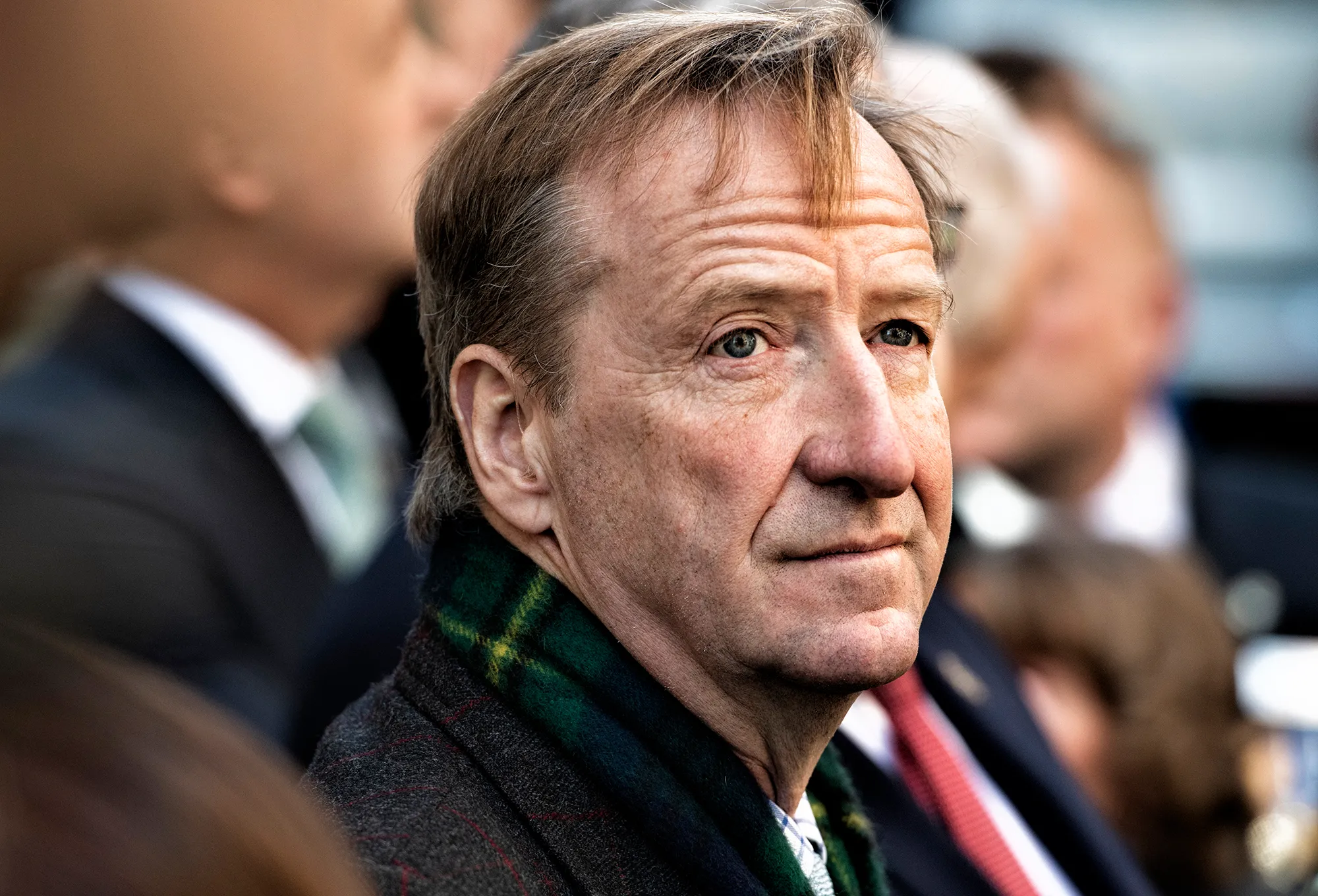
Head of MI6, (the foreign intelligence service of the government of the United Kingdom) Alexander Younger wait for a visit of Britain’s Elizabeth II outside Watergate House to mark the centenary the United Kingdom’s Intelligence, Security and Cyber Agency (GCHQ) in London, Britain, 14 February 2019. PA-EFE/FACUNDO ARRIZABALAGA
The interview was the first Younger had given to a national newspaper and was again softball. Titled “MI6 returns to ‘tapping up’ in an effort to recruit black and Asian officers”, it focused almost entirely on the intelligence service’s stated desire to recruit from ethnic minority communities.
Simply, we have to attract the best of modern Britain,” Younger told Hopkins. “Every community from every part of Britain should feel they have what it takes, no matter what their background or status.”
Just two weeks before the interview with MI6’s chief was published, The Guardian itself reported on the high court stating that it would “hear an application for a judicial review of the Crown Prosecution Service’s decision not to charge MI6’s former counterterrorism director, Sir Mark Allen, over the abduction of Abdel Hakim Belhaj and his pregnant wife who were transferred to Libya in a joint CIA-MI6 operation in 2004”.
None of this featured in The Guardian article, which did, however, cover discussions of whether the James Bond actor Daniel Craig would qualify for the intelligence service. “He would not get into MI6,” Younger told Hopkins.
More recently, in August 2019, The Guardian was awarded yet another exclusive, this time with Metropolitan police assistant commissioner Neil Basu, Britain’s most senior counter-terrorism officer. This was Basu’s first major interview since taking up his post” the previous year and resulted in a three-part series of articles, one of which was entitled “Met police examine Vladimir Putin’s role in Salisbury attack”.
The security services were probably feeding The Guardian these “exclusives” as part of the process of bringing it onside and neutralising the only independent newspaper with the resources to receive and cover a leak such as Snowden’s. They were possibly acting to prevent any revelations of this kind happening again.
What, if any, private conversations have taken place between Viner and the security services during her tenure as editor are not known. But in 2018, when Paul Johnson eventually left the D-Notice Committee, its chair, the MOD’s Dominic Wilson, praised Johnson who, he said, had been “instrumental in re-establishing links with The Guardian”.

Decline in critical reporting
Amidst these spoon-fed intelligence exclusives, Viner also oversaw the breakup of The Guardian’s celebrated investigative team, whose muck-racking journalists were told to apply for other jobs outside of investigations.
One well-placed source told the Press Gazette at the time that journalists on the investigations team “have not felt backed by senior editors over the last year”, and that “some also feel the company has become more risk-averse in the same period”.
In the period since Snowden, The Guardian has lost many of its top investigative reporters who had covered national security issues, notably Shiv Malik, Nick Davies, David Leigh, Richard Norton-Taylor, Ewen MacAskill and Ian Cobain. The few journalists who were replaced were succeeded by less experienced reporters with apparently less commitment to exposing the security state. The current defence and security editor, Dan Sabbagh, started at The Guardian as head of media and technology and has no history of covering national security.
It seems they’ve got rid of everyone who seemed to cover the security services and military in an adversarial way,” one current Guardian journalist told us.
Indeed, during the last two years of Rusbridger’s editorship, The Guardian published about 110 articles per year tagged as MI6 on its website. Since Viner took over, the average per year has halved and is decreasing year by year.
Effective scrutiny of the security and intelligence agencies — epitomised by the Snowden scoops but also many other stories — appears to have been abandoned,” a former Guardian journalist told us. The former reporter added that, in recent years, it “sometimes seems The Guardian is worried about upsetting the spooks.”
A second former Guardian journalist added: “The Guardian no longer seems to have such a challenging relationship with the intelligence services, and is perhaps seeking to mend fences since Snowden. This is concerning, because spooks are always manipulative and not always to be trusted.”
While some articles critical of the security services still do appear in the paper, its “scoops” increasingly focus on issues more acceptable to them. Since the Snowden affair, The Guardian does not appear to have published any articles based on an intelligence or security services source that was not officially sanctioned to speak.
The Guardian has, by contrast, published a steady stream of exclusives on the major official enemy of the security services, Russia, exposing Putin, his friends and the work of its intelligence services and military.
In the Panama Papers leak in April 2016, which revealed how companies and individuals around the world were using an offshore law firm to avoid paying tax, The Guardian’s front-page launch scoop was authored by Luke Harding, who has received many security service tips focused on the “Russia threat”, and was titled “Revealed: the $2bn offshore trail that leads to Vladimir Putin”.
Three sentences into the piece, however, Harding notes that “the president’s name does not appear in any of the records” although he insists that “the data reveals a pattern – his friends have earned millions from deals that seemingly could not have been secured without his patronage”.
There was a much bigger story in the Panama Papers which The Guardian chose to downplay by leaving it to the following day. This concerned the father of the then Prime Minister, David Cameron, who “ran an offshore fund that avoided ever having to pay tax in Britain by hiring a small army of Bahamas residents – including a part-time bishop – to sign its paperwork”.
We understand there was some argument between journalists about not leading with the Cameron story as the launch splash. Putin’s friends were eventually deemed more important than the Prime Minister of the country where the paper published.
Getting Julian Assange
The Guardian also appears to have been engaged in a campaign against the WikiLeaks publisher Julian Assange, who had been a collaborator during the early WikiLeaks revelations in 2010.
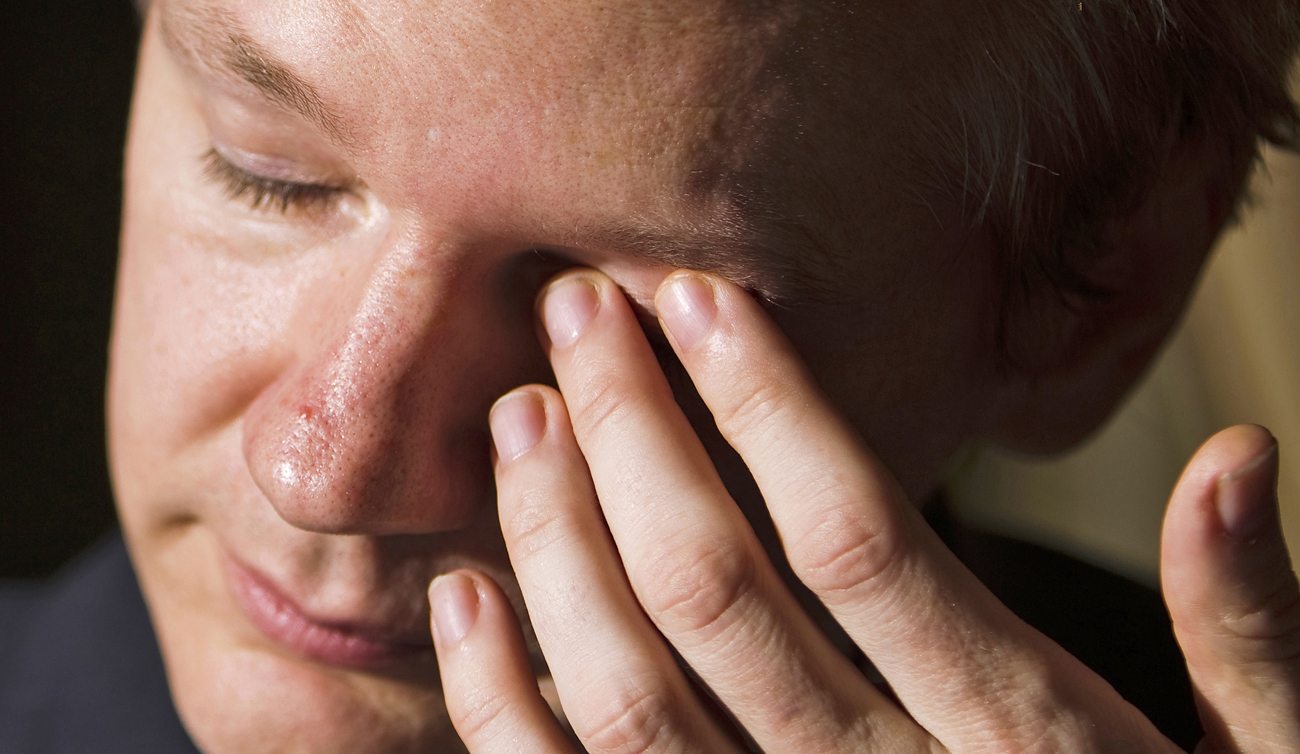
A file photograph showing WikiLeaks founder Julian Assange shows an issue of the British daily newspaper The Guardian during a press conference at the Frontline Club in London, Britain, 26 July 2010. EPA/STR
One 2017 story came from investigative reporter Carole Cadwalladr, who writes for The Guardian’s sister paper The Observer, titled “When Nigel Farage met Julian Assange”. This concerned the visit of former UKIP leader Nigel Farage to the Ecuadorian embassy in March 2017, organised by the radio station LBC, for whom Farage worked as a presenter. Farage’s producer at LBC accompanied Farage at the meeting, but this was not mentioned by Cadwalladr.
Rather, she posited that this meeting was “potentially … a channel of communication” between WikiLeaks, Farage and Donald Trump, who were all said to be closely linked to Russia, adding that these actors were in a “political alignment” and that “WikiLeaks is, in many ways, the swirling vortex at the centre of everything”.
Yet Cadwalladr’s one official on-the-record source for this speculation was a “highly placed contact with links to US intelligence”, who told her, “When the heat is turned up and all electronic communication, you have to assume, is being intensely monitored, then those are the times when intelligence communication falls back on human couriers. Where you have individuals passing information in ways and places that cannot be monitored.”
It seems likely this was innuendo being fed to The Observer by an intelligence-linked individual to promote disinformation to undermine Assange.
In 2018, however, The Guardian’s attempted vilification of Assange was significantly stepped up. A new string of articles began on 18 May 2018 with one alleging Assange’s “long-standing relationship with RT”, the Russian state broadcaster. The series, which has been closely documented elsewhere, lasted for several months, consistently alleging with little or the most minimal circumstantial evidence that Assange had ties to Russia or the Kremlin.
One story, co-authored again by Luke Harding, claimed that “Russian diplomats held secret talks in London … with people close to Julian Assange to assess whether they could help him flee the UK, The Guardian has learned”. The former consul in the Ecuadorian embassy in London at this time, Fidel Narvaez, vigorously denies the existence of any such “escape plot” involving Russia and is involved in a complaint process with The Guardian for insinuating he coordinated such a plot.
This apparent mini-campaign ran until November 2018, culminating in a front-page splash, based on anonymous sources, claiming that Assange had three secret meetings at the Ecuadorian embassy with Trump’s former campaign manager Paul Manafort.
This “scoop” failed all tests of journalistic credibility since it would have been impossible for anyone to have entered the highly secured Ecuadorian embassy three times with no proof. WikiLeaks and others have strongly argued that the story was manufactured and it is telling that The Guardian has since failed to refer to it in its subsequent articles on the Assange case. The Guardian, however, has still not retracted or apologised for the story which remains on its website.
The “exclusive” appeared just two weeks after Paul Johnson had been congratulated for “re-establishing links” between The Guardian and the security services.
The string of Guardian articles, along with the vilification and smear stories about Assange elsewhere in the British media, helped create the conditions for a deal between Ecuador, the UK and the US to expel Assange from the embassy in April. Assange now sits in Belmarsh maximum-security prison where he faces extradition to the US, and life in prison there, on charges under the Espionage Act.
Acting for the establishment
Another major focus of The Guardian’s energies under Viner’s editorship has been to attack the leader of the UK Labour Party, Jeremy Corbyn.
The context is that Corbyn appears to have recently been a target of the security services. In 2015, soon after he was elected Labour leader, the Sunday Times reported a serving general warning that “there would be a direct challenge from the army and mass resignations if Corbyn became prime minister”. The source told the newspaper: “The Army just wouldn’t stand for it. The general staff would not allow a prime minister to jeopardise the security of this country and I think people would use whatever means possible, fair or foul, to prevent that.”
On 20 May 2017, a little over two weeks before the 2017 General Election, the Daily Telegraph was fed the story that “MI5 opened a file on Jeremy Corbyn amid concerns over his links to the IRA”. It formed part of a Telegraph investigation claiming to reveal “Mr Corbyn’s full links to the IRA” and was sourced to an individual “close to” the MI5 investigation, who said “a file had been opened on him by the early nineties”.
The Metropolitan Police Special Branch was also said to be monitoring Corbyn in the same period.
Jeremy Corbyn, Leader of the Labour Party, makes a keynote speech on the day before Parliament returns, Manchester, Britain, 02 September 2019. EPA-EFE/PETER POWELL
Then, on the very eve of the General Election, the Telegraph gave space to an article from Sir Richard Dearlove, the former director of MI6, under a headline: “Jeremy Corbyn is a danger to this nation. At MI6, which I once led, he wouldn’t clear the security vetting.”
Further, in September 2018, two anonymous senior government sources told The Times that Corbyn had been “summoned” for a “‘facts of life’ talk on terror” by MI5 chief Andrew Parker.
Just two weeks after news of this private meeting was leaked by the government, the Daily Mail reportedanother leak, this time revealing that “Jeremy Corbyn’s most influential House of Commons adviser has been barred from entering Ukraine on the grounds that he is a national security threat because of his alleged links to Vladimir Putin’s ‘global propaganda network’.”
The article concerned Andrew Murray, who had been working in Corbyn’s office for a year but had still not received a security pass to enter the UK parliament. The Mail reported, based on what it called “a senior parliamentary source”, that Murray’s application had encountered “vetting problems”.
Murray later heavily suggested that the security services had leaked the story to the Mail. “Call me sceptical if you must, but I do not see journalistic enterprise behind the Mail’s sudden capacity to tease obscure information out of the [Ukrainian security service],” he wrote in the New Statesman. He added, “Someone else is doing the hard work – possibly someone being paid by the taxpayer. I doubt if their job description is preventing the election of a Corbyn government, but who knows?”
Murray told us he was approached by the New Statesman after the story about him being banned from Ukraine was leaked. “However,” he added, “I wouldn’t dream of suggesting anything like that to The Guardian, since I do not know any journalists still working there who I could trust.”
The Guardian itself has run a remarkable number of news and comment articles criticising Corbyn since he was elected in 2015 and the paper’s clearly hostile stance has been widely noted.
Given its appeal to traditional Labour supporters, the paper has probably done more to undermine Corbyn than any other. In particular, its massive coverage of alleged widespread anti-Semitism in the Labour Party has helped to disparage Corbyn more than other smears carried in the media.
The Guardian and The Observer have published hundreds of articles on “Labour anti-Semitism” and, since the beginning of this year, carried over 50 such articles with headlines clearly negative to Corbyn. Typical headlines have included “The Observer view: Labour leadership is complicit in anti-Semitism”, “Jeremy Corbyn is either blind to anti-Semitism – or he just doesn’t care”, and “Labour‘s anti-Semitism problem is institutional. It needs investigation”.
The Guardian’s coverage of anti-Semitism in Labour has been suspiciously extensive, compared to the known extent of the problem in the party, and its focus on Corbyn personally suggests that the issue is being used politically.
While anti-Semitism does exist in the Labour Party, evidence suggests it is at relatively low levels. Since September 2015, when Corbyn became Labour leader, 0.06% of the Labour membership has been investigated for anti-Semitic comments or posts.
In 2016, an independent inquiry commissioned by Labour concluded that the party “is not overrun by anti-Semitism, Islamophobia or other forms of racism. Further, it is the party that initiated every single United Kingdom race equality law.”
Analysis of two YouGov surveys, conducted in 2015 and 2017, shows that anti-Semitic views held by Labour voters declined substantially in the first two years of Corbyn’s tenure and that such views were significantly more common among Conservative voters.
Despite this, since January 2016, The Guardian has published 1,215 stories mentioning Labour and anti-Semitism, an average of around one per day, according to a search on Factiva, the database of newspaper articles. In the same period, The Guardian published just 194 articles mentioning the Conservative Party’s much more serious problem with Islamophobia. A YouGov poll in 2019, for example, found that nearly half of the Tory Party membership would prefer not to have a Muslim prime minister.
At the same time, some stories which paint Corbyn’s critics in a negative light have been suppressed by The Guardian. According to someone with knowledge of the matter, The Guardian declined to publish the results of a months-long critical investigation by one of its reporters into a prominent anti-Corbyn Labour MP, citing only vague legal issues.
In July 2016, one of this article’s authors emailed a Guardian editor asking if he could pitch an investigation about the first attempt by the right-wing of the Labour Party to remove Corbyn, informing The Guardian of very good inside sources on those behind the attempt and their real plans. The approach was rejected as being of no interest before a pitch was even sent.
A reliable publication?
On 20 May 2019, The Times newspaper reported on a Freedom of Information request made by the Rendition Project, a group of academic experts working on torture and rendition issues, which showed that the MOD had been “developing a secret policy on torture that allows ministers to sign off intelligence-sharing that could lead to the abuse of detainees”.
This might traditionally have been a Guardian story, not something for the Rupert Murdoch-owned Times. According to one civil society source, however, many groups working in this field no longer trust The Guardian.
A former Guardian journalist similarly told us: “It is significant that exclusive stories recently about British collusion in torture and policy towards the interrogation of terror suspects and other detainees have been passed to other papers including The Times rather than The Guardian.”
The Times published its scoop under a strong headline, “Torture: Britain breaks law in Ministry of Defence secret policy”. However, before the article was published, the MOD fed The Guardian the same documents The Times were about to splash with, believing it could soften the impact of the revelations by telling its side of the story.
The Guardian posted its own article just before The Times, with a headline that would have pleased the government: “MoD says revised torture guidance does not lower standards”.
Its lead paragraph was a simple summary of the MOD’s position: “The Ministry of Defence has insisted that newly emerged departmental guidance on the sharing of intelligence derived from torture with allies, remains in line with practices agreed in the aftermath of a series of scandals following the wars in Afghanistan and Iraq.” However, an inspection of the documents showed this was clearly disinformation.
The Guardian had gone in six short years from being the natural outlet to place stories exposing wrongdoing by the security state to a platform trusted by the security state to amplify its information operations. A once relatively independent media platform has been largely neutralised by UK security services fearful of being exposed further. Which begs the question: where does the next Snowden go? DM
The Guardian did not respond to a request for comment.
Daily Maverick will formally launch Declassified – a new UK-focused investigation and analysis organisation run by the authors of this article – in November 2019.
Matt Kennard is an investigative journalist and co-founder of Declassified. He was previously director of the Centre for Investigative Journalism in London, and before that a reporter for the Financial Times in the US and UK. He is the author of two books, Irregular Army and The Racket. 
Mark Curtis is a leading UK foreign policy analyst, journalist and the author of six books including Web of Deceit: Britain’s Real Role in the World and Secret Affairs: Britain’s Collusion with Radical Islam.5