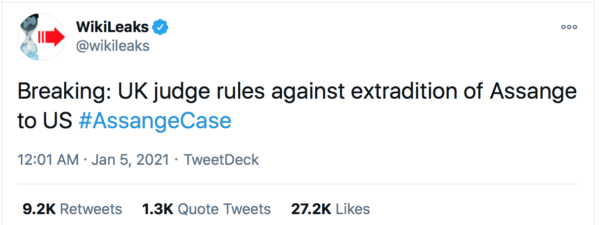
Magistrate Vanessa Baraitser on Monday rejected a U.S. extradition request on both indictments for WikiLeaks publisher Julian Assange.
Magistrate Vanessa Baraitser on Monday ordered Julian Assange discharged based on a severe risk of suicide.
She said U.S. authorities did not convince her they could prevent him taking his life. Before reaching her conclusion Baraitser agreed with virtually every point in the U.S. favor until she came to the condition of his health and what extradition to the U.S. would mean. Baraitser brought Assange down a dark alley before her surprise decision at the end.
The moment the judge said Assange would be “discharged” the courtroom camera swung to him sitting in the glassed-in dock. He showed no reaction.
Baraitser was ready to immediately hear a bail application but Assange’s lawyers have asked until Wednesday to make it. She told the court that her decision whether to release Assange from remand in Belmarsh prison would also depend on the U.S. decision on an appeal, which the U.S. has said it would lodge.
Craig Murray, the former British diplomat and friend of Assange, told jubilant supporters on the street outside Old Bailey that he expected “Julian to be walking among us” on Wednesday.
Press freedom advocates were disappointed in the judgement, saying Baraitser established a precedent to ensnare journalists by accepting U.S. contentions that Assange was not engaging in journalistic activity but rather assisting his source, Chelsea Manning, crack into a government computer, as well as that he illegally possessed and published classified material.
By affirming that journalists can be prosecuted under the U.S. Espionage Act, as well as the equivalent British Official Secrets Act, Baraitser handed down a perilous ruling for the future of journalism, the advocates argue.
However it may have been unrealistic to expect her to rule that the U.S. was criminalizing journalism. The outcome is probably the best Assange supporters could realistically have expected. Murray said it was time to be joyful of the ruling and that the issue of press freedom was for “tomorrow.”
As the judge agreed on every point with the U.S. indictments of Assange, there is little the United States can appeal other than to argue that Assange is not severely suicidal or that it can be managed, and that its prisons are not the well-established dungeons that they are. The U.S. may argue on appeal that Assange violated the Espionage and Official Secrets Acts but Baraitser’s ruling to deny extradition on mental health grounds would remain.
Baraitser in her ruling said the UC Global case of spying on Assange while he was in the Ecuador Embassy would have no bearing because the case has not yet reached a verdict in a Spanish court.
BREAKING: Assange’s Extradition DENIED by British Court – what does it mean for Kim Dotcom?
Incredible news overnight, Assange’s Extradition has been DENIED by the British Court!
This is the most important defence of journalism we’ve probably ever had, and it’s a surprising ruling because we had all assumed the interests in destroying Assange as punishment for exposing war crimes by the West was done and dusted.
Incredibly, Nicky Hager’s astounding witness evidence given in the show trail against Assange in September was ignored by most NZ media because most NZ Media rooms are now slavish cowards to the woke social media lynch mob, and the Woke’s denigration of Assange as a rapist means any coverage in NZ must be deplatformed and never spoken of lest the Wellington Twitterati cancels you.
However, with this now as global news, expect the NZ media cowards to all jump on board with their empty praise.
The decision to not extradite Assange was weighed up by the mental health impacts of such draconian demands by America, but this ruling to refuse extraditing him becomes a shining light for the rights of journalists and dramatically resets the power dynamics between the State and whistleblowers.
In terms of Kim Dotcom, the Supreme Court of NZ or the Immigration Minister need to ask themselves if Assange didn’t meet the threshold for extradition, then how the fuck does Kim Dotcom’s trumped up charges meet the extradition threshold???
The mental health damage to Dotcom and the total destruction of his business has been as extreme as Assange’s, why would we do what the UK won’t?
I wept genuine tears of joy this morning.
A great day for journalism.
When I saw this I had a surge of anger.
I can hardly convey how angry this makes me. Our DISGUSTING , lying, state propaganda media totally suppressed this news about our Nicky Hager.
This came from a Northern Irish newspaper.
These days I could not tell you who is worse - RNZ, Newshub or Stuff (in the case of the Herald I refuse to pay or register for my propaganda) is worse. They just echo each other. Journalism in this country is as DEAD as a dodo.
Yesterday we had two quite conventional (but thinking) friends who said independently they could not abide listening to RNZ these days.
The Kafkaesque Imprisonment of Julian Assange Exposes U.S. Myths About Freedom and Tyranny
The real measure of how free is a society is not how its mainstream, well-behaved ruling class servants are treated, but the fate of its actual dissidents.
Persecution is not typically doled out to those who recite mainstream pieties, or refrain from posing meaningful threats to those who wield institutional power, or obediently stay within the lines of permissible speech and activism imposed by the ruling class.
Those who render themselves acquiescent and harmless that way will — in every society, including the most repressive — usually be free of reprisals. They will not be censored or jailed. They will be permitted to live their lives largely unmolested by authorities, while many will be well-rewarded for this servitude. Such individuals will see themselves as free because, in a sense, they are: they are free to submit, conform and acquiesce. And if they do so, they will not even realize, or at least not care, and may even regard as justifiable, that those who refuse this Orwellian bargain they have embraced (“freedom” in exchange for submission) are crushed with unlimited force.
Those who do not seek to meaningfully dissent or subvert power will usually deny — because they do not perceive — that such dissent and subversion are, in fact, rigorously prohibited. They will continue to believe blissfully that the society in which they live guarantees core civic freedoms — of speech, of press, of assembly, of due process — because they have rendered their own speech and activism, if it exists at all, so innocuous that nobody with the capacity to do so would bother to try to curtail it. The observation apocryphally attributed to socialist activist Rosa Luxemburg, imprisoned for her opposition to German involvement in World War I and then summarily executed by the state, expresses it best: “Those who do not move, do not notice their chains.”
The metric to determine whether a society is free is not how its orthodoxy-spouting, well-behaved, deferential-to-authority citizens are treated. Such people are treated well, or at least usually left alone, by every sovereign and every power center in every era, all over the world.
You will not feel the sting of Silicon Valley or other institutional censorship as long as you affirm the latest COVID pronouncements of the World Health Organization and Dr. Anthony Fauci (even as those decrees contradict the ones they issued only a few months earlier), but you will if you question, refute or deviate from them. You will not have your Facebook page deleted if you defend Israeli occupation of Palestine but will be banished from that platform if you live in the West Bank and Gaza and urge resistance to Israeli occupying troops. If you call Trump an orange fascist clown, you can stay on YouTube for eternity, but not if you defend his most controversial policies and claims. You can vocally insist that the 2000, 2004 and 2016 U.S. presidential elections were all stolen without the slightest concern of being banned, but the same claims about the 2020 election will result in the summary denial of your ability to use online tech monopolies to be heard.
Censorship, like most repression, is reserved for those who dissent from majoritarian orthodoxies, not for those who express views comfortably within the mainstream. Establishment Democrats and Republicans — adherents to the prevailing neoliberal order — have no need for free speech protections since nobody with power would care enough to silence them. It is only the disaffected, those who reside on the fringes and the margins, who need those rights. And those are precisely the people who, by definition, are most often denied them.
Similarly: powerful officials in Washington can illegally leak the most sensitive government secrets and will suffer no punishment, or will get the lightest tap on the wrist, provided their aim is to advance mainstream narratives. But low-level leakers whose aim is to expose wrongdoing by the powerful or reveal their systemic lying will have the full weight of the criminal justice system and the intelligence community come crashing down on them, to destroy them with vengeance and also to put their heads on a pike to terrorize future dissidents out of similarly stepping forward.
Journalists like Bob Woodward, who spend decades spilling the most sensitive secrets at the behest of the ruling class D.C. elites, will be lavished with awards and immense wealth. But those like Julian Assange who publish similar secrets but against the will of those elites, with the goal and outcome of exposing (rather than obscuring) ruling class lies and impeding (rather than advancing) their agenda, will suffer the opposite fate as Woodward: they will endure every imaginable punishment, including indefinite imprisonment in maximum-security cells. That is because Woodward is a servant of power while Assange is a dissident against it.
All of this illustrates a vital truth. The real measure of how free is a society — from China, Saudi Arabia and Egypt to France, Britain and the U.S. — is not how its mainstream, well-behaved ruling class servants are treated. Royal court vassals always end up fine: rewarded for their subservience and thus, convinced that freedoms abound, they redouble their fealty to prevailing status quo power structures.
Whether a society is truly free is determined by how it treats its dissidents, those who live and speak and think outside of permissible lines, those who effectively subvert ruling class aims. If you want to know whether free speech is genuine or illusory, look not to the treatment of those who loyally serve establishment factions and vocally affirm their most sacred pieties, but to the fate of those who reside outside of those factions and work in opposition to them. If you want to know whether a free press is authentically guaranteed, look at the plight of those who publish secrets designed not to propagandize the population to venerate elites but, instead, those whose publications result in generating mass discontent against them.
That is what makes the ongoing imprisonment of Julian Assange not only a grotesque injustice but also a vital, crystal-clear prism for seeing the fundamental fraud of U.S. narratives about who is free and who is not, about where tyranny reigns and where it does not.
Assange has been imprisoned for almost two years. He was dragged out of the Ecuadorian Embassy in London by British police on April 11, 2019. That was possible only because the U.S., U.K. and Spanish governments coerced Ecuador’s meek President, Lenin Moreno, to withdraw the asylum extended to Assange seven years earlier by his staunch sovereignty-defending predecessor, Rafael Correa.
The U.S. and British governments hate Assange because of his revelations that exposed their lies and crimes, while Spain was enraged by WikiLeaks’ journalistic coverage of and activism against Madrid’s 2018 violent repression of the Catalan independence movement. So they bullied and bribed Moreno to throw Assange to the wolves — i.e., to them. And ever since, Assange has been held in the high-security Belmarsh prison in London, a facility used for terrorist suspects that is so harsh that the BBC asked in 2004 whether it is “Britain’s Guantanamo Bay.”
Assange is not currently imprisoned because he was convicted of a crime. Two weeks after he was dragged out of the embassy, he was found guilty of the minor offense of “skipping bail” and sentenced to 50 weeks in prison, the maximum penalty allowed by law. He fully served that sentence as of April of this year, and was thus scheduled to be released, facing no more charges. But just weeks before his release date, the U.S. Justice Department unveiled an indictment of Assange arising out of WikiLeaks’ 2010 publication of U.S. State Department diplomatic cables and war logs that revealed massive corruption by numerous governments, Bush and Obama officials, and various corporations around the world.
That U.S. indictment and the accompanying request to extradite Assange to the U.S. to stand trial provided, by design, the pretext for the British government to imprison Assange indefinitely. A judge quickly ruled that Assange could not be released on bail pending his extradition hearing, but instead must stay behind bars while the U.K. courts fully adjudicate the Justice Department’s extradition request. No matter what happens, it will takes years for this extradition process to conclude because whichever side (the DOJ or Assange) loses at each stage (and Assange is highly likely to lose the first round when the lower-court decision on the extradition request is issued next week), they will appeal, and Assange will linger in prison while these appeals wind their way very slowly through the U.K. judicial system.
That means that — absent a pardon by Trump or the withdrawal of the charges by what will become the Biden DOJ — Assange will be locked up for years without any need to prove he is guilty of any crime. He will have been just disappeared: silenced by the very governments whose corruption and crimes he denounced and exposed.
Those are the same governments — the U.S. and U.K. — that sanctimoniously condemn their adversaries (but rarely their repressive allies) for violating free speech, free press and due process rights. These are the same governments that succeed — largely due to a limitlessly compliant corporate media that either believes the propaganda or knowingly disseminates it for their own rewards — in convincing large numbers of their citizens that, unlike in the Bad Countries such as Russia and Iran, these civic freedoms are guaranteed and protected in the Good Western Countries.
(The ample evidence showing that the indictment of Assange is the single gravest threat to press freedoms in years, and that the arguments mounted to justify it are fraudulent, has been repeatedly documented by myself and others, so I will not rehash those discussions here. Those interested can see the article and video program I produced on this prosecution along with my op-ed in The Washington Post; Laura Poitras’ New York Timesop-ed last week on the indictment; former Brazilian President Lula da Silva’s Guardian op-ed calling for Assange’s immediate release; the editorial from The Guardian and column from The Washington Post’s media reporter Margaret Sullivan condemning this prosecution as abusive; and statements from the Freedom of the Press Foundation, the Committee to Protect Journalists, Columbia Journalism Review, and the ACLU warning of the serious dangers to press freedoms it poses).
UK Parliamentarians are requesting an urgent meeting with Julian Assange, citing the implications that his case will have on the future of a free press and the US-UK Extradition Treaty that bans extradition for political offenses.
The letter sent to Assange, published on Twitter by WikiLeaks, says that they recently met with the UN Special Rapporteur on Torture, Nils Melzer, who has previously warned that Assange may be executed if he is extradited to the US.
“We are writing to request that provision be made to hold an online video discussion between Julian Assange and a cross-party group of UK parliamentarians,” the letter begins. “As you will be aware, Julian Assange is currently on remand in HMP Belmarsh. He faces extradition to the USA for his journalistic work with WikiLeaks, including information exposing US war atrocities in Afghanistan and Iraq. In the US, Julian Assange faces a prison sentence of up to 175 years, meaning he could spend the rest of his life in jail.”
The letter goes on to say that “this case has important implications for press and publishing freedoms in the UK, for the US-UK Extradition Treaty including its ban on extradition for political offences and for wider human rights.”
They note that Amnesty International has expressed concern about the implications of the case on press freedom, stating that “prosecuting Julian Assange on these charges could have a chilling effect on the right to freedom of expression.”
They also discuss meeting with Melzer, who has concluded that Assange’s rights are being clearly violated.
Last year, Meltzer put out a damning report on the way Assange has been tortured over the last decade — and what could happen if he is extradited.
“My most urgent concern is that, in the United States, Mr. Assange would be exposed to a real risk of serious violations of his human rights, including his freedom of expression, his right to a fair trial and the prohibition of torture and other cruel, inhuman or degrading treatment or punishment,” said Melzer.
“I am particularly alarmed at the recent announcement by the US Department of Justice of 17 new charges against Mr. Assange under the Espionage Act, which currently carry up to 175 years in prison. This may well result in a life sentence without parole, or possibly even the death penalty, if further charges were to be added in the future,” Melzer continued.
The group of parliamentarians stated that they would like to discuss the case with Assange prior to the extradition decision scheduled for January 4.
On Wednesday, Project Veritas released shocking never before heard audio of Assange reaching out to the US State Department in 2011 asking them to work with him to minimize harm from the leaks, and warning that a suspended former employee was going to leak them without the redactions that WikiLeaks had been working to impliment.
In Leaked Audio, Julian Assange Warns Clinton State Department Lawyer About Cables Stolen From WikiLeaks
WikiLeaks founder Julian Assange warned the Hillary Clinton-led State Department that a rogue employee had stolen a trove of classified cables from the whistleblower organization and was about to release it.
Leaked audio obtained by Project Veritasreveals that in 2011, WikiLeaks founder Julian Assange warned the Hillary Clinton-led State Department that a rogue employee had stolen a trove of classified cables from the whistleblower organization and was about to release it.
Assange told State Department attorney Cliff Johnson that WikiLeaks had planned to release the cables with sensitive information redacted, and expressed concern over endangering people by what he believed to be a reckless release.
"Yes, so the situation is that we have intelligence that the State Department Database Archive of 250,000 diplomatic cables including declassified cables is being spread around and is to the degree that we believe that within the next few days it will become public," said Assange, adding "We're not sure but the timing could be imminently or within the next few days to a week and there may be some possibility to stop it."
State Department attorney Cliff Johnson: “Who would be releasing these cables? Is this WikiLeaks?”
Julian Assange: “No, we would not be releasing them--this is Daniel Domscheit-Berg, a previous employee that we suspended last August.”
Johnson: “And he apparently has access to the material that Wikileaks also has?”
Assange: “Yes. That’s correct.”
Johnson: “And he has access to everything you have is that right?”
Assange: “That's correct.”
Johnson: “OK. And that includes classified as well as the unclassified cables.”
Assange: “That's correct.”
Listen to part of the 75-minute conversation:
"The thing that stands out throughout this tape is that over and over again, Assange expresses his concern for the people endangered by what he believes to be a reckless release—like when he told Johnson: ‘In case there are any individuals who haven't been warned that they should be warned.’," said Veritas founder James O'Keefe - adding "Political pressure is building for President Donald Trump to pardon Assange at the end of his first term and this tape goes a long way to rebooting how he has been portrayed."
State Department attorney thanks assange (more via Project Veritas):
Although Assange said to the attorney, he did not actually control the classified information, he did have the encryption key to unlock the materials and he knew where on the web it was being held.
“The material, there is an encrypted version of the materials on the web somewhere, that we do not control,” Assange said. “One doesn't actually need to convey the material itself, one only needs to convey the location of the material, and its encryption key.”
With Assange’s help, the journalist said he believed the U.S. government with its resources could corral the information in time to prevent its release or to even eliminate the files covertly.
“If there is another possibility which is the taking down of those files, that is a degree of research and effort that we do not have the capacity to do,” he said. “There are not so many of them.”
Cliff Johnson: “And, you know all the locations of them, do you think?”
Julian Assange: “We know several and it's probably not that hard to find the others.”
Johnson: “Can you provide us with that location information?”
Assange: “I can encourage other people to do so.”
Johnson: “Right. I appreciate what you've told us Mr. Assange.”
Assange’s work with Manning made him a fugitive from American justice
The Australian-born journalist has been targeted by the U.S. government since 2011, when he partnered with Pvt. Chelsea Manning, an Army intelligence specialist, to release documents and videos Manning downloaded from Army computers.
Manning pleaded guilty to violating the Espionage Act and the Computer Fraud and Abuse Act and accepted a 35-year sentence.
President Barack Obama commuted Manning’s sentence to time served, roughly seven years, Jan. 17, 2017—three days before the end of his term.
For many years, Assange was holed up in the Ecuador’s embassy in London, until he was turned out in 2019, and then apprehended by British officials acting in concert with the U.S. government.
The day he was arrested by British officials, April 11, 2019, the Justice Department unsealed its indictment of Assange charging him with conspiracy to commit computer intrusion, or hacking. The conspiracy charge carries a maximum of five years in prison and stems from Assuage offering Manning help cracking a government password.
Journalists have broad privilege to publish classified or otherwise illegally obtained information, only if they do not participate in the acquisition.
Assange remains in British incarceration awaiting his January hearing where it will be decided if the United Kingdom will extradite the WikiLeaks founder to the United States.
* * *
Entire recording below:
Julian Assange Has Formally Requested a Pardon From President Donald Trump
Julian Assange formally requested a pardon from President Donald Trump on Tuesday morning, the Gateway Pundit can now reveal.
People from across the political spectrum have called on President Trump to pardon the WikiLeaks founder, citing the importance of the freedom to publish.
Assange’s fiancé Stella Morris, the mother of his two young children, has previously called for a pardon — but a formal request was not filed with the White House until this week.
Assange is imprisoned in the United Kingdom pending a decision about his extradition to the United States where he faces charges under the Espionage Act for his publication of the Iraq and Afghan War Logs. If convicted he could face a maximum sentence of 175 years for the “crime” of publishing material that the US government did not want the population to know.
In 2018, President Trump’s attorneys quietly made a case in defense of WikiLeaks throughout legal filings responding to a lawsuit filed by Democrat Party donors who alleged that the campaign and former advisor Roger Stone conspired with Russians to publish the leaked Democratic National Committee emails.
Their assessment was correct.
Buried within hundreds of pages of case filings, in a motion filed in October 2018, Trump lawyer Michael A. Carvin argued that under section 230 of the Communications Decency Act (47 U.S.C. § 230), “a website that provides a forum where ‘third parties can post information’ is not liable for the third party’s posted information.”
“That is so even when even when the website performs ‘editorial functions’ ‘such as deciding whether to publish,’” the filing contends. “Since WikiLeaks provided a forum for a third party (the unnamed ‘Russian actors’) to publish content developed by that third party (the hacked emails), it cannot be held liable for the publication.”
This defense holds true for the war log releases that Assange has been charged for publishing.
“In addition, the First Amendment generally denies the government power to punish truthful speech,” Carvin wrote. He added that privacy cannot justify these violations of core First Amendment norms. The filing then refers to the 1989 case of Florida Star v. B.J.F., in which it was determined that “punishing truthful publication in the name of privacy” is an “extraordinary measure.”
The formal pardon request comes on the heels of a viral claim from a Trump ally that the president would be pardoning the publisher. While he ended up retracting his statement, claiming he had faulty sources, it was clear that it was a move that people from both sides of the political spectrum support. The tweet gained over 75,000 “likes” on Twitter in about an hour, before being retracted.
National Security Agency whistleblower Edward Snowden weighed in on the news saying that “I very much hope this is true. The case against Assange is based on a legal theory that would criminalize the work of every journalist, both at home and abroad.”
Snowden has previously lobbied for a pardon for Assange, even before one for himself.
“Mr. President, if you grant only one act of clemency during your time in office, please: free Julian Assange. You alone can save his life,” Snowden tweeted earlier this month.
Journalist John Pilger has spent the last three weeks watching Julian Assange’s extradition trial at London’s Old Bailey. He spoke with Arena Online’s editor, Timothy Erik Ström:
Q: Having watched Julian Assange’s trial firsthand, can you describe the prevailing atmosphere in the court?
The prevailing atmosphere has been shocking. I say that without hesitation; I have sat in many courts and seldom known such a corruption of due process; this is due revenge. Putting aside the ritual associated with ‘British justice’, at times it has been evocative of a Stalinist show trial. One difference is that in the show trials, the defendant stood in the court proper. In the Assange trial, the defendant was caged behind thick glass, and had to crawl on his knees to a slit in the glass, overseen by his guard, to make contact with his lawyers. His message, whispered barely audibly through face masks, was then passed by post-it the length of the court to where his barristers were arguing the case against his extradition to an American hellhole.
Consider this daily routine of Julian Assange, an Australian on trial for truth-telling journalism. He was woken at five o’clock in his cell at Belmarsh prison in the bleak southern sprawl of London. The first time I saw Julian in Belmarsh, having passed through half an hour of ‘security’ checks, including a dog’s snout in my rear, I found a painfully thin figure sitting alone wearing a yellow armband. He had lost more than 10 kilos in a matter of months; his arms had no muscle. His first words were: ‘I think I am losing my mind’.
I tried to assure him he wasn’t. His resilience and courage are formidable, but there is a limit. That was more than a year ago. In the past three weeks, in the pre-dawn, he was strip-searched, shackled, and prepared for transport to the Central Criminal Court, the Old Bailey, in a truck that his partner, Stella Moris, described as an upended coffin. It had one small window; he had to stand precariously to look out. The truck and its guards were operated by Serco, one of many politically connected companies that run much of Boris Johnson’s Britain.
The journey to the Old Bailey took at least an hour and a half. That’s a minimum of three hours being jolted through snail-like traffic every day. He was led into his narrow cage at the back of the court, then look up, blinking, trying to make out faces in the public gallery through the reflection of the glass. He saw the courtly figure of his dad, John Shipton, and me, and our fists went up. Through the glass, he reached out to touch fingers with Stella, who is a lawyer and seated in the body of the court.
We were here for the ultimate of what the philosopher Guy Debord called The Society of the Spectacle: a man fighting for his life. Yet his crime is to have performed an epic public service: revealing that which we have a right to know: the lies of our governments and the crimes they commit in our name. His creation of WikiLeaks and its failsafe protection of sources revolutionised journalism, restoring it to the vision of its idealists. Edmund Burke’s notion of free journalism as a fourth estate is now a fifth estate that shines a light on those who diminish the very meaning of democracy with their criminal secrecy. That’s why his punishment is so extreme.
The sheer bias in the courts I have sat in this year and last year, with Julian in the dock, blight any notion of British justice. When thuggish police dragged him from his asylum in the Ecuadorean embassy—look closely at the photo and you’ll see he is clutching a Gore Vidal book; Assange has a political humour similar to Vidal’s—a judge gave him an outrageous 50-week sentence in a maximum-security prison for mere bail infringement.
For months, he was denied exercise and held in solitary confinement disguised as ‘heath care’. He once told me he strode the length of his cell, back and forth, back and forth, for his own half-marathon. In the next cell, the occupant screamed through the night. At first he was denied his reading glasses, left behind in the embassy brutality. He was denied the legal documents with which to prepare his case, and access to the prison library and the use of a basic laptop. Books sent to him by a friend, the journalist Charles Glass, himself a survivor of hostage-taking in Beirut, were returned. He could not call his American lawyers. He has been constantly medicated by the prison authorities. When I asked him what they were giving him, he couldn’t say. The governor of Belmarsh has been awarded the Order of the British Empire.
At the Old Bailey, one of the expert medical witnesses, Dr Kate Humphrey, a clinical neuropsychologist at Imperial College, London, described the damage: Julian’s intellect had gone from ‘in the superior, or more likely very superior range’ to ‘significantly below’ this optimal level, to the point where he was struggling to absorb information and ‘perform in the low average range’.
This is what the United Nations Special Rapporteur on Torture, Professor Nils Melzer, calls ‘psychological torture’, the result of a gang-like ‘mobbing’ by governments and their media shills. Some of the expert medical evidence is so shocking I have no intention of repeating it here. Suffice to say that Assange is diagnosed with autism and Asperger’s syndrome and, according to Professor Michael Kopelman, one of the world’s leading neuropsychiatrists, he suffers from ‘suicidal preoccupations’ and is likely to find a way to take his life if he is extradited to America.
James Lewis QC, America’s British prosecutor, spent the best part of his cross-examination of Professor Kopelman dismissing mental illness and its dangers as ‘malingering’. I have never heard in a modern setting such a primitive view of human frailty and vulnerability.
My own view is that if Assange is freed, he is likely to recover a substantial part of his life. He has a loving partner, devoted friends and allies and the innate strength of a principled political prisoner. He also has a wicked sense of humour.
But that is a long way off. The moments of collusion between the judge—or magistrate, a Gothic-looking Vanessa Baraitser, about whom little is known—and the prosecution acting for the Trump regime have been brazen. Until the last few days, defence arguments have been routinely dismissed. The lead prosecutor, James Lewis QC, ex SAS and currently Chief Justice of the Falklands, by and large gets what he wants, notably up to four hours to denigrate expert witnesses, while the defence’s examination is guillotined at half an hour. I have no doubt, had there been a jury, his freedom would be assured.
The dissident artist Ai Weiwei came to join us one morning in the public gallery. He noted that in China the judge’s decision would already have been made. This caused some dark ironic amusement. My companion in the gallery, the astute diarist and former British ambassador Craig Murray wrote:
I fear that all over London a very hard rain is now falling on those who for a lifetime have worked within institutions of liberal democracy that at least broadly and usually used to operate within the governance of their own professed principles. It has been clear to me from Day 1 that I am watching a charade unfold. It is not in the least a shock to me that Baraitser does not think anything beyond the written opening arguments has any effect. I have again and again reported to you that, where rulings have to be made, she has brought them into court pre-written, before hearing the arguments before her.
I strongly expect the final decision was made in this case even before opening arguments were received.
The plan of the US Government throughout has been to limit the information available to the public and limit the effective access to a wider public of what information is available. Thus we have seen the extreme restrictions on both physical and video access. A complicit mainstream media has ensured those of us who know what is happening are very few in the wider population.
There are few records of the proceedings. They are: Craig Murray’s personal blog, Joe Lauria’s live reporting on Consortium News and the World Socialist Website. American journalist Kevin Gosztola’s blog, Shadowproof, funded mostly by himself, has reported more of the trial than the major US press and TV, including CNN, combined.
In Australia, Assange’s homeland, the ‘coverage’ follows a familiar formula set overseas. The London correspondent of the Sydney Morning Herald, Latika Bourke, wrote this recently:
The court heard Assange became depressed during the seven years he spent in the Ecuadorian embassy where he sought political asylum to escape extradition to Sweden to answer rape and sexual assault charges.
There were no ‘rape and sexual assault charges’ in Sweden.Bourke’s lazy falsehood is not uncommon. If the Assange trial is the political trial of the century, as I believe it is, its outcome will not only seal the fate of a journalist for doing his job but intimidate the very principles of free journalism and free speech. The absence of serious mainstream reporting of the proceedings is, at the very least, self-destructive. Journalists should ask: who is next?
How shaming it all is. A decade ago, the Guardian exploited Assange’s work, claimed its profit and prizes as well as a lucrative Hollywood deal, then turned on him with venom. Throughout the Old Bailey trial, two names have been cited by the prosecution, the Guardian’s David Leigh, now retired as ‘investigations editor’ and Luke Harding, the Russiaphobe and author of a fictional Guardian ‘scoop’ that claimed Trump adviser Paul Manafort and a group of Russians visited Assange in the Ecuadorean embassy. This never happened, and the Guardian has yet to apologise. The Harding and Leigh book on Assange—written behind their subject’s back—disclosed a secret password to a WikiLeaks file that Assange had entrusted to Leigh during the Guardian’s ‘partnership’. Why the defence has not called this pair is difficult to understand.
Assange is quoted in their book declaring during a dinner at a London restaurant that he didn’t care if informants named in the leaks were harmed. Neither Harding nor Leigh was at the dinner. John Goetz, an investigations reporter with Der Spiegel, was at the dinner and testified that Assange said nothing of the kind. Incredibly, Judge Baraitser stopped Goetz actually saying this in court.
However, the defence has succeeded in demonstrating the extent to which Assange sought to protect and redact names in the files released by WikiLeaks and that no credible evidence existed of individuals harmed by the leaks. The great whistle-blower Daniel Ellsberg said that Assange had personally redacted 15,000 files. The renowned New Zealand investigative journalist Nicky Hager, who worked with Assange on the Afghanistan and Iraq war leaks, described how Assange took ‘extraordinary precautions in redacting names of informants’.
Q: What are the implications of this trial’s verdict for journalism more broadly—is it an omen of things to come?
The ‘Assange effect’ is already being felt across the world. If they displease the regime in Washington, investigative journalists are liable to prosecution under the 1917 US Espionage Act; the precedent is stark. It doesn’t matter where you are. For Washington, other people’s nationality and sovereignty rarely mattered; now it does not exist. Britain has effectively surrendered its jurisdiction to Trump’s corrupt Department of Justice. In Australia, a National Security Information Act promises Kafkaesque trials for transgressors. The Australian Broadcasting Corporation has been raided by police and journalists’ computers taken away. The government has given unprecedented powers to intelligence officials, making journalistic whistle-blowing almost impossible. Prime Minister Scott Morrison says Assange ‘must face the music’. The perfidious cruelty of his statement is reinforced by its banality.
‘Evil’, wrote Hannah Arendt, ‘comes from a failure to think. It defies thought for as soon as thought tries to engage itself with evil and examine the premises and principles from which it originates, it is frustrated because it finds nothing there. That is the banality of evil’.
Q: Having followed the story of WikiLeaks closely for a decade, how has this eyewitness experience shifted your understanding of what’s at stake with Assange’s trial?
I have long been a critic of journalism as an echo of unaccountable power and a champion of those who are beacons. So, for me, the arrival of WikiLeaks was exciting; I admired the way Assange regarded the public with respect, that he was prepared to share his work with the ‘mainstream’ but not join their collusive club. This, and naked jealousy, made him enemies among the overpaid and undertalented, insecure in their pretensions of independence and impartiality.
I admired the moral dimension to WikiLeaks. Assange was rarely asked about this, yet much of his remarkable energy comes from a powerful moral sense that governments and other vested interests should not operate behind walls of secrecy. He is a democrat. He explained this in one of our first interviews at my home in 2010.
What is at stake for the rest of us has long been at stake: freedom to call authority to account, freedom to challenge, to call out hypocrisy, to dissent. The difference today is that the world’s imperial power, the United States, has never been as unsure of its metastatic authority as it is today. Like a flailing rogue, it is spinning us towards a world war if we allow it. Little of this menace is reflected in the media.
WikiLeaks, on the other hand, has allowed us to glimpse a rampant imperial march through whole societies—think of the carnage in Iraq, Afghanistan, Libya, Syria, Yemen, to name a few, the dispossession of 37 million people and the deaths of 12 million men, women and children in the ‘war on terror’—most of it behind a façade of deception.
Julian Assange is a threat to these recurring horrors—that’s why he is being persecuted, why a court of law has become an instrument of oppression, why he ought to be our collective conscience: why we all should be the threat.
The judge’s decision will be known on the 4th of January.
John Pilger: Julian Assange’s Crimes Are Truth Telling & Making War Criminals Look in The Mirror!

 Posts
Posts