Showing posts with label koalas. Show all posts

Tuesday, 19 November 2019

Koala bears are FUNCTIONALLY EXTINCT


Koalas Declared 
‘Functionally Extinct’ With 
Too Few Left To Support The 
Next Generation
Children born in the next few years may be the first to live in a world without koalas.

There are only about 80,000 of these tree-climbing marsupials left in the wild, too few to support a healthy new generation.
The rise of global temperatures, clear-cutting of the eucalyptus forests the koalas call home, and widespread degradation of the water and nutrients they need to thrive have contributed to the species’ disappearance.
According to the Australian Koala Foundation, Only 41 of 128 reported and protected koala habitats are populated at all. With so few left in such a concentrated area, it’s feasible that a single event could drive koalas into extinction.
“I know the Australian public are concerned for the safety of koalas and are tired of seeing dead koalas on our roads,” AKF chairman Deborah Tabart wrote in a letter to the Australian Prime Minister. “I am calling on the new prime minister after the May election to enact the Koala Protection Act (KPA) which has been written and ready to go since 2016.”

Source: YouTube/ABC News (Australia)
Koala habitats are diminishing because of global climate change and deforestation.
The AKF’s claim of the koala’s “functional extinction,” issued shortly before a major election, has been met with opposition. The term is defined in different ways. As New Scientist reports, the koalas current situation can be described as, “a species that has declined to a point where it can no longer play the role it once did in a ecosystem, with significant effects on that ecosystem.”
Another definition of functional extinction applies to species whose decline is too rapid to prevent it from going extinct, or causing the extinction of other species.

Source: YouTube/ABC News (Australia)
Some estimates predict koalas will be extinct by 2050.
“Australia is a big country, there are koalas all over the place and some of them are doing fine,” biologist Christine Adams-Hosking of the University of Queensland told New Scientist. “You can’t just make that statement broad-brush.”
More likely, “at the rate of habitat clearing that is going on, we are going to see increased local population extinctions,” she said.
Learn more about the pending extinction of koalas in the video below.

Thursday, 6 June 2019

Koalas are functionally extinct


Some things just BREAK YOUR HEART. I've held one in my arms. This is very hard to bear

KOALAS DECLARED FUNCTIONALLY EXTINCT
Image result for koala bear
Sam Carana, Via Facebook

The Australian Koala Foundation has declared koalas officially “functionally extinct”. According to fossil records, Koalas are native to Australia and have been living there for at least 30 million years. The Australian Koala Foundation thinks that no more than 80,000 Koalas are left in Australia. Deborah Tabart, who chairs the Australian Koala Foundation, adds: "This is approximately 1% of the 8 million Koalas that were shot for fur and sent to London between 1890 and 1927”.

Next to getting killed by people and dogs, there is habitat loss. Koalas live in the eucalyptus forest and they eat eucalyptus leaves. As more eucalyptus trees get cut down and as the number and size of roads, cities and farms grows, these forests get divided into ever smaller patches. Once the distance between patches becomes too large, Koalas can no longer travel from one patch of forest to another. As numbers in a particular patch of forest fall below a critical level, the Koalas become prone to inbreeding and thus more vulnerable to disease.

Diseased koalas are treated with antibiotics, but the koalas often lose weight and die even after receiving treatment. Research suspects that drugs meant to save the koalas might be upsetting the balance of their gut diversity and interfering with their ability to digest eucalyptus leaves, which contain a compound called tannin that can be highly toxic if it isn't broken down by certain types of gut bacteria, and if those microbes are absent, koalas might be unable to process the eucalyptus leaves.

Furthermore, climate change-driven droughts and heat waves are causing dehydration and heat stress, leading to organ failure and premature death of Koalas. This dire situation makes that Koalas have now been declared to be officially “functionally extinct”, since it seems unlikely that Kaolas will be able to survive for long.


Saturday, 29 September 2018

Australia's koalas head for extinction


Alarming': State ignoring koala data as icon heads towards extinction

Koalas are in strife across eastern Australia, including in NSW where the WWF estimates the animal faces extinction in the state by 2050.

SMH,
28 September, 2018

The Berejiklian government is ignoring its own advice on the best regions to project koalas as numbers of the much-loved marsupial plummet towards extinction in the state by mid-century, reports show.

Documents obtained under freedom of information laws by the North Coast Environment Council and the National Parks Association – and released on Save the Koala Day on Friday – found state reserves cover just 0.2 per cent of so-called "koala hubs" that are home to key colonies of the animal.

"To save the koala as a species, governments will need to protect the actual real living koala populations," the council's Susie Russell said. "Calling random areas of forest 'koala reserves' does nothing if there are no koalas living there."

For instance, of 77,517 hectares of koala hubs in north-east NSW, only one-seventh were located in national parks, with a fifth in state forests and the remaining two-thirds on private land, the data show.

Dr Oisin Sweeney, senior ecologist with the NPA, said it must be "deeply frustrating" for Office of Environment and Heritage staff to have work so hard to identify the best koala habitat only to see the government largely ignore this when setting land aside for protection.

Changes to forestry permits that will allow an intensification of logging particularly in the state's north-east of the state, increased land-clearing for farming, and rezoning for housing will further hit key koala habitats, he said.

"By completely ignoring urban development, the government is abandoning a big chunk of known koala colonies," Dr Sweeney said.

Koala populations in the Pilliga region of northern NSW have plunged amid heatwaves and drought. 
He estimates the state has about 15,000 to 20,000 koalas, "with almost every biodiversity area in NSW showing alarming declines".

A separate report released on Friday by WWF says koalas will be extinct in NSW by 2050 on current trends "without a significant reduction in tree clearing, mitigation of climate change and [a] major expansion of protected areas". It estimated the koala population sank by one-third to 21,000 by 2010.

Environment Minister Gabrielle Upton defended the government's record, saying its $45 million Koala Strategy to add reserve more habitat, tackle diseases and fix roadkill hotspots was "the biggest commitment by any state government to secure koalas in the wild".

Ms Upton also introduced a bill on Thursday to transfer more than 4500 hectares of state forest to the national park estate, about half of which was habitat. About 20,000 hectares of state forest on the Central Coast, Hunter, Hawkesbury, North Coast and Southern Highlands has now been set aside as new koala reserves, she said.

Labor's environment spokeswoman Penny Sharpe said "the death knell for koalas in NSW is sounding loud and clear".

"Increased land clearing, deforestation, failure to create new National Parks, failing to protect existing koala habitats are the ingredients that will see koalas in NSW lost forever," she said.

Dawn Walker, the Greens spokeswoman for koalas and forests, said the Koala Plan was "a sham" because it failed to halt logging of native forests or wind back looser land-clearing laws. The government should establish a Great Koala National Park in the Coffs Harbour hinterland where a fifth of the state's wild koalas were at risk from logging, she said.

According to the released documents, the Great Koala National Park proposal "is the most important area of public land for koalas in NSW and a conservation priority given the concentration of hubs within its boundaries". About 56 per cent of hubs in the state's north east would be contained within that plan.

An OEH spokeswoman said the koala plan was "based on the NSW Chief Scientist and Engineer's recommendations and informed by input from an expert advisory committee".

A centrepiece of the NSW Koala Strategy was the setting aside of large areas "where koalas can thrive and new habitats can be created", and more than 24,000 hectares of state forest would be secured in initial part of the plan, she said.

Saturday, 10 January 2015

Desperate koalas

Desperate koalas accept water from humans in fire-ravaged Australia

6 January, 2015


By Stephen Messenger
6 January 2015

(The Dodo) – In a touching show of solidarity amidst so much devastation, a wild koala stranded by wildfires in South Australia was captured on film accepting help from a passerby — offering proof that a wellspring of hope can emerge from even the simplest of gestures, and a few lifesaving sips from a stranger's canteen.

Fires have burned through nearly 30,000 acres of bushland in the hills around Adelaide, claiming dozens of homes and displacing countless creatures. To make matters worse, summer temperatures in recent days have soared to around 100ºF, toughening the battle for firefighters trying beat back the blaze.

But while the human toll continues to climb, everyday folks, such as Colin Phil Cook, are doing their part to help ease the impact for the victims — like this parched koala.

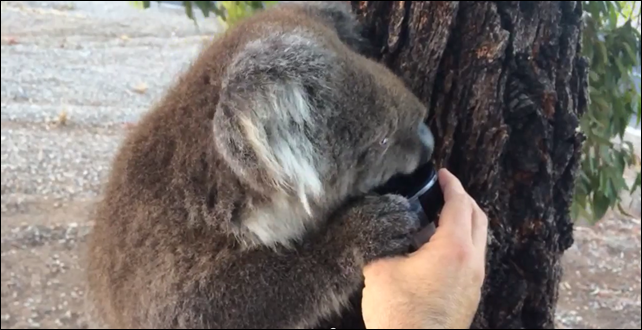
A desperate Koala in Adelaide Hills drinks water from a cup during Australia's drought, heat wave, and bushfires, 3 January 2015. Photo: abuckle / YouTube
"A scorching hot Summers morning and a heat stricken Koala not getting enough moisture from the drying Gum leaves. Many die throughout Summer here in Sth. Australia," writes Cook on YouTube. "I came across this little chap in a distressed state so I offered a helping hand from my water bottle and he drank … eagerly without hesitation."

The koala Cook encountered is far from the only one in need of a helping and.

YouTube user abuckle also uploaded a video of a thirsty koala freely accepting a drink from his place in the shade. […]

Sadly, if past wildfires in Australia are any indicator, this blaze could result in millions of animals lost — but even in the face of that unimaginable tragedy, hope remains that others can be saved. [more]