Showing posts with label iceberg. Show all posts

Friday, 18 December 2020

Tracking the largest iceberg on earth


The world’s largest iceberg is headed for South Georgia—and its wildlife

Scientists worry the iceberg could be a “taste of things to come” as Antarctica begins to warm.


National Geographic,

17 December, 2020


THE LARGEST ICEBERG on Earth is threatening to come to a halt soon in a pristine Antarctic wildlife sanctuary that’s home to penguins, seals, and a small population of endangered blue whales.


The iceberg, labeled A68, broke off from the Larsen C ice shelf on the east coast of the Antarctic Peninsula in 2017. It had been slowly inching north until this year, when an ocean current quickly propelled it into the Southern Atlantic Ocean. (Find out about how climate change is melting the Antarctic Peninsula.)


About 95 miles long and 30 miles wide at its widest point, the iceberg covers an area of roughly 1,500 square miles and extends 500 to 600 feet underwater. Satellite images show it is shaped like a closed hand with an index finger pointing forward.


Scientists expect the iceberg, currently about 31 miles from South Georgia, to either anchor in the shallow waters around the island or move past it in the coming days. Should it come to a halt, it’s also unclear how long the iceberg might stay intact and in place.


There’s always a chance it could shoot up north, or it could get grounded where it is for a period of time,” says Chris Readinger, the Antarctic lead analyst at the U.S. National Ice Center. “It looks like the highest probability is it would drift south of the island.”


Recent images, he says, show the iceberg is beginning to break apart, and scientists are eagerly watching to see what it does next.


We don’t have that much scientific information for icebergs like this,” says Geraint Tarling, an ecologist for the British Antarctic Survey. He describes A68’s genesis as a natural event, but says given the warming climate, particularly in the region that spawned the berg, it could be “a taste of things to come.”


The Antarctic Peninsula is one of the fastest warming regions on Earth, and the ice shelves along its eastern coast are breaking apart. The Larsen A ice shelf, near the northern tip of the peninsula, collapsed in 1995; its neighbor to the south, Larsen B, was caught on spectacular satellite images as it followed suit in 2002.


The Larsen C is the next ice shelf in line and by far the largest of the three. A large, deep crack appeared in 2010 and continued to grow until July 2017, when it broke off. The A68 iceberg was born—a chunk of ice the size of Delaware with a mass of about 10 percent of the shelf itself.


For most of 2017, the berg didn’t move much. But in 2018 it began drifting north and rotated several times, according to tracking records from Brigham Young University. Throughout 2019, it wandered north through Antarctica’s Weddell Sea until it was caught in the strong Antarctic Circumpolar Current, a counterclockwise ocean current that circles the continent.


Icebergs the size of A68 are so massive and extend so deeply into the sea that it often takes a sizable current to propel it forward. Throughout 2020, A68 chugged north and east, zigging and zagging and rotating occasionally—but advancing steadily closer to South Georgia.


It probably can’t get any closer,” says Readinger. “The ocean there is about 500 feet deep and the berg is about there [in depth].”


The iceberg could screech to a halt on the shallow underwater shelf that surrounds the island and not collide with dry land. Readinger notes that it’s in warmer waters than can sustain it and it’s likely already beginning to break apart.


There are little tiny bergs about a mile long spinning off of it,”” says Readinger. “I wouldn’t be surprised if a large piece breaks off and we name it A68d.”


Chunks of A68 have broken off in the past three years, named A68b and A68c.


It’s getting very close to grounding, which means it will hit the underwater shelf. If it does that, it will get stuck, or it will rotate around,” says David Long, director of the center for remote sensing at Brigham Young University, a lab that tracks iceberg movements. Long says it may hit “pointy end first,” which could cause it to break apart more quickly, and ocean currents could force the rest of the iceberg to pirouette north past South Georgia. He expects it to rotate around to the east before continuing north.


A taste of what’s to come?

Ice shelves like the Larsen C are the floating ends of glaciers on land. As the glacier flows out to sea, icebergs calve off the ocean-facing end of the ice shelf. In a world that isn’t warming, these natural processes can be in balance. The Larsen C has existed for at least 10,000 years.


Its collapse at the hand of global warming was first predicted more than 40 years ago—but that doesn’t mean global warming launched A68. “When you try to say something about climate change, you can’t say it about one event,” says Kelly Brunt, a geophysicist from the University of Maryland. “Climate change is a statistical game.”


The crew sailed for six days through some of the roughest ocean on the planet to reach the island of South Georgia in the South Atlantic Ocean.


But is it likely to send more icebergs toward South Georgia in the future?


About 90 percent of the icebergs that break off from all of Antarctica travel counterclockwise around the continent, hugging the coast, into the Weddell Sea; from there they drift north toward South Georgia, through a region that’s dubbed “iceberg alley.”


In 2002, Long tracked every berg he could identify from 1978 to the present. The result was an exponential increase in the number of them, seemingly an indication of climate change. But by tracing icebergs to their points of origin, he found that the increase he measured may have been part of a natural cycle of ice shelf growth and decay. So while it couldn’t be blamed on warming in the region with the data they had at the time, “It did not rule out that warming was contributing,” he says.


When the A68 calved from Larsen C in 2017, the British Antarctic Survey reached similar conclusions, saying climate change may have played a role, but the ice shelf’s natural life cycle was also a factor.


The collapse of Larsen B in 2002, however, demonstrated how a warming atmosphere can help bring that life cycle to a sudden end. Meltwater ponds formed on the surface of Larsen B, and water percolating down through the ice helped shatter the shelf into an armada of icebergs.


More recent work Long has done with scientists at the National Snow and Ice Data Center suggest that the ice shelves remaining on the Antarctic Peninsula may be very vulnerable to that “hydrofracture” mechanism. Based on that, Long says, “We could expect more icebergs as warming continues.”


How many will make it as far as South Georgia is another matter. Even if icebergs do become more common in the region, country-size ones like A68 may remain rare. Since the 1970s, Readinger says the number of such giants in iceberg alley hasn’t measurably increased or decreased.


And smaller bergs tend to break apart before reaching the area around South Georgia.


They have to be pretty big to get all the way [to South Georgia],” says Long. “It’s hard to know whether there will be an increase.”


A threat to wildlife


For now, A68 poses a large threat to the region’s wildlife and marine biodiversity.


Large icebergs with deep keels “scour the seabeds,” explains Tarling. “What’s really important about South Georgia is that it’s incredibly diverse on the seabeds. It’s a diversity almost equivalent to the Galapagos.”


On the seabeds surrounding South Georgia, scientists have found abundant communities of brittle stars, urchins, worms, and sponges. They’re also home to an abundance of fish and Antarctic krill, an essential part of a food chain that feeds seals, penguins, and a number of whale species.


The region’s charismatic penguins and seals will also suffer if the iceberg grounds in place, because it would create a wall between land and their feeding grounds at the edge of the coastal shelf.


It’s a really important time in the life cycle when the adults are bringing up chicks and pups and need to make small, frequent journeys out to feeding areas,” says Tarling.


He notes that even if the iceberg breaks apart, the resulting fleet of little bergs could still block the animals’ foraging paths.


A68, which contains hundreds of millions of tons of freshwater, will ultimately melt, making living conditions harder for creatures such as algae and plankton that have adapted to living in saltwater.


In late January, a team of scientists led by the British Antarctic Survey will depart from the Falkland Islands to the iceberg to study its effects on the ecosystem. The information will be crucial to understanding how the ecosystem will change if warming results in more icebergs in the future.

Monday, 7 December 2020

Iceberg is on collision course with South Georgia

We have been watching this iceberg since it broke off from Larsen C Ice Shelf in 2017


A68 iceberg on collision path with South Georgia


BBC,

4 November, 2020


The world's biggest iceberg, known as A68a, is bearing down on the British Overseas Territory of South Georgia.


The Antarctic ice giant is a similar size to the South Atlantic island, and there's a strong possibility the berg could now ground and anchor itself offshore of the wildlife haven.


If that happens, it poses a grave threat to local penguins and seals.


The animals' normal foraging routes could be blocked, preventing them from feeding their young properly.


And it goes without saying that all creatures living on the seafloor would be crushed where A68a touched down - a disturbance that would take a very long time to reverse.


"Ecosystems can and will bounce back of course, but there's a danger here that if this iceberg gets stuck, it could be there for 10 years," said Prof Geraint Tarling from the British Antarctic Survey (BAS).


"And that would make a very big difference, not just to the ecosystem of South Georgia but its economy as well," he told BBC News.


The British Overseas Territory is something of a graveyard for Antarctica's greatest icebergs.


These tabular behemoths get drawn up from the White Continent on strong currents, only for their keels to then catch in the shallows of the continental shelf that surrounds the remote island.


Time and time again, it happens. Huge ice sculptures slowly withering in sight of the land.


A68a - which has the look of a hand with a pointing finger - has been riding this "iceberg alley" since breaking free from Antarctica in mid-2017. It's now just a few hundred km to the southwest of the BOT.


Roughly the size of the English county of Somerset (4,200 sq km), the berg weighs hundreds of billions of tonnes. But its relative thinness (a submerged depth of perhaps 200m or less) means it has the potential to drift right up to South Georgia's coast before anchoring.


"A close-in iceberg has massive implications for where land-based predators might be able to forage," explained Prof Tarling.


"When you're talking about penguins and seals during the period that's really crucial to them - during pup- and chick-rearing - the actual distance they have to travel to find food (fish and krill) really matters. If they have to do a big detour, it means they're not going to get back to their young in time to prevent them starving to death in the interim."


When the colossus A38 grounded at South Georgia in 2004, countless dead penguin chicks and seal pups were found on local beaches.


The BAS researcher is in the process of trying to organise the resources to study A68a at South Georgia, should it do its worst and ground in one of the key productive areas for wildlife and the local fishing industry.


The potential impacts are multi-faceted - and not all negative, he stresses.


For example, icebergs bring with them enormous quantities of dust that will fertilise the ocean plankton around them, and this benefit will then cascade up the food chain.


Although satellite imagery suggests A68a is on a direct path for South Georgia, it might yet escape capture. Anything is possible, says BAS remote-sensing and mapping specialist Dr Peter Fretwell.


"The currents should take it on what looks like a strange loop around the south end of South Georgia, before then spinning it along the edge of the continental shelf and back off to the northwest. But it's very difficult to say precisely what will happen," he told BBC News.


Colleague Dr Andrew Fleming said a request was going into the European Space Agency for more satellite imagery, particularly from its pair of Sentinel-1 radar spacecraft.


These imagers work at wavelengths that allow them to see through cloud, meaning they can track the iceberg no matter what the weather conditions are like.


"A68a is spectacular," Dr Fleming said. "The idea that it is still in one large piece is actually remarkable, particularly given the huge fractures you see running through it in the radar imagery. I'd fully expected it to have broken apart by now.


"If it spins around South Georgia and heads on northwards, it should start breaking up. It will very quickly get into warmer waters, and wave action especially will start killing it off."


South Georgia is best known because of Sir Ernest 

Shackelton's expedition of 1916


https://youngadventuress.com/2018/03/shackleton-south-georgia.html

Tuesday, 1 October 2019

1636 km2 iceberg calces off Amery Ice Shelf in Antarctica


Meanwhile Radio NZ is too busy going after "hate speech" that they neglected to report on this.

Sorry, folks it does not fit their agenda even if the world media reports on it


Massive iceberg breaks off 

Antarctic ice sheet


1 October, 2019


One of the biggest icebergs recorded has broken away from an Antarctica.


The massive block of ice - covering 1636 square kilometres - calved from the Amery Ice Shelf, the BBC reported.


The iceberg, named D28, was estimated to weigh 315 billion tonnes.


It had shown massive cracks for years before breaking free.


The block of ice was so large it would have to be monitored to ensure the safety of shipping, the BBC said.

one trillion tonne iceberg broke off from Antarctica's Larsen C Ice Shelf in 2017.

The calving of the estimated 6000 square kilometre block of ice reduced that ice shelf's area by more than 12 per cent.


Sunday, 18 November 2018

Signs from Down-Under

I was hoping today (Sunday) completely off but by evening information was flooding in and I have a feeling of extreme anxiety and dread in my chest


Rapid changes in New Zealand

I have been commenting a lot on how much cooler the Tasman Sea has been compared with last year (apart from close to the Australian coast)

I received the following photo from a friend this evening with the comment:

This doesn't look good. 2.7 - 4.5 C above normal in the Tasman


Being somewhat sceptical that things could change so quickly I decided to check for myself. Sure enough.


Pam and I went out for an early evening drive and we were commenting on how "normal" the skies seemed.

But then we got out of the car to see this.

By the time we got back home to get the camera it had all slightly dissipated and looked like this.


When I posted this on Facebook I got the following message:
" Yep.... that's how it started in California too. Wait until you start seeing all the rainbow colors in the clouds and the sundogs regularly."

I don't know anout "sundogs" but I know about rainbow colours.
As if on cue....
 

MetService meteorologist Tui McInnes said the rainbow was in fact a phenomena called a Circumhorizontal Arc.

"Basically what happens is sunlight enters the cloud and ice crystals in the cloud refract the light and form a rainbow," she said.

"It isn't a necessarily rare phenomenon, however the person observing it has to be standing in the right place at the right time.

"The sun needs to be behind them in order to see the refracted light, and of course you have to have colder clouds that contain ice crystals mixed in with some sunny spells!"

You see! It's got a name so is quite natural!
 
And then, what is this?!!

Silly comment of the day:

"That is so weird, they need to name it so that we don't speculate and start a darn conspiracy theory."
****
Meanwhile, a large tornado ripped through South Canterbury.

It may seem like nothing to Americans but this is totally unprecedented for South Canterbury


..

Video sent to 1 NEWS shows the large funnel of dirt sweeping across farmland just south of Rakaia.

Lily Tworogal, who took one of the videos, says she has never seen anything like it.

Certainly not in New Zealand!” she says.

She was driving north to Christchurch on a family trip when she and her father spotted the tornado.

First it was a swirl of dust and then just grew bigger and bigger,” she says.

***

Meanwhile in Antarctica

Looks like the sea ice holding iceberg A68 is melting fast!


From NASA Worldview 11/17/18


Wednesday, 31 October 2018

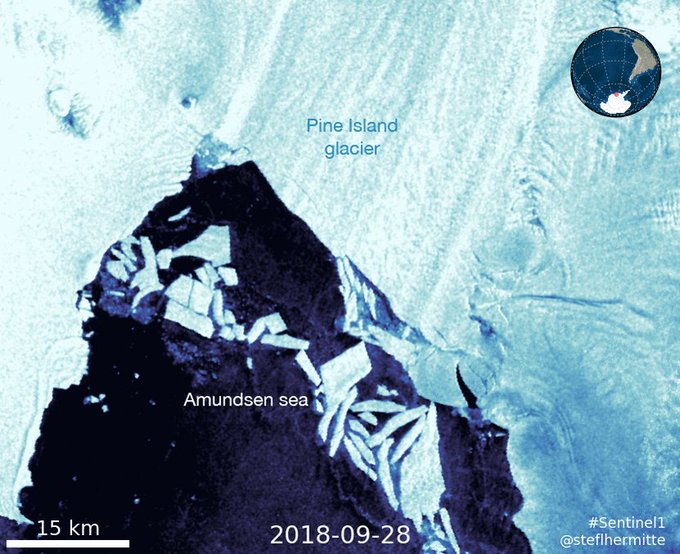
Iceberg breaks of Pine Island Glacier in Antarctica


Huge Antarctic iceberg breaks off Pine Island Glacier

Pine Island Glacier calving front seen in 2016.

The calving front of the Pine Island Glacier, seen by a NASA aircraft in 2016. Image: NASA IceBridge.


30 October, 2018


An iceberg about five times the size of Manhattan has broken off the Pine Island Glacier in West Antarctica over the past 24 hours, an ominous sign of the continued retreat of this fast-flowing mass of ice. Like many other marine terminating glaciers in Antarctica, this glacier is retreating over time, and increasing the movement of ice into the sea.

Why it matters: While this iceberg itself is not record-breaking — it ranks as the sixth-largest iceberg to break off the Pine Island Glacier since 2001 — it illustrates the continued instability of marine-terminating glaciers in parts of the icebound continent.

The details: The iceberg had first appeared as a rift across Pine Island Glacier in September, before leading to the calving of about 300 square kilometers, or 116 square miles, of ice. The largest individual iceberg measures about 226 square kilometers in area, or 87 square miles.


shows the rapid evolution from a rift across Pine Island Glacier in September to the calving of ~300km² of icebergs end of October, where the largest iceberg (226km²) will be named B-46 by NIC @CopernicusEU 1/2
In early 2000 large PIG calving events happened every ~5 yrs (2001, 2007, 2011), but since 2013 there were 4 of them (2013, 2015, 2017, 2018). Consequently, the glacier front retreated strongly from the 1972-2013 range and it is now ~5km further inland than in 2015-2017 2/2 pic.twitter.com/8O7gPyQAmh
Stef Lhermitte, a geoscientist at the Netherlands' Delft University of Technology who closely tracks Antarctic ice, tweeted that the glacier front, where the ice meets the sea, has now receded by about 5 kilometers, or close to a mile inland compared to recent decades.

Ice shelves, such as the one at the Pine Island Glacier, act like door stops to the land-based ice behind it. Once they diminish, due to a combination of warming from the ocean below and air temperatures above, it's more likely that inland ice will collapse into the sea, raising global sea levels.

Determining the amount of future ice loss from Antarctica is the biggest source of uncertainty in sea level rise projections, but recent studies have suggested that Antarctic ice melt is likely to be at the higher end of the scale.

  • Recent research published in Nature Climate Change, found that "ice losses from Antarctica have accelerated during the past 25 years," and that 40% of the continent's sea level rise contribution has occurred during just the past 5 years.


  • Antarctica lost 1,883 billion tons of ice between 2007 and 2017, which was significantly higher than scientists estimated in a seminal report published in 2013.


The bottom line: The new iceberg is significant for reflecting trends taking place around Antarctica, which many climate scientists find worrisome.


Sunday, 21 October 2018

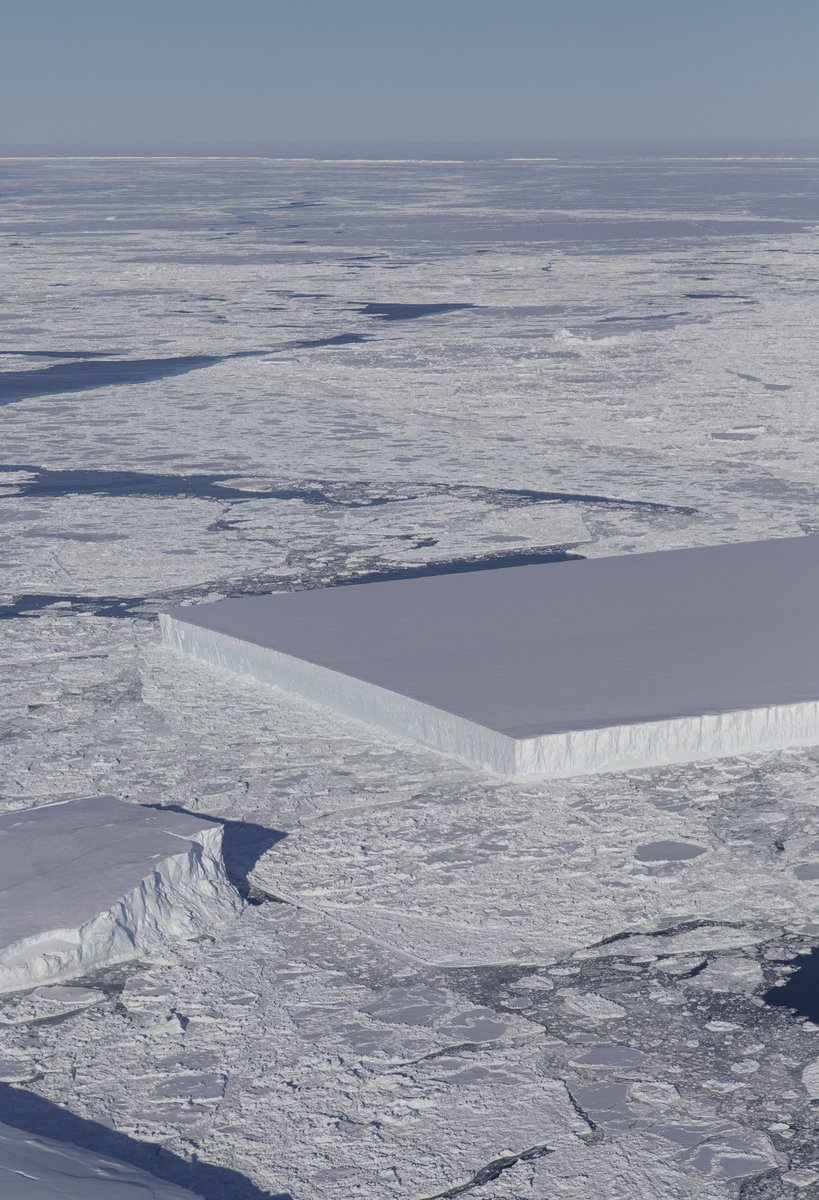
A perfectly square tabular iceberg - a natural phenomenon?


"What makes this one a bit unusual is that it looks almost like a square,"


 Icebergs these days are perfectly square...yeah right! We are being asked to believe anything these days


NASA finds almost perfectly square tabular iceberg


21 October, 2018

NASA has confused a lot of people on social media with pictures of an almost perfectly square iceberg in Antarctica, but there's one very easy explanation.

The photo was posted on Twitter, and many suggested its straight edges may not necessarily have come from nature.

Several people suggested the iceberg was man-made, while others believed it could have been created by aliens.

But it turns out, at least according to ice scientist Kelly Brunt from the University of Maryland, some icebergs are just made like that.

"We get two types of icebergs: We get the type that everyone can envision in their head that sank the Titanic, and they look like prisms or triangles at the surface and you know they have a crazy subsurface. And then you have what are called 'tabular icebergs,'" she told LiveScience.

Tabular icebergs form long, flat and straight and break off at the end.

"What makes this one a bit unusual is that it looks almost like a square," Dr Brunt said.

She told LiveScience the iceberg would have formed recently and is likely more than 1.6km across. She warned against wandering about on it though.

It's too big to flip over, but it could certainly crack up and disintegrate at any moment.

Here is a large iceberg that has broken off Larsen C ice shelf.Is there another one that is perfectly square??