Showing posts with label Larsen C. Show all posts

Friday, 18 December 2020

Tracking the largest iceberg on earth


The world’s largest iceberg is headed for South Georgia—and its wildlife

Scientists worry the iceberg could be a “taste of things to come” as Antarctica begins to warm.


National Geographic,

17 December, 2020


THE LARGEST ICEBERG on Earth is threatening to come to a halt soon in a pristine Antarctic wildlife sanctuary that’s home to penguins, seals, and a small population of endangered blue whales.


The iceberg, labeled A68, broke off from the Larsen C ice shelf on the east coast of the Antarctic Peninsula in 2017. It had been slowly inching north until this year, when an ocean current quickly propelled it into the Southern Atlantic Ocean. (Find out about how climate change is melting the Antarctic Peninsula.)


About 95 miles long and 30 miles wide at its widest point, the iceberg covers an area of roughly 1,500 square miles and extends 500 to 600 feet underwater. Satellite images show it is shaped like a closed hand with an index finger pointing forward.


Scientists expect the iceberg, currently about 31 miles from South Georgia, to either anchor in the shallow waters around the island or move past it in the coming days. Should it come to a halt, it’s also unclear how long the iceberg might stay intact and in place.


There’s always a chance it could shoot up north, or it could get grounded where it is for a period of time,” says Chris Readinger, the Antarctic lead analyst at the U.S. National Ice Center. “It looks like the highest probability is it would drift south of the island.”


Recent images, he says, show the iceberg is beginning to break apart, and scientists are eagerly watching to see what it does next.


We don’t have that much scientific information for icebergs like this,” says Geraint Tarling, an ecologist for the British Antarctic Survey. He describes A68’s genesis as a natural event, but says given the warming climate, particularly in the region that spawned the berg, it could be “a taste of things to come.”


The Antarctic Peninsula is one of the fastest warming regions on Earth, and the ice shelves along its eastern coast are breaking apart. The Larsen A ice shelf, near the northern tip of the peninsula, collapsed in 1995; its neighbor to the south, Larsen B, was caught on spectacular satellite images as it followed suit in 2002.


The Larsen C is the next ice shelf in line and by far the largest of the three. A large, deep crack appeared in 2010 and continued to grow until July 2017, when it broke off. The A68 iceberg was born—a chunk of ice the size of Delaware with a mass of about 10 percent of the shelf itself.


For most of 2017, the berg didn’t move much. But in 2018 it began drifting north and rotated several times, according to tracking records from Brigham Young University. Throughout 2019, it wandered north through Antarctica’s Weddell Sea until it was caught in the strong Antarctic Circumpolar Current, a counterclockwise ocean current that circles the continent.


Icebergs the size of A68 are so massive and extend so deeply into the sea that it often takes a sizable current to propel it forward. Throughout 2020, A68 chugged north and east, zigging and zagging and rotating occasionally—but advancing steadily closer to South Georgia.


It probably can’t get any closer,” says Readinger. “The ocean there is about 500 feet deep and the berg is about there [in depth].”


The iceberg could screech to a halt on the shallow underwater shelf that surrounds the island and not collide with dry land. Readinger notes that it’s in warmer waters than can sustain it and it’s likely already beginning to break apart.


There are little tiny bergs about a mile long spinning off of it,”” says Readinger. “I wouldn’t be surprised if a large piece breaks off and we name it A68d.”


Chunks of A68 have broken off in the past three years, named A68b and A68c.


It’s getting very close to grounding, which means it will hit the underwater shelf. If it does that, it will get stuck, or it will rotate around,” says David Long, director of the center for remote sensing at Brigham Young University, a lab that tracks iceberg movements. Long says it may hit “pointy end first,” which could cause it to break apart more quickly, and ocean currents could force the rest of the iceberg to pirouette north past South Georgia. He expects it to rotate around to the east before continuing north.


A taste of what’s to come?

Ice shelves like the Larsen C are the floating ends of glaciers on land. As the glacier flows out to sea, icebergs calve off the ocean-facing end of the ice shelf. In a world that isn’t warming, these natural processes can be in balance. The Larsen C has existed for at least 10,000 years.


Its collapse at the hand of global warming was first predicted more than 40 years ago—but that doesn’t mean global warming launched A68. “When you try to say something about climate change, you can’t say it about one event,” says Kelly Brunt, a geophysicist from the University of Maryland. “Climate change is a statistical game.”


The crew sailed for six days through some of the roughest ocean on the planet to reach the island of South Georgia in the South Atlantic Ocean.


But is it likely to send more icebergs toward South Georgia in the future?


About 90 percent of the icebergs that break off from all of Antarctica travel counterclockwise around the continent, hugging the coast, into the Weddell Sea; from there they drift north toward South Georgia, through a region that’s dubbed “iceberg alley.”


In 2002, Long tracked every berg he could identify from 1978 to the present. The result was an exponential increase in the number of them, seemingly an indication of climate change. But by tracing icebergs to their points of origin, he found that the increase he measured may have been part of a natural cycle of ice shelf growth and decay. So while it couldn’t be blamed on warming in the region with the data they had at the time, “It did not rule out that warming was contributing,” he says.


When the A68 calved from Larsen C in 2017, the British Antarctic Survey reached similar conclusions, saying climate change may have played a role, but the ice shelf’s natural life cycle was also a factor.


The collapse of Larsen B in 2002, however, demonstrated how a warming atmosphere can help bring that life cycle to a sudden end. Meltwater ponds formed on the surface of Larsen B, and water percolating down through the ice helped shatter the shelf into an armada of icebergs.


More recent work Long has done with scientists at the National Snow and Ice Data Center suggest that the ice shelves remaining on the Antarctic Peninsula may be very vulnerable to that “hydrofracture” mechanism. Based on that, Long says, “We could expect more icebergs as warming continues.”


How many will make it as far as South Georgia is another matter. Even if icebergs do become more common in the region, country-size ones like A68 may remain rare. Since the 1970s, Readinger says the number of such giants in iceberg alley hasn’t measurably increased or decreased.


And smaller bergs tend to break apart before reaching the area around South Georgia.


They have to be pretty big to get all the way [to South Georgia],” says Long. “It’s hard to know whether there will be an increase.”


A threat to wildlife


For now, A68 poses a large threat to the region’s wildlife and marine biodiversity.


Large icebergs with deep keels “scour the seabeds,” explains Tarling. “What’s really important about South Georgia is that it’s incredibly diverse on the seabeds. It’s a diversity almost equivalent to the Galapagos.”


On the seabeds surrounding South Georgia, scientists have found abundant communities of brittle stars, urchins, worms, and sponges. They’re also home to an abundance of fish and Antarctic krill, an essential part of a food chain that feeds seals, penguins, and a number of whale species.


The region’s charismatic penguins and seals will also suffer if the iceberg grounds in place, because it would create a wall between land and their feeding grounds at the edge of the coastal shelf.


It’s a really important time in the life cycle when the adults are bringing up chicks and pups and need to make small, frequent journeys out to feeding areas,” says Tarling.


He notes that even if the iceberg breaks apart, the resulting fleet of little bergs could still block the animals’ foraging paths.


A68, which contains hundreds of millions of tons of freshwater, will ultimately melt, making living conditions harder for creatures such as algae and plankton that have adapted to living in saltwater.


In late January, a team of scientists led by the British Antarctic Survey will depart from the Falkland Islands to the iceberg to study its effects on the ecosystem. The information will be crucial to understanding how the ecosystem will change if warming results in more icebergs in the future.

Monday, 7 December 2020

Iceberg is on collision course with South Georgia

We have been watching this iceberg since it broke off from Larsen C Ice Shelf in 2017


A68 iceberg on collision path with South Georgia


BBC,

4 November, 2020


The world's biggest iceberg, known as A68a, is bearing down on the British Overseas Territory of South Georgia.


The Antarctic ice giant is a similar size to the South Atlantic island, and there's a strong possibility the berg could now ground and anchor itself offshore of the wildlife haven.


If that happens, it poses a grave threat to local penguins and seals.


The animals' normal foraging routes could be blocked, preventing them from feeding their young properly.


And it goes without saying that all creatures living on the seafloor would be crushed where A68a touched down - a disturbance that would take a very long time to reverse.


"Ecosystems can and will bounce back of course, but there's a danger here that if this iceberg gets stuck, it could be there for 10 years," said Prof Geraint Tarling from the British Antarctic Survey (BAS).


"And that would make a very big difference, not just to the ecosystem of South Georgia but its economy as well," he told BBC News.


The British Overseas Territory is something of a graveyard for Antarctica's greatest icebergs.


These tabular behemoths get drawn up from the White Continent on strong currents, only for their keels to then catch in the shallows of the continental shelf that surrounds the remote island.


Time and time again, it happens. Huge ice sculptures slowly withering in sight of the land.


A68a - which has the look of a hand with a pointing finger - has been riding this "iceberg alley" since breaking free from Antarctica in mid-2017. It's now just a few hundred km to the southwest of the BOT.


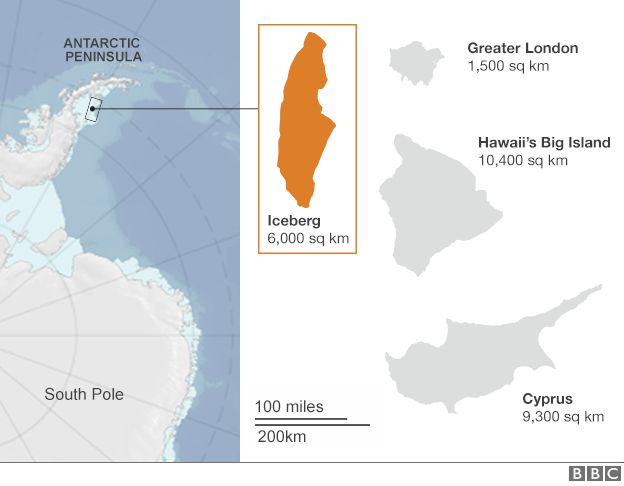
Roughly the size of the English county of Somerset (4,200 sq km), the berg weighs hundreds of billions of tonnes. But its relative thinness (a submerged depth of perhaps 200m or less) means it has the potential to drift right up to South Georgia's coast before anchoring.


"A close-in iceberg has massive implications for where land-based predators might be able to forage," explained Prof Tarling.


"When you're talking about penguins and seals during the period that's really crucial to them - during pup- and chick-rearing - the actual distance they have to travel to find food (fish and krill) really matters. If they have to do a big detour, it means they're not going to get back to their young in time to prevent them starving to death in the interim."


When the colossus A38 grounded at South Georgia in 2004, countless dead penguin chicks and seal pups were found on local beaches.


The BAS researcher is in the process of trying to organise the resources to study A68a at South Georgia, should it do its worst and ground in one of the key productive areas for wildlife and the local fishing industry.


The potential impacts are multi-faceted - and not all negative, he stresses.


For example, icebergs bring with them enormous quantities of dust that will fertilise the ocean plankton around them, and this benefit will then cascade up the food chain.


Although satellite imagery suggests A68a is on a direct path for South Georgia, it might yet escape capture. Anything is possible, says BAS remote-sensing and mapping specialist Dr Peter Fretwell.


"The currents should take it on what looks like a strange loop around the south end of South Georgia, before then spinning it along the edge of the continental shelf and back off to the northwest. But it's very difficult to say precisely what will happen," he told BBC News.


Colleague Dr Andrew Fleming said a request was going into the European Space Agency for more satellite imagery, particularly from its pair of Sentinel-1 radar spacecraft.


These imagers work at wavelengths that allow them to see through cloud, meaning they can track the iceberg no matter what the weather conditions are like.


"A68a is spectacular," Dr Fleming said. "The idea that it is still in one large piece is actually remarkable, particularly given the huge fractures you see running through it in the radar imagery. I'd fully expected it to have broken apart by now.


"If it spins around South Georgia and heads on northwards, it should start breaking up. It will very quickly get into warmer waters, and wave action especially will start killing it off."


South Georgia is best known because of Sir Ernest 

Shackelton's expedition of 1916


https://youngadventuress.com/2018/03/shackleton-south-georgia.html

Monday, 1 October 2018

Antarctica update - 10/01/2018

Antarctica today - 10/01/2018


The break-off from Larsen C is on the move and there Is ice melt on the other side of the Antarctic peninsula


Ozone levels


Saturday, 15 September 2018

A report from the Antarctic - 09/15/2018

Antarctic Sea Ice Extent Hits New Record Low


Today  Robert Fanney reported that Antarctic Sea Ice Extent Hits New Record Low for the Day. 

Margo has also done an exhaustive report in which she talks at length about the situation in Antarctica.


This is in addition to a report that I did a couple of weeks ago - 


Today’s news comes at a time when the sun is just starting to return to the continent and the South Pole is still in darkness.


The following,which comes from Zack Labe shows the global sea ice anomaly.

The purple represents Antarctica.


This is the sea ice extent for Antarctica on 13 September.


Here is the sea ice concentration.


And here is the thickness for 14 September as registered by the US Navy.


And a .gif showing changes in the last 30 days.


THE HOLE IN THE OZONE LAYER

The hole in the ozone layer, that we are all told is healing should reach its maximum size in the Antarctic winter.

However, this short video shows that this is not happening and it appears to be getting bigger.

We shall be monitoring this over the next weeks and months.


Iceberg A68A, that broke off from Larsen B a year ago is on the move


A year ago, in July 2017 a large iceberg calved off the Larsen C ice shelf

Satellite data confirms ‘calving’ of trillion-tonne, 5,800 sq km iceberg from the Larsen C ice shelf, dramatically altering the landscape.


It became stuck and has remained so since then to the last week or so.
Here are couple of stories that came out about this.


Just over a year ago in July 2017 iceberg A68 calved from the Larsen C Ice Shelf. 

I appeared on BBC News before it actually calved explaining what was happening.

At first A68 was slow to move and as I predicted back then, it likely got stuck on the sea bed (we say "grounded"). It has stayed pretty much in the same place through to July 2018.

But now A68 has started to swing northwards.

As the light is coming back to Antarctica, at high latitudes visual imagery is very washed out. But if we look at other data such as the brightness temperature, you can see some striking features.


Margo has been monitoring this recently from NASA Worldview and put together the following report:


The area has mostly been in thick cloud but the next two photographs show the changes over a day.


Fracturing of sea ice in the Ross Sea

To further illustrate the rapid deterioration of ice in the Antarctica while the sun is only just returning to the region this photo from today of an area in the Ross Sea, to the south of New Zealand and not far from the coast shows fractures in the sea ice.

US Navy data indicates that ice in the region is about a metre thick.


My suspicion is that this melt season in Antarctica is going to be a rocky ride.

Monday, 10 September 2018

On the Larsen ice sheets in Antactictica

Meet the Larsens: The Story of a Happy Ice Shelf Family Torn Apart by Abrupt Climate Change


Margo's Healing Corner

 Margo tells the story of the break-up of the Larsen Ice Shelves in the Antarctic.

Time is short.

Get your spiritual houses in order.

God bless everyone! 
 
Peace, Margo


Show Links:


Sunday, 24 September 2017

Giant Antarctic iceberg head out to sea

Where have you seen this reported apart from here?

Of course, I realise it pales into significance compared with the NZ election results and your morning latte.

Big Antarctic iceberg edges out to sea


BBC,
22 September, 2017

The giant berg A-68 looks finally to be on the move.
Recent weeks have seen it shuffle back and forth next to the Antarctic ice shelf from which it broke away.
But the latest satellite imagery now indicates the near-6,000 sq km block is swinging out into the Weddell Sea.
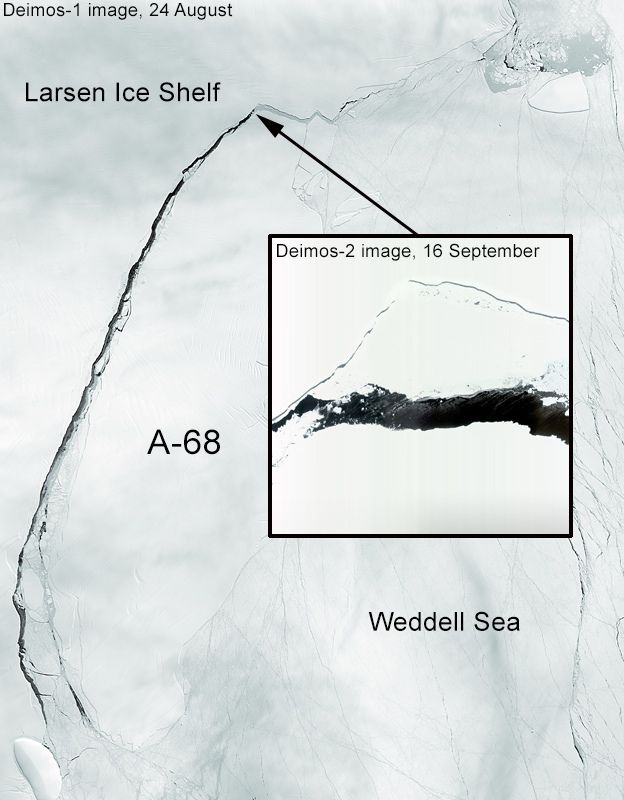
A wide stretch of clear water has opened up between the berg's southern end and the remaining Larsen shelf structure, suggesting A-68 is set to swing around and head north.
"Iceberg size
This is the direction the Weddell currents should take the iceberg.
Polar experts expect the trillion-tonne block to essentially bump along the shelf edge until it reaches the great eastward movement of ocean water known as the Antarctic Circumpolar Current.
This would then export what is one of the largest bergs ever recorded out into the South Atlantic.
How far A-68 actually gets along this predicted path is anyone's guess, however. The berg already shows evidence of fragmentation at its edges.
These bits - they carry the designation A-68b, A-68c, etc - all still float close to their parent. But in time they will get separated, and it is entirely possible that big segments with deep keels could get anchored in shallow waters and become semi-permanent "ice islands".
A-68 calved during mid-winter and it required radar satellites - such as Europe's Sentinel-1 spacecraft - with their unique ability to pierce cloud and darkness to keep track of developments.
With the return now to longer days in the Antarctic, opportunities are increasingly opening up for high-resolution optical satellites to take a close look at the state of the berg.
And new imagery from the Spanish Deimos-2 spacecraft shows how the initial sharp edges of the block's northern-western corner have been lost.

A-68


Scientists are not just looking at the berg; they also continue to monitor the Larsen Ice Shelf.
They are checking to see if its behaviour has changed since the calving.
The shelf is the floating protrusion of glaciers coming off the Antarctic landmass, and the ejection of such a large section of its structure could potentially trigger further fracturing or a change in the speed of ice flow.
So far, however, there is little evidence of either.
When A-68 moves clear of its birth position it will reveal seafloor that probably has not been free of ice cover for 120,000 years - during the peak of the last warm phase in Earth's history known as the Eemian.
The area has already gained protected status from the Commission for the Conservation of Antarctic Marine Living Resources (CCAMLR).
This gives scientists priority access and keeps fisheries activity at bay for a minimum of two years.
Previous research in locations uncovered by departing bergs has found new species.
Expeditions to visit A-68 this coming Antarctic summer season are in the planning stage.