World food prices rose in January for the eighth consecutive month, led by cereals, vegetable oils and sugar, according to a report by the Food and Agriculture Organization (FAO) of the United Nations.
The FAO said that its food price index marked a 4.3 percent increase from December, reaching its highest level since July 2014. The index tracks monthly changes in the international prices of commonly traded food commodities.
The cereal price index showed a sharp 7.1 percent monthly increase led by a global surge in the price of maize, the crop North Americans call corn.
Maize prices spiked 11.2 percent and are now 42.3 percent above their January 2020 level, “reflecting increasingly tight global supply amid substantial purchases by China and lower-than-expected production and stock estimates in the United States of America as well as a temporary suspension of maize export registrations in Argentina.”
The report also said wheat rose 6.8 percent driven by strong global demand and expectations of reduced sales by Russia when its wheat export duty doubles in March 2021. Robust demand for rice from Asian and African buyers underpinned strong price growth for that crop.
January vegetable oil sold for 5.8 percent more than December, hitting its highest price since May 2012. Drivers included lower-than-expected palm oil production in Indonesia and Malaysia "due to excessive rainfall and ongoing shortages in the migrant labor force, and prolonged strikes in Argentina reducing export availability for soy oil.”
The sugar price index was 8.1 percent higher than in December as robust global import demand spurred concerns about lower availabilities due to worsening crop prospects in the European Union, Russia and Thailand, as well as drier-than-normal weather conditions in South America. The FAO said the dairy price index also jumped by 1.6 percent, underpinned by China's high purchases ahead of the country's upcoming New Year holiday festivities amid seasonally lower exportable supplies in New Zealand.
The meat price index’s 1.0 percent increase from December was led by “brisk global imports of poultry meat, especially from Brazil, amid avian influenza outbreaks that have constrained output and exports from several European countries,” said the report.
Fruit and vegetable prices set to skyrocket in Australia due to labour shortage | 7NEWS
Coronavirus is affecting food prices with fears of a 25 per cent hike in fresh fruit and vegetables over summer. The problem is travel restrictions cutting off seasonal harvest crews with the NSW industry alone short some 90,000 workers.
Hunger in US | 'Everybody's
just worried about their next
meal'
#Hunger in the #UnitedStates is up markedly this year. Feeding America says the number of people seeking help at its food banks nationwide has increased an average of 60% since the pandemic began. Four out of every 10 people have never set foot in a pantry until now.
Feeding America's own 181 food banks have distributed 1.6 billion pounds of food per quarter in the pandemic, compared with roughly 1 billion before.
The AP's hunger project included a portrait series with pantry patrons across the country — several of them first-timers who've fallen on hard times.
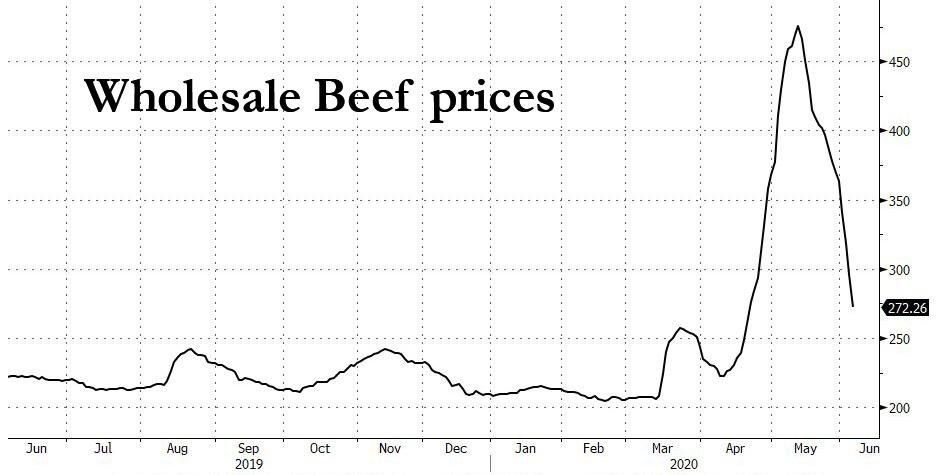
First the good news: after soaring to record highs one month ago due to widespread shutdowns of meat processing plants and supply chain impairments, wholesale beef prices have tumbled sharply and are just barely higher than where they were before the coronavirus pandemic struck.
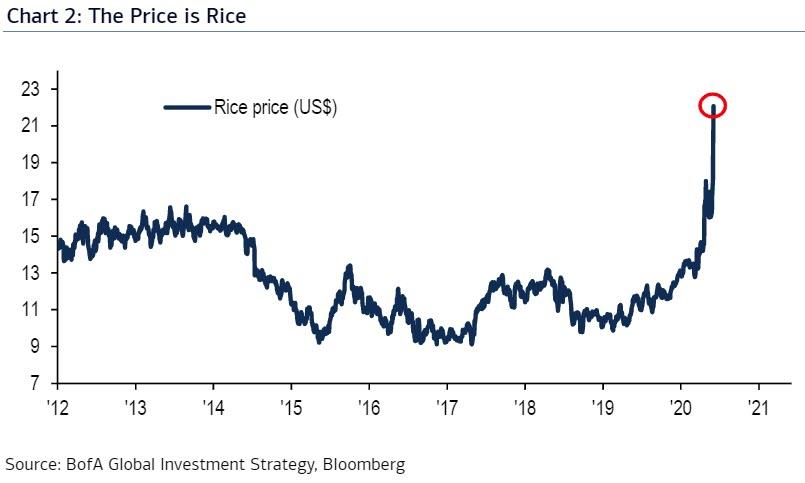
Now the not so good news: as Bank of America's Michael Hartnett notes in his Flow Show today, while beef may be affordable again, rice - the staple food for half of world's population - is becoming increasingly unaffordable, "surging 70% since Jan on COVID-19 labor supply chain hit & stockpiling."
Should rice prices not revert to normal and soon, how long before the protests, riots and looting that are currently sweeping the US and various European countries spread across the entire world, this time over a far more tangible cause: hunger. As a reminder, it was the surge in food prices in late 2010 and early 2011 that precipitated the Arab Spring protests that toppled numerous political regimes and eventually culminated with the mass exodus of migrants from northern Africa and the middle east toward Europe.
Food
prices are climbing fast in the world's biggest emerging markets,
posing a possible inflation threat after months of dormant pressures.
Asia's
two largest developing economies face a price surge for staple
products -- pork in China and onions in India -- that are central to
consumers' diets. In Turkey and Nigeria, supply problems are driving
up costs, while United Nations data show global food prices rose at
the fastest pace in October in more than two years.
While
the spike is painful for poorer consumers, it hasn't reached a level
to convince central banks to pull the brake on policy easing, as they
remain focused on boosting economic growth amid a global slowdown.
Average inflation across emerging markets is still at an all-time
low, according to a Bloomberg gauge of consumer price indexes.
"We
think it's likely they would look through food inflation that is
concentrated on a handful of products and driven by idiosyncratic
factors," said Taimur Baig, managing director and chief
economist at DBS Bank Ltd. in Singapore. "Bias toward further
monetary and fiscal easing will remain in 2020, in our view."
Price
Shock
Nevertheless,
the threat of a price shock is real. Nomura Holdings Inc. economists
recently warned of three potential triggers of higher food costs --
weather-related shocks, higher oil prices and a sharp depreciation in
the dollar -- saying emerging and frontier markets are most at risk
since food costs make up a larger portion of their consumers' income.
The
key will be whether the increases begin to feed into consumers'
longer-term inflation expectations, which could drive up wages and
core inflation in a spiral, said Sonal Varma, Nomura's chief
economist for India and Asia ex-Japan.
"This
is a big policy dilemma for central banks, to have supply-side driven
higher food inflation while growth is weakening," Varma said.
"The question is: Do central banks believe that this is durable
or that it's transitory?"
Here's
how the phenomenon is playing out in key emerging markets:
China
Pork
prices doubled in October following massive livestock culls to
protect against swine fever, pushing up consumer inflation to 3.8%,
the highest level since January 2012. Though pork prices have since
come off their recent highs, economists expect inflation to peak at
5% or 6% in January. Inflation at that level could impede central
bank efforts to ease monetary policy and boost an economy amid an
ongoing trade war and weak domestic demand.
In
the meantime, swine fever is jumping borders, with neighboring
Vietnam culling almost 6 million pigs to prevent the spread of the
disease. It hasn't showed up yet in Vietnam's CPI -- partly because
high food prices a year ago have skewed the statistical base -- but
the impact likely will be reflected in coming months, said Alex
Holmes, an Asia economist at Capital Economics Ltd. in Singapore.
Live pig prices in November are up almost 30% from a year earlier,
according to an industry group.
India
In
India, where spikes in the cost of onions have sparked social unrest
in years past, a 26% year-on-year rise in vegetable prices pushed
October headline inflation above the Reserve Bank's threshold of 4%
for the first time in 15 months.
That
runs up against a central bank intent on easing policy to spur
growth. Data due Friday is likely to show India's gross domestic
product grew 4.5% in the July-September quarter, its slowest pace
since early 2013, according to a Bloomberg survey of economists.
The
latest Bloomberg survey shows consumer price inflation expected to
peak at 4.8% in the October-December period, before tapering off.
Turkey
Food
inflation hovered near 30% in the first quarter and has remained
above 15% for much of the year, due to a currency crisis in August
2018 coupled with supply-chain issues and a heavy reliance on natural
irrigation. The government has taken to buying produce directly from
farmers and selling it in cities, with President Recep Tayyip Erdogan
denouncing alleged price-gougers as traitors and terrorists. Recent
droughts in grain-producing provinces raise concerns about possible
supply constraints next year, with the central bank expecting food
inflation at 11% by the end of 2020.
Africa
A
regional drought has curbed food output in some southern African
countries. Driven by increases in the cost of corn products,
food-price growth has pushed Zambian inflation to a three-year high,
and monthly food inflation in Zimbabwe has reached almost 50% as
supplies dwindle. In Nigeria, the price of imported rice has surged
7.3% since August after President Muhammadu Buhari ordered border
closures, partly to counter widespread food smuggling.
Threats
from the US and China trade war, the growing risk of disease and
extreme weather have threatened the global food price stability for
2019.
While
global food price environment remains relatively stable, ongoing
geopolitical tension, the threat of El Niño weather system and
diseases affecting livestock bring great uncertainty to the outlook
for 2019.
According
to research from Rabobank, the specialist food and agribusiness bank,
food producers face a "melting pot" of risks.
Stefan
Vogel, head of agri commodity markets at Rabobank and report
co-author, said: “The agri commodity price environment may be
relatively stable currently, but it’s difficult to remember a time
there were so many threats to food commodity prices on so many
fronts, from trade wars to currency movements to weather threats and
livestock disease.”
Justin
Sherrard, global strategist for animal protein at the bank, added:
“Food producers face a melting pot of risks. Although it’s
possible that not all of them will come to pass, they need to be
prepared for a difficult and worrying year in 2019.”
The
trade war between the US and China has shaped 2018. If, as expected,
it continues into 2019, it will alter global trade flows in the year
ahead and beyond, the report says.
Soybeans
are most affected. Currently importing 60 per cent of the world’s
soybean trade, Rabobank forecasts China’s intake will fall below
90m tonnes in 2018/19 due to import restrictions.
With
China buying from elsewhere, US farmers face an oversupply of
soybeans and will likely see stocks more than double to record levels
by the end of 2018/19, the bank forecasts.
Meanwhile,
Brazil, the world’s second largest soybean producer, will see crop
prices supported. This will make soybean farmers the principal
beneficiary of the trade war, while putting heightened feed cost
burdens on the livestock sector.
In
animal protein, US meat and seafood exporters will be looking to new
trading partners outside of China. This provides a window of
opportunity for Brazil, Canada and EU, who will all be looking to
fill the demand in the Chinese market for pork.
The
US dollar is currently at an 18-month high and it is anticipated to
continue to strengthen into late 2019 before stabilising. US exports
will subsequently continue to suffer from a lack of competitiveness
abroad, further challenging US farmer profitability.
In
Brazil, the weak real has been hit by longstanding domestic political
uncertainty, helping to keep sugar and coffee exports competitive in
export markets.
However,
a surplus of coffee beans and sugar is keeping a lid on prices. Yet
Brazil has also benefited from China buying more pork. The world’s
second-largest economy has turned its head there – and to Europe –
which Rabobank expects to continue into 2019.
Mr
Vogel added: “The largest threat for farmers is the US-China trade
war. Depending on whether the superpowers can reconcile, we’re
likely to see commodities like US soybeans continue to take a real
hit as China snubs them.
“This
is causing American crop farmers financial pain, while our
expectation that the dollar will remain strong deep into 2019 is also
a challenge for them."
He
added: “Nevertheless, US soybeans are cheaper than Brazilian given
levels of surplus crop, with US farmers turning to other soybean
importing nations to sell stock.
“China
might partly switch back to buying from the US if and when the
dispute is resolved, but a full recovery of this trade flow seems
unlikely.”
Biosecurity
risks
Rabobank
expects the spread of African Swine Fever (ASF) to continue to have a
global impact on pork production, proving especially harmful in China
with a decline in supply, rising prices and higher imports.E
Europe
still faces an oversupply of pork, and this will become a particular
issue if the ASF outbreak hits production levels and results in a
drop off in export opportunities.
But
with pork being the animal protein most at risk of disease, it’s
likely to impact consumer perceptions, and as a result, demand.
It’s
a similar story in the poultry market, as the growing risk of Avian
Influenza continues to cause consumer concern, leading to significant
volatility in trade streams.
Justin
Sherrard said: “With the severity of disease outbreaks showing no
signs of being curbed, especially in pork and poultry, biosecurity
will become a higher business priority for livestock producers in the
year ahead.
“Major
outbreaks are affecting global trade flows and consumer preferences,
and as a result we expect to see a shift to beef and seafood
consumption in some markets.”
El
Niño remains on the horizon
With
an 80 per cent chance of El Niño being formally declared by the end
of the winter in the Northern Hemisphere, Rabobank expects the
weather event to drive further uncertainty across commodities
markets.
Wetter
weather in the US Southern Plains could mean an uplift in wheat
production, according to Rabobank.
Should
the weather phenomenon come to fruition, yields of palm oil, sugar
and Robusta coffee are likely to take a hit.
This
will alter, in parts, trade flows in those currently oversupplied
markets, given global demand for coffee and sugar is expected to
remain robust.
Fishmeal
supply has been increasing since El Niño’s last outbreak, with
early 2018 Peruvian quota being the highest in recent years at 3.3m
tonnes.
If
climate conditions are not stable, a lower quota will add upside
pressure and volatility to fishmeal prices in 2019.
The
annual Outlook reports, are produced by Rabobank’s specialist team
of agricultural commodity markets researchers and animal protein
analysts based around the world.
The
agricultural commodity report, titled ‘Trade War Turbulence, With
Softs Landing’ is in its ninth year, while this is the fourth
edition of the animal protein report ‘Growth Slows Down…As Doubt
Gears Up.”
To
the west, a heat dome high pressure system sits its dry and
desiccating watch, deflecting storm systems northward toward Canada,
Alaska, and, recently, even the Arctic Ocean. It is a weather system
that drinks deep of Northwestern Pacific waters heated to 2-4+ C
above average by humankind’s extraordinary greenhouse gas
overburden. A mountain of dense and far hotter than normal air that
is shoving the storm-laden Jet Stream at a right angle away from the
US west coast and on up into an Arctic Ocean unprepared for the
delivery of such a high intensity heat and moisture flow.
(Not one, not two, but three high pressure centers stacking up on June 24, 2014 off the North American West Coast. The highs are indicated by the white, clockwise swirls on this GFS surface graphic. This triple barrel high pressure heat dome represents an impenetrable barrier to storms moving across the Pacific Ocean. You can see one of these storms, represented by the purple, counter-clockwise swirl approaching Alaska and the Aleutians. A second Pacific-originating storm is visible north of Barrow in the Beaufort Sea. Under a typical pattern, these storms would have funneled into the US west coast or skirted the Alaskan Coast before riding into Canada. Storms taking a sharp left turn through Alaska and the Bering Sea into the Arctic is an unprecedented and highly atypical weather pattern. Image source: Earth Nullschool. Data Source: NOAA/GFS.)
What
do the west coast blocking pattern, the California Drought, the
Mackenzie Delta Arctic heatwave and the Savannah summer shower turned
monster storm have in common? Twelve words: hydrological cycle and
jet stream patterns wrecked by human caused atmospheric warming.
Three
Year Long Drought Intensifies
Californians,
at this time, may well be hoping hard for a mutant summer shower like
the one that hit Savannah yesterday. But they won’t be getting it
anytime soon. The triple barrel high off the US west coast won’t
move or let the rains in until something more powerful comes along to
knock it out of the way. And the only hope for such an event might
come in the form of a monster El Nino this winter. Then, Californians
may beg for the rain to stop. But, for now, they’re digging in
their heels to fight the most intense drought in at least a hundred
years.
(This week’s California Drought Map provided by the US Drought Monitor. Orange indicates severe drought, red indicates extreme drought, and that brick color spreading from the coast and into California’s Central Valley is what they call exceptional drought. Not a corner of the state is spared severe or higher drought levels, with fully 77% of the state suffering from extreme or exceptional drought.)
With
no rain in sight, with the snows all gone from the Sierra Nevada
mountains to the east, and with both federal and state reservoirs
under increasingly more stringent water restrictions, what it means
for Californians is incessant drilling. So far this year an estimated
450 million dollars has been spent statewide to plunge ever-deeper
wells into the state’s rapidly-dwindling underground aquifers. In
regions where a 200 foot well was once considered deep, 600, 800 or
even 1000 foot wells are now common.
In
total, about 75% of California’s lost water supply has been
replaced by what essentially amounts to mining ground water. But the
drought mitigating flow can only last for so long. And if the rains
don’t come, those sources will first dwindle and then dry up. So
California’s agriculture and a decent chunk of its other industry
may well be living on borrowed time facilitated by unsustainable
drilling for water.
“I’m
in a community out there with about 20 homes. We’re on one deep
well ourselves and we lost it two years ago. We were at 200 feet and
now we are down to 400 but all these new guys are going down to six,
800 and 1000 feet; it’s going to suck us dry here again pretty
soon.”
So
for Central Valley residents it’s literally a race to the bottom in
the form of who can dig the deepest well the fastest.
(Sierra Nevada Mountains in right center frame shows near zero snow cover on June 24 of 2014. Typically, California relies on snow melt to stave off water shortages through dry summers. This year, with drought conditions extending into a third year, snow melt had dwindled to a trickle by mid June. Sattelite Imagery provided by NASA LANCE MODIS.)
Global
Warming to Raise Food Prices
For
years, scientific models had shown that the US Southwest was
vulnerable to increased drought under human-caused warming.
Scientists warned that increased community resiliency combined with
rapid reductions in global carbon emissions would be necessary to
preserve the productiveness of regions vital to the nation.
California
is one such region. Its economy, even outside the greater US, is the
8th richest in the world. It is also the US’s largest producer of
vegetables, most fruits, and nuts. Other major agricultural
production for the state includes meat, fish, and dairy.
Though
much of the current drought’s impacts have been mitigated through
unsustainable drilling for ground water, US meat and produce prices
are expected to rise by another 3-6% due to impacts from the ongoing
and intensifying California drought. But so far, major impacts due to
large-scale reductions in total acres planted have been avoided.
Without the drilling, overall repercussions would have been
devastating, as planted areas rapidly dwindled in size. But with
wells running dry, time appears to be running out.
Among
the bustle of morning trade at Yanqing food market, one corner
remains quiet. Wedged between the beef and fish counters, where
traders in galoshes cheerily hack the heads off wriggling carp, the
poultry stalls are boarded, their freezers taped shut. A handwritten
notice from the management offers: "All chicken products have
stopped being sold, sorry for any inconvenience."
As
the death toll from H7N9 avian flu rises, public concern over health
and food safety is growing too. The full impact on China's massive
poultry sector is yet to be realised, but early indications point to
widespread damage. Qiu Baoqin, of the National Poultry Industry
Association, told AFP that H7N9 had been a "devastating blow".
There
are 33 cases of H7N9 in Shanghai and its neighbouring provinces with
nine fatalities. Microbiologists from the Chinese Academy of Sciences
attribute the strain to a mingling of viruses from migrating birds
with those found in chickens, pigeons and ducks in the Yangtze river
delta.
The
new strain of avian flu has caused fried chicken sales to plummet in
China, according to local reports. Photograph: EPA
In
sample tests from fowl markets, 34 have proved positive for H7N9. The
cities of Shanghai, Hangzhou and Nanjing have shut live poultry
markets, culling hundreds of thousands of birds in an attempt to curb
the spread
Last
year China produced more than 18m tonnes of poultry, over 20% of its
total meat output, according to the statistics bureau. But as markets
opened after the national Qingming holiday shares in companies tied
to the industry tumbled – Shandong Minhe Animal Husbandry, a
poultry producer, lost 9.5% on 8 April.
In
Shanghai, some schools have stopped serving chicken. McDonald's
slashed the price of its McNugget meal from 36 yuan (£3.60) to 20
yuan (£2).
A
chicken farm on the outskirts of Shanghai, China. Photograph: AP
"I
normally buy chicken or duck several times a month, but since the
bird flu I stopped buying them completely," said Ms Chen, a
shopper at Yanqing street market in Shanghai.
Bird
flu is the latest in a string of food scandals to hit the city of 23
million residents in recent weeks: in March, 16,000 dead pigs were
found floating in tributaries supplying Shanghai's drinking water. On
1 April, 250kg of dead fish appeared in a canal in the suburbs.
The
price of vegetables at Yanqing market have spiked accordingly. Chen
says she will pay these premium prices rather than buy meat. "We're
also avoiding pork," she said, adding: "Actually my family
and I don't dare to eat anything these days."
A
technician tests for the H7N9 bird flu virus at the Kunming Centre
for Disease Control. Photograph: ChinaFotoPress via Getty Images
In
a teahouse in Ninghai, a county in Zhejiang province 180 miles from
Shanghai, Tu Youjin counts himself as a victim of H7N9. Tu's company,
Ningbo Zhenning Poultry Breeding Limited, is a co-operative working
with 150 farms in the region. It supplies Shanghai and other cities
with 4m chickens a year. (Shanghai consumes 130m birds annually,
mostly imported from Jiangsu, Anhui and Zhejiang, provinces where
H7N9 has been found in people.)
Local
officials have found no trace of flu among his fowl, but sales have
dropped off a cliff. Normally, the farm sells 10,000 chickens a day,
but now they are selling fewer than a dozen, he said.
"We
can't even sell our eggs," said Tu. "I'm under great
pressure as my company makes up the farmers' losses, most of them are
elderly peasants. The government has shown concern but we haven't had
any compensation so far."
A
chicken peeks out from a cage as it awaits an inspection by health
workers in Hong Kong. Photograph: AP
Chinese
consumers are eating more meat every year – demand for chicken rose
18% in urban households between 2005 and 2011 – food scares affect
consumer habits. Prices of meat and associated products rose by 2.9%
on average in March, according to the statistics bureau. But pork
fell by 5.5%, a slump attributed to the pigs in the river.
"In
2004, when H5N1 hit the market, it needed months to recover,"
said Feng Zijian, vice director of the Chinese Centre for Disease
Control and Prevention. "The impact of H7N9 will continue to be
felt in the upcoming period. We just don't know how long this bird
flu will last."
Bird
Flu Causing Suffocation Shows Severe Spectrum of New Virus
Bird
flu turned fatal for a 52- year-old Shanghai woman whose lungs became
so damaged that she began to suffocate, causing her vital organs to
rapidly shut down, doctors in China said.
The
retiree became ill March 27, with a fever that soared as high as 40.6
degrees Celsius (105.1 Fahrenheit), doctors at Huashan Hospital in
Shanghai wrote in a report on the case in the journal Emerging
Microbes & Infections. Treatment with intravenous antibiotics,
steroids, antibody therapy, and mechanical ventilation failed to
help, and she died April 3.
Her
illness, the first H7N9 avian influenza case to be described in a
medical journal, highlights the seriousness of the new strain, which
has sickened at least 38 people in eastern China, killing 10, in the
past two months. Hospital doctors didn’t know the cause of the
woman’s illness when she was admitted. Tests identified the H7N9
virus after she died.
“What
they had here was a seriously ill patient and they didn’t know what
was going on,” said Dominic Dwyer, director of the Institute of
Clinical Pathology and Medical Research at Sydney’s Westmead
Hospital, who reviewed the case report. “This person was so ill,
they just threw everything” at her.
Three
new infections were confirmed in Shanghai yesterday, along with
another two in the neighboring province of Jiangsu. More than two
dozen cases have been reported since the woman’s death, spurring
heightened vigilance for the new strain, which the World Health
Organization said doesn’t appear to be spreading from person to
person.
No
Tamiflu
“All
fatal cases in Shanghai, including this patient, were admitted to
hospital very late until the symptom of shortness of breath
developed,” Feifei Yang and colleagues at Huashan Hospital wrote in
the journal.
Without
knowing the cause of their disease, the patients weren’t offered
anti-flu drugs, such as Roche Holding AG’s (ROG) Tamiflu, which
might have helped them fight the virus, especially if taken early,
the authors said.
The
woman’s early high fever, the late onset of respiratory problems
and quick deterioration are reminiscent of the deadly H5N1 strain of
bird flu, said Nikki Shindo, a doctor and flu expert at the WHO,
commenting on the report.
The
woman began experiencing fevers and chills on March 27. After several
days, she developed a cough, tightness in her chest and difficulty
breathing. A chest X-ray showed severe pneumonitis and she was given
antibiotics. Her condition worsened and a week after her symptoms
began, she was hospitalized for acute respiratory distress syndrome
and died the next day.
Blood
tests showed cardiac enzymes that suggest the patient had a heart
attack, Dwyer said, referring to the published case report. Her heart
complications may have been caused by the virus directly or the
effects of “trying to push blood through a very heavily congested
lung,” he said.
“This
is what happens with severe influenza, even if it doesn’t go
outside the lung,” Dwyer said. “The big question here is, are
these severe cases the tip of a very big iceberg or do most cases get
really ill like this?’

 Posts
Posts


![Pork prices have been surging in China as African swine fever ravaged supply, while India has been struggling with eye-watering onion prices due to extended monsoons [File: Dania Maxwell/Bloomberg]](https://www.aljazeera.com/mritems/imagecache/mbdxxlarge/mritems/Images/2019/11/12/83f71383d7874061a77ee37e4f87fb26_18.jpg)


