Showing posts with label alga bloom. Show all posts

Tuesday, 15 December 2015

Algal blooms come in early on Hutt River

A summer of deadly algae is upon us

The Phormidium algae growing on this rock often produces a toxin that can kill dogs in just half an hour if eaten.
SUPPLIED   The Phormidium algae growing on this rock often produces a toxin that can kill dogs in just half an hour if eaten.
15 December, 2014

Playing at the river's edge this summer could prove fatal for Wellington and Wairarapa dogs.
The deadly algae that killed five dogs by the Hutt River one summer looks set to appear in the Hutt, Ruamahanga and Waipoua Rivers again this year, according to a Greater Wellington Regional Council scientist.
The marine plant species, called Phormidium, produces a toxin as deadly as cobra venom. It grows in mats on river stones, but can detach and float to the edge.
Dog owner Dale Wilkinson and remaining basset hounds, Saffron, Urma, whose mother was one of the dogs that died after consuming the deadly algae by the Hutt River, and Alfie. Wilkinson lost pups  Sarah and Reg in 2008.
FAIRFAX NZ
Dog owner Dale Wilkinson and remaining basset hounds, Saffron, Urma, whose mother was one of the dogs that died after consuming the deadly algae by the Hutt River, and Alfie. Wilkinson lost pups Sarah and Reg in 2008.

There, drying up in the sunshine, it produces a distinctive earthy or musty smell that is almost irresistible to dogs. A canine who ingests a piece as small as a 50-cent coin can start seizing in minutes and die within half an hour.

Humans who come into contact with it can also suffer serious health risks.
Environmental scientist Mark Heath samples water for Phormidium algae.
VICTORIA UNIVERSITY
Environmental scientist Mark Heath samples water for Phormidium algae.

Council environmental scientist Mark Heath, who did his Victoria University PhD on the deadly algae, said the weather this summer, with El Nino conditions, was likely to boost the algae's growth.


"If you see a black leathery mat on those river bed rocks, that's to be avoided. They're very distinctive because of the smell they produce: a very deep, earthy odour.
"We're monitoring it once a week and we encourage everyone to check our Summer Check website, that has the current information on what the risk is."
Heath's studies showed the algae seemed to prefer water with low phosphorus levels as, unlike other water plants, they can ingest this essential mineral for life from the sediment on the river bottom.
It was likely that as efforts to clean up rivers and waterways - such as building water treatment plants and creating estuaries - reduced the level of phosphorus in the water, the prevalence of Phormidium and its risks to dogs was growing.
"We tend to believe that the occurrence of [Phormidium] is increasing around the country."
But the good news from Heath's research was that as work tackling nutrient pollution increased, the deadly algae was expected to become rarer.
"There's no easy solution ... All the things we can do to reduce our nutrients going into rivers, things like riparian planting. It's got to be a long-term and pragmatic approach."
Heath said scientists only had theories about why the algae made the deadly toxin, which it had been producing for billions of years, long before mammals were around to die from it. "It may be a reaction to stress ... it might be a communication signal between the algae themselves."

DOUBLE DOG DEATHS

In 2008, Lower Hutt resident Dale Wilkinson lost two of his dogs after the group of five basset hounds had a trip to the Hutt River.
Two went in the water, and three had stayed on the river's edge. "We always used to run them down there."
The pups were all fine when they got home, but about half an hour later 10-year-old Sarah was seriously ill, her mouth foaming.
"It was pretty bad. I went out to let them out after being fed and found one of them lying on the ground barely breathing ... The [dog's] heart just slows down and then stops."
The Wilkinsons rushed Sarah to the after-hours vet, but she was dead by the time they arrived. "We didn't think about the other ones."
But when they arrived home, a younger dog, Reg, was lying dead in his kennel. "To lose two of them at once was just unbelievable. They'd been with us for a long time."
Their regular vet checked the surviving dogs and performed an autopsy on Reg and found what was thought to be the Phormidium algae in his stomach.
Neither of the dead dogs had been swimming, and both deaths happened without warning. "It was probably an hour and a half after they'd eaten it."
The Wilkinsons now avoided the Hutt River, especially in summer, and warned people to keep their dogs away from areas that smelt like compost.


Thursday, 18 June 2015

Massive algal blooms

Hot Pacific Ocean Runs Bloody — Blob Now Features Record Red Tide

Red Tide. It’s what happens when massive algae blooms cover vast regions of ocean.
17 June, 2015

The biological density of the blooms is so great that they can paint the waters affected a shade of brown or red. A bloody color indicative of clouds of dangerous microbes just beneath the surface. And today, a massive Red Tide — perhaps the largest ever recorded — now stretches from California to Alaska along a vast stretch of the North American West Coast already reeling under the ongoing and dangerous impact of a massive ocean heating event that researchers have called ‘The Blob.’

Red Tide
(A Red Tide can paint the ocean in bloody shades as seen in the image above. It’s also bad news for many marine species — first due to production of deadly biotoxins and second due to its ability to rob ocean waters of oxygen as the bloom dies off and decays. Image source:Wind’s Sustainability Blog.)

A Red Tide has numerous impacts to both marine life and human industry. Microbes within the tide produce biotoxins that are deadly to marine species. Domoic acid, PSP and DSP are all toxins that have been identified during the current Red Tide event. The toxins primarily affect fish and marine mammals — risking mass fish and dolphin, sea lion, seal, otter, and whale deaths during widespread blooms. The toxins concentrate as they move up the food chain, making them most dangerous to top predators. Primary effects of the most lethal toxins are convulsions and paralysis. Other toxins cause nausea, cramps and diarrhea.
Human beings are also at risk and for this reason crab and shellfish fisheries all up and down the US West Coast are being closed. Impacts are so widespread marine ecologists like Vera Trainer, manager of the Marine Microbes and Toxins Programs at the Northwest Fisheries Science Center in Seattle, are calling the event unpredented:
“The fact that we’re seeing multiple toxins at the same time, we’re seeing high levels of domoic acid, and we’re seeing a coastwide bloom — those are indications that this is unprecedented.”
Global Warming, Hot Blob — Prime Suspects

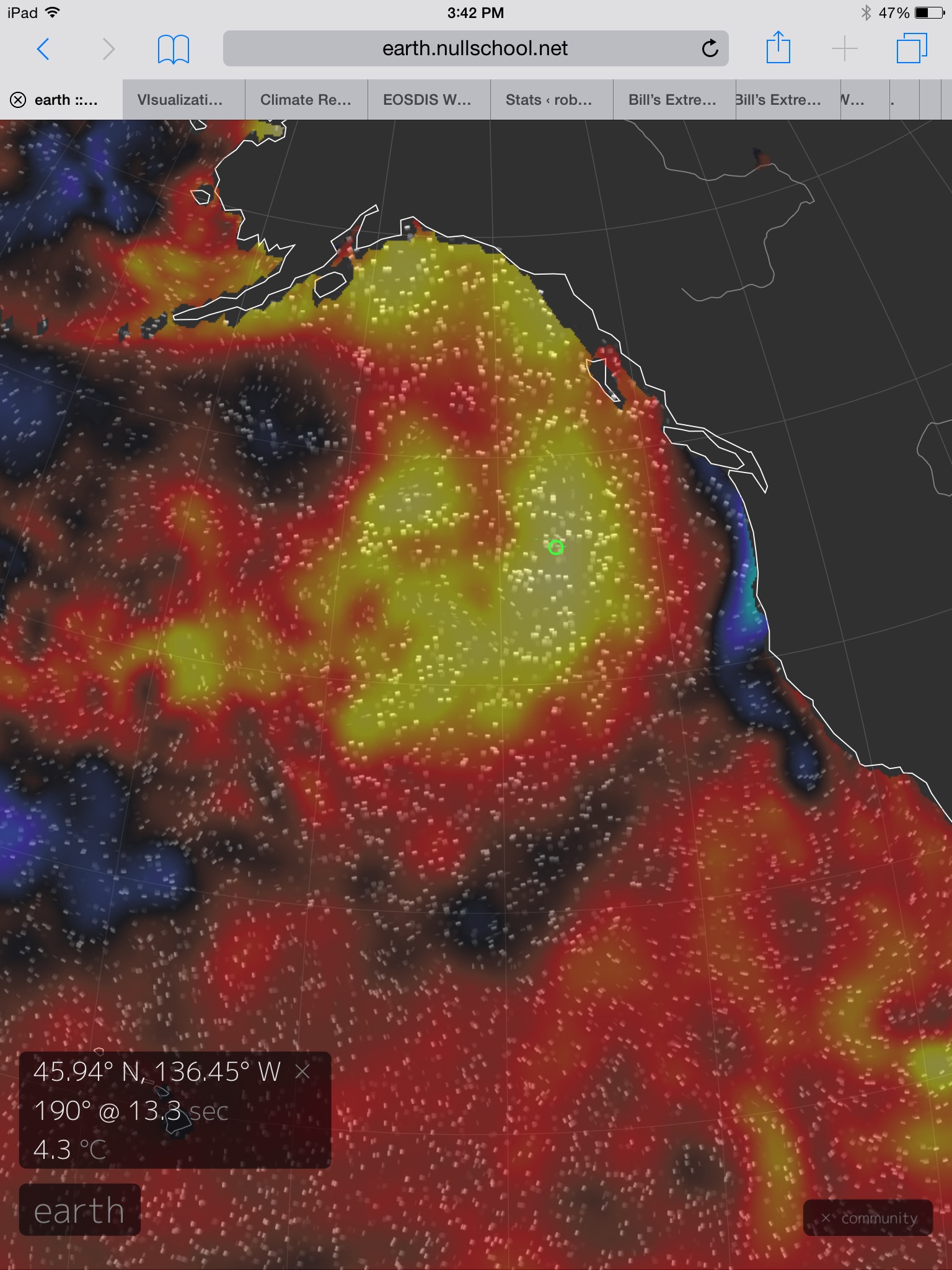
Scientists currently suspect extreme Northeastern Pacific Ocean heat led to the sudden appearance of Red Tide this week — a combination of warm and nutrient rich waters are well known to be the key ingredients for Red Tide formation. Ingredients that are increasingly prevalent due to human fossil fuel burning. Ingredients that are increasingly evident in the Northeastern Pacific. In short the burning of fossil fuels both warms the atmosphere and ocean even as it seeds the surface water with nitrogen. The warm water is a preferred environment for the microbes that form the Red Tide and the nitrogen — both as a constant rain from the sky due to fossil fuel emission and as effluent from streams due to farm runoff — essentially fertilizes the bloom.

image
(The Northeastern Pacific hot Blob now features a dangerous Red Tide — perhaps the largest and most toxin laden Red Tide ever seen. Image source: Earth Nullschool.)

Warming the world ocean through human carbon emissions is thus a very dangerous consequence. Now, more and more regions are featuring hot zones that are increasingly deadly to sea life. This region of the Northeast Pacific in particular has seen a number of instances of mass ocean creature death due to impacts associated with warming waters. The recent Red Tide being the last of a long chain including a mass starfish die-off, fish kills, bird kills, and marine mammal deaths and disruption — including a winter and spring emergence of crowds of starving sea lion pups along California beaches.

Next Step — Anoxia, Possible Hydrogen Sulfide Issue

This particular Red Tide is still in its early stages. It could last for weeks. But as it reaches its last days, the mass production of microbial life will rob the ocean surface of the nutrients necessary to sustain it. As this happens, the microbes will experience a sudden die-off. The mass of dead microbes will then sink and decay. This decay will further rob already de-oxygenated waters, particularly off Washington and Seattle, of still more oxygen. So the final act of this particular Red Tide will be to make a bad ocean water oxygen situation in many of the affected regions even worse (in the worst case potentially setting some zones up for an ugly deep water hydrogen sulfide production).

Links:
Hat Tip to Andy in San Diego


Monday, 22 September 2014

Ocean warming in the Arctic

Bloom in the Bering Sea


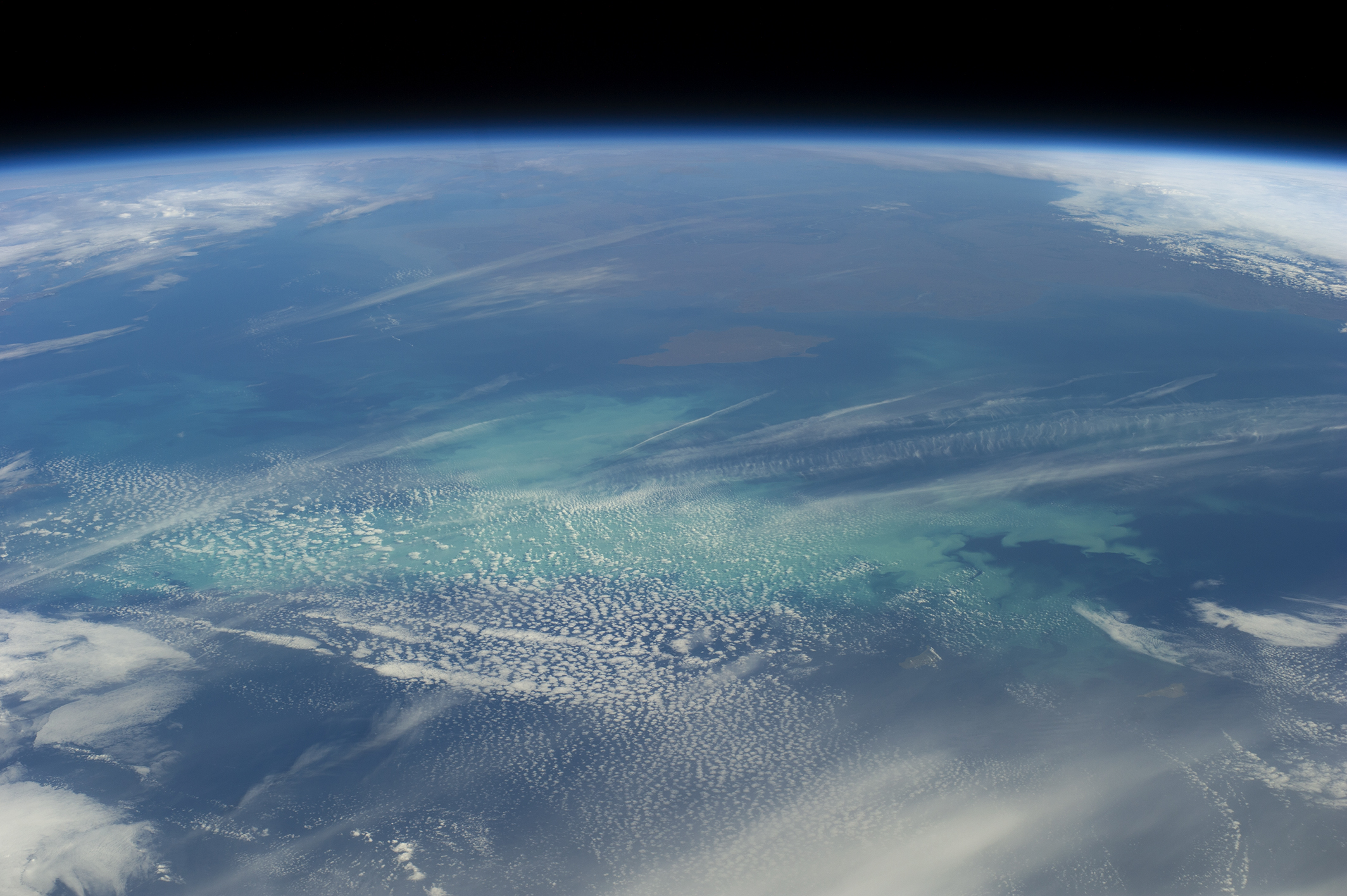
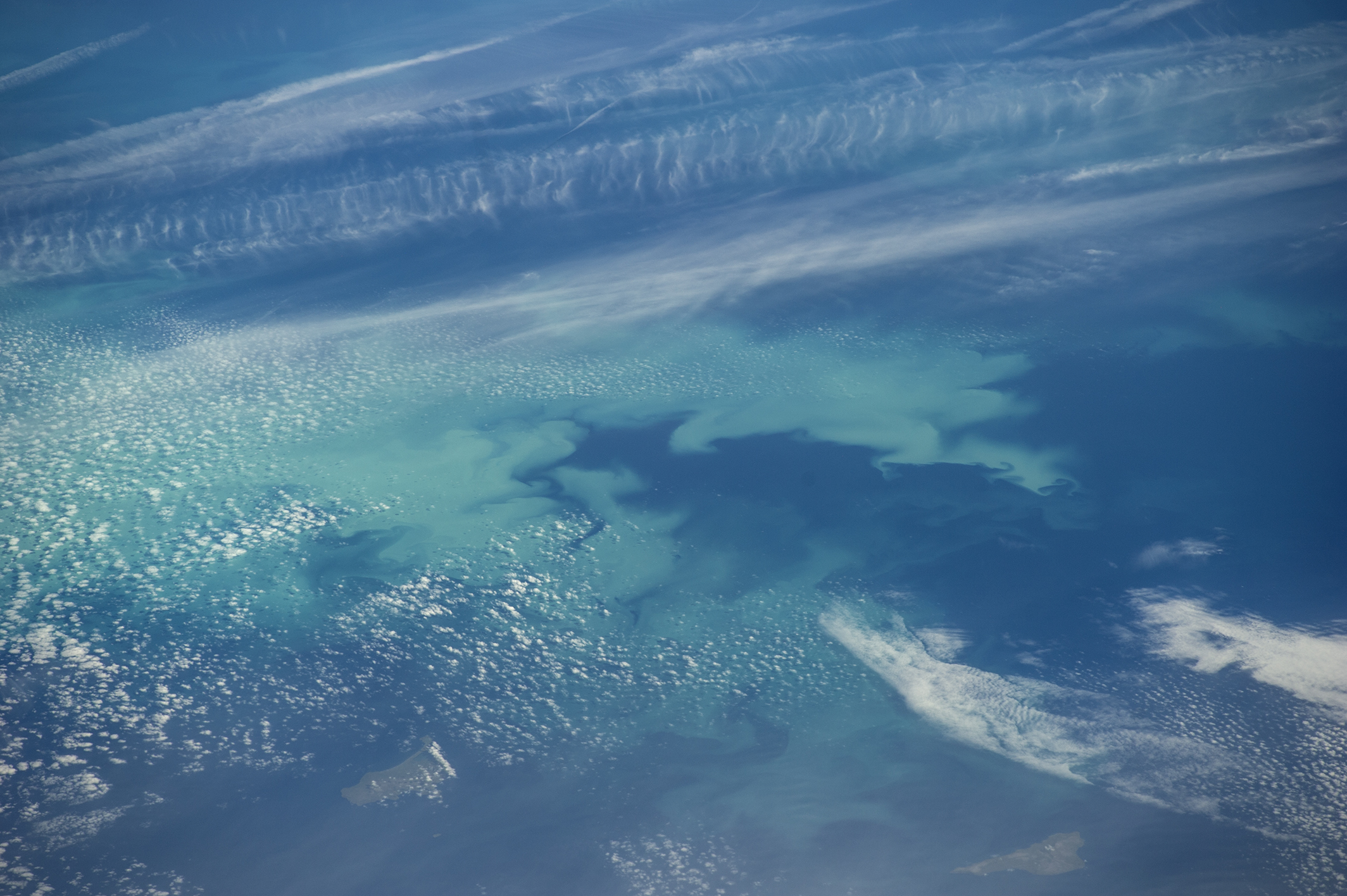
The Bering Sea is no stranger to phytoplankton blooms, such as this late-summer event off the coast of Alaska.

On September 4, 2014, the Moderate Resolution Imaging Spectroradiometer (MODIS) on NASA’s Aqua satellite acquired a natural-color image (top) of a bloom southwest of Nunivak Island and the coast of Alaska. The bloom was still visible a day later when astronauts aboard the International Space Station took photographs (below).

Blooms in the Bering Sea typically increase in spring, when nutrients and freshened water (from melting ice) are more abundant near the ocean surface. Then phytoplankton populations usually plummet in summertime after exhausting the nutrients in surface waters or falling prey to ocean grazers. By autumn, however, storms and cooler water allow nutrients to mix back to the surface, fueling more blooms.

acquired September 5, 2014
download large image (2 MB, JPEG, 2128x1416)

“Phytoplankton blooms in the Bering Sea are very common,” said Kevin Arrigo, a biological oceanographer at Stanford University. “It is one of the most productive places in the world ’s oceans.”

The chlorophyll contained in these tiny plant-like organisms often shows up in natural-color images as a green hue. However, the phytoplankton in this image are very reflective, which suggests they are a type of algae called coccolithophores, according to Arrigo.

“These algae cover themselves with little calcium carbonate discs, and if they are concentrated enough, they can make the water milky in appearance,” he said. “These kinds of blooms used to be rare in the Bering Sea but are becoming more common.”


acquired September 5, 2014
download large image (2 MB, JPEG, 2128x1416)

References and Related Reading

NASA Earth Observatory (2000, May 8) New Coccolithophore Bloom in Bering Sea.

NASA Earth Observatory (1999, April 26) What is a Coccolithophore?

NOAA Fisheries (2014, spring) Spring and Fall Phytoplankton Blooms in the Eastern Bering Sea During 1995-2011. Accessed September 12, 2014.


NASA MODIS image by Jeff Schmaltz, LANCE/EOSDIS Rapid Response. 

Astronaut photographs ISS040-E-12807 and ISS040-E-12808 were acquired on September 5, 2014, with a Nikon D3S digital camera, and are provided by the ISS Crew Earth Observations Facility and the Earth Science and Remote Sensing Unit, Johnson Space Center. The image was taken by the Expedition 40 crew. It has been cropped and enhanced to improve contrast, and lens artifacts have been removed. The International Space Station Program supports the laboratory as part of the ISS National Lab to help astronauts take pictures of Earth that will be of the greatest value to scientists and the public, and to make those images freely available on the Internet. Additional images taken by astronauts and cosmonauts can be viewed at the NASA/JSC Gateway to Astronaut Photography of Earth. Caption by Kathryn Hansen.

Monday, 5 May 2014

The dying Pacific

Just because you don't pay attention it doesn't mean problems go away!!


My feeling is that you can look to ocean acidification and Fukushima in roughly equal measure


"Alarm as record numbers of seals & sea lions starve to death along California coast, and more. Plus, a bonanza of well-meaning but absolutely clueless scientists who, over the past three years, have had no less than a jillion apples fall on their heads, and who still haven't thought it might be due to gravity. A rose is a rose is a rose unless you're a scientist, in which case, you might be thinking it's a walrus."
---Michael Green

Alarm as record numbers of seals & sea lions ‘starving to death’ along California coast

— “It’s just spiked… calls started coming nonstop”

— “So many unhealthy… washing ashore”

— “Extremely complex issue… multitude of factors in play”

— “Definitely a mystery, we’re hoping it’s not the new norm”


ENENews,

3 May, 2014


San Francisco Chronicle, May 3, 2014: Young seals, sea lions starving in record numbers — Rescuers are scrambling to save a record number of young sea lions and seals along California’s northern and central coast while scientists work to understand why the animals are beaching themselves [...] The emaciated and dehydrated pups are turning up along the 600 miles of coastline from Mendocino to San Luis Obispo monitored by the Marine Mammal Center. Many are too weak to move after washing ashore [...] As of Wednesday, the center had brought in 429 California sea lions, elephant seals, harbor seals and fur seals this year. That’s well above the 291 animals admitted by the same date last year [...] Southern California witnessed an almost 70 percent die-off of young sea lions – those born in summer 2012 – near the Channel Islands, where most American sea lions breed.


Sharon Melin, NOAA biologist: “In 2013, it was only the young animals that tried to do it on their own [...] this year there’s lots of stranding going on, but those are a different age-class of pups.”


Dr. Shawn Johnson, Marine Mammal Center: “The ones we are seeing are basically starving to death [...] It’s definitely a mystery. We’re hoping it’s not the new norm.”


Coastline Pilot, May 1, 2014: “In the last month we’ve seen the rescues spike,” [Pacific Marine Mammal Center's Keith Matassa] said. [...] Researchers are still trying to determine why so many unhealthy sea lions are washing ashore. “The reasons behind the animal strandings are an extremely complex issue,” Matassa said. “Although there is a leading theory that their food source is playing a significant role, there are a multitude of factors that come in to play.”
“Starving to death”? 


Gov’t Investigator: Acute hemorrhaging found in dead owls along west coast


  • Mortality event began 8 months after Fukushima explosions
  • “In very poor condition… badly emaciated” when arriving in Pacific Northwest from Arctic


ENENews,
3 May, 2014


Campbell River Mirror, Feb. 18, 2014: Guest Speakers in the morning include Dr. Victoria Bowes, avian pathologist, with BC Min. of Agriculture, who will present “The Overwintering Snowy Owl Mortality Investigation”


Dr. Victoria Bowes, British Columbia Ministry of Agriculture, June 2013: In the winter of 2011, and again in 2012, an unexpected record number of overwintering Snowy Owls arrived along the southern coast of BC [...] from the high Arctic already in poor body condition, and over a short period of time many of the weakened birds were admitted to local wildlife rehabilitators. Others [...] were found dead or dying. [...] The unanswered question was whether or not there were underlying predisposing factors that made these birds more vulnerable. In January 2013, and again in April, a team of investigators assembled [...] to examine a total of 49 Snowy Owl carcasses [...] the majority of birds in both necropsy sessions were emaciated adult or sub-adult males. An associated finding was carcass pallor accompanied by acute gastric and intestinal hemorrhage [...] terminal intestinal hemorrhage has been recognized as a manifestation of severe physiologic stress [...]

South China Morning Post, Jan. 20, 2013: [...] snowy owls arrive in Vancouver [...] worrying bird welfare experts [...] The owls perch listlessly [...] the second winter in a row that Vancouver has been treated to a visit [...] raising concern among experts who say the owls should normally only visit Vancouver every five or so years [...] some of the birds are badly emaciated.

Rob Hope, Orphaned Wildlife Rehabilitation Society: Some were suffering from asperogillosis, a breathing problem [...] that can be triggered by a weakened immune system or malnutrition. [Owls arrived in] November, earlier than they would normally venture so far south [...] “We have been finding a lot in very poor condition by the time they arrive. They are already in a weakened state.”

Orange County Register, May 2, 2014: Sea lions are [...] washing ashore, many of them pups dehydrated, malnourished and on the brink of death. The year started off quieter than last year, and the Pacific Marine Mammal Center’s director of development, Melissa Sciacca, thought they were in the clear – until about a month ago, when the calls started coming in nonstop. [...] “We thought it was going to be a nice calm year; in the last month it’s just spiked,” she said. “The rescues just keep coming in at a steady pace.” It’s the second year stranded sea lions have been reported in alarming numbers. [...] Last year, scientists tested for radioactivity, and it was determined that wasn’t the cause, and infectious disease was also ruled out.


‘Marine Mystery’ in California: “Toxic outbreak threatening marine life”


  • Birds falling from sky, sea lions convulsing — “Worst they’ve ever seen”
  • Toxin hits record level, almost 1,000% above gov’t limit
  • Heart lesions, severe shrinking in part of brain, nervous system failure 


ENENews,
3 May, 2014


Santa Cruz Sentinel, May 2, 2014: State health warnings over shellfish, anchovies and sardines are highlighting a marine mystery [...] what’s behind a toxic outbreak threatening marine life? [...] Researchers in the relatively new area of study say the problem is the worst they have ever seen. [Though the] toxin likely has always been part of the ecosystem, the threat appears to be growing. [...] results of late are the highest ever [...] sea lions affected by domoic acid show a severely shrunken hippocampus [and] lesions on the hearts and brains [...] the mystery behind why and when it happens remains largely unsolved [...]


Tenaya Norris, Marine Mammal Center: “We don’t know why these algae produce these toxins [...] They can be in the water and not producing this toxin, and they can be out in the water and raging.”

Raphael Kudela, UCSC marine ecologist: ”There is some evidence that there are more events of larger magnitude [...] it really affects sea otters.”

Rebecca Dmytryk, Wildlife Emergency Services: “We’ve literally had them drop from the sky.”

KION, Apr. 28, 2014: Sea lions found sick and convulsing off Monterey Bay coast [...] now researchers say there may be some indication that humans may also be causing domoic acid to be produced in higher concentrations [...] At least 35 sick sea lions were found stranded on the Monterey Bay. They were convulsing with seizure-like symptoms. [...]

KION, Apr. 14, 2014: [The state] began seeing low levels of demoic acid in the fish in mid-March and 2 days ago noticed it increased to almost 10 times higher than federal regulations.

KSBW, Apr. 30, 2014: Toxic algae blooms killing sea birds, threaten humans — A new health warning has been issued urging people to not eat certain parts of anchovy, sardines, or crab caught in the Monterey Bay. [It's causing seabirds'] nervous systems to fail. [...] the state public health department issued a warning not to eat recreationally harvested shellfish [...] from the Monterey Bay. On Monday, officials issued an update advising consumers not to eat the internal organs of commercially or recreationally caught anchovy, sardines or crab [...] Typically the toxic algae blooms only last a week or two but the latest one has lasted all month [...]


Watch the KSBW broadcast here


Recent articles that relate to California and Monterey Bay


01:17 PM EST on May 3rd, 2014 | 131 comments

‘Marine Mystery’ in California: “Toxic outbreak threatening marine life” — Birds falling from sky, sea lions convulsing — “Worst they’ve ever seen” — Toxin hits record level, almost 1,000% above gov’t limit — Heart lesions, severe shrinking in part of brain, nervous system failure (VIDEO)

09:34 AM EST on May 1st, 2014 | 77 comments

SF Chronicle: “Unbelievable hordes” of fish near California coast; Most birds, sea lions, dolphins, whales anywhere — Expert: ‘Off the charts’ pelican population “highly unusual… could reflect breeding failures elsewhere”; “Abnormal ocean conditions” to blame?

11:10 PM EST on April 18th, 2014 | 137 comments

NBC: Record level of sick or injured California seals and sea lions turning up — “The numbers are extraordinary” — “Scientists worried… The worst kind of perfect storm” — Pups should be weighing 2 or 3 times as much, “severely malnourished” (VIDEO)

09:51 AM EST on February 1st, 2014 | 172 comments

CBS San Francisco: “Widespread distrust” of scientists over Fukushima — Official: “People are worried, people want to know what’s going on” — UC Berkeley professor admits much of his funding is from gov’t: If you don’t trust us, who is it you want to trust? Says man-made cesium-137 is “natural background radiation” (VIDEO)

01:05 AM EST on January 25th, 2014 | 77 comments

TV: At height of Fukushima emergency, region in California where plume hit had NO monitors — Email shows EPA ‘decided’ not to deploy RADNET to area — Only one left broke as radioactivity began spiking — “No clue” about exposure levels (MAP)

08:16 PM EST on January 14th, 2014 | 163 comments

“They’re All Gone”: Shock as sardines vanish off California — Fishermen didn’t find a single one all summer — Scientist: This is about the entire Pacific coast… Canada, Mexico, U.S. — NOAA: We don’t know why; The young aren’t surviving

01:27 PM EST on January 11th, 2014 | 322 comments

California Official: Information on risk from Fukushima needs to be made public — State in contact with NRC — CBS: ‘Health Scare Over Possible Fukushima Radiation In Pacific-Caught Fish’ — Surfer: I’d never go surfing right now (VIDEO)

11:38 PM EST on January 5th, 2014 | 302 comments

L.A. Times: Alarming West Coast sardine crash likely radiating through ecosystem — Experts warn marine mammals and seabirds are starving, may suffer for years to come — Boats return without a single fish — Monterey Bay: Hard to resist idea that humpback whales are trying to tell us something

05:12 PM EST on December 30th, 2013 | 118 comments

Lead Researcher: Fukushima pollution may be causing sea star epidemic on West Coast — Sea urchins, sea cucumbers also affected — “Something’s making them susceptible”… “It’s unlike anything we’ve seen”… “Populations go locally extinct overnight”

04:02 PM EST on December 22nd, 2013 | 70 comments

Experts: “Really an off year” — Pelicans starving in Pacific Northwest since 2011, killing baby birds for food — Breeding success “really poor” since 2011 — “I believe pelicans are responding to large scale changes” — “Sardine crash” persists in Pacific since decline in 2011

08:59 PM EST on December 12th, 2013 | 87 comments

Marine Biologist: All the sea stars along west coast of North America could be wiped out — Some developing ‘bald spots’; “Others look completely healthy except for guts coming out” — ‘Speculation’ it could be related to Fukushima

09:26 AM EST on December 12th, 2013 | 107 comments

CNN: The Pacific has seen its fair share of weird recently — Bay in California “now a massive soup bowl” — “Miles of anchovies, mountains deep” — It’s like none ever recorded… Old timers have never seen anything like this — “We may be experiencing ‘global weirding’” (VIDEO)

06:44 PM EST on December 11th, 2013 | 148 comments

Study: Type of dead sea creature covered 98% of ocean floor last year about 150 miles off California coast; Unprecedented, was below 1% prior to event — ‘Major’ changes began in spring 2011

12:46 PM EST on December 9th, 2013 | 76 comments

SF Chronicle: Fukushima radiation possible culprit in huge starfish die off from Mexico to Alaska — Potential catastrophe, it’s extremely virulent “going on up and down coast… It’s going to change what’s out there pretty fundamentally”

04:22 PM EST on November 30th, 2013 | 217 comments

CBS News: 100s of whales in bay on California coast; It’s never been like this, we just can’t even believe it — Experts: We just aren’t sure what’s going on; “A once-in-a-lifetime chance… unheard of, it’s unbelievable, nobody’s seen this” (VIDEO)

11:19 PM EST on November 29th, 2013 | 125 comments

Scientist: Leading edge of Fukushima plume is now showing up on West Coast — Fish Market Owner: My customers have a lot of concerns about the nuclear contamination, they’re very smart and educated… I didn’t expect this much concern (AUDIO)

09:08 AM EST on November 25th, 2013 | 106 comments

NYTimes: Unprecedented concentration of sea creatures near shore in California; Experts baffled, longtime residents astounded — Biologist: “It’s a very strange year… The $64,000 question is why?” — Similar to ‘extraordinary’ events seen recently along Canada’s Pacific coast? (VIDEO)

04:05 PM EST on November 17th, 2013 | 150 comments

CBS News: ‘Immense mystery’ as sea stars being wiped out along West Coast, could be gone for generations — Bewildering disease is spreading and “no idea what’s causing it, or how to stop it” — Timelapse shows all legs lost in 7 hours (VIDEOS)

03:13 PM EST on November 2nd, 2013 | 84 comments

NBC News: “Grisly disease decimating starfish populations… from Orange County to Alaska” — Scientists: Alarm as they began eating each other, then melting away — Similar problem on East Coast observed since 2011 — Now spreading at “scary” rate (VIDEO)

10:54 PM EST on April 16th, 2013 | 31 comments

Sabotage: High-powered rifle used in attack on California power substation — Same perpetrators blamed for cutting AT&T fiberoptic cables — Objective was “shutting down the system” — FBI now leading investigation (VIDEO)