Showing posts with label Wikileaks. Show all posts

Sunday, 27 December 2020

A summary of Wikileaks' Vault 7 leaks

 WIKILEAKS CIA FILES: THE 6 BIGGEST SPYING SECRETS REVEALED BY THE RELEASE OF 'VAULT 7'


WikiLeaks has released a huge set of files that it calls "Year Zero" and which mark the biggest exposure of CIA spying secrets ever. The massive set of documents – over 8,000 pages in all – include a host of hacking secrets that could embarrass intelligence agencies and the US government, as well as undermining spying efforts across the world. Here are six of the biggest secrets and pieces of information yet to emerge from the huge dump. 1) The CIA has the ability to break into Android and iPhone handsets, and all kinds of computers. The US intelligence agency has been involved in a concerted effort to write various kinds of malware to spy on just about every piece of electronic equipment that people use. That includes iPhones, Androids and computers running Windows, macOS and Linux. If that software is as powerful as WikiLeaks claims, it could be used to remotely control those devices and switch them on and off. Once that happened, a vast array of data would be made available – including users' locations, messages they had sent, and potentially everything heard by the microphone or seen by the camera. 2) Doing so would make apps like Signal, Telegram and WhatsApp entirely insecure.
Encrypted messaging apps are only as secure as the device they are used on – if an operating system is compromised, then the messages can be read before they encrypted and sent to the other user. WikiLeaks claims that has happened, potentially meaning that messages have been compromised even if all of the usual precautions had been taken. 3) The CIA could use smart TVs to listen in on conversations that happened around them
One of the most eye-catching programmes detailed in the documents is "Weeping Angel". That allows intelligence agencies to install special software that allows TVs to be turned into listening devices – so that even when they appear to be switched off, they're actually on. That's just one of the technologies created by the Embedded Devices Branch, the CIA division at the centre of much of the leaks of new information. 4) The agency explored hacking into cars and crashing them, allowing 'nearly undetectable assassinations'.
Many of the documents reference tools that appear to have dangerous and unknown uses. One file, for instance, shows that the CIA were looking into ways of remotely controlling cars and vans by hacking into them. "The purpose of such control is not specified, but it would permit the CIA to engage in nearly undetectable assassinations," WikiLeaks notes, in an unproven piece of speculation. 5) The CIA hid vulnerabilities that could be used by hackers from other countries or governments.
WikiLeaks claims that its source handed over the documents in order to provoke a debate about the power of intelligence agencies and how their information should be exposed. Perhaps central to that is the accusation that the CIA was "hoarding" exploits that it had found – rather than handing them over to the companies that could fix them, and so make users safe, as they had promised to do. Such bugs were found in the biggest consumer electronics in the world, including phones and computers made Apple, Google and Microsoft. But those companies didn't get the chance to fix those exploits because the agency kept them secret in order to keep using them, the documents suggest. "Serious vulnerabilities not disclosed to the manufacturers places huge swathes of the population and critical infrastructure at risk to foreign intelligence or cyber criminals who independently discover or hear rumors of the vulnerability," a WikiLeaks statement read. "If the CIA can discover such vulnerabilities so can others." WikiLeaks noted that those unfixed exploits affected everyone using the equipment, including "the U.S. Cabinet, Congress, top CEOs, system administrators, security officers and engineers". 6) More information is coming… The documents have still not been looked through entirely. There are 8,378 pages of files, some of which have already been analysed but many of which hasn't. The files are being shared publicly on the WikiLeaks website and the organisation has encouraged its supporters to keep looking through the documents in the hope of finding more stories. And that's not to mention the other sets of documents that are coming. The "Year Zero" leaks are just the first in a series of "Vault 7" dumps, Julian Assange said. When taken together, those "Vault 7" leaks will make up the biggest intelligence publication in history, WikiLeaks claimed.

Monday, 2 March 2020

The Julian Assange extradition case

This is probably THE barometer of where things are going and yet I hardly have the energy to follow it.

After all, we are in the midst of the Sixth Great Extinction, financial meltdown and a viral pandemic

Your Man in the Public Gallery – Assange Hearing Day Four 225


28 February, 2020


Please try this experiment for me.

Try asking this question out loud, in a tone of intellectual interest and engagement: “Are you suggesting that the two have the same effect?”.

Now try asking this question out loud, in a tone of hostility and incredulity bordering on sarcasm: “Are you suggesting that the two have the same effect?”.

Firstly, congratulations on your acting skills; you take direction very well. Secondly, is it not fascinating how precisely the same words can convey the opposite meaning dependent on modulation of stress, pitch, and volume?

Yesterday the prosecution continued its argument that the provision in the 2007 UK/US Extradition Treaty that bars extradition for political offences is a dead letter, and that Julian Assange’s objectives are not political in any event. James Lewis QC for the prosecution spoke for about an hour, and Edward Fitzgerald QC replied for the defence for about the same time. During Lewis’s presentation, he was interrupted by Judge Baraitser precisely once. During Fitzgerald’s reply, Baraitser interjected seventeen times.

In the transcript, those interruptions will not look unreasonable:
Could you clarify that for me Mr Fitzgerald…”
So how do you cope with Mr Lewis’s point that…”
But surely that’s a circular argument…”
But it’s not incorporated, is it?…”

All these and the other dozen interruptions were designed to appear to show the judge attempting to clarify the defence’s argument in a spirit of intellectual testing. But if you heard the tone of Baraitser’s voice, saw her body language and facial expressions, it was anything but.

The false picture a transcript might give is exacerbated by the courtly Fitzgerald’s continually replying to each obvious harassment with “Thank you Madam, that is very helpful”, which again if you were there, plainly meant the opposite. But what a transcript will helpfully nevertheless show was the bully pulpit of Baraitser’s tactic in interrupting Fitzgerald again and again and again, belittling his points and very deliberately indeed preventing him from getting into the flow of his argument. The contrast in every way with her treatment of Lewis could not be more pronounced.

So now to report the legal arguments themselves.

James Lewis for the prosecution, continuing his arguments from the day before, said that Parliament had not included a bar on extradition for political offences in the 2003 Act. It could therefore not be reintroduced into law by a treaty. “To introduce a Political Offences bar by the back door would be to subvert the intention of Parliament.”

Lewis also argued that these were not political offences. The definition of a political offence was in the UK limited to behaviour intended “to overturn or change a government or induce it to change its policy.” Furthermore the aim must be to change government or policy in the short term, not the indeterminate future.

Lewis stated that further the term “political offence” could only be applied to offences committed within the territory where it was attempted to make the change. So to be classified as political offences, Assange would have had to commit them within the territory of the USA, but he did not.

If Baraitser did decide the bar on political offences applied, the court would have to determine the meaning of “political offence” in the UK/US Extradition Treaty and construe the meaning of paragraphs 4.1 and 4.2 of the Treaty. To construe the terms of an international treaty was beyond the powers of the court.

Lewis perorated that the conduct of Julian Assange cannot possibly be classified as a political offence. “It is impossible to place Julian Assange in the position of a political refugee”. The activity in which Wikileaks was engaged was not in its proper meaning political opposition to the US Administration or an attempt to overthrow that administration. Therefore the offence was not political.

For the defence Edward Fitzgerald replied that the 2003 Extradition Act was an enabling act under which treaties could operate. Parliament had been concerned to remove any threat of abuse of the political offence bar to cover terrorist acts of violence against innocent civilians. But there remained a clear protection, accepted worldwide, for peaceful political dissent. This was reflected in the Extradition Treaty on the basis of which the court was acting.

Baraitser interrupted that the UK/US Extradition Treaty was not incorporated into English Law.

Fitzgerald replied that the entire extradition request is on the basis of the treaty. It is an abuse of process for the authorities to rely on the treaty for the application but then to claim that its provisions do not apply.

On the face of it, it is a very bizarre argument that a treaty which gives rise to the extradition, on which the extradition is founded, can be disregarded in its provisions. It is on the face of it absurd.” Edward Fitzgerald QC for the Defence

Fitzgerald added that English Courts construe treaties all the time. He gave examples.

Fitzgerald went on that the defence did not accept that treason, espionage and sedition were not regarded as political offences in England. But even if one did accept Lewis’s too narrow definition of political offence, Assange’s behaviour still met the test. What on earth could be the motive of publishing evidence of government war crimes and corruption, other than to change the policy of the government? Indeed, the evidence would prove that Wikileaks had effectively changed the policy of the US government, particularly on Iraq.

Baraitser interjected that to expose government wrongdoing was not the same thing as to try to change government policy. Fitzgerald asked her, finally in some exasperation after umpteen interruptions, what other point could there be in exposing government wrongdoing other than to induce a change in government policy?

That concluded opening arguments for the prosecution and defence.

MY PERSONAL COMMENTARY

Let me put this as neutrally as possible. If you could fairly state that Lewis’s argument was much more logical, rational and intuitive than Fitzgerald’s, you could understand why Lewis did not need an interruption while Fitzgerald had to be continually interrupted for “clarification”. But in fact it was Lewis who was making out the case that the provisions of the very treaty under which the extradition is being made, do not in fact apply, a logical step which I suggest the man on the Clapham omnibus might reason to need rather more testing than Fitzgerald’s assertion to the contrary. Baraitser’s comparative harassment of Fitzgerald when he had the prosecution on the ropes was straight out of the Stalin show trial playbook.

The defence did not mention it, and I do not know if it features in their written arguments, but I thought Lewis’s point that these could not be political offences, because Julian Assange was not in the USA when he committed them, was breathtakingly dishonest. The USA claims universal jurisdiction. Assange is being charged with crimes of publishing committed while he was outside the USA. The USA claims the right to charge anyone of any nationality, anywhere in the world, who harms US interests. They also in addition here claim that as the materials could be seen on the internet in the USA, there was an offence in the USA. At the same time to claim this could not be a political offence as the crime was committed outside the USA is, as Edward Fitzgerald might say, on the face of it absurd. Which curiously Baraitser did not pick up on.

Lewis’s argument that the Treaty does not have any standing in English law is not something he just made up. Nigel Farage did not materialise from nowhere. There is in truth a long tradition in English law that even a treaty signed and ratified with some bloody Johnny Foreigner country, can in no way bind an English court. Lewis could and did spout reams and reams of judgements from old beetroot faced judges holding forth to say exactly that in the House of Lords, before going off to shoot grouse and spank the footman’s son. Lewis was especially fond of the Tin Council case.

There is of course a contrary and more enlightened tradition, and a number of judgements that say the exact opposite, mostly more recent. This is why there was so much repetitive argument as each side piled up more and more volumes of “authorities” on their side of the case.

The difficulty for Lewis – and for Baraitser – is that this case is not analogous to me buying a Mars bar and then going to court because an International Treaty on Mars Bars says mine is too small.

Rather the 2003 Extradition Act is an Enabling Act on which extradition treaties then depend. You can’t thus extradite under the 2003 Act without the Treaty. So the Extradition Treaty of 2007 in a very real sense becomes an executive instrument legally required to authorise the extradition. For the executing authorities to breach the terms of the necessary executive instrument under which they are acting, simply has to be an abuse of process. So the Extradition Treaty owing to its type and its necessity for legal action, is in fact incorporated in English Law by the Extradition Act of 2003 on which it depends.

The Extradition Treaty is a necessary precondition of the extradition, whereas a Mars Bar Treaty is not a necessary precondition to buying the Mars Bar.

That is as plain as I can put it. I do hope that is comprehensible.

It is of course difficult for Lewis that on the same day the Court of Appeal was ruling against the construction of the Heathrow Third Runway, partly because of its incompatibility with the Paris Agreement of 2016, despite the latter not being fully incorporated into English law by the Climate Change Act of 2008.

VITAL PERSONAL EXPERIENCE

It is intensely embarrassing for the Foreign and Commonwealth Office (FCO) when an English court repudiates the application of a treaty the UK has ratified with one or more foreign states. For that reason, in the modern world, very serious procedures and precautions have been put into place to make certain that this cannot happen. Therefore the prosecution’s argument that all the provisions of the UK/US Extradition Treaty of 2007 are not able to be implemented under the Extradition Act of 2003, ought to be impossible.

I need to explain I have myself negotiated and overseen the entry into force of treaties within the FCO. The last one in which I personally tied the ribbon and applied the sealing wax (literally) was the Anglo-Belgian Continental Shelf Treaty of 1991, but I was involved in negotiating others and the system I am going to describe was still in place when I left the FCO as an Ambassador in 2005, and I believe is unchanged today (and remember the Extradition Act was 2003 and the US/UK Extradition Treaty ratified 2007, so my knowledge is not outdated). Departmental nomenclatures change from time to time and so does structural organisation. But the offices and functions I will describe remain, even if names may be different.

All international treaties have a two stage process. First they are signed to show the government agrees to the treaty. Then, after a delay, they are ratified. This second stage takes place when the government has enabled the legislation and other required agency to implement the treaty. This is the answer to Lewis’s observation about the roles of the executive and legislature. The ratification stage only takes place after any required legislative action. That is the whole point.

This is how it happens in the FCO. Officials negotiate the extradition treaty. It is signed for the UK. The signed treaty then gets returned to FCO Legal Advisers, Nationality and Treaty Department, Consular Department, North American Department and others and is sent on to Treasury/Cabinet Office Solicitors and to Home Office, Parliament and to any other Government Department whose area is impacted by the individual treaty.

The Treaty is extensively vetted to check that it can be fully implemented in all the jurisdictions of the UK. If it cannot, then amendments to the law have to be made so that it can. These amendments can be made by Act of Parliament or more generally by secondary legislation using powers conferred on the Secretary of State by an act. If there is already an Act of Parliament under which the Treaty can be implemented, then no enabling legislation needs to be passed. International Agreements are not all individually incorporated into English or Scottish laws by specific new legislation.

This is a very careful step by step process, carried out by lawyers and officials in the FCO, Treasury, Cabinet Office, Home Office, Parliament and elsewhere. Each will in parallel look at every clause of the Treaty and check that it can be applied. All changes needed to give effect to the treaty then have to be made – amending legislation, and necessary administrative steps. Only when all hurdles have been cleared, including legislation, and Parliamentary officials, Treasury, Cabinet Office, Home Office and FCO all certify that the Treaty is capable of having effect in the UK, will the FCO Legal Advisers give the go ahead for the Treaty to be ratified. You absolutely cannot ratify the treaty before FCO Legal Advisers have given this clearance.

This is a serious process. That is why the US/UK Extradition Treaty was signed in 2003 and ratified in 2007. That is not an abnormal delay.

So I know for certain that ALL the relevant British Government legal departments MUST have agreed that Article 4.1 of the UK/US Extradition Treaty was capable of being given effect under the 2003 Extradition Act. That certification has to have happened or the Treaty could never have been ratified.

It follows of necessity that the UK Government, in seeking to argue now that Article 4.1 is incompatible with the 2003 Act, is knowingly lying. There could not be a more gross abuse of process.

I have been keen for the hearing on this particular point to conclude so that I could give you the benefit of my experience. I shall rest there for now, but later today hope to post further on yesterday’s row in court over releasing Julian from the anti-terrorist armoured dock.

With grateful thanks to those who donated or subscribed to make this reporting possible. I wish to stress again that I absolutely do not want anybody to give anything if it causes them the slightest possibility of financial strain.

This article is entirely free to reproduce and publish, including in translation, and I very much hope people will do so actively. Truth shall set us free.

ASSANGE EXTRADITION:CN Editor speaks to George Galloway


Consortium News Editor-in-Chief Joe Lauria sat down with former British MP George Galloway in London to discuss the first week of Julian Assange’s extradition hearing at Woolwich Crown Court.


Wednesday, 26 February 2020

Assange extradition trial starts in London


UK inexplicably bars 
WikiLeaks editor from 
extradition hearing day after 
Assange handcuffed 11 times 
& STRIPPED twice

UK inexplicably bars WikiLeaks editor from extradition hearing day after Assange handcuffed 11 times & STRIPPED twice
RT,
25 February, 2020
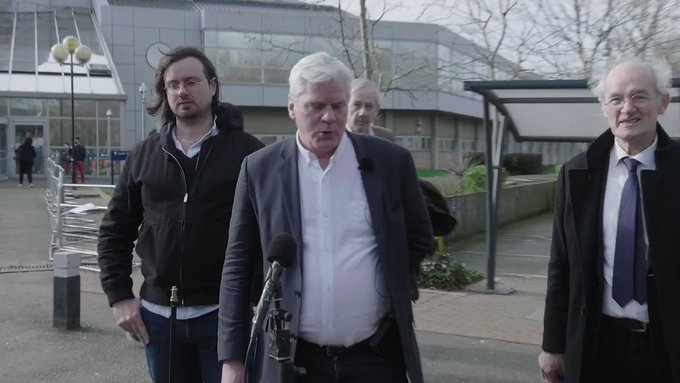
Wikileaks editor Kristin Hrafnsson was temporarily barred from the extradition hearing for publisher Julian Assange, who was reportedly handcuffed 11 times, stripped twice, and robbed of his legal papers after the first court day.
Hrafnsson was pulled out of the crowd as he attempted to enter the public gallery of Woolwich Crown Court on Tuesday morning, he told RT, after someone shouted “Where is the WikiLeaks editor?
Explaining that he was given “no grounds” for the order and was unable to locate the head of the court to get an answer, he recorded and released a statement denouncing his exclusion from the supposedly-public proceedings as “outrageous” and calling on the public to “demand some answers — because I’m not getting any.

@wikileaks Editor @khrafnsson Kristinn Hrafnsson was picked out and demanded he leave the court with no reason given. He has now been let back in after intervention from solicitors. Here is his statement when he was expelled.
Assange’s father John Shipton also walked out in solidarity, while the publisher’s lawyer Gareth Pierce worked to get Hrafnsson permission to enter. He was finally approached and told “a misunderstanding had occurred,” given a verbal apology and allowed to enter the public gallery, but his exclusion was never explained. Hrafnsson has demanded an explanation in writing and a formal apology. The WikiLeaks editor was equally disgusted by the treatment of Assange himself, who was — according to his lawyer — handcuffed 11 times, stripped twice, and deprived of his legal papers following the conclusion of the first day of hearings. “How can anybody prepare for a trial when he is treated in this manner?” Hrafnsson asked, calling the UK’s handling of its high-profile prisoner “highly abusive.”
This is not a thing you should expect in a civilized country where human rights concerns are highlighted.
Hrafnsson is not optimistic about Assange’s future, noting that the “English court is being misled by Americans who are trying to abuse the process of extradition by mere fabrications.” The cramped quarters — just 12 or 13 seats in the public gallery, while the legions of protesters are kept outside the court compound “for no apparent reason” — are “totally inadequate for a trial of this importance,” he said, observing that despite London’s claims, the hearing is “not being held in public.”
Assange is facing extradition to the US, where he could be sentenced to 175 years in prison on a bundle of espionage and hacking charges stemming from the 2010 release by WikiLeaks of classified Department of Defense files that have come to be known as the Afghan and Iraq War Logs. The US has continued to argue that the disclosures put political dissidents and journalists in danger, but no names of “victims” or other proof have been supplied to back up that assertion.

https://www.rt.com/news/481671-us-assange-kidnap-poison/


CRAIG MURRAY: Your Man 
In The Public Gallery – 
Assange Hearing Day 1

By Craig Murray


February 25th

Woolwich Crown Court is designed to impose the power of the state. Normal courts in this country are public buildings, deliberately placed by our ancestors right in the centre of towns, almost always just up a few steps from a main street. The major purpose of their positioning and of their architecture was to facilitate public access in the belief that it is vital that justice can be seen by the public.

Woolwich Crown Court, which hosts Belmarsh Magistrates Court, is built on totally the opposite principle. It is designed with no other purpose than to exclude the public. Attached to a prison on a windswept marsh far from any normal social centre, an island accessible only through navigating a maze of dual carriageways, the entire location and architecture of the building is predicated on preventing public access. It is surrounded by a continuation of the same extremely heavy duty steel paling barrier that surrounds the prison. It is the most extraordinary thing, a courthouse which is a part of the prison system itself, a place where you are already considered guilty and in jail on arrival. Woolwich Crown Court is nothing but the physical negation of the presumption of innocence, the very incarnation of injustice in unyielding steel, concrete and armoured glass. It has precisely the same relationship to the administration of justice as Guantanamo Bay or the Lubyanka. It is in truth just the sentencing wing of Belmarsh prison.

When enquiring about facilities for the public to attend the hearing, an Assange activist was told by a member of court staff that we should realise that Woolwich is a “counter-terrorism court”. That is true de facto, but in truth a “counter-terrorism court” is an institution unknown to the UK constitution. Indeed, if a single day at Woolwich Crown Court does not convince you the existence of liberal democracy is now a lie, then your mind must be very closed indeed.

Extradition hearings are not held at Belmarsh Magistrates Court inside Woolwich Crown Court. They are always held at Westminster Magistrates Court as the application is deemed to be delivered to the government at Westminster. Now get your head around this. This hearing is at Westminster Magistrates Court. It is being held by the Westminster magistrates and Westminster court staff, but located at Belmarsh Magistrates Court inside Woolwich Crown Court. All of which weird convolution is precisely so they can use the “counter-terrorist court” to limit public access and to impose the fear of the power of the state.

One consequence is that, in the courtroom itself, Julian Assange is confined at the back of the court behind a bulletproof glass screen. He made the point several times during proceedings that this makes it very difficult for him to see and hear the proceedings. The magistrate, Vanessa Baraitser, chose to interpret this with studied dishonesty as a problem caused by the very faint noise of demonstrators outside, as opposed to a problem caused by Assange being locked away from the court in a massive bulletproof glass box.

Now there is no reason at all for Assange to be in that box, designed to restrain extremely physically violent terrorists. He could sit, as a defendant at a hearing normally would, in the body of the court with his lawyers. But the cowardly and vicious Baraitser has refused repeated and persistent requests from the defence for Assange to be allowed to sit with his lawyers. Baraitser of course is but a puppet, being supervised by Chief Magistrate Lady Arbuthnot, a woman so enmeshed in the defence and security service establishment I can conceive of no way in which her involvement in this case could be more corrupt.

It does not matter to Baraitser or Arbuthnot if there is any genuine need for Assange to be incarcerated in a bulletproof box, or whether it stops him from following proceedings in court. Baraitser’s intention is to humiliate Assange, and to instill in the rest of us horror at the vast crushing power of the state. The inexorable strength of the sentencing wing of the nightmarish Belmarsh Prison must be maintained. If you are here, you are guilty.

It’s the Lubyanka. You may only be a remand prisoner. This may only be a hearing not a trial. You may have no history of violence and not be accused of any violence. You may have three of the country’s most eminent psychiatrists submitting reports of your history of severe clinical depression and warning of suicide. But I, Vanessa Baraitser, am still going to lock you up in a box designed for the most violent of terrorists. To show what we can do to dissidents. And if you can’t then follow court proceedings, all the better.

You will perhaps better accept what I say about the Court when I tell you that, for a hearing being followed all round the world, they have brought it to a courtroom which had a total number of sixteen seats available to members of the public. 16. To make sure I got one of those 16 and could be your man in the gallery, I was outside that great locked iron fence queuing in the cold, wet and wind from 6am. At 8am the gate was unlocked, and I was able to walk inside the fence to another queue before the doors of the courtroom, where despite the fact notices clearly state the court opens to the public at 8am, I had to queue outside the building again for another hour and forty minutes. Then I was processed through armoured airlock doors, through airport type security, and had to queue behind two further locked doors, before finally getting to my seat just as the court started at 10am. By which stage the intention was we should have been thoroughly cowed and intimidated, not to mention drenched and potentially hypothermic.

There was a separate media entrance and a media room with live transmission from the courtroom, and there were so many scores of media I thought I could relax and not worry as the basic facts would be widely reported. In fact, I could not have been more wrong. I followed the arguments very clearly every minute of the day, and not a single one of the most important facts and arguments today has been reported anywhere in the mainstream media. That is a bold claim, but I fear it is perfectly true. So I have much work to do to let the world know what actually happened. The mere act of being an honest witness is suddenly extremely important, when the entire media has abandoned that role.

James Lewis QC made the opening statement for the prosecution. It consisted of two parts, both equally extraordinary. The first and longest part was truly remarkable for containing no legal argument, and for being addressed not to the magistrate but to the media. It is not just that it was obvious that is where his remarks were aimed, he actually stated on two occasions during his opening statement that he was addressing the media, once repeating a sentence and saying specifically that he was repeating it again because it was important that the media got it.

I am frankly astonished that Baraitser allowed this. It is completely out of order for a counsel to address remarks not to the court but to the media, and there simply could not be any clearer evidence that this is a political show trial and that Baraitser is complicit in that. I have not the slightest doubt that the defence would have been pulled up extremely quickly had they started addressing remarks to the media. Baraitser makes zero pretence of being anything other than in thrall to the Crown, and by extension to the US Government.

The points which Lewis wished the media to know were these: it is not true that mainstream outlets like the Guardian and New York Times are also threatened by the charges against Assange, because Assange was not charged with publishing the cables but only with publishing the names of informants, and with cultivating Manning and assisting him to attempt computer hacking. Only Assange had done these things, not mainstream outlets.

Lewis then proceeded to read out a series of articles from the mainstream media attacking Assange, as evidence that the media and Assange were not in the same boat. The entire opening hour consisted of the prosecution addressing the media, attempting to drive a clear wedge between the media and Wikileaks and thus aimed at reducing media support for Assange. It was a political address, not remotely a legal submission. At the same time, the prosecution had prepared reams of copies of this section of Lewis’ address, which were handed out to the media and given them electronically so they could cut and paste.

Following an adjournment, magistrate Baraitser questioned the prosecution on the veracity of some of these claims. In particular, the claim that newspapers were not in the same position because Assange was charged not with publication, but with “aiding and abetting” Chelsea Manning in getting the material, did not seem consistent with Lewis’ reading of the 1989 Official Secrets Act, which said that merely obtaining and publishing any government secret was an offence. Surely, Baraitser suggested, that meant that newspapers just publishing the Manning leaks would be guilty of an offence?

This appeared to catch Lewis entirely off guard. The last thing he had expected was any perspicacity from Baraitser, whose job was just to do what he said. Lewis hummed and hawed, put his glasses on and off several times, adjusted his microphone repeatedly and picked up a succession of pieces of paper from his brief, each of which appeared to surprise him by its contents, as he waved them haplessly in the air and said he really should have cited the Shayler case but couldn’t find it. It was liking watching Columbo with none of the charm and without the killer question at the end of the process.
Suddenly Lewis appeared to come to a decision. Yes, he said much more firmly. The 1989 Official Secrets Act had been introduced by the Thatcher Government after the Ponting Case, specifically to remove the public interest defence and to make unauthorised possession of an official secret a crime of strict liability – meaning no matter how you got it, publishing and even possessing made you guilty. Therefore, under the principle of dual criminality, Assange was liable for extradition whether or not he had aided and abetted Manning. Lewis then went on to add that any journalist and any publication that printed the official secret would therefore also be committing an offence, no matter how they had obtained it, and no matter if it did or did not name informants.

Lewis had thus just flat out contradicted his entire opening statement to the media stating that they need not worry as the Assange charges could never be applied to them. And he did so straight after the adjournment, immediately after his team had handed out copies of the argument he had now just completely contradicted. I cannot think it has often happened in court that a senior lawyer has proven himself so absolutely and so immediately to be an unmitigated and ill-motivated liar. This was undoubtedly the most breathtaking moment in today’s court hearing.

Yet remarkably I cannot find any mention anywhere in the mainstream media that this happened at all. What I can find, everywhere, is the mainstream media reporting, via cut and paste, Lewis’s first part of his statement on why the prosecution of Assange is not a threat to press freedom; but nobody seems to have reported that he totally abandoned his own argument five minutes later. Were the journalists too stupid to understand the exchanges?

The explanation is very simple. The clarification coming from a question Baraitser asked Lewis, there is no printed or electronic record of Lewis’ reply. His original statement was provided in cut and paste format to the media. His contradiction of it would require a journalist to listen to what was said in court, understand it and write it down. There is no significant percentage of mainstream media journalists who command that elementary ability nowadays. “Journalism” consists of cut and paste of approved sources only. Lewis could have stabbed Assange to death in the courtroom, and it would not be reported unless contained in a government press release.

I was left uncertain of Baraitser’s purpose in this. Plainly she discomfited Lewis very badly on this point, and appeared rather to enjoy doing so. On the other hand the point she made is not necessarily helpful to the defence. What she was saying was essentially that Julian could be extradited under dual criminality, from the UK point of view, just for publishing, whether or not he conspired with Chelsea Manning, and that all the journalists who published could be charged too. But surely this is a point so extreme that it would be bound to be invalid under the Human Rights Act? Was she pushing Lewis to articulate a position so extreme as to be untenable – giving him enough rope to hang himself – or was she slavering at the prospect of not just extraditing Assange, but of mass prosecutions of journalists?

The reaction of one group was very interesting. The four US government lawyers seated immediately behind Lewis had the grace to look very uncomfortable indeed as Lewis baldly declared that any journalist and any newspaper or broadcast media publishing or even possessing any government secret was committing a serious offence. Their entire strategy had been to pretend not to be saying that.

Lewis then moved on to conclude the prosecution’s arguments. The court had no decision to make, he stated. Assange must be extradited. The offence met the test of dual criminality as it was an offence both in the USA and UK. UK extradition law specifically barred the court from testing whether there was any evidence to back up the charges. If there had been, as the defence argued, abuse of process, the court must still extradite and then the court must pursue the abuse of process as a separate matter against the abusers. (This is a particularly specious argument as it is not possible for the court to take action against the US government due to sovereign immunity, as Lewis well knows). Finally, Lewis stated that the Human Rights Act and freedom of speech were completely irrelevant in extradition proceedings.

Edward Fitzgerald then arose to make the opening statement for the defence. He started by stating that the motive for the prosecution was entirely political, and that political offences were specifically excluded under article 4.1 of the UK/US extradition treaty. He pointed out that at the time of the Chelsea Manning Trial and again in 2013 the Obama administration had taken specific decisions not to prosecute Assange for the Manning leaks. This had been reversed by the Trump administration for reasons that were entirely political.

On abuse of process, Fitzgerald referred to evidence presented to the Spanish criminal courts that the CIA had commissioned a Spanish security company to spy on Julian Assange in the Embassy, and that this spying specifically included surveillance of Assange’s privileged meetings with his lawyers to discuss extradition. For the state trying to extradite to spy on the defendant’s client-lawyer consultations is in itself grounds to dismiss the case. (This point is undoubtedly true. Any decent judge would throw the case out summarily for the outrageous spying on the defence lawyers).

Fitzgerald went on to say the defence would produce evidence the CIA not only spied on Assange and his lawyers, but actively considered kidnapping or poisoning him, and that this showed there was no commitment to proper rule of law in this case.

Fitzgerald said that the prosecution’s framing of the case contained deliberate misrepresentation of the facts that also amounted to abuse of process. It was not true that there was any evidence of harm to informants, and the US government had confirmed this in other fora, eg in Chelsea Manning’s trial. There had been no conspiracy to hack computers, and Chelsea Manning had been acquitted on that charge at court martial. Lastly it was untrue that Wikileaks had initiated publication of unredacted names of informants, as other media organisations had been responsible for this first.

Again, so far as I can see, while the US allegation of harm to informants is widely reported, the defence’s total refutation on the facts and claim that the fabrication of facts amounts to abuse of process is not much reported at all. Fitzgerald finally referred to US prison conditions, the impossibility of a fair trial in the US, and the fact the Trump Administration has stated foreign nationals will not receive First Amendment protections, as reasons that extradition must be barred. You can read the whole defence statement, but in my view the strongest passage was on why this is a political prosecution, and thus precluded from extradition.


For the purposes of section 81(a), I next have to deal with the question of how
this politically motivated prosecution satisfies the test of being directed against
Julian Assange because of his political opinions. The essence of his political
opinions which have provoked this prosecution are summarised in the reports
of Professor Feldstein , Professor Rogers , Professor Noam
Chomsky and Professor Kopelman:-
i. He is a leading proponent of an open society and of freedom of expression.
ii. He is anti-war and anti-imperialism.
iii. He is a world-renowned champion of political transparency and of the
public’s right to access information on issues of importance – issues such
as political corruption, war crimes, torture and the mistreatment of
Guantanamo detainees.

5.4.Those beliefs and those actions inevitably bring him into conflict with powerful states including the current US administration, for political reasons. Which explains why he has been denounced as a terrorist and why President Trump has in the past called for the death penalty.

5.5.But I should add his revelations are far from confined to the wrongdoings of
the US. He has exposed surveillance by Russia; and published exposes of Mr
Assad in Syria; and it is said that WikiLeaks revelations about corruption in
Tunisia and torture in Egypt were the catalyst for the Arab Spring itself.

5.6.The US say he is no journalist. But you will see a full record of his work in
Bundle M. He has been a member of the Australian journalists union since
2009, he is a member of the NUJ and the European Federation of Journalists.

He has won numerous media awards including being honoured with the
highest award for Australian journalists. His work has been recognised by the
Economist, Amnesty International and the Council of Europe. He is the winner
of the Martha Gelhorn prize and has been repeatedly nominated for the Nobel
Peace Prize, including both last year and this year. You can see from the
materials that he has written books, articles and documentaries. He has had
articles published in the Guardian, the New York Times, the Washington Post
and the New Statesman, just to name a few. Some of the very publications for
which his extradition is being sought have been refereed to and relied upon in
Courts throughout the world, including the UK Supreme Court and the
European Court of Human Rights. In short, he has championed the cause of
transparency and freedom of information throughout the world.

5.7.Professor Noam Chomsky puts it like this: – ‘in courageously upholding
political beliefs that most of profess to share he has performed an
enormous service to all those in the world who treasure the values of
freedom and democracy and who therefore demand the right to know
what their elected representatives are doing’ [see tab 39, paragraph 14].
So Julian Assange’s positive impact on the world is undeniable. The hostility
it has provoked from the Trump administration is equally undeniable.

The legal test for ‘political opinions’

5.8.I am sure you are aware of the legal authorities on this issue: namely whether a request is made because of the defendant’s political opinions. A broad
approach has to be adopted when applying the test. In support of this we rely
on the case of Re Asliturk [2002] EWHC 2326 (abuse authorities, tab 11, at
paras 25 – 26) which clearly establishes that such a wide approach should be
adopted to the concept of political opinions. And that will clearly cover Julian
Assange’s ideological positions. Moreover, we also rely on cases such as
Emilia Gomez v SSHD [2000] INLR 549 at tab 43 of the political offence
authorities bundle. These show that the concept of “political opinions” extends
to the political opinions imputed to the individual citizen by the state which
prosecutes him. For that reason the characterisation of Julian Assange and
WikiLeaks as a “non-state hostile intelligence agency” by Mr Pompeo makes
clear that he has been targeted for his imputed political opinions. All the
experts whose reports you have show that Julian Assange has been targeted
because of the political position imputed to him by the Trump administration –
as an enemy of America who must be brought down.

Tomorrow the defence continue. I am genuinely uncertain what will happen as I feel at the moment far too exhausted to be there at 6am to queue to get in. But I hope somehow I will contrive another report tomorrow evening.

With grateful thanks to those who donated or subscribed to make this reporting possible.

This article is entirely free to reproduce and publish, including in translation, and I very much hope people will do so actively. Truth shall set us free.

Unlike our adversaries including the Integrity Initiative, the 77th Brigade, Bellingcat, the Atlantic Council and hundreds of other warmongering propaganda operations, this blog has no source of state, corporate or institutional finance whatsoever. It runs entirely on voluntary subscriptions from its readers – many of whom do not necessarily agree with the every article, but welcome the alternative voice, insider information and debate.