More Arctic Methane Shenanigans: Ivy League university Yale in the United States of America is worried that their January 2019 propaganda video on methane hydrates wasn’t swallowed hook, line and sinker by human beings connected to the Internet.
The first sign that you are reading a political propaganda piece and not science communication, is when an article isn’t talking about Climate Element X, but rather about human beings connected to the Internet who are worried about Climate Element X. Sometimes this may be hard to recognise, but in our case, it’s spelled out:
«Such concerned voices in recent weeks are the focus of this post»
Bud Ward, Yale Climate Connections
This may seem trivial to an untrained eye, but when the focus isn’t Climate Element X, but concerned voices, then the scientific discipline involved is also no longer climate or natural sciences, but social or political sciences. In a nutshell: How can we make these darn concerned voices go away? Josef Stalin or George W. Bush could prolly suggest one or two ways such voices can be silenced. But let’s read Yale’s article carefully.
«The blogosphere for years has been abuzz, and particularly in recent weeks, with information – and, equally importantly, misinformation – about the near-term risks posed by uncontrollable and potentially catastrophic releases of large Arctic deposits of methane hydrates, ice-like substances holding a powerful greenhouse gas.»
Bud Ward, Yale Climate Connections
Comment: Several high–profile voices from David Attenborough and Stephen Hawking to scientists and world leaders have stated in recent years that Climate Change is the defining or most important issue of our time. Yale University shouldn’t be so surprised to also find human beings connected to the Internet who share this view. In fact, their chosen authority figure, USGS Lead Scientist Carolyn Ruppel, confirms the fact that these hydrate deposits are thawing already, and thereby also releasing their methane to the Earth’s atmosphere.
«Highly vocal have been voices cautioning about existing or perhaps imminent methane releases to the atmosphere, resulting in global catastrophe or cataclysm and threatening human civilization.»
Bud Ward, Yale Climate Connections
Comment: Any thawing of sediments under a rapidly warming ocean containing hundreds of gigatons of a highly potent greenhouse gas is of course a potential threat to human agriculture & civilisation, and cautioning about these emissions by our planet itself seems, if anything, highly appropriate. This is something we need to know about, and Yale University ought to look closer at its own university shield, which in English has the motto “Light and Truth”. Yale shouldn’t take it upon themselves to spread Darkness and Lies, so should praise any and all information campaigns about these very important issues instead of trying to quell them.
«Such concerned voices in recent weeks are the focus of this post, as many appear to be in response to the January 29 post of videographer Peter Sinclair’s monthly video, at this site. That video included interviews with several highly regarded experts pushing back on the doom-and-gloom “methane time bomb” meme.»
Bud Ward, Yale Climate Connections
Comment: Peter Sinclair’s video on YouTube was a cleverly crafted propaganda video, in which scientific authority and language were abused in order to give human beings connected to the Internet the impression that ice couldn’t melt because it requires heat. The USGS Lead Scientist was kicking in open doors with her “revelation” that hydrate meltdown requires heat — we all know that this heat is available in abundance once the thawing front in the ESAS reaches more deposits deeper down in the subsea permafrost layers. Calling this irreversible deeper and deeper thaw into the methane containing layers a “time bomb” is hardly an exaggeration.
«It’s no surprise that some of those recent and ongoing online commentaries mischaracterize the expert perspectives reflected in that January 29 video. One comes to expect that of the online world of commentary and hyperbole.»
Bud Ward, Yale Climate Connections
Comment: What’s the issue with the “online world” and human beings connected to the Internet? Does Yale expect people in 2019 to arrive by horse and carriage to deliver their commentary, or do they perhaps prefer surface mail or telefax messages littered with handwritten comments? It’s strange, but amusing, to see Yale repeat a meme that is almost as old as the Internet itself, namely that modern human beings using it must be inherently evil or ill–informed. And what’s the nature of these “mischaracterisations of expert perspectives”? Is it that the whole video was called propagandistic? If it’s ridden with political propaganda, is it not a political propaganda video? If such characteristics are unwanted, maybe Yale should think about not releasing political propaganda footage to YouTube? Nip it in the bud, eh. Easier than trying to control the response, when propagandising the planet.
«Carolyn Ruppel, PhD, who heads the gas hydrates research project for the United States Geological Survey, USGS, is among those featured in that video, along with other reputable scientists.»
Bud Ward, Yale Climate Connections
Comment: … Who admits on tape that she stopped working with the Arctic half a decade ago.
«But given constraints on how much information could be included in that single six-minute video, we provide here six brief educational videos – ranging from one minute to nearly five minutes – drawn from the Ruppel interview remarks not included in that initial video.»
Bud Ward, Yale Climate Connections
Comment: Artificial, self–imposed constraints. Peter Sinclair voluntarily made his monthly YouTube video that short, likely because he wanted to convey a simple, propagandistic message about Arctic methane: Nothing To See Here, Move Along! He wanted to “Keep It Simple, Stupid” for political propaganda effect, not out of respect for the scientific matter at hand. His narrative shows an almost crying female student who used to believe Arctic methane meltdown was kinda dangerous, but who now understands that the danger was “overblown”, because #endothermic. Because ice simply can’t melt on planet Earth because melting would require heat. It’s so stupid.
«These six segments provide authoritative background on the “methane time bomb” and why experts may not “lie awake at night” fretting about it.»
Bud Ward, Yale Climate Connections
Comment: Well, that would be nice, wouldn’t it. But they don’t. Please see my walk–through of the videos below. And thank you for providing the extra footage, revealing to me and everyone that the propagandistic contents and intents of the January video were exactly as bad as first assumed, if not worse.
Video Footage Walk–Through
For clarity, what human beings connected to the Internet are mostly worried about, the aforementioned Climate Element X, is methane hydrates in the shallow ESAS (0–50m water depth) in East Siberia.
#1
«[…] But it doesn’t mean there is hydrate everywhere in there. One of the things in terrestrial areas, is that gas hydrate tends to focus only in certain areas, it’s not this big, wide–spread or high–saturated deposit. So, one thing I think we generally have to be careful of, is talking about what the inventory of gas hydrate is to begin with. OK. So, even if the thawing’s happening, the amount there in the first place on these Arctic continental shelves, is not a huge amount. And it is not ubiquitous. And it is not necessarily even a thick deposit. So, that’s one of the things: The amount available to even emit methane is probably not nearly as large as some people are estimating.»
Carolyn Ruppel, Lead Scientist, USGS
Comment: Well, obviously, the worry is about the methane that’s there, and how fast that’s gonna thaw. If Ruppel disagrees with “some people” about the amounts, that’s a matter for scientific debate among experts. On Wikipedia, citing science reports, the only figure we find for subsea methane / methane hydrates in the ESAS is 1,400 Gt carbon. Ruppel admits these deposits are thawing, and the scientific consensus seems to be that the submerged permafrost is thawing by about a foot every year, across the ESAS shallow seas.
#2
«Barents Sea […] pockmarks […] on the sea floor […] methane releases […] But that doesn’t necessarily mean we need to panic about the amount of methane that’s coming out.»
Carolyn Ruppel, Lead Scientist, USGS
Comment: True, but the human beings connected to the Internet are panicking about current and future releases from the ESAS, not the Barents Sea. Giant, kilometer–wide pockmarks in the Barents sea floor only make the matter worse, not better.
that prob
ably the amount is not nearly as large as people might think it is,
#3
«[…] Again, it’s not ubiquitous. So, again, I’d argue if they don’t think about the vagaries of gas hydrates.»
Carolyn Ruppel, Lead Scientist, USGS
Comment: Again, obviously, the worry is about the methane that’s there, and how fast that’s gonna thaw. If Ruppel disagrees with “people” about the amounts, that’s a matter for scientific debate among experts. On Wikipedia, citing science reports, the only figure we find for subsea methane / methane hydrates in the ESAS is 1,400 Gt carbon. Ruppel herself admits these deposits are thawing, and the scientific consensus seems to be that the submerged permafrost is thawing by about a foot every year, across the ESAS shallow seas.
#4
Ruppel here explains that ocean waters are under-
saturated
with methane, meaning that for releases from waters more than 100 meters deep, methane tends to be absorbed in the water column before reaching the surface. “It’s not a freight train that this methane is going to wind up directly in the atmosphere.”
Bud Ward, Editor, Yale Climate Connections
Comment: Well, the worry, as mentioned, is methane hydrates in the shallow ESAS (0–50m water depth) in East Siberia. These human beings connected to the Internet are obviously less worried about other seas and deeper waters.
#5
Bud Ward, Editor, Yale Climate Connections
Ruppel here discusses what she calls a common “misconception” involving the risk of a “catastrophic trigger” of methane releases. The thermodynamic properties of methane hydrate render that fear “not a scientifically sound worry,” she says. “That is simply not how these deposits can function thermodynamically.” She explains that the reaction that releases methane is “endothermic.” The significance of that, she says, is that the methane absorbs heat from the surroundings, and the methane “keeps shutting itself down.”
Comment: Well, the video shows a dry, laboratory environment, with hydrate resting on a table at prolly sub–zero temperatures Celsius. In real life, ESAS sea floor permafrost thaws about a foot every year, and the above zero C wet environment (commonly known as ‘the ocean’) melting the hydrates won’t be shut down, even though the hydrate melt is endothermic. The physics is the same as for a glass of ice cubes being introduced to tap water: They will melt. The melting of ice cubes into liquid water is also endothermic (it requires heat transfer), that doesn’t stop them from melting. In fact, global warming and the collapse of the Cryosphere (or Frozen Earth) is all about adding heat and melting the ice. Duh!
#6
Here Ruppel points out that “methane seepage is not new … in
Bud Ward, Editor, Yale Climate Connections
Comment: Fine, it’s not new. But over the ESAS, the main worry
geophysics, the tools have changed quite a bit in the last decade … you can actually do this with your fish finder. Go out on a lake, turn your fish finder on, and you may find methane coming out. We have the tools to routinely image the water column, and that is why we are finding methane coming out everywhere.”
“It would be inappropriate for us to portray them as new, just started happening,” she advises.
here, you have a time–series of scientific measurements of methane releases from the seabed. The increase in volume is very significant. You should study the peer–reviewed scientific literature. I dunno, go on the Internet or something, to find that info. Stop worrying about human beings connected to the Internet who worry, and read up on the actual evidence, recorded in peer–reviewed scientific reports.
Yale
University, USGS' Hydrate Division and for all I know most of
humanity may be so scared of this being Out Of Our Hands, that their
logic starts falling apart. We recently saw this in one of Peter
Sinclair's "This Is Not Cool" videos, where prominent
scientists reminded us that the situation was Still Under Control and
of course, Still In Our Hands. So what about the scientific
discoveries that indicate Climate Collapse is now Out Of Our Hands?
What happens to the scientific process when we throw the baby out
with the bathwater, claiming babies cannot be in that water, because
they would get wet?
It
has been a source of joy for me to hear after all that he has gone
through in recent times, and with his Australian tour having been
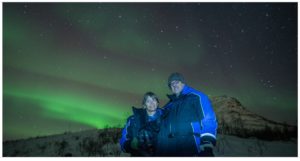
cancelled (Australia’s loss) Guy and Pauline have been able to take
some time out to enjoy some time in the Norwegian Arctic observing
the Northern Lights.
However,
as can be seen, people who disrespect and wish harm towards Guy, whom
I can only call arseholes have followed him there.
Guy
is not mentioning any names but I can hazard a guess who was
responsible.
In
order for the light to shine so brightly, the darkness must be
present
~
Sir Francis Bacon
Some
readers have informed me that my essays must stick to climate
science. According to this perspective, my personal life is not worth
reading about, hence not worth writing about. Others of course feel
similarly about my work on abrupt climate change leading to near-term
human extinction. I rarely waterboard an unsuspecting victim into
reading anything I write, but on this occasion I’m providing a note
of warning: What follows is a personal account, nearly devoid of
evidence about abrupt climate change.
As
regular followers of my work are aware, I recently visited Norway.
The airfare was generously, accidentally provided by the attempted
host and sponsor of my Australian tour when he withdrew support. The
evidence-free smear campaign launched my way caused him to fearfully
withdraw sponsorship after flexible airline tickets were purchased.
Living my message led me on a chase for the northern lights, which
I’d never seen. I’ll express a few thoughts as I depart the
country this dark Sunday morning. In
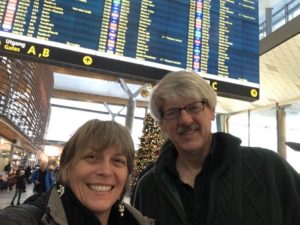
the Oslo airport, headed to Tromsø I
know the environmental costs of air travel. I also know about global
dimming, the topic few self-proclaimed authorities refuse to
acknowledge. Please keep your judgment to yourself. The
trip was an overwhelming success. Aurora
borealis
spectacularly swirled and shimmied from horizon to horizon. The ten
people in my first-night tour group were treated to a multicolored,
all-night show. Even though I’m chromatically challenged, the
celestial show was impressive. The
second night was canceled by a snowstorm. The final night found us
viewing great lights again, this time beneath the sparkling Geminid
meteor shower. The
return to my Scandahoovian roots — as my mom would jokingly say —
attracted the kind of animus I’ve come to expect from people who
would prefer I become as miserable as they are. Sadly for them, those
days are long behind me. I no longer use the expectations of others
as a means of entrapment. As
usual, I volunteered my time to meet with anybody who desired on my
first and likely last trip to Norway. This is known as generosity.
Many people, unfamiliar with the concept, confuse it with seeking
status. As
usual, my generosity was countered with selfishness and hatred. My
attempt to serve as a rare “leaver” in the spirit of American
writer Daniel Quinn was abundantly greeted with Quinn’s commonplace
“takers.” Emblematic
of my generosity, I agreed to have lunch with anybody who desired.
Almost immediately, I was attacked by anonymous trolls claiming I
would use the opportunity to extract meal money out of unsuspecting
“fans.” I’m
the most generous person I know with respect to money and time. I
have given away nearly all that hasn’t been taken from me. Whereas
I’m not averse to dining at the expense of somebody who wants to
converse with me, I don’t charge for the experience. People far
less knowledgeable and interesting than me charge $500 US per hour to
chat on the telephone. Dining surely costs even more! In contrast,
I’ve been practicing a “gift economy” in a world dominated by
takers so long I’ve barely a dime to my name. Such is the outcome
one can expect in response to generosity in a culture of
colonization. A
visiting Catalonian selected the venue. My partner and I arrived at
the appointed time and place to enjoy the delightful company of new
companions from Norway, Spain, and England. Good
news: Seven of us enjoyed the meal and conversation. More good news:
One of the seven generously picked up the tab. Bad
news, at least for the jealous trolls: I’ll not reveal which one.
More bad news: We’re leaving Norway this morning. I’d
like to report that I will reflect positively on the entire Norwegian
experience in the years to come. For better and worse, I don’t have
years ahead of me.
A PERSONAL POSTSCRIPT
Unfortunately it seems to be my fate to fall out with people who have have picked a fight- in each case over Guy McPherson.
Notable examples have been Nicole Foss and Mike Ferrigan.
Now I can add Torstein Viddal to that list.
Already notorious for being crusty (that is the most charitable description I can give) and picking a fight usually over nothing
His response to what I took to an innocent question of mine regarding a Jennifer Hynes interview with Paul Beckwith left me shaken and definitely more understanding of what Guy has had to put up with.
"Scary, scary. Can you tell me what interview this was taken from, Torsten?"
His response:
"Can you explaing to me the realistic situation where you would need to know which interview this was taken from Robin. Has someone got their knife to your throat....?"
More comments followed which I do not have access to as we worked himself up to what must have been quite a rage. Finally, I was kicked out of his Facebook group and blocked:
“I'm
gonna block you forever here now. You fool me for a long time, but
your posting of the Climate Denier vid yesterday was very revealing.”
I have noticed this tendency to pick arguments and especially with Guy. My observation is that he tends to make prognosticiations which Guy has quoted and then he gets angry with being quoted and denies his original statements.
It would take a fairly obsessed mind to spend time putting the following piece with Mike Ferrigan and Mike Sliwa together.
It is very sad that we can't just debate the science and keep it seemly without the ad hominem attacks and efforts to destroy Guy's reputation.
The video is from Extinction Radio. One might ask what any of the following has to with near-term extinction or climate change, but we have to keep in mind who we are dealing with.
It is not in my nature to ignore such behaviour and slurs towards the messenger of Bad News.
Just
in case you think this is just about me I would like to share two
comments on this from Facebook (names withheld):
“My
interactions with Torstein have been consistently weird. He rarely
answers a question directly”
“I
have had so many battles with him (Torsten), always about nothing. Also other friends have been blocked like you. I hope you find ways to
feel better. I’m not sure what would make him feel better about
himself. Not sure that I care”
And
about Guy McPherson:
“My
experiences with Guy are that I have found him generous, helpful and
generally magnanimous. I don’t always agree with all he says, and I
think he’s cool with that, which adds to his integrity”
Precisely!
****
All
of this is very sad. I like to get on with people and do with the
majority and cannot help those with whom I cannot get on with.
It
has given me once again cause to consider the future of what I have
been doing day-in and day-out for over six years.
2017
volume maximum 20,756 km³ on April 18th (*lowest*)
2017
volume minimum 4,539 km³ on September 11th (4th lowest)
2017
extent maximum 13,878,287 km² on March 6th (*lowest*)
2017
extent minimum 4,472,225 km² on September 9th (6th lowest)
However,
the above daily numbers carry a taste of ��. If you
don’t want to cherry–pick your data to make a point, you may want
to look at the latest, updated, running annual average. The ice,
after all, has to be out there and survive those waves 24/7, 365 days
of the year.
The
Arctic Sea Ice Volume is 2017 at it’s ever recorded low. Maybe this
sounds somehow special, but what‘s going on in the Arctic now has
huge consequences for the climate of the planet. Finland‘s
President Niinistö said in North Russia: ‘If
We Lose the Arctic, We Lose the World’
In
this episode I have an interview with Torstein
Viddal from
Norway, now living on Greenland. He is a novelist, has a master in
information science and is an eco activist since decades. Torstein is
following data of ice extent and volume in the Arctic very closely.
Now in 2017 he has observed the lowest ice volume of millions of
years.
Torstein
about the dire situation we are in:
Emotionally
I think I will always be like – keeping it real. Accepting the
situation we are in, is so much easier than denying it, because I
suspect, that even the deniers fear what’s inside that box, but
they are not looking into.
(Foto
from Torstein Viddal from Greenland)
I
have inserted a short introduction from THE Arctic expert in the
world, Professor
Peter Wadhams,
from October 2016.
Peter Wadhams, professor emeritus of ocean
physics at Cambridge University, is a sea ice specialist with 46
years of research on sea ice and ocean processes in the Arctic and
Antarctic. In more than 50 expeditions to both polar regions, he has
worked from ice camps, icebreakers, and aircraft. He also has
traveled six times on Royal Navy submarines under frozen north polar
seas to conduct research. His book, highly recommended, is "A
Farewell to Ice".


 Posts
Posts