Showing posts with label Reserve Bank. Show all posts

Sunday, 10 January 2021

NZ Reserve Bank hacked

 NZ Reserve Bank data breach: Sensitive information illegally accessed


NZ Herald,

10 January, 2021


The Reserve Bank of New Zealand is responding "with urgency" to a breach of one of its data systems.

A third-party file sharing service used by the Bank to share and store some sensitive information, has been illegally accessed.

Governor Adrian Orr says the breach has been contained, and the Bank is treating the matter with the highest priority, and acting with urgency.

"We are working closely with domestic and international cyber security experts and other relevant authorities as part of our investigation and response to this malicious attack. The nature and extent of information that has been potentially accessed is still being determined, but it may include some commercially and personally sensitive information."

"The system has been secured and taken offline until we have completed our initial investigations. It will take time to understand the full implications of this breach, and we are working with system users whose information may have been accessed. Our core functions remain sound and operational.

A spokesman for the RBNZ refused to immediately name the third-party provider, nor if the GCSB or any other government security agency had been roped in to assist.

The past 12-months have seen an escalation in cyberattacks, according to Crown agency Cert (Computer Emergency Response Team) NZ, with attacks increasing by 33 per cent year-on-year.

August and September saw the GCSB come to NZX's aid as the local stock exchange struggled to repel a series of DDoS (distributed denial of service) attacks that overwhelmed its website.

Earlier in 2020, there were cyberattacks on multiple corporate targets including Fisher & Paykel Appliances, Toll Group and Lion.

In F&P Appliance''s case, a "ransomware" gang leaked a number of its spreadsheet and planning files onto the internet, in a bid to pressure the company to pay for the return of its stolen files. F&P refused.

AUT computer science professor Dave Parry told the Herald that a Covid was a double-whammy had contributed to the dramatic rise in cyberattacks.

The pandemic has spurred a working-from-home boom, often involving much lower security, as the same time that lockdowns around the globe had reduced many of organised crimes' usual "real-life" avenues - leading to a spike in cybercrime.

Businesses were being targeted to exploit the gaps in security that were opening up as staff shuffled files between work and home - and simply because commercial organisations are richer targets.

Thursday, 27 August 2020

NZ Reserve Bank has more than doubled the money supply

 The one graph every New Zealander should see


Redpillblog,

18 August, 2020


Here is the one graph every New Zealander should see.


In every country in every historical period the over-issue of money has led to hyperinflation.  In its latest report the NZ Reserve Bank has confirmed that since December it has more than doubled the money supply.  For years the bank’s assets have been around $30billion.  They are now $56 billion.

In response to COVID-19 we’ve introduced a range of initiatives to provide additional monetary stimulus and to support the smooth functioning of New Zealand’s financial markets. These initiatives have enlarged our balance sheet from its December (pre-COVID-19) level of $24.6 billion to $56.0 billion at the end of June. Of this increase $4.9 billion occurred during June.

However the story does not end there.  As the bank mentions in the 
next sentence:

Our balance sheet is likely to increase further from here.

Clearly this is not business as usual.  New Zealanders have become good preppers for earthquakes, tsunamis and viruses.  Should they now be prepping for hyperinflation?

Last week New Zealand’s alternative gold-pegged currency RedPill released  
7 Hyperinflation Essentials that help business owners evaluate the risk.

If the Labour government’s 
May announcement of pumping another $163 billion into the economy transpires the Reserve Bank’s balance sheet will reach $187 billion by 2024.  For an economy the size of New Zealand this is a staggering sum.

By way of comparison the Reserve Bank estimates the total cost of rebuilding Christchurch after the 2011 earthquake at $40 billion.  Is it only a matter of time before the NZ dollar hyper inflates? 

Monday, 16 March 2020

NZ Reserve Bank responds to economic impact of coronavirus

Reserve Bank announces 
emergency official cash 
rate cut
The Reserve Bank has cut its benchmark interest rate by
three quarters of a percentage point, to support the 
economy against the impact of the Covid-19 virus.


Watch:


16 March, 2020

The central bank cut its official cash rate to a record low 0.25 percent from 1 percent.

Governor Adrian Orr said the cut was necessary to support businesses and employment.

"The negative economic implications of the Covid-19 virus continue to rise warranting further monetary stimulus."

"Since the outbreak of the virus, global trade, travel, and business and consumer spending have been curtailed significantly," he said.


At a press conference after the announcement this morning, Orr said the impact on the New Zealand economy was, and would continue to be, significant.

"An interest rate cut was not gonna stop Covid-19 virus, and monetary policy should be done in a medium-term framework and with the best information possible and with line of sight on what is happening to other economic activity, for example fiscal policy.

"I would love to think New Zealand is in exactly the right position in a horrible situation to be in the best possible position that we can."

He said there were however a couple of things to the country's advantage that should be kept in mind.

"First we are in a strong economic position at present, inflation is low and stable and employment has been around its maximum sustainable level. Second, New Zealand's financial system remains sound and our major financial institutions are well capitalised and liquid."

He said they expected growth and inflation to be lower, but would not give an estimate of scale.

He said the central bank was planning to buy government debt bonds.

"As big as is needed. One of the interesting challenges in New Zealand - it's the irony of being well behaved - is that we don't have massive amounts of government debt to buy, but we certainly have quite a lot to buy for a significant monetary impulse.

"They aren't the only assets that we could buy and large-scale asset purchasing is also not the only tool that we have. We also have the FX, and the stock market, and on and on and on."

The last time the RBNZ made such a big cut was in March 2011 after the Canterbury earthquake.


Central banks around the world have been cutting rates to counter the economic impact of the virus.

Orr said the monetary policy committee had decided the OCR would stay at the new low for at least 12 months, but it was reluctant to cut further.

"The Committee also agreed that should further stimulus be required, a Large-Scale Asset Purchase programme of New Zealand government bonds would be preferable to further OCR reductions."

Last week, the bank outlined a range of unconventional monetary policy tools such as negative interest rates, special loans to banks, and buying bonds to put money into the economy.


The rate cut will complement the government's planned economic package due on Tuesday, which is expected to detail specific assistance to businesses including wage subsidies, and cash grants.

The RBNZ has been at pains to say that monetary policy can have only a limited effect to counter the effect of the virus, but lower interest rates will reduce borrowing costs and encourage banks to lend to businesses, and ensure liquidity in the financial system.


The New Zealand dollar fell to a near-11 year low of 59.7 US cents.

The Reserve Bank is also giving retail banks a 12 month breathing space over new rules requiring them to increase their capital reserves.

The rules obliging banks to start beefing up their finances with more capital were due to come into force in July.

The Reserve Bank has delayed that for a year and says if necessary will push that out further.

Deputy governor Geoff Bascand said the delay was needed to support lending during a period of much uncertainty.


All the major banks have cut home loan interest rates in response to the rate cut by the Reserve Bank.

Interest on savings deposits had also been cut accordingly.

Finance Minister Grant Robertson told RNZ's Morning Report the cut would provide some clarity.

"I certainly think it provides certainty for a lot of people, obviously a 75 ... basis point cut, that is significant. One of the things we sometimes hear from trading banks is they're not sure if they can pass on the impacts of a cut because they're not sure whether it might bounce back up again or go down further," he said.

"This says certainly that this is the position that they're going to be in for some time, so [banks] can now work with their customers to pass on the benefits of the cut."


Wednesday, 7 August 2019

NZ DOLLAR CRASHES


THIS I trust

Kiwi Craters After RBNZ Surprises Traders WIth 50bps Rate-Cut


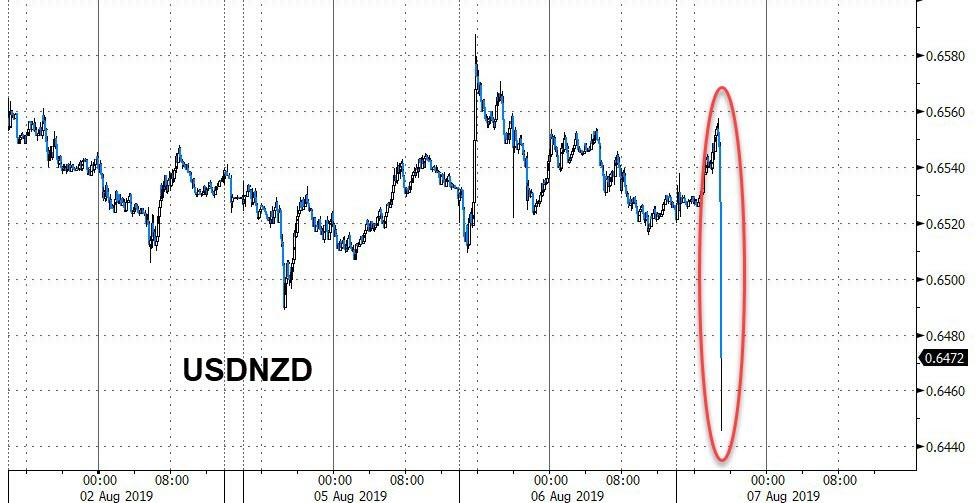
The New Zealand Dollar is tumbling following a surprise 50bps rate-cut by RBNZ (economists had forecast 25bps) to 1.00%, citing downside risks on inflation and jobs.


6 August, 2019

Mimiccing The Fed's apparent lack of data-dependence, this surprise rate-cut followed a strong 3.9% unemployment print; and just like The Fed, RBNZ is clear that global trade issues are an important factor:
"Heightened uncertainty and declining international trade have contributed to lower trading-partner growth."
Some key quotes from the statement here:
GDP growth has slowed over the past year and growth headwinds are rising,” the central bank said in a statement.
In the absence of additional monetary stimulus, employment and inflation would likely ease relative to our targets.
Our actions today demonstrate our ongoing commitment to ensure inflation increases to the mid-point of the target range, and employment remains around its maximum sustainable level.”

Kiwi has plunged...


Near its weakest level against the dollar since Jan 2015...
And 10Y Kiwi note yields plunged 17bps to a record low 1.128%!


Clearly the central bank is trying to get ahead of the curve of global easing and as Bloomberg's Garfield Reynolds notes, RBNZ obviously decided they didn't dare risk any sort of bounce in the kiwi if they followed the Fed's playbook and made a so-called hawkish cut. The currency had ticked up into the decision to offer the board a warning about the perils of insufficient action.


Here's the take from Kyle Rodda, analyst at IG Markets in Melbourne.
This was not what the market was expecting at all, it’s a shock to many. Considering the data isn’t terrible for New Zealand at all, this is an example of a central bank that’s looking beyond current data and trying to get ahead of the global slowdown.”

They also secured themselves a weaker currency even if the Fed finds itself pushed toward further rate cuts.
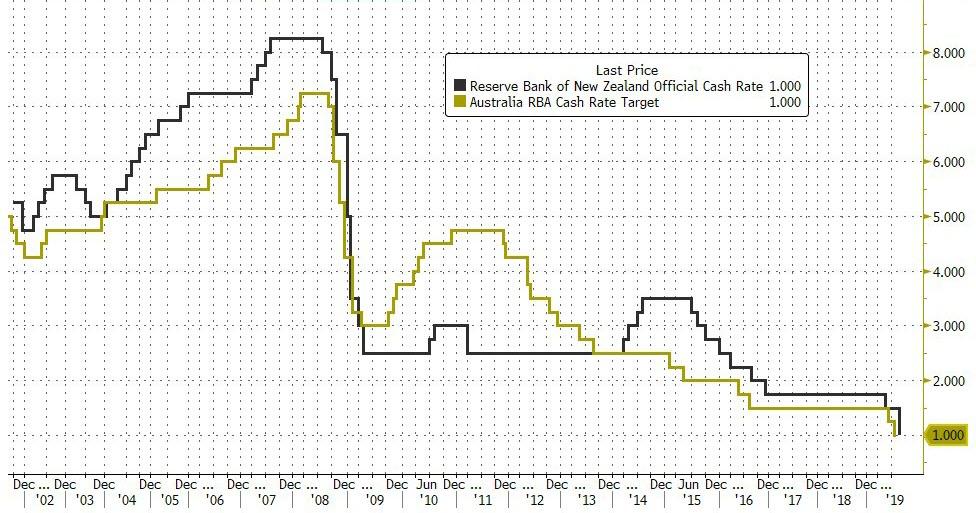
Additionally, this brings RBNZ's policy rate in line with RBA's rate...


This I do NOT


Reserve Bank cuts Official Cash Rate by 0.5 percent to sit at 1 percent


7 August, 2019


The Reserve Bank (RBNZ) has slashed its benchmark interest rate by a greater than expected half a percent in the face of significant headwinds at home and abroad, sending the New Zealand dollar plunging.

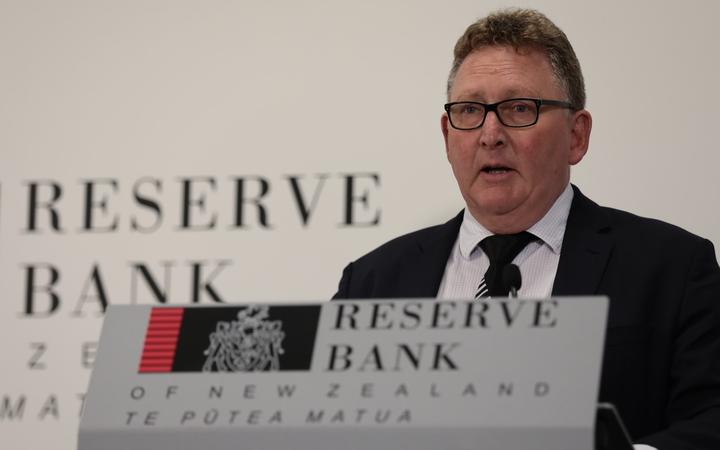
Reserve Bank governor Adrian Orr.


Reserve Bank governor Adrian Orr Photo: RNZ / Dom Thomas

The official cash rate (OCR) was reduced to a record low 1 percent, when forecasters had been expecting a lesser quarter percent cut..

RBNZ Governor Adrian Orr said the risks have risen and the economy needed more stimulus to help counter the weaker outlook.

"In the absence of additional monetary stimulus, employment and inflation would likely ease relative to our targets."

The RBNZ held the rate steady in June after cutting by a quarter of a percentage point in May - its first move in more than two years.

The last time the RBNZ cut by such an amount was in March 2011 after the Canterbury earthquakes.

But Mr Orr said recent solid growth and employment numbers were positive, but the worsening international outlook was hurting New Zealand.

"Global economic activity continues to weaken, easing demand for New Zealand's goods and services. Heightened uncertainty and declining international trade have contributed to lower trading-partner growth."

Economy should improve


Mr Orr said low interest rates and increased government spending were expected to lift the economy over the coming year. Inflation was expected to reach its 2 percent target and employment should remain strong, which are the RBNZ's overriding policy objectives.

Interest rate decisions are now made by a committee of four RBNZ staff and three outside members.

A summary of the committee's deliberations showed discussion about the effect of increased government spending, soft wage growth, and a slowing housing market dampening consumer spending.

"They agreed that the larger initial monetary stimulus would best ensure the Committee continues to meet its inflation and employment objectives," the statement said.

Neither the statement nor the RBNZ's forward projections pointed to another rate cut, and suggested the OCR might be held at current levels through to 2022.

The New Zealand dollar slumped a full cent against the US after the decision, as investors were caught by surprise by the size of the cut. The Kiwi settled at around 64.4 US cents.

ASB Bank was quick to respond to the hefty cut, by reducing its floating mortgage rate by half-a-percent, but it trimmed its short term fixed rate by only a small amount.

An economist said the RBNZ had clearly decided to 'front-load' the support for the economy, and its commentary still had an easing bias.

"We forecast a further 25 basis point (quarter-percent) cut in November, but timing will be heavily influenced by global risks, which are fluid at present," ASB chief economist Nick Tuffley said.


Monday, 29 October 2018

Former NZ Reserve Bank governor gives warning


Former RBNZ Governor: A decade of high debt and loose money comes home to roost


26 October, 2018

Alan Bollard joins the line up of ex-central bankers sounding warnings about “loose money” that occured on their watch. We’ve heard “warnings” from Greenspan and Bernanke in the USA in recent years. And former UK prime minister and chancellor of the exchequer Gordon Brown just last month warned we were sleepwalking into a crisis.

Now Bollard says:

It may be that some future economic risks are not yet fully priced into markets. Already there have been significant swings in exchange rates as the US reserve currency strengthens and some third countries are considering erecting new tariff structures themselves.

Apec finance ministers are convening to address these issues, including growth prospects and how to make tax policies, financing and economies more effective and inclusive. But now, as they prepare their advice for the region’s leaders, including Prime Minister Jacinda Ardern, to meet here in November, there is another issue on the agenda – new economic and financial risks.

Since the global financial crisis, financial sector debt has decreased appropriately, but cheap credit has brought mounting debt in the private sector and state-owned enterprises in emerging markets. Deteriorating local currencies and tightening international monetary policy could make it difficult to service some of this debt. Tariff increases causing domestic inflation would worsen policy options.


Ten years ago, we saw how badly managed financial risk could hurt the world’s economies. A decade later, we do not want to see how badly managed economic risk could trigger another financial crisis.”


'The world is sleepwalking into a financial crisis' – Gordon Brown

Former PM delivers scathing analysis of how the problems of 2009 remain unresolved

A leaderless world is sleepwalking towards a repeat of its near meltdown in late 2008 and early 2009 because it has failed to remedy the causes of the financial crash of a decade ago, former prime minister Gordon Brown has warned.

Britain’s leader during the period when the collapse of the US investment bank Lehman Brothers put every major bank at risk, said that after a decade of stagnation the global economy was now moving into a decade of vulnerability.....