This video from Army and Navy Day last weekend seems to indicate where the support of rank-and-file military might lie even as the top notch do not.
As He Blocks Election Security
Bills, McConnell Takes Checks
from Voting Machine
Lobbyists
The bills McConnell is blocking would subject the voting machine vendors to new cybersecurity regulations and could reduce their overall sales to states.
In 2016, Russian hackers targeted voting systems in 21 states and, according to Special Counsel Robert Mueller’s report, breached systems in Illinois and two counties in Florida, gaining access to information on millions of registered voters. In his report, Mueller described the Russian government’s interference in the 2016 elections as “sweeping and systematic.”
Three years later, security experts warn that not enough has been done to address vulnerabilities in the U.S. election system. The director of the Federal Bureau of Investigations recently told Congress that “the threats just keep escalating,” adding that he viewed the 2018 midterms as a “dress rehearsal for the big show in 2020.”
In fourteen states, some 2018 midterm voters submitted their votes on touchscreens that did not produce paper trails necessary to verify their votes or audit election outcomes. If votes had been inaccurately processed in these precincts—whether through equipment errors or foreign hacking operations—election officials wouldn’t have been able to find or correct the problems.
Several Democratic and Republican members of Congress have submitted legislation to shore up election security. Proposals from Sen. Ron Wyden (D-Ore.), Sen. James Lankford (R-Okla.) and Rep. John Sarbanes (D-Md.) include replacing paperless electronic voting machines with hand-marked paper ballots and optical scanners, subjecting voting equipment vendors to rigorous cybersecurity standards, and requiring vendors to report cybersecurity incidents.
But all the bills have hit a roadblock. Senate Majority Leader Mitch McConnell (R-Ky.) has reportedly told his colleagues that he will not allow the Senate to vote on election security legislation this session.
“At this point I don’t see any likelihood that those bills would get to the floor if we mark them up,” Senator Roy Blunt (R-Mo.) said recently when asked by Sen. Dick Durbin (D-Ill.) whether the Rules Committee, which Blunt chairs, would mark up any election security bills. The Hill asked McConnell’s office about Blunt’s comments regarding election security and was referred to the majority leader’s verdict on the Mueller report: “case closed.”
Senator Wyden told Sludge he thinks McConnell does not want to make elections more secure.
“The only logical conclusion is that Senator McConnell wants American elections to be vulnerable to hackers and foreign interference,” Wyden said. “It is unconscionable for Republicans to stick their heads in the sand and do nothing after what happened in 2016. If Congress doesn’t act, it’s only a matter of time before hackers successfully interfere again.”
The two largest voting machine vendors in the U.S., Election Systems & Software (ES&S) and Dominion Voting Systems, together supply more than 80% of the nation’s voting machines. The companies have operated extensive lobbying operations in states for years, and both companies recently hired new lobbyists to represent them at the federal level.
ES&S hired lobbying firm Peck Madigan Jones in Oct. 2018 and paid it a combined $150,000 to lobby the U.S. Senate and House of Representatives in the fourth quarter of 2018 and the first quarter of 2019. ES&S did not employ any federal lobbyists in 2017, and when they reported lobbying in previous years it was at a much lower level, spending just $10,000 in many quarters. Dominion Voting Systems, which was recently acquired by New York-based hedge fund Staple Street Capital, signed its first-ever federal lobbying contract in January 2019 with Brownstein Hyatt Farber and Schreck and has paid the company at least $30,000 so far to lobby Congress.
Several of the lobbyists working for ES&S and Dominion Voting Systems have recently made contributions to McConnell’s campaign and joint fundraising committee.
Brownstein Hyatt Farber and Schreck lobbyist David Cohen, who lobbies for Dominion Voting Systems on issues related to election security and monitors federal legislation for the company, gave McConnell $2,000 on March 31: $1,000 to his campaign committee and $1,000 to his joint fundraising committee. Lobbyist Brain Wild, who works alongside Cohen on the Dominion contract, gave McConnell $1,000 on the same day.
Emily Kirlin, a lobbyist for Peck Madigan Jones who lobbies for ES&S on election security and H.R. 1, gave McConnell’s campaign committee $1,000 on February 19, and her colleague who works with her on the contract, Jen Olson, gave McConnell $1,000 on March 4.
“It’s not surprising to me that Mitch McConnell is receiving these campaign contributions,” the Brennan Center for Justice’s Lawrence Noren told Sludge. “He seems single-handedly to be standing in the way of anything passing in Congress around election security, and that includes things that the vendors might want, like money for the states to replace antiquated equipment.”
“Mitch McConnell’s conflicts of interest in blocking any and all election security legislation is not only shameful, it is placing our democracy at risk,” Craig Holman, government affairs lobbyist at Public Citizen, told Sludge. “The conflicts of interest arise from more than the campaign contributions he is receiving from voting machine vendors—contributions which certainly appear to be a reward from the industry for letting them off the hook—but it is also a self-serving act for strictly partisan purposes.
“McConnell believes this foreign interference in our democratic process will again favor the GOP, and so he is doing everything possible to make sure that window stays wide open for those who seek to do harm to our political system,” Holman said.
McConnell’s office did not immediately respond to a request for comment.
TUCKER, GA – JUNE 20, 2017: Michele Parsons uses a paperless electronic voting machine to cast her ballot during a special election in Georgia’s 6th Congressional District special election at St. Bede’s Episcopal Church. (Photo by Joe Raedle/Getty Images)
Voting machine vendors like ES&S and Dominion Voting Systems are not currently subject to any specific regulations or mandatory security standards.
“In contrast to other sectors, particularly those that the federal government has designated ‘critical infrastructure,’ there is almost no federal oversight of private vendors that design and maintain the systems that allow us to determine who can vote, how they vote, what voters see when they cast their vote, how votes are counted, and how those vote totals are communicated to the public,” Noren told Congress recently in a testimony. “In fact, there are more federal regulations for ballpoint pens and magic markers than there are for voting systems and other parts of our federal election infrastructure.”
Several of the bills that have been proposed in Congress would subject them to regulation and oversight for the first time, and some could result in the companies doing less business with the states as they encourage the use of hand-marked ballots instead of machines.
A bill from Senator Wyden—the Protecting American Votes and Election Act (PAVE Act)—would, for the first time, establish minimum cybersecurity requirements that election equipment vendors would have to comply with in order for their equipment to be eligible for use in federal elections. The rules would be established by the Department of Homeland Security, and systems would have to be tested and certified by the Election Assistance Commission (EAC).
The PAVE Act would also require voting systems to use an “individual, durable, voter-verifiable, paper ballot of the voter’s vote that shall be marked and made available for physical inspection and verification by the voter before the voter’s vote is cast and tabulated.” And while the bill does not explicitly ban electronic systems for marking paper ballots—something that both ES&S and Dominion Voting Systems have begun manufacturing—it specifies that funding it would give to states to replace their paperless systems could not be used “to acquire any electronic device that a voter can use to mark a paper ballot.”
If a paper ballot requirement were to become law, with or without a funding restriction such as the one included in Wyden’s bill, the increased costs and security risks of ballot-marking machines could make them less appealing to states looking to purchase new systems.
According to testimony from Alex Halderman, Professor of Computer Science and Engineering at the University of Michigan, equipping a precinct with ballot-marking electronic devices costs about three times as much as equipping it with a truly paper-based system along with a dedicated electronic device for voters with disabilities. “Fortunately, the most cost-effective approach is also the most secure: hand-marked paper ballots counted using optical scanners,” Halderman stated.
Another bill being blocked by McConnell, the House-passed H.R.1, includes a paper ballot requirement and would subject vendors to additional new security regulations. Voting machine vendors would be required to follow cybersecurity best practices that would be issued by the EAC’s Technical Guidelines Development Committee, and they would have to report election cybersecurity incidents and response plans to the EAC. They would also be forced to submit their equipment to independent security testing, and the EAC would be empowered to decertify any equipment that does not meet its security standards.
“I don’t know why Mitch McConnell is staging a full roadblock of election security legislation,” Wyden said. “But it is clear as day that there are politicians in the country who view insecure voting equipment as a benefit that helps them win elections. Instead of defending Americans’ constitutional rights, they are looking at this issue from a purely cynical and political standpoint.”
CHINA MITCH: McConnell
Has Family Ties to Bank of
China, Top Chinese Shipping
Firm
McConnell's familial link to Chao family's Foremost shipping company, Chinese State Shipbuilding corporation, and Bank of China resurface after Kentucky senator's declaration of victory for Joe Biden
As news breaks Tuesday of Senate Majority Leader Mitch McConnell’s praise for the United States’ election “process” and declaration of “congratulations” for “President-elect Joe Biden,” the Kentucky senator’s extensive family ties to China have resurfaced as a topic of conversation.
McConnell’s marriage into the Chao family dynasty has coincided with a trajectory of ever-increasing personal profit for McConnell and the Chaos, as well as Chinese state business interests.
BANK OFCHINA
McConnell’s wife, Elaine Chao, is the daughter of shipping magnates James and Ruth Chao and the sister of Angela Chao, the latter of whom was appointed to a non-executive position on the Bank of China’s board of directors in 2016.
CHAO FAMILY WEALTH
A massive spike in McConnell’s financial disclosures occurred in 2007 and 2008 following the death of Ruth Chao, with the senator’s federal disclosure jumping from $3 million to $33 million in that two year span according to Forbes.
McConnell’s re-election campaigns have received over $1 million in contributions from Elaine Chao’s family, including James and Angela, according to a 2019 report from the New York Times.
CHAO SHIPPING EMPIRE
Aside from her position at the Bank of China, Angela Chao also serves as the CEO of Foremost, which is the Chao family’s billion-dollar maritime shipping empire. While Foremost is an ostensibly American company with offices located in New York City, Forbes noted that the company’s fleet of vessels “sail under flags registered in Liberia and Hong Kong, and the company does the vast majority of its business in Asia.”
Foremost’s upward trajectory has remained steady during McConnell’s tenure in the Senate, with the company continuing to prosper even during multiple economic downturns in the industry. Shipping database VesselsValue has estimated the company fleet’s net worth at $1.2 billion, making it the most valuable such fleet of any dry bulk shipping operation headquartered in the United States in 2019.
Perhaps some of Foremost’s good fortune can be attributed to the several hundred million dollars’ worth of loans it is contracted to receive from the Chinese government, or the fact that James and Angela Chao, who describe themselves as Americans, have served on the board of the Chinese government-owned China State Shipbuilding corporation. China State Shipbui
The New York Times noted in its 2019 report that the Bank of China, where Angela Chao serves as a non-executive director, is a top lender to China State Shipbuilding.
AMERICA LAST, CHINA FIRST POLITICS AT DEPT OF TRANSPORTATION
Under Elaine Chao’s tenure as Secretary of Transportation, the agency budget “has repeatedly called to cut programs intended to stabilize the financially troubled maritime industry in the United States, moving to cut new funding for federal grants to small commercial shipyards and federal loan guarantees to domestic shipbuilders” according to the Times.
The report also noted that while the Chao family has paid for Chinese programs that provide scholarships and ship simulators for Chinese sailors, Elaine Chao’s Department of Transportation has repeatedly tried to excise grant funding for programs that keep domestic American vessels in service and buy ships that would be used to train American seamen.
McConnell and the Chaos have repeatedly dismissed concerns about conflicts of interest relating to the Senate Majority leader’s family ties to Foremost and Beijing, with Angela Chao insinuating that her ties to McConnell have only come under scrutiny because of anti-Chinese prejudice.
However, critics have noted that the fact McConnell’s public refusal to help President Trump in the latter’s fight to restore election integrity could be influenced by the fact that President Trump’s pro-American, hardline stance towards trade with China may pose a threat to business interests close to McConnell.
***
Mike Adams represents the hard extreme of the resistance against the coup.
Trump’s intelligence and military team members have put everything in place for an Insurrection Act scenario, but Trump still has to be the one to pull the trigger. Will he?
The Republican party is finished. McConnell just committed career suicide and discredited the entire party by siding with Biden as the “winner” of the obviously fraudulent election.
A new political party will arise from all this, and Americans will reject both the hopelessly corrupt DNC and the pathetic, spineless GOP.
We’ve all been thinking too small. Signs are now pointing toward war with China, not merely a domestic war with the deep state. America may be in an active international war before Jan. 20th.
Cyber hacks that appear to be from China (although the fake news media keeps reporting Russia) have penetrated and compromised the US government agencies that control all nuclear missiles and nuclear material stockpiles. This was a devastating cyber attack, with huge implications for national security.
I am designating this event a “Cyber Red Dawn.”
Gen. Flynn appears to call for Trump to invoke the Insurrection Act. Confirms “foreign interference” in the US elections.
Lin Wood accuses SCOTUS Justice Roberts of being a treasonous, corrupt, (possible) pedophile who has betrayed America.
SCOTUS now designated as “complicit” in conspiracy to overthrow the United States of America.
Reminder of the Pentagon order to shut down its internal “secure” communications systems, across the board, due to devastating cyber intrusion.
The Department of Energy and National Nuclear Security Administration were both hacked and compromised, revealing national security secrets and details about America’s nuclear missiles, nuclear fuel, conventional power grid assets and more. A huge breach. Cyber warfare.
US Army reveals, “We expect adversary actions directed against the homeland.”
SCOTUS is slow-walking the Sidney Powell lawsuit in yet another betrayal of America. The courts will NOT be the solution. Only the military.
Dr. Jerome Corsi says Trump will win.
There is a tug of war within the National Intelligence Agency. Miles Guo (gnews) says, “the war between the CCP and the United States has already started and the battlefield is in the United States.”
Vaccine news: A SECOND Alaska healthcare worker has an allergic reaction to Pfizer’s coronavirus vaccine just one day after another staff member at the same hospital went into anaphylactic shock.
A nurse in the USA passes out and nearly face plants on camera, just minutes after taking the coronavirus vaccine on live TV. Public relations nightmare for the vaccine industry. Doctors rushed to block the camera on the scene…
***
For what it is worth this is what Hal Turner is reporting. I will wait and see but based on precedent I remain sceptical
A "Limited" declaration of Martial Law and/or Invocation of the Insurrection Act of 1807, may be just hours away for several specific U.S. States.
Director of National Intelligence John Ratcliff gave his report on Election Interference today, despite prior word that Intelligence Agencies were battling each other over whether or not to include China in the final report.
Ratcliff CONFIRMED intense foreign interference in the November 3 election by China and others, which, in his estimation, CHANGED THE RESULTS OFF THE ELECTION.
As a result of Ratcliff's report, President Trump is considering declaring Martial Law in the following States:
MI,
WI,
PA,
GA,
and likely AZ as well.
If the Martial Law Declaration is issued, it will include an ORDER for the military to FULLY secure and lockdown ALL election facilities, and voting assets.
United States Marines have already been recalled for this duty.
I was just told this evening that "the United States Army has been redeploying troops and equipment within the United States in anticipation of a limited Martial Law Declaration."
Gen Thomas Mclnerney - Election was “largest cyberwarfare attack on a democracy in history” 11-28-20
Michael Flynn’s decision in January to withdraw his guilty plea in the special counsel’s investigation set into motion a series of disclosures that cast new light on the FBI investigation of the retired Army general.
President Donald Trump pardoned Flynn on Wednesday, asserting that the FBI should have never investigated his former national security adviser.
In the lead up to the pardon, the FBI and Justice Department turned over documents that showed that the lead FBI agent on the Flynn probe questioned the legitimacy of the investigation.
James Comey told Congress that he was uncertain whether Flynn lied in a White House interview that eventually led to his plea deal.
Michael Flynn’s decision earlier this year to withdraw from a plea deal he struck with the special counsel’s office set into motion a series of unprecedented FBI and Justice Department disclosures that has culminated in a presidential pardon for the retired Army general.
President Donald Trump issued a “full pardon” for Flynn on Wednesday. The White House issued a statement asserting that Flynn “should never have been prosecuted.”
Flynn pleaded guilty on Dec. 1, 2017 to making false statements to the FBI during an interview at the White House on Jan. 24, 2017, regarding a phone call he had a month earlier with Russian ambassador Sergey Kislyak.
After a series of delays in his case, Flynn made moves earlier this year to withdraw from his plea deal, saying in a court filing on Jan. 29 that did not intentionally lie to the FBI. (RELATED: Trump Pardons Michael Flynn)
Flynn said he pleaded guilty due to pressure he faced from the special counsel’s office to cooperate in the Russia probe.
Following Flynn’s about-face, Attorney General William Barr ordered a review of Flynn’s case.
He appointed Jeffrey Jensen, the U.S. attorney in St. Louis, to review the Justice Department and FBI’s handling of Flynn-related documents. On May 7, the Justice Department filed a motion to withdraw charges against Flynn, citing evidence that prosecutors had withheld from Flynn’s lawyers.
In a series of court filings, Jensen produced previously withheld documents that detailed FBI and DOJ deliberations about the Flynn case. The documents indicated that FBI officials were not certain whether Flynn intentionally lied to investigators about his contacts with Kislyak.
Other documents showed FBI officials strategizing how to approach the White House interview with Flynn that yielded his guilty plea.
Flynn’s lawyers and defenders have said the evidence shows he did not lie to the FBI. His critics have denied that the belated disclosures have exonerated him, or that he deserves a pardon.
Here are the most significant disclosures in Flynn’s case.
FBI memo closing counterintelligence investigation of Flynn
On Jan. 4, 2017, FBI special agent William Barnett, the lead investigator on a counterintelligence investigation of Flynn, issued a memorandum suggesting that the counterintelligence investigation against Flynn be closed.
The FBI had investigated Flynn and three other Trump advisers since August 2016 on suspicions that they had conspired with Russia to influence the 2016 election.
Barnett wrote that a review of intelligence community databases and sources “did not yield any information” to suggest that Flynn was a secret Russian agent.
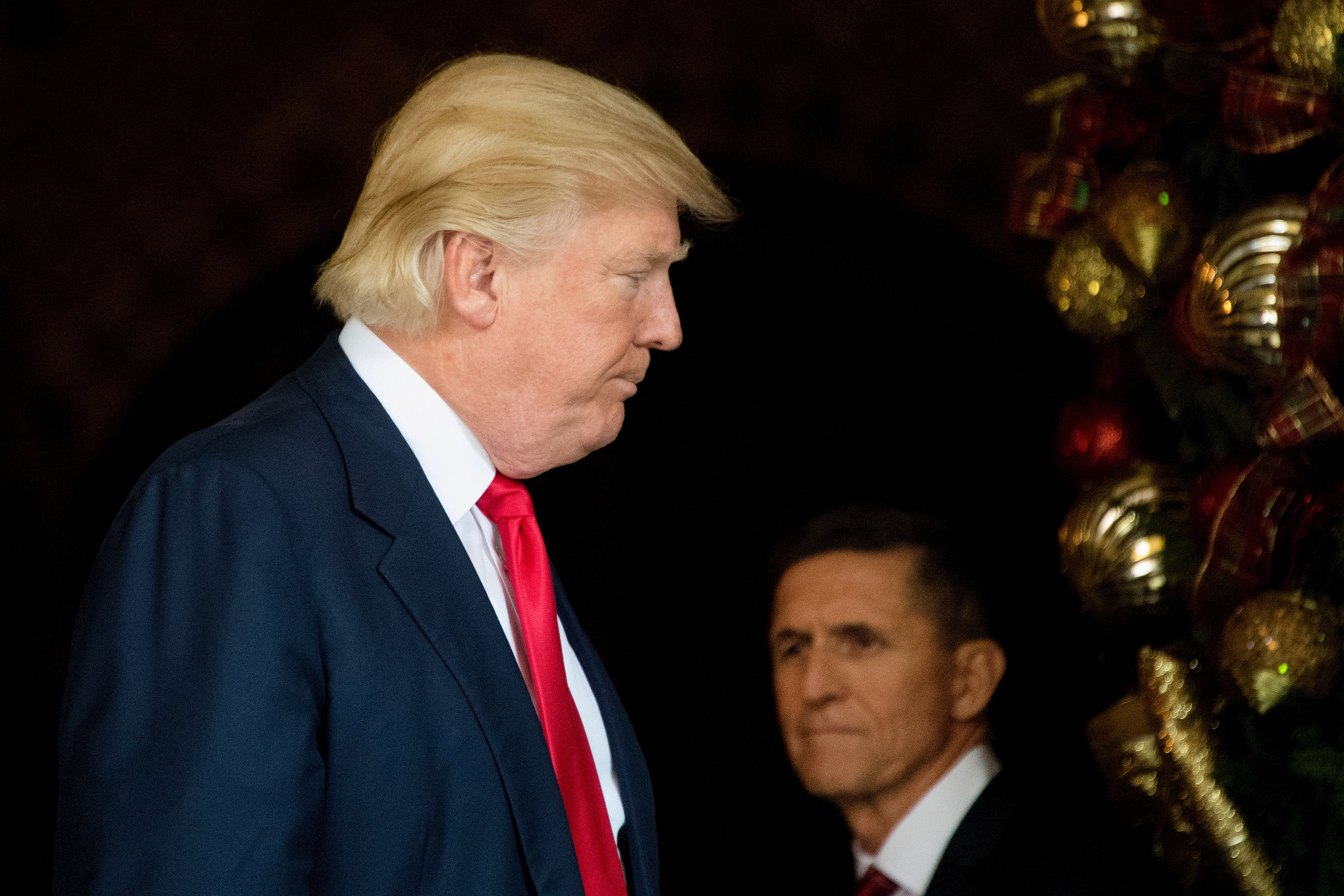
US President-elect Donald Trump (L) stands with Trump National Security Adviser Lt. General Michael Flynn (R) at Mar-a-Lago in Palm Beach, Florida, where he is holding meetings on December 21, 2016. (JIM WATSON/AFP via Getty Images)
The investigation against Flynn remained open, though it shifted to a criminal investigation.
Peter Strzok, who served as deputy chief of FBI counterintelligence, intervened to keep the Flynn investigation going after the bureau obtained a transcript of Flynn’s calls days earlier with Kislyak.
Other FBI documents show that agents began discussing whether Flynn’s calls violated the Logan Act, an obscure law that prohibits U.S. citizens from negotiating with foreign governments on behalf of the U.S.
Strzok would conduct the White House interview with Flynn at the center of his case.
Official questioned goal of Flynn interview
FBI officials huddled before the White House interview with Flynn to discuss the goals of the meeting, according to a memo discovered by Jensen.
Bill Priestap, the chief of FBI counterintelligence, wrote in notes just before the interview with Flynn that he wondered whether the FBI’s goal with the White House interview was to “get [Flynn] to lie,” either in order to get him fired or prosecuted.
“What is our goal? Truth/Admission or to get him to lie so we can prosecute him or get him fired?” wrote Priestap.
Flynn’s lawyer, Sidney Powell, wrote in a court filing that disclosed the notes that they showed that the FBI “pre-planned a deliberate attack” on Flynn.
McCabe notes of his phone call with Flynn
Andrew McCabe, the former FBI deputy director, took notes of his phone call with Flynn setting up the fateful White House interview. The documents were turned over to Flynn’s lawyers in December 2018, well before Jensen began his review of the case.
McCabe wrote in the notes that he suggested to Flynn that lawyers not be present during the White House interview.
“I explained that I thought the quickest way to get this done was to have a conversation between [General Flynn] and the agents only,” McCabe wrote.
Flynn’s defenders have seized on the disclosure as evidence that the FBI targeted Flynn and hoped to get him to lie.
In a May 8, 2020 interview, Barr, the attorney general, accused the Comey-McCabe FBI of setting a “perjury trap” for Flynn.
James Comey was unsure whether Flynn lied
The investigation into whether Flynn lied to the FBI was never an open-and-shut case.
On March 2, 2017, then-FBI Director James Comey told the House Intelligence Committee that he and others at the FBI were not certain whether Flynn lied during his White House interview.
“Do you believe that Mr. Flynn lied?” Comey was asked in the interview.
“I don’t know,” Comey replied. “I think there is an argument to be made that he lied. It is a close one.”
Lead Flynn investigator cast doubt on counterintelligence probe
Perhaps the most significant blow to the FBI’s investigation of Flynn came from Barnett, the special agent who led probe of the retired general.
Barnett told Jensen, the U.S. attorney, in a Sept. 17 interview that he “did not understand the point of the investigation.”
Barnett also said that the special counsel’s team had a “get Trump” attitude.
On March 2, 2017, then-FBI Director James Comey told the House Intelligence Committee that he and others at the FBI were not certain whether Flynn lied during his White House interview.
“Do you believe that Mr. Flynn lied?” Comey was asked in the interview.
“I don’t know,” Comey replied. “I think there is an argument to be made that he lied. It is a close one.”
Lead Flynn investigator cast doubt on counterintelligence probe
Perhaps the most significant blow to the FBI’s investigation of Flynn came from Barnett, the special agent who led probe of the retired general.
Barnett told Jensen, the U.S. attorney, in a Sept. 17 interview that he “did not understand the point of the investigation.”
Barnett also said that the special counsel’s team had a “get Trump” attitude.
In private FBI messages turned over the Jensen, Barnett wrote to a colleague on Nov. 8, 2016, that he was “so glad” that FBI brass had ordered the closure of the investigation into Flynn.

 Posts
Posts