Showing posts with label Correa. Show all posts

Saturday, 13 April 2019

Facebook removes President Correa's Facebook page


'Facebook Removes Page Of Ecuador's Former President On Same Day As Assange's Arrest


10 April, 2019
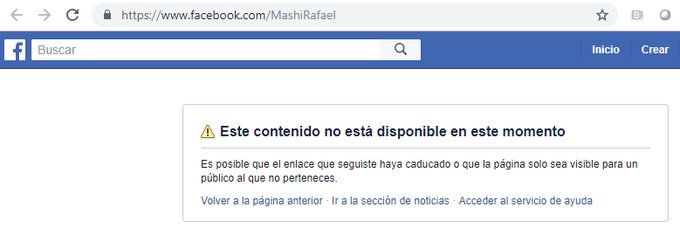
Facebook has unpublished the page of Ecuador’s former president, Rafael Correa, the social media giant confirmed on Thursday, claiming that the popular leftist leader violated the company’s security policies.
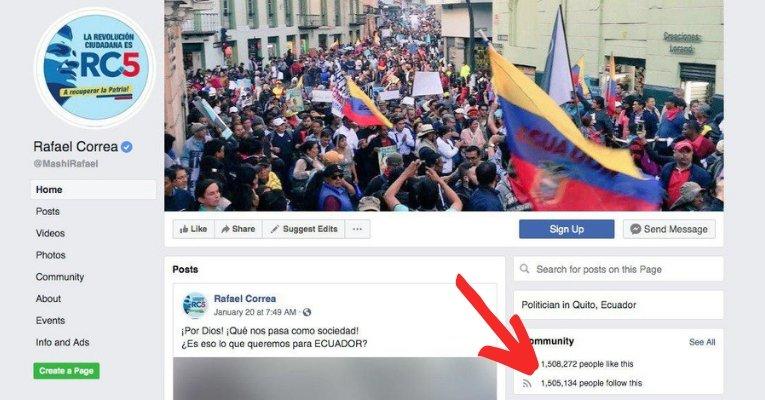
In a statement republished by Ecuadorean newspaper El Comercio, a company spokesperson said:

“Protecting the privacy and security of people is central to Facebook [and] we have clear policies that do not allow the disclosure of personal information such as phone numbers, addresses, bank account data, cards, or any record or data that could compromise the integrity physical or financial of the people in our community.”
The move comes on the same day that Ecuador’s government allowed British security personnel to enter their embassy in London to arrest journalist and WikiLeaks founder Julian Assange, who has been sought by U.S. officials for years due to his role in releasing scandalous information implicating Washington in a range of crimes, including war crimes.
Assange, 47, had been living at the Embassy of Ecuador in London since 2012, when then-President Correa granted political asylum to the Australian amid the British government’s attempts to detain him. At the time, Correa called Eduador’s actions an act of sovereign “duty.”
Ecuador’s current leader, Lenin Moreno, was openly opposed to Assange, whom he referred to on various occasions as a “miserable hacker,” an “irritant,” and a “stone in the shoe” of his government. Moreno’s distancing from the asylee came following a 2017 meeting with Trump campaign confidant and political “fixer” Paul Manafort, where the two discussed Ecuador’s handover of Assange to U.K. and U.S. authorities.
In March, WikiLeaks published a tranche of documents dubbed the INA Papers linking President Lenin Moreno to the INA Investment Corporation, an offshore shell company used by Moreno to procure furniture, property, and various luxury items.
The account number for the offshore account allegedly used by the president to launder money was shared across Ecuadorean social networks by netizens of all political stripes, including by Correa – who had about 1.5 million followers and whose Facebook page enjoyed more interactions and attention than that of President Moreno himself.
The account number was also shared alongside personal photos of President Moreno enjoying lavish breakfasts and dinners of lobster—imagery considered especially damning for the people of Ecuador given Moreno’s previous boasting of an austere poverty diet consisting of eggs and white rice.
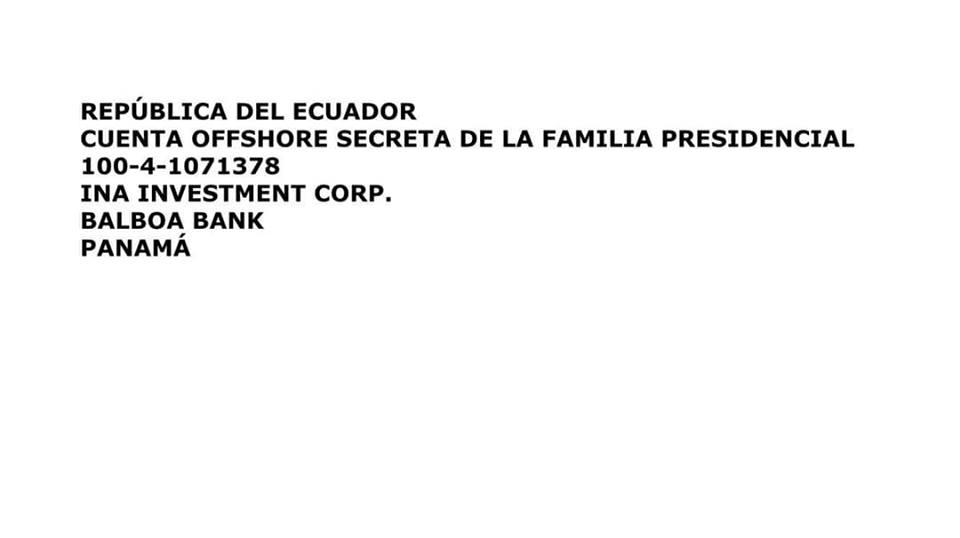
Information on the bank account allegedly used by Ecuador’s president to launder money.
It also came amid attempts by the neoliberal Ecuadorean government to curry favor with financiers in Europe and the United States amid the continuing debt crisis. In March, the IMF finally bailed out Moreno’s government to the tune of $4.2 billion.
Prior to the removal of the page, Correa lambasted his successor in a series of posts that still remain on Twitter at the time of this writing.
Since 2015, Correa—who lives with his family in Brussels, Belgium—had used the social platform to great effect, using strongly-worded posts, video interviews, and live-streams as a platform amid the Ecuadorean media’s de facto blackout of the former leader, who remains reviled by the center-right former opposition and sections of the country’s left.
Former President Correa minced no words in his assessment of Moreno, denouncing him in an English-language tweet as “the greatest traitor in Ecuadorian and Latin American history … Moreno is a corrupt man, but what he has done is a crime that humanity will never forget.”
The greatest traitor in Ecuadorian and Latin American history, Lenin Moreno, allowed the British police to enter our embassy in London to arrest Assange.
Moreno is a corrupt man, but what he has done is a crime that humanity will never forget.

9,868 people are talking about this
In a separate tweet responding to Moreno’s announcement of the handover, Correa further tore into what he called “one of the most atrocious acts [and the] fruit of servility, villainy and revenge.”
“From now on worldwide, the scoundrel and betrayal can be summarized in two words: Lenin Moreno,” the popular former president added.

The removal of Correa’s page for violating Facebook’s “community standards” is an unprecedented move, and the former statesman is the most high-profile public political figure to ever be removed from the social platform–placing the economist and icon of Latin American “socialism of the 21st century” in the same unlikely category as right-wing conspiracy theorist and broadcaster Alex Jones.

Sunday, 6 October 2013

Ecuador's Correa criticises US

Ecuador's Correa: Obama's exceptionalism talk reminiscent of Nazi rhetoric before WWII
US exceptionalism rhetoric poses extreme danger and is reminiscent of Nazi ideals and talk “before and during World War II,” Ecuadorian President Rafael Correa said in exclusive interview with RT Spanish


RT,
4 October, 2013


Referring to US President Barack Obama’s statement that “America is exceptional” because it stands up not only for its own “narrow self interest, but for the interests of all," Correa said: “Does not this remind you of the Nazis’ rhetoric before and during World War II? They considered themselves the chosen race, the superior race, etc. Such words and ideas pose extreme danger,” President Correa said on RT Spanish’ Entrevista program.   


As for cases of espionage in Latin America and the subsequent criticism from regional leaders, Obama said the US will try to respect the sovereignty of those countries “in cases where it will be possible.” 


At the recent UN General Assembly, Brazil launched a blistering attack on US espionage, saying it “is a breach of international law.” 

President Correa said the US will keep violating other countries’ sovereignty, but this will eventually change.  


“What Plato wrote in his [Socratic] dialogues more than 2,000 years ago is true. Justice is nothing other than the advantage of the stronger. They are strong, that’s why they will continue lying, violating other states’ sovereignty, and breaching international law. But one day this unjust world will have to change,” Correa said. 
When asked about whether the UN headquarters should be moved out of the US, Correa replied “definitely yes.” But, he pointed out that there are other things that carry more importance. 

For example, the headquarters of the American Convention on Human Rights is located in Washington, yet “the US did not ratify the Pact of San Jose, that is, the American Convention on Human Rights…but the headquarters of the organization is in the US and they finance their activities,” Correa said. “This is outrageous and an example of a relationship the US established with developing countries in the form of subordination.”
'US will not be able to hide the truth about Chevron’s oil disaster’

While responding to questions about Chevron-Texaco’s oil damages in Ecuador, Correa said that the US would not be able to hide the truth - despite having money, power, and hundreds of lawyers by its side. “Chevron has caused irreparable damage to the Ecuadorian jungle,” the president said. “Texaco did nothing to clear the area…At the time, there were cleaner technologies available, but they wanted to save a few bucks, and they destroyed the environment and did not even bother pay for the damages.”
Correa pointed out that the scale of the disaster in Ecuador is 85 times higher than the BP oil spill in the Gulf of Mexico, and 18 times higher than the Exxon Valdez spill in Alaska. “But they decided that if it happened in the Amazon region of Ecuador, then there is nothing to worry about.”
The case against Chevron-Texaco has been ongoing for two decades, and stems from the oil company’s operations in the Amazon, which date back to the period between 1972 and 1990.
In February 2011, a judgment by a provincial court in Ecuador produced a multi-billion dollar award against Chevron. However, as the company currently has no holdings in Ecuador, the plaintiffs have instead attempted to force payment in Canada, Brazil, and Argentina.
The $19 billion verdict was the result of a 1993 lawsuit filed in New York federal court by a group of American attorneys – including Steven Donziger - on behalf of 88 residents of the Amazon rainforest. In the intervening period, Texaco was acquired by Chevron in 2001, and plaintiffs re-filed their case in Ecuador in 2003.
For its part, Chevron insists that it was absolved of responsibility for the environmental damages by a 1995 cleanup agreement. The oil company places responsibility for the damages on Petroecuador, Ecuador’s national oil company.
At the end of September, Ecuador’s foreign ministry announced that the US had seemingly denied visas to a delegation that was set to travel to the UN General Assembly in New York to present their case regarding an ongoing dispute against Chevron-Texaco.
According to the ministry’s official announcement, visas for the five Ecuadorian nationals were returned by the US Embassy in Quito “without any explanation.”
The group was to present testimony during a special event at the UN regarding the ecological impact caused by Chevron-Texaco’s oil operations in the Amazon rainforest region of Ecuador, which contaminated two million hectares, according to the country’s government.
You may watch the full video of the interview with President Correa in Spanish here.
However see this - 


Amazon Oil Drilling Project Approved By Ecuador's Parliament

Ecuador's parliament on Thursday authorized drilling of the nation's largest oil fields in part of the Amazon rainforest after the failure of President Rafael Correa's plan to have rich nations pay to avoid its exploitation.


3 October, 2013

The socialist leader launched the initiative in 2007 to protect the Yasuni jungle area, which boasts some of the planet's most diverse wildlife, but scrapped it after attracting only a small fraction of the $3.6 billion sought.

The government-dominated National Assembly authorized drilling in blocks 43 and 31, but attached conditions to minimize the impact on both the environment and local tribes.

Though Correa says the estimated $22 billion earnings potential will be used to combat poverty in the South American nation, there have been protests from indigenous groups and green campaigners.

About 680,000 people have signed a petition calling for a referendum.

"We want them to respect our territory," Alicia Cauilla, a representative of the Waorani people who live around the Yasuni area, said in an appeal to the assembly.

"Let us live how we want."

Correa has played down the potential impact of oil drilling in the area, saying it would affect only 0.01 percent of the entire Yasuni basin.

A U.S.-trained economist, Correa has won broad popular support among Ecuador's low-income majority with heavy spending on welfare, health, education and infrastructure projects.

He says it is essential for the country to expand its oil reserves in order to direct more state spending toward the poor.

Oil output in OPEC's smallest member has stagnated since 2010 when the government asked oil investors to sign less-profitable service contracts or leave the country. Since then, oil companies have not invested in exploration.

State oil company Petroamazonas will be in charge of extraction in blocks 43 and 31, which are estimated to hold 800 million barrels of crude and projected to yield 225,000 barrels per day eventually. Ecuador currently produces 540,000 bpd.