Showing posts with label Austrlia. Show all posts

Thursday, 18 July 2019

Are birds falling from the sky in Australia carrying avian EBOLA?


Birds Falling from Sky; 
Bleeding from Beaks -- Avian 
EBOLA


17 July, 2019


Dozens of birds were believed to have been poisoned after animal rescuers found more than 60 "falling out of the sky" near an Adelaide, Australia primary school. But necropsy (an animal autopsy) testing shows the birds infected with a Hemorrhagic Virus similar to Ebola - which CAN spread to humans! When the virus was isolated, officials allegedly issued ORDERS to conceal the true cause to prevent pubic panic.

The birds were found dead or dying near One Tree Hill Primary School, in Adelaide's north, on Wednesday.

Long-billed Corellas — which is a protected species in South Australia — and short-billed Corellas were among those found.

A volunteer from Casper's Bird Rescue who went to investigate reports of the dead birds called for help when about 60 Corellas were found either dead or dying in the area.

Casper's Bird Rescue founder Sarah King said she did not believe any of the birds had survived.

"I got a phone call from that carer quite distressed saying they are literally everywhere falling out of the trees, falling out of the sky," she said.

"It was obvious then that it was a bit more of a situation than we thought … from my understanding none have survived.


Ms King said the animal rescuers had contacted the local city council to make sure it had not used some type of poison which may have killed the birds, and it said only herbicides were used that were not dangerous for wildlife.

One Tree Hill Primary School posted on social media following the find and said there were "no survivors" out of the birds collected.


"The children in vacation care were very upset at the scene of birds falling from the sky and in pain, with blood coming out of their mouths," the Facebook post said.

Hal Turner Commentary

If this is some type of Human-infection-capable, bird-borne Hemorrhagic virus, there will literally be no way to stop it from spreading. Birds go everywhere and we think nothing of it.

Think about the possibilities: They land on water fountains, drink in lakes and ponds, poop . . . on everything. Other animals prey on birds . . . would those predators get infected too? This has "disaster" written all over it.

Folks in Australia should pay close attention to how this is resolved; their very lives may depend on it.


Here is the original report


A number of children at an Adelaide school have been left traumatised after witnessing ”very sick” birds “fall from the sky”.

One Tree Hill Primary School, in Adelaide’s northeast, wrote on Facebook on Wednesday more than 50 corellas in the area have been poisoned.

Unfortunately, all of them died.

I received a distressing phone call from a worker at school who was finding the very sick birds all over the school,” the school wrote.

The children in vacation care were very upset at the scene of birds falling from the sky and in pain with blood coming out of their mouths.

The children were so caring and wanted to make sure the birds were getting some help.”

The school added the animal rescue took the birds into its care.

The rescue will continue to ensure our children do not need to see this in their school grounds,” the school wrote.

One woman wrote the news was “very disturbing”.

I think children could be traumatised by such a horrible thing. And so cruel,” she wrote.

Others called it “terrible” and “horrible”.

South Australia Police has been contacted for comment.


Saturday, 20 January 2018

Extreme heat AGAIN in Australia

Baby rescued from locked car, several die in extreme heat in Australia

Temperatures soared across Victoria in Australia on Friday, leading to a spate of health call outs.
20 January, 2018

A 15-month-old baby had to be rescued from a locked car as the heatwave in Australia shows no sign of cooling off.
The baby was one of four children who had to be rescued from vehicles on Friday in Melbourne as the mercury continued to climb higher.
Eleven children had to be rescued the previous day, but none had to be taken to hospital.
Several people died from cardiac arrests as extreme heat swept across the state of Victoria.
Paramedics were called to 31 cardiac arrests on Thursday alone. 
The 15-month-old was the only infant taken to hospital, Ambulance Victoria said.
"The child taken to hospital was ... only in that car for a very short time and in that very short time became visibly distressed and needed medical transport," Paul Holman said.
"It really shows you ... how vulnerable these little ones are," Holman said.
The mercury topped 40.3 degrees Celsius in the Melbourne CBD at 2.27pm on Friday, and dropped to 35.8C as the cool change arrived not long after 3pm.

The searing heat led to concerns about players safety at the Australia Open. 
Elize Cornet of France collapsed onto her back midway through a game out of heat exhaustion. Up against Belgian Elise Mertens, Cornet eventually finished the game but required a medical time-out to continue.
Shortly after temperatures peaked just above 40C - a marker that would have been enough for Australian Open officials to enact their discretionary heat policy - the mercury began to slowly drop. 
The cool change  saw temperatures in the inner-city plummet 10 degrees. 

Forecast Image

Friday, 18 August 2017

Hotter- than- average spring for Australia

Unusual winter warmth predicted to extend through spring for most of Australia


SMH,
17 August, 2017


Most of Australia can expect a hotter-than-average spring driven in part by unusually warm waters off the east coast, increasing the chances of an early and active fire season in the south-east.

For Sydney, the outlook is also for the abnormally warm winter to extend through spring.

The Bureau of Meteorology's three-month outlook released on Thursday also shows the odds will favour milder overnight temperatures will extend through much of September to November for eastern half of the country. (See chart below.)


Felicity Gamble, the bureau's acting head of climate prediction services, said that with neutral influences in the Indian, Pacific and Southern oceans, secondary factors such as the balmy waters off the east coast were playing a key role.

Most of Australia can expect a hotter-than-average spring driven in part by unusually warm waters off the east coast, increasing the chances of an early and active fire season in the south-east.


For Sydney, the outlook is also for the abnormally warm winter to extend through spring.


Forest regions of NSW, including areas around Sydney, are rapidly drying out, raising the risk of early and significant fire activity this bushfire season.
The Bureau of Meteorology's three-month outlook released on Thursday also shows the odds will favour milder overnight temperatures will extend through much of September to November for eastern half of the country. (See chart below.)

Felicity Gamble, the bureau's acting head of climate prediction services, said that with neutral influences in the Indian, Pacific and Southern oceans, secondary factors such as the balmy waters off the east coast were playing a key role.

"We're seeing those above-average temperatures [of winter] continuing," Ms Gamble said, adding a clear climate change signal was evident. "It's the background trend in warming temperatures that we've seen over the past couple of decades."

For Sydney, day-time temperatures so far this winter have been averaging 19.3 degrees, ranking it third behind 2013 and 2005, Blair Trewin, the bureau's senior climatologist, said. It's also likely to be among the top four warmest Augusts for NSW.

The city will have a couple of relatively chilly days on Friday and Saturday with tops of 16 degrees forecast. The rest of the month is likely to have average maximums of about 20 degrees, Joel Pippard, a Weatherzone meteorologist said.


July was easily Australia's hottest on record for daytime temperatures and June was the seventh-warmest, the bureau said earlier this month

Globally, last month tied with July a year ago as the warmest on record, NASA said earlier this week.

Rain outlook

A warm spring may add to the drying out of much of Australia after a drier than usual winter.
The bureau's outlook points to mixed odds for rain for the eastern part of the country, while the south-west may be in for a dry spring. (See chart below.)
Cooler-than-normal waters off the west coast means "there's less moisture to be drawn" as rain-bearing fronts move in, Ms Gamble said.
With little additional rain, July and August are shaping up to be Sydney's driest for those two months since 1995, Dr Trewin said.
A Fairfax Media has reported, bushfire researchers have already identified low moisture levels in both dead and live fuel across regions near Sydney and the far south coast of NSW.
The Sydney region can expect another mostly dry week, with the chance of some rain on Monday, Mr Pippard said.
After past two months of particularly dry weather, fire crews in NSW may be in for an active spring.
"It's definitely worth considering an early start to the bushfire season for most of NSW and southern Queensland," Mr Pippard said.
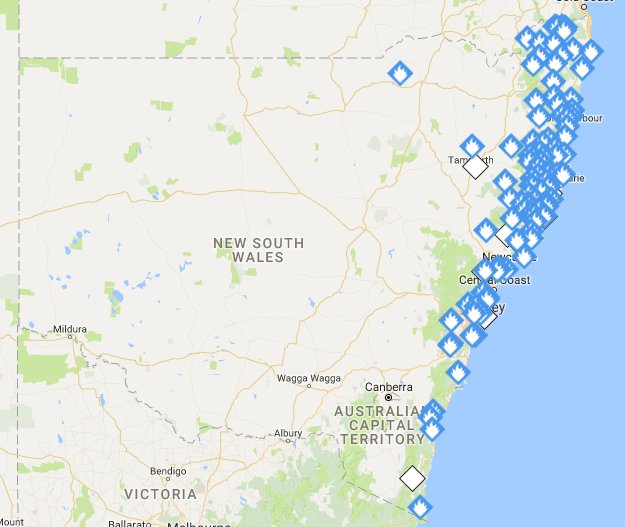
The NSW Rural Fire Service said on Wednesday they were battling 70 fires across the state, with many still active on Thursday morning:


At 7am 64 bush & grass fires burning across NSW. 21 not yet contained. Warm and windy conditions expected for parts of NSW today. 
Both states have had a few particularly warm days this week. Sydney posted its warmest August morning for 6am readings on Wednesday, with the mercury sitting on 22.1 degrees.
Odds continue to favour an early and active fire season for NSW.
Odds continue to favour an early and active fire season for NSW. Photo: Wolter Peeters
Elsewhere in NSW, Port Macquarie and Coffs Harbour both posted their hottest days on Wednesday for this early in the warming season. On Tuesday, Wilcannia and Cobar in the state's west had their hottest August days on record.
The bureau's outlook release on Thursday marks the first of a regular fortnightly rather than monthly update. The more frequently releases are intended to give farmers and other users of the climate maps earlier access to any change.
The move follows an instance in October 2015 when the bureau noted a sudden shift towards drier conditions with an emerging El Nino. That prompted a mid-monthly report that will now become standard by the agency.