A
flash flood has struck a northern Athens suburb following a squall,
with the Greek capital's fire department receiving 140 calls for
assistance and to pump water from flooded homes and businesses
A
flash flood has struck a northern Athens suburb following a squall,
with the Greek capital's fire department receiving 140 calls for
assistance and to pump water from flooded homes and businesses.
Fire
crews headed to an open-air parking lot in the suburb of Maroussi on
Thursday to see if there were any people trapped in cars that were
bobbing in a suddenly created muddy lake.
Authorities
urged drivers to avoid the area and shut down a side road off the
main highway leading north out of Athens.
The
flash flood comes three days after a devastating wildfire northeast
of Athens killed at least 82 people and injured more than 180.
Electricity
usage breaks all-time record as soaring temperatures for July
documented in several locations
Firefighters
battled a number of large blazes on Wednesday as Israelis sought to
stay cool during an intense heatwave that set records for highest
recorded temperatures in July.
Several
large fires broke out in the afternoon at the Horshim Forest in
central Israel and the Ahihud Forest in the north, as well as at the
Churchill Forest near Nazareth Illit.
Seven
firefighting crews and four firefighting planes were also working to
put out a massive blaze near Kibbutz Re’im east of the Gaza border,
one of 10 fires that broke out along the border since the morning.
Protests
Erupt in Athens As Greece Approves Eurozone Bailout
The Real News
TRNN's
Jaisal Noor speaks to protestors in Athens, Greece about why they
oppose the $96 billion dollar Eurozone bailout the Greek Parliament
passed late Wednesday by a vote of 229 to 64
Having heard Paul Craig Roberts speaking about this I agree with him that whatever the EU intentions the United States for its own geopolitical interests in keeping NATO and the EU intact for its war against Russia, will not allow a Grexit to happen. Here is commentary from Channel 4's Paul Mason
It’s
easy to get drawn in to the detail. I spent some of yesterday in the
hot corridors of the Greek parliament where the various factions and
groupings within Syriza, the radical left party, were working out
their postures on today’s vote.
No to the rescue deal, says the left. Abstain, say others. Vote yes while declaring it’s been done at gunpoint, says Alexis Tsipras in a live TV interview. But step away from the argument, bitter as the black coffee served in the parliament’s canteen, and the bigger picture is: the deal will pass, Syriza will vote for it.
Step
back further and take in the implications of the IMF’s secret
report, leaked yesterday, into the dynamics of Greece’s debt. The
IMF says – after the weeks of dislocation caused by the relentless
bank run and the capital controls – that the austerity deal is
pointless. Greece needs a massive debt write-off or large upfront
transfers of taxpayers money from the rest of Europe. It needs a 30
year grace period in which it will stop repaying the loans.
Yet
the entire deal done on Sunday night was premised on not a single
cent worth of debt relief. Vague commitments to “reprofile” debt
– pushing repayment times backwards and lowering the interest rates
– were all Angela Merkel could be persuaded to do.
What
this means is very simple: the third bailout agreed in principle on
Sunday night is doomed to fail. First because the IMF cannot sign up
to it without debt relief; second because, without debt relief it
will collapse the Greek economy. This is even before you factor in
issues like mass resistance to its details, or the total lack of
enthusiasm for execution of the deal by the Syriza ministers who will
have to do it.
IMF
report
But
on both sides of the Greek political class there is cognitive
dissonance, and it’s being generated by the same thing: a blindness
to what the Euro has become.
The
Greek centre and centre right will keep Syriza in power today on the
grounds of being good Europeans. Syriza will vote for a deal it
opposes, and which anybody who’s read even a summary of the IMF
report now understands is doomed. Again on the grounds that it is
demonstrating commitment to Europe and that, as Alexis Tsipras
argues, “rules out Grexit”.
The
implication of the IMF report is that Grexit is inevitable. Without
debt relief the Greek debt to GDP ratio will rise to 200%. It will be
using 15% of its GDP simply to make interest payments and payments
coming due.
So
we go back to the old problem that has dogged Greece since 2010. Yes
it has an inefficient, state-dominated economy that needs to be
reformed; yes it has antiquated and corruption-inducing restrictions
on who can run certain businesses. But you can’t modernise a place
like Greece amid the relentless downward pressure on growth that
austerity measures produce.
By
saying this – albeit in a secret document the Europeans wanted
suppressed – the IMF has shown it is a learning organism. It has
abandoned the dogma that predicted austerity would bring a 4% fall in
GDP and drawn conclusions from the 25% fall in GDP that actually
occurred.
One
of the recurrent features of this crisis is the mismatch between the
speed at which political parties learn things and how people do.
I’ve
found, among ordinary people who were passionate supporters of the No
vote in the referendum, the widespread acceptance that – to go
forward with measures on social justice or alternatives to austerity
– Greece will have to leave the Euro. Most people I talk to want it
done in a controlled manner, consensually and with some kind of
mandate from the people.
They’ve
realised that Angela Merkel’s absolute refusal to countenance debt
write-offs inside the Euro, alongside the IMF’s absolute insistence
that they should happen, have created a cul-de-sac no Greek
government can get out of without reversing out of Euro membership.
Syriza
– which was always a coalition of left social democrats, New Left
marxists and a harder left communist group – is finding it
institutionally hard to accept this logic.
Opponents
of exit argue that, with the Euro question “solved” they can get
on with prosecuting a domestic crusade against corruption, poor
police methods and the dysfunctional judiciary and the state.
What
nobody knows is how much of its absolute sovereignty over domestic
law the Eurozone would actually use if, for example, Syriza tried to
cleanse the judiciary. Would this be deemed as “politicising the
state?” Nobody knows – because the European Commission and ECB
have never had to have policies on such things before.
‘Third
bailout will be a нdisaster’
Equally
uncertain is: what kind of party does Syriza now become? Right now it
is still, basically, an expression of the desire of large numbers of
Greek people to stay in the Euro with less austerity.
The
Greek electorate’s pattern over the past 5 years has been to put
parties into power who say they will mitigate austerity but stay in
the Euro. First Papandreou, then New Democracy – who also, now
barely remembered – once opposed an austerity memorandum – and
now Syriza. By throwing successive parties into the European mincing
machine, the outcome has been to shred party politics. Pasok was
shredded, New Democracy was shredded and it’s possible that Syriza
too will split, be vilified, denounced as traitors etc.
We
know from opinion polls that about 35% of Greeks want to leave the
Euro but that a further 25% of those who voted No in the referendum
probably fear what Alexis Tsipras spelled out last night: €250bn
has left the country over the past 5 years and if Greece leaves the
Euro this “drachma lobby” would be able to return to Greece and
buy out everything and everybody.
But
listen to the IMF report – which implies the third bailout will be
a disaster; and to the intransigence of Angela Merkel – who says no
debt relief within the Euro. The more I look at it, logically and
dispassionately, that €250bn waiting outside Greece for Grexit now
looks like very smart money. And you the highly logical and
dispassionate investment community is drawing that conclusion too.
The
levels of economic pain and dysfunctional borrowing set to be
inflicted on Greece mean that at some point in the next 12-18 months
there is a chance that centrist 20-30% of public opinion will flip to
a policy of controlled, or maybe temporary exit from the Eurozone.
The only question then is: which party will offer a convincing
narrative and lead it.
Mother,
who is 83 years old can't remember a *spontaneous* AND
*pro-government* rally in her lifetime. In Greece, the barricades, the riot
police -and the fear, are one
Eurogroup
Gives Greece 10 Day Ultimatum: Apply For Bailout Or Grexit
MOODY'S
PLACES GREECE'S Caa1 GOVT. BOND RATING ON REVIEW FOR DOWNGRADE
REVIEW
GREECE
CREDITOR TALKS UNCERTAINTY KEY DRIVER FOR MOODY'S REVIEW
GREECE
TALKS OUTCOME COULD BE NEGATIVE FOR FUNDING: MOODY'S
Surely
Greece must be delighted to be part of the European "Union"
at this point.
* *
*
Europe
has an unpleasant habit of dropping tape bombs at the most
inopportune of times, like at 3pm or later a Friday. And while on
Wednesday it was the ECB yanking repoable Greek collateral for local
banks, today it was first S&P, which downgraded Greece 5 months
after upgrading it, and moments ago it was none other than the Cyprus
bail-in man himself, the Eurogroup's Dijsselbloem, aka Diesel
"Blueprint" BOOM,
who just have Greece a 10 day ultimatum to fall into place or risk a
terminal bank run and capital controls (both hinted at earlier by the
post-DOJ settlement political "rating agency')
GREECE
MUST APPLY FOR BAILOUT EXTENSION ON FEB 16 AT THE LATEST TO KEEP
EURO ZONE FINANCIAL BACKING -EUROGROUP CHAIRMAN DIJSSELBLOEM
This
means that Greece now has 10 days, or until the Monday after next to
decide whether it will stay in the Eurozone or Grexit. More
from Reuters:
[Yanis
Varoufakis] made clear that the new government, which came to power
on a wave of anti-austerity anger in elections last month, now wanted
to forego remaining bailout money that had austerity strings
attached:
"Greece
is not asking for the remaining tranches of the current bailout
programme - except the 1.9 billion euros that the ECB and the EU
member states' central banks must return."
Euro
zone finance ministers will discuss how to proceed with financial
support for Athens at a special session next Wednesday ahead of the
first summit of EU leaders with the new Greek prime minister, Alexis
Tsipras, the following day.
However,
the chairman of the finance ministers said the following meeting of
theEurogroup
on Feb. 16 would be Greece's last chance to apply for a bailout
extension because some euro zone countries would need to consult
their parliaments.
"Time
will become very short if they (Greece) don't ask for an extension
(by then)," said Jeroen Dijsselbloem.
The
current bailout for Greece expires on Feb 28. Without it the country
will not get financing or debt relief from its lenders and has little
hope of financing itself in the markets.
*
* *
Participants
said no progress was made at a preparatory meeting of senior finance
officials in Brussels on Thursday because Greece and its euro zone
partners were so far apart.
"It
was Greece against all others, basically one versus 18," one
official said.
Almost
sounds like a reverse veto out of the European "Union".
At
the end of the day what D-Boom has effectively said is this:
Which
is precisely the thing Greece, whose negotiating position already has
been crushed with the threat of a wholesale bank run, did not want to
hear especially now that the government really has no choice: either
it complies with European demands, and can sign its resignation
right after having flopped epically, or it pushes on to find out just
how badly Europe is bluffing.
Suddenly
next week's emergency Eurogroup meeting on Wednesday is looking quite
fascinating. We hope the caterers have bulletproof jackets.
Greece’s
Syriza government vows to fight pressure to stick to bailout terms
Eurozone
ministers to hold special debt talks next week as new Greek
government rules out accepting a plan based on old bailout
Greek Finance Minister Yanis Varoufakis, speaks on his phone during the vote for the president of Greece’s parliament in Athens. Photograph: Petros Giannakouris/AP
Greece’s
radical Syriza government has vowed to keep fighting pressure from
its eurozone neighbours to stick to the strict terms of its bailout
package as battle lines were drawn ahead of crunch debt talks next
week.
Eurozone
finance ministers have called an emergency meeting for Wednesday
night in Brussels to discuss the Greek crisis after a whistlestop
tour of Europe by Yanis Varoufakis, Greece’s finance minister, made
little headway.
Germany
wants Greece to arrive with a plan on the repayment of €240bn
(£180bn) in bailout loans it received from the international
community. The special debt meeting will be followed on Friday by a
summit of European leaders, the first with Alexis Tsipras, the Greek
prime minister.
But
a government official ruled out accepting a plan based on the old
bailout and said Varoufakis would ask for a bridge agreement to tide
Athens over until it can present a new debt and reform programme. “We
will not accept any deal which is not related to a new programme,”
an official told Reuters news agency.
The
Syriza party swept to power on a promise to ditch the strict
austerity cuts tied to Greece’s bailout from the troika of lenders
– the European Union, European Central Bank and International
Monetary Fund. Now they are in government, Varoufakis and Tspiras
have spent the past week meeting their counterparts around Europe,
including the British chancellor, George Osborne, to push that same
message and argue that ending austerity would do more for economic
recovery than relentless cuts.
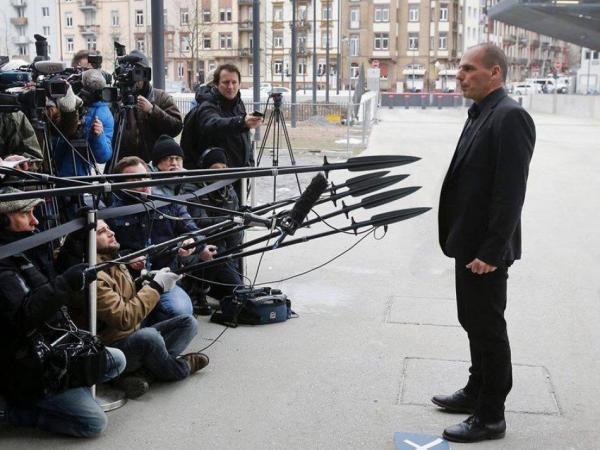
But
they got few concessions and a meeting in Germany with finance
minister Wolfgang Schäuble ended with a tense press conference as
Greece’s paymasters appeared as determined as ever to make Athens
stick to the deficit-cutting agenda and pay back the bailout money.
Greek
stock markets fell on Friday ending a volatile week of trading. Bank
shares were under pressure amid fears of a fresh run on Greek bank
deposits. Concerns were intensified this week by a decision from the
European Central Bank to tighten the rules on the collateral that
Greek banks can post in exchange for loans.
Standard
and Poor’s, the credit ratings agency, highlighted the tight
timeframe for Athens to reach a deal as it cut the credit rating on
Greek sovereign debt to “B-” from “B”.
The
ratings agency said: “The downgrade reflects our view that the
liquidity constraints weighing on Greece’s banks and its economy
have narrowed the timeframe during which the new government can reach
an agreement on a financing programme with its official creditors.
It
also raised the prospect of a Greek exit from the single currency
bloc.
“Although
the newly elected Greek government has been in power for less than
two weeks, we believe its limited cash buffers and approaching debt
redemptions to official preferred creditors constrain its negotiating
flexibility. In our view, a prolongation of talks with official
creditors could also lead to further pressure on financial stability
in the form of deposit withdrawals and, in a worst-case scenario, the
imposition of capital controls and a loss of access to
lender-of-last-resort financing, potentially resulting in Greece’s
exclusion from the Economic and Monetary Union.”
The
Athens FTSE banks index lost almost 10% while Greece’s broader ATG
shares index lost 2% from Thursday.
The
bailout from the troika – which came with stringent conditions,
including big spending cuts – is due to expire at the end of this
month. But for now many analysts appear hopeful a deal will be done
that avoids a Greek exit, or “Grexit”.
“We
still think that the Greek government and its creditors, including,
importantly, the ECB, will eventually come to an agreement on a
follow-up bailout that avoids Grexit and a default by the Greek
government,” economists at Citigroup saidon Friday
They
outlined two agreements that will be needed soon: “An interim
agreement (probably by end-February) to keep the Greek government and
Greek banks funded for up to four months, with the ECB playing a key
role during this period, and ... a more substantial and durable
agreement on a follow-up bailout to be struck during that period.”
“We
continue to expect an agreement on both fronts, but it would require
both sides to substantially narrow their differences and we see
material risks that either one of these negotiations will fail,”
the note said.
With
time tight and worries that the prospect of the Greek exit from the
eurozone will have repercussions around the world, the US again
intervened in the standoff on Friday.
After
a meeting with Tsipras, the US ambassador to Greece, David Pearce,
urged the new government to work cooperatively with its European
colleagues and the IMF and to keep on with reforms.
“Greece
should continue to make administrative and structural reforms and
exercise fiscal prudence,” the embassy said in a statement.
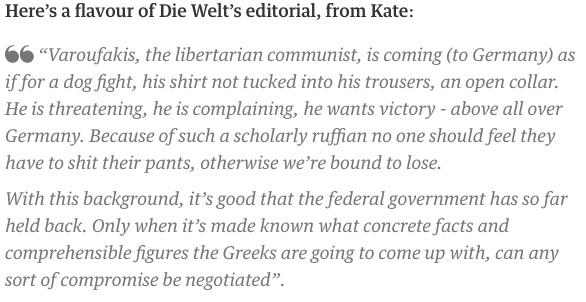
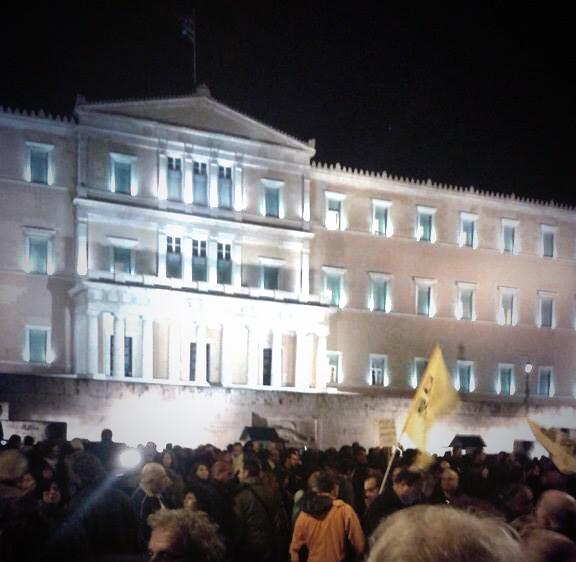
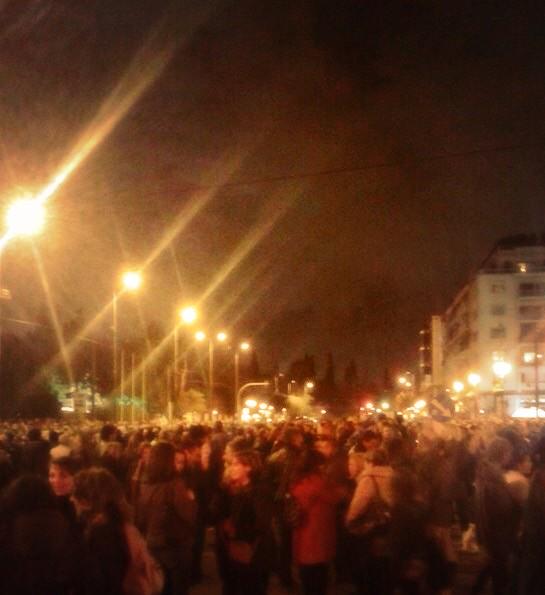
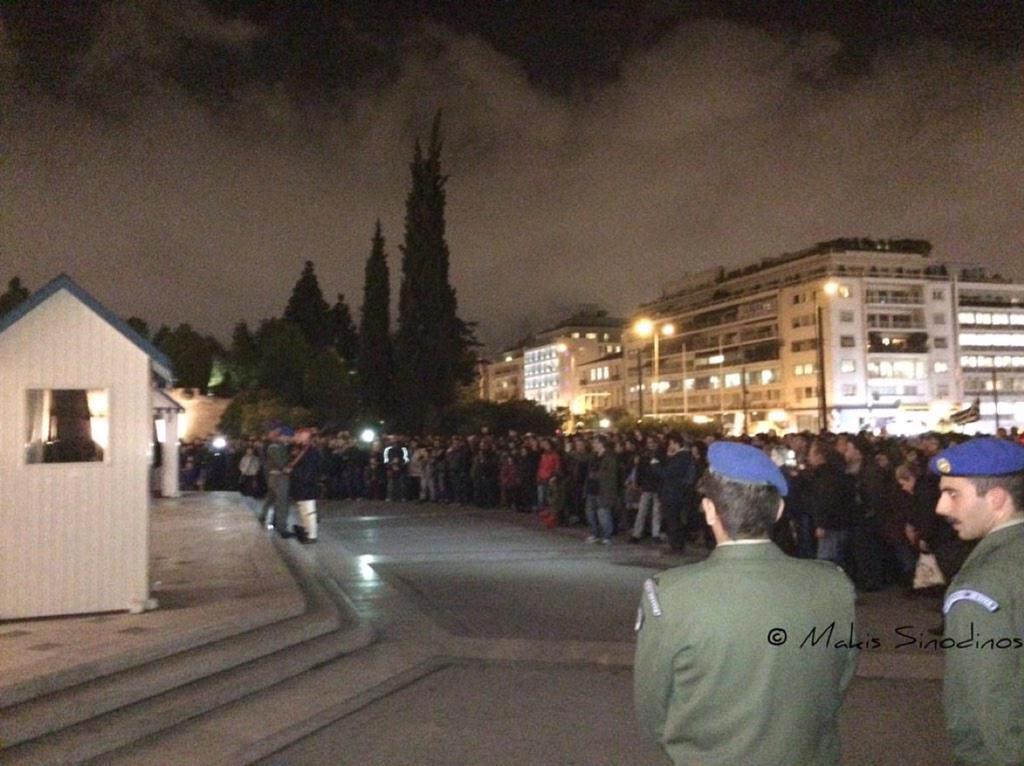
A
demonstration largely different from those Athens has seen in recent
years took place today in downtown Athens’ Syntagma Square. The
rally was called for 6.00 pm and was organized through social media.
It was the first pro-government demonstration organized in
Greece in recent years. Four years ago, in summer 2011 the
Spanish-inspired movement of the “Indignados” attracted thousands
of protestors rallying against austerity measures in the same square.
Once
again, the protestors’ request was the abolition of the austerity
policies imposed upon Greece. The crowds gathered in front of the
Greek Parliament in support of the new anti-austerity SYRIZA-led
government’s efforts to renegotiate the country’s international
debt. The chants were mostly against German Chancellor Angela Merkel
and Finance
Minister Wolfgang Schaeuble, who earlier today met with his Greek
counterpart in Berlin.
Apparently, the two Ministers did not come to an agreement regarding
the Greek bailout program’s future.
On
the opposite, Greek Finance Minister Yanis Varoufakis, emerging
lately as Greece’s new “super star,” was the protestor’s
favorite along with Prime Minister Alexis Tsipras.
“European
Central Bank (ECB) President Draghi chose to play Merkel’s game
again and blackmail the Greek people and the new Greek government,”
was, among others, declared in the demonstration’s declaration,
calling people to hold a peaceful protest in Syntagma Square against
ECB’s decision not to accept Greek bonds as loan collateral.
It
should be noted that police presence was null and it was the first
time protestors could even reach the Tomb of the Unknown Soldier and
the stairs

 Posts
Posts