Showing posts with label stock market. Show all posts

Thursday, 4 February 2021

Michael Snyder on the ramifications of GameStop

 The Exact Same Thing That Is Happening To GameStop Is Eventually Going To Happen To The Stock Market As A Whole


Economic Collapse,

4 February, 2021

Stock is only worth what someone is willing to pay for it at a particular moment in time.  Sadly, this is a lesson that many GameStop traders are learning right now.  Just a few days ago, GameStop had surged above $300 a share and a lot of investors that had gotten caught up in the frenzy thought that they were suddenly rich.  But you only make money in the stock market when you get out.  Those that sold at the peak of the bubble were extremely fortunate, but most GameStop investors are determined to hold on to the bitter end, and the end will definitely be quite bitter indeed.

I think that it is great that a horde of retail investors want to punish the short sellers, but GameStop is definitely not a long-term investment.

In fact, the fair value for a share of GameStop stock is probably less than a dollar.

So it was quite bizarre that “the Reddit army” was able to push the price of the stock to more than $300 a share.  Ultimately, any really determined group of investors can temporarily pump up the price of any stock, but in order for it to stay elevated there must be buyers that are willing to purchase the stock at that level day after day.

Everyone knew that GameStop was going to come back down, and that has happened in dramatic fashion during the last two trading sessions

Shares of GameStop sank further on Tuesday, with shares of the volatile retail-trader favorite sliding 60% to finish at $90 per share.

The tumble follows a more than 30% drop during the regular market session Monday after finishing at $325 per share on Friday. That brings the two-day loss to 72%.

For the sake of GameStop investors, I hope that the stock bounces back a bit on Wednesday, but it is just a matter of time before it returns to a level that is much closer to fair value.

Some investors such as Dave Portnoy got really excited about what Reddit traders were trying to do, and he got in at the very top of the bubble.  Now that several of those stocks have cratered, Portnoy has lost approximately 700,000 dollars

After the bell, Portnoy provided an update on his AMC, NOC, and NAKD positions. He said he bought them at the “absolute high” and sold them at the “exact bottom.” In total, he said losses amounted to $700k, something we noted earlier.

That has got to hurt.

Others have also seen the value of their stock holdings drop in precipitous fashion.

For example, Keith Gill saw the value of his holdings in GameStop drop by 13 million dollars on Tuesday alone…

Keith Gill — who goes by DeepF——Value on Reddit and Roaring Kitty on YouTube — says he suffered a loss north of $13 million on Tuesday alone from his GameStop bet, but he’s still not selling.

He’s the man who helped inspire the epic short squeeze in GameStop last week that sent shockwaves through Wall Street. Through YouTube videos and Reddit posts, Gill attracted an army of day traders who cheered each other on and piled into the brick-and-mortar video game stock and call options, creating a massive short squeeze as the shares jumped 400% last week alone.

I know that he says that he is doing this to make a point, but I have a feeling that someday he is going to look back and kick himself for not selling when he had the chance.

Golden opportunities come along very rarely in life for most people, and when they do it is important to take advantage of them.

Of course one of the big reasons why GameStop crashed was because Robinhood had restricted trading in that stock, and now that the stock has crashed Robinhood is rolling back the limitations

Robinhood on Tuesday rolled back more of its trading limitations, now allowing clients to buy up to 100 shares of GameStop.

GameStop climbed off the lows as the Robinhood changes were announced.

Speaking of Robinhood, this whole episode has exposed the fact that they were never actually “looking out for the little guy” at all.  The following comes from Senator Josh Hawley

Enter Robinhood—as in, steal from the rich. Robinhood was the trading platform for the little guy. No fees, no hassle. It was Big Tech, once again, allegedly democratizing another sphere of American life captured by elite control. But like the tech platforms, Robinhood wasn’t really about its users. Its bread was buttered by selling the data on users’ trades to the big players—the elite guys, like Citadel—to give them inside tips on where retail investors were sending their money. And the Citadel guys, in turn, pay off their regulators—like treasury secretary Janet Yellen—in their years away from government for favors when they’re back in power.

What a crooked system we have, but our politicians will never have enough courage to actually try to change it.

And of course the so-called “guardians of democracy” in the mainstream media relentlessly defend our extremely corrupt system.

Sadly, it is just a matter of time before the entire house of cards comes crashing down for good.

The talking heads on television are preaching to us about the dangers of “the GameStop bubble”, but the truth is that our entire stock market has become one gigantic bubble.

As I keep reminding my readers, if the market were to drop by 50 percent tomorrow, it would still be way overvalued.

Price to earnings ratios always return to their historical averages eventually, and it will be no different in our case.

Of course we should hope that the eventual crash can be put off for as long as possible, because the collapse of the stock bubble will severely hurt millions of people financially.

But as sure as you are reading this, it will happen.

So I really don’t want to hear any more babbling from the sanctimonious idiots in the financial community that are trying to tell us that GameStop investors “had it coming”.

Yes, everyone could see that the GameStop saga was not going to end well, but everyone should also be able to see that things are not going to end well for the market as a whole.

If you can make some money in the short-term by playing the stock market, that is great.

But as our friends at Zero Hedge like to say, “on a long enough timeline the survival rate for everyone drops to zero”. 

Thursday, 29 October 2020

The second wave is here!!

There will be much more on this except for the fact that the bulk of the media is hiding this - I could see no reflection of this in British or NZ media.

 US Dow Plunges 943 Points as COVID-19 Cases Spike, Countries Issue Lockdowns

Sputnik

29 October, 2020


US stocks plummeted Wednesday as investor fears over spiking COVID-19 cases across the nation and abroad reignited concerns of a stunted economic recovery, prompting massive sell-offs amid the pandemic.

At closing, the Dow Jones Industrial Average index fell by 943.24 points, marking its third day of losses for the week thus far. The S&P 500 sank by 119.65 points, and the Nasdaq Composite dove into red territory with a 426.48-point decline.

Extending their losses, companies such as Delta Air Lines and Royal Caribbean Cruises Ltd. each saw their stocks devalued by nearly 5% as the travel and leisure sector has endured an uphill battle at recovering from pandemic-rooted setbacks.

Crude oil prices fared no better, falling nearly 6% and extending their three-week lows.

Unlike many of the Asian indices, the European markets experienced similar steep declines during the day’s trading, with sell-offs largely driven by indications that both Germany and France would be imposing new lockdown restrictions in an effort to curb recent COVID-19 spikes.

German officials announced later Wednesday that a partial lockdown would be imposed to combat the respiratory illness. French President Emmanuel Macron followed by ordering a nationwide lockdown to curb the spread of COVID-19

According to Worldometer, Germany has reported more than 477,000 COVID-19 cases, whereas France has documented upwards of 1.1 million.

Echoing the pandemic’s early days, reports of new COVID-19 cases, hospitalizations and deaths have also seen a massive surge in the US. Data compiled by Johns Hopkins University indicates that the US has documented an average of over 70,000 daily coronavirus cases over the last week, with related hospitalization rates undergoing an uptick.

The university’s latest report notes the US has a 6.19% test positivity ratio, and that new COVID-19 cases are increasing in Texas, Wisconsin, California, Florida and Illinois. In fact, Illinois’ governor recently ordered that bars and indoor dining be closed in several regions of the state until further notice.

With cases on the rise and no economic stimulus in sight, the situation will likely lead to more lockdowns across the US, CNBC’s Jim Cramer said Wednesday on the outlet’s morning business show “Squawk Box.”

“It’s very hard to buy a lot of stocks when you see these numbers,” Cramer said, before noting that “it’s a shame too, because with stimulus, we’d be very tempted to own some of these stocks.”

“The lockdowns without the stimulus equals what we’re seeing, and I think it’s a shame because had there been stimulus, we would then be focusing on earnings, and the earnings are actually pretty darn good,” he added.

At present, the US is leading the world with over 8.8 million recorded cases of the deadly virus, according to Johns Hopkins University.


https://markets.businessinsider.com/news/stocks/stock-market-news-today-plunge-new-virus-lockdowns-dow-sp500-2020-10-1029736777?op=1#

  • US stocks cratered on Wednesday as a spike in COVID-19 cases prompted new lockdowns in Europe.
  • 40% surge in COVID-19-related deaths in Europe over the past week spurred Germany and France to announce new restrictions. Bars, restaurants, and gyms will close while schools remain open.
  • Tech stocks led the market lower as the CEOs of Twitter, Facebook, and Alphabet testified at a congressional hearing.
  • Oil prices tumbled, dragging energy stocks lower. West Texas Intermediate crude fell as much as 6.6%, to $36.97 per barrel.
  • Watch major indexes update live here.

US stocks cratered on Wednesday as a spike in COVID-19 cases prompted new lockdowns in Europe.

The Dow Jones industrial average's 3.4% decline marked its worst single-day drop since June 11, while the S&P 500's 1.9% drop was its largest since September 23.

German Chancellor Angela Merkel struck a deal for a "lockdown light," in which bars, restaurants, gyms, and movie theaters will close for at least a month starting this weekend while schools and nurseries remain open, Bloomberg reported.

French President Emmanuel Macron announced a new national lockdown to begin this Friday and last until December 1, though, like in Germany, schools will remain open, according to Bloomberg.

Here's where US indexes stood at the 4 p.m. ET close on Wednesday:

Read more: 'The road to financial implosion': A notorious market bear says the Fed has set the stage for a 67% stock plunge — and warns of zero-to-negative returns over the next 12 years

The Cboe Volatility Index, or VIXclimbed as high as 40.52, its highest point in more than four months. The VIX has traded at an average of 26.30 since the start of August after registering multiyear highs in March.

While coronavirus case records have fueled concerns about the pace of economic recovery, the prospect of timely fiscal support in the US is all but exhausted. The Senate adjourned on Monday and isn't set to reconvene until November 9, putting to bed any remaining hope for a stimulus bill. As the recovery slows, some fear that new aid will arrive too late to keep the economy from tumbling again.

Next week's presidential election has also contributed to the upswing in volatility. While elections typically escalate price swings, the chance of delayed results this year has investors bracing for extended market choppiness.

Technology stocks led the market lower on Wednesday as the CEOs of TwitterFacebook, and Alphabet testified before Congress on Section 230 legislation, while Microsoft's earnings outlook disappointed investors.

First Solar's third-quarter earnings report bested analysts' expectations. Deutsche Bank posted a better-than-expected third-quarter profit, and its debt-trading unit posted a 47% surge in business.

The billionaire investor Stanley Druckenmiller said a blue-wave election outcome could hurt stocks in the long term.

Gold lost ground on Wednesday, falling as much as 2%, to $1,869.53 per ounce

Oil prices tumbled, which dragged energy stocks lower. West Texas Intermediate crude fell as much as 6.6%, to $36.97 per barrel. Brent crude, oil's international benchmark, fell 6%, to $38.75 per barrel, at intraday lows.


https://markets.businessinsider.com/news/stocks/vix-futures-stock-market-fear-gauge-coronavirus-surge-presidential-election-2020-10-1029734344#

France's Macron Imposes Second Lockdown to Curb COVID-19 Spread

Sputnik

28 October, 2020


French President Emmanuel Macron will reimpose a nationwide lockdown starting Friday to curb the spread of COVID-19.

In a speech Wednesday, Macron explained that universities will be required to transfer to online teaching and that traveling between regions will be prohibited. In addition, residents will be expected to work from home, and the external borders of the Schengen Area remain closed.

"The second wave of the pandemic in France will be more severe and deadly than the first," the French leader said, adding that more than 35,785 people in the country have died since the start of the pandemic, and in the last 24 hours alone, more than 36,000 people have been infected. 

In 24 hours Tuesday, health officials say there were more than 500 virus-related deaths, the highest daily figure since April, France 24 reported.

According to Macron, the measures are expected to remain in place until December 1. If the situation improves in 15 days, the country will reconsider opening some shops. In general, however, the measures are expected to remain in effect until new daily infections fall from the current 40,000 per day to about 5,000 per day.

“The government didn’t take into account what the first wave was and didn’t learn all its lessons,” Frederic Valletoux, president of the French Hospital Federation, said Wednesday on France Inter radio, France 24 reported.

This is France's second nation-wide lockdown. The first lockdown was imposed on March 17. Restrictions during the first lockdown lasted until May, BBC reported.

The latest data by Worldometer shows that there have been more than 1.2 million cases of the virus in France and more than 35,000 deaths as a result.

The new restrictions, widely dubbed a “lockdown light,” are set to take effect on Monday and to last until Nov. 30. They were approved during a videoconference meeting between Merkel and Germany's 16 state governors, who are responsible for imposing and lifting restrictions.

Merkel said she and the governors would review the situation after two weeks and possibly “adapt” some measures. But she was adamant that the restrictions, which she acknowledged are tough, can't be put off.

The national disease control center reported on Wednesday morning the latest in a string of daily records for new confirmed cases — 14,964, taking Germany's total to 449,275. The country of 83 million people also saw 27 more virus-related deaths, raising its death toll in the pandemic to 10,098.

Merkel said the number of COVID-19 patients in intensive care doubled over the past 10 days.

“We can say that our health system can cope with the challenge today,” Merkel said. “But if the pace of infections continues like this, then we’ll reach the limits of what the health system can manage within weeks.”

Under the restrictions approved Wednesday, theaters, operas, concert halls, cinemas, saunas, gyms, swimming pools and some other sports facilities will be shut for four weeks, along with tattoo, massage and beauty parlors. Brothels and some other businesses also will have to close.

Groups of at most 10 people, from a maximum two households, will be allowed in public.

Merkel called on Germans to refrain from making non-essential journeys, including to see relatives, whether inside or outside the country. She said that hotels will be able to host only people on essential travel, not on tourist trips.

But schools, kindergartens, non-essential shops and hairdressers are to remain open, and church services will still be allowed, unlike during Germany’s shutdown in the first phase of the pandemic in March and April. Restaurants will be able to provide take-out food.

The chancellor has repeatedly urged Germans over the past two weeks to reduce their social contacts in a bid to curb the spread of the virus — so far with little success. In recent months, states also have created a patchwork of increasingly varying rules. The hope is that they will take a uniform approach this time, with the aim of allowing life to return to something more like normal in December.

The government plans to spend up to 10 billion euros ($11.8 billion) to compensate companies hit by the shutdown for revenue they miss out on.

Prosperous Germany took less of an economic hit from its spring lockdown, which was milder than those in several other countries, than some of its European peers.

Officials say Germany, which has coped with the outbreak better than many of its neighboring European countries, is beginning to lose control of the situation, with local health authorities unable to trace contacts of those infected and some hospitals refusing to take in new patients.

“We are prescribing a four-week therapy, so to speak,” Bavarian governor Markus Soeder said. “We hope the dose is right and that it will be successful.”

“As with every therapy, (it should) not be broken off too early,” Soeder added. “It must work. We must not make the mistake we have often seen elsewhere of lapsing too early back into another rhythm.”

The plans have caused anguish in Germany’s hospitality industry, with thousands of venue owners staging a protest ahead of Wednesday's decision at Berlin’s landmark Brandenburg Gate to demand further government financial support.

Merkel noted that there has been a lot of talk about some activities and business areas not generating infections. But she said, “We are now at a point where, on average, we don’t know were 75% of infections across the country come from.”

“One cannot say any more that a certain area doesn’t contribute at all to infections,” Merkel said.


Russian President Vladimir Putin on Tuesday ordered a nationwide mask mandate as a second wave of coronavirus cases put the country’s medical system under a severe strain.


With COVID-19 cases rising at over 15,000 a day, the country's health agency ordered all Russians to wear masks in crowded public spaces, including public transport, and in closed spaces like taxis and elevators.


The agency also suggested that bars and restaurants close between 11 p.m. and 6 a.m., Reuters reported.


Protesters turned out by the hundreds in Turin, Milan and other Italian cities and towns Monday to vent their anger, sometimes violently, at the latest pandemic restrictions that force restaurants and cafes to close early and shutter cinemas, gyms and other leisure venues.


In the northern city of Turin, some demonstrators broke off from a peaceful protest, smashing store windows on an elegant shopping street, setting smoke bombs and hurling bottles at police in a main city square where the Piedmont regional government is headquartered, RAI state TV said.


Monday, 9 March 2020

Aussie market plunges 6% on virus fears - worst fall since GFC | ABC News


Bad news is not for little Hobbits, it seems!

The Hobbit Movie Trailer Featuring Kids in Place of ...
Australian TV on stock 
market crisis: NZ media 
SILENT


The Australian share market has lost more than $100 billion in today's trade so far, amid the economic fallout from the coronavirus and an oil price war. The ABC's Ian Verrender and David Taylor join Ros Childs to discuss what's happened, why it's happened, and what the government may have planned to try and combat the economic plunge.

This is all I could find - it all has the air of talking to children.


Wednesday, 26 February 2020

The Dow crashes 1800 points this week


Fear of COVID-19 coronavirus spreading globally is driving down US stock markets, with the Dow Jones Industrial Average sliding by almost 900 points before recovering slightly to close at 27,081.36.


Nasdaq composite dropped by 255 points (2.77 percent) by Tuesday closing, while the S&P 500 was down 97 points (3 percent).


Tuesday’s downturn follows Monday’s numbers, when the Dow lost more than 1,000 points and both S&P 500 and Nasdaq were down by more than 3 percent – wiping out most of the gains since the beginning of the year.


Lows As Stocks Suffer Worst 

Breadth Since DotCom 

Collapse

25 February, 2020


WHO, CDC, and HSS all dropped the honesty hammer today:

  • WHO SAYS REST OF WORLD IS NOT YET READY FOR VIRUS SPREAD
  • CDC OFFICIAL SAYS CORONAVIRUS PANDEMIC IS LIKELY
  • AZAR SAYS U.S. MAY NEED UP TO 300M MASKS FOR HEALTHCARE WORKERS
And just like that 'complacency' gone...

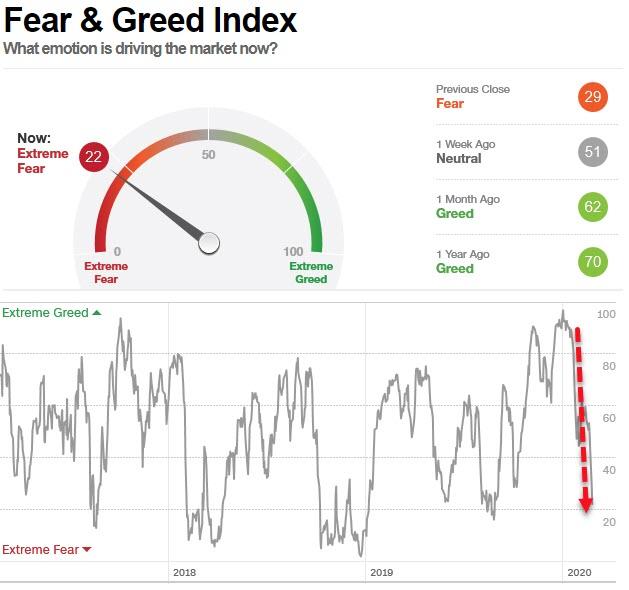
From "Extreme Greed" to "Extreme Fear" in a week...
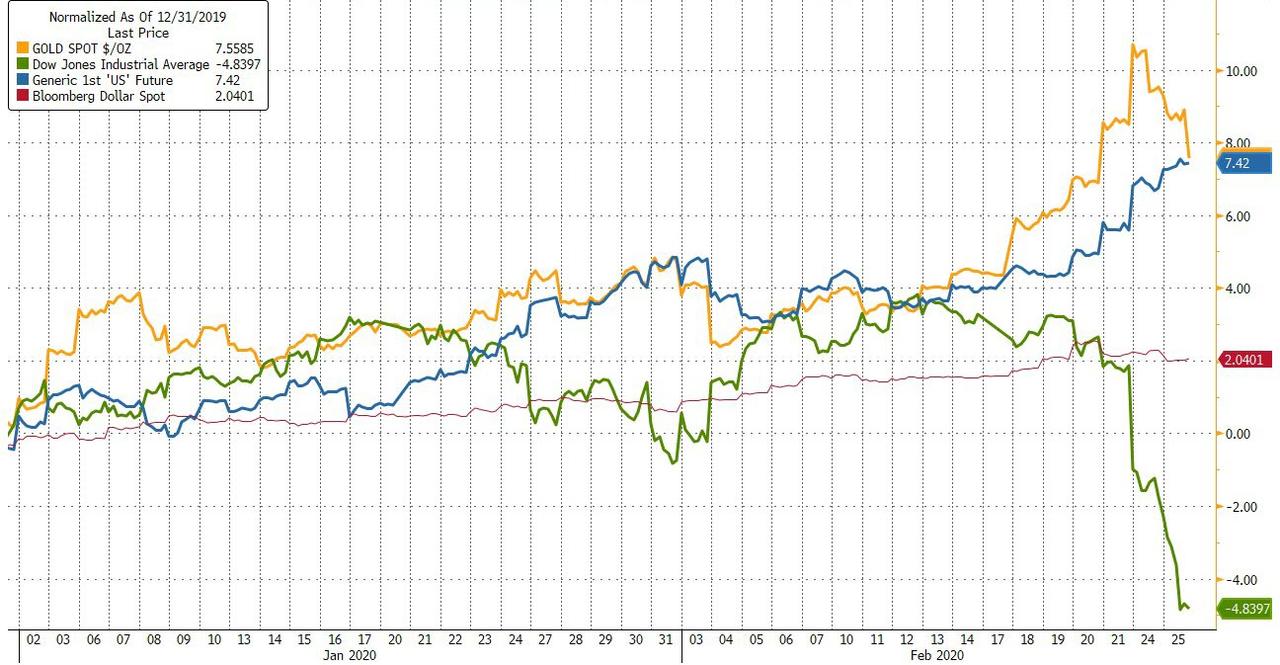
So, rates, FX, and commodities were right after all...
Source: Bloomberg
Year-to-date, gold and bonds are up around 7.5%, stocks are down around 5%
Source: Bloomberg
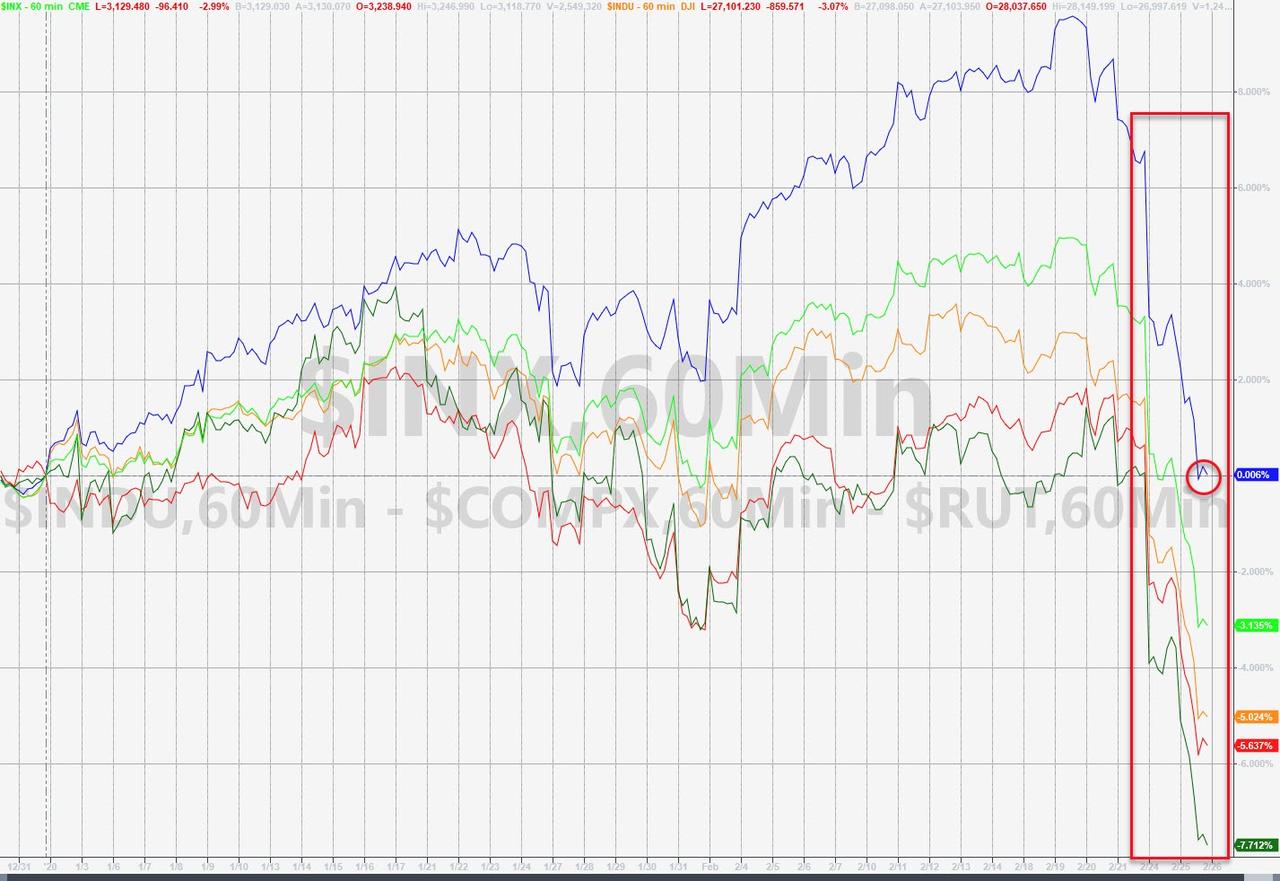
Nasdaq briefly touched unchanged on the year, all the other majors are now red for the year...
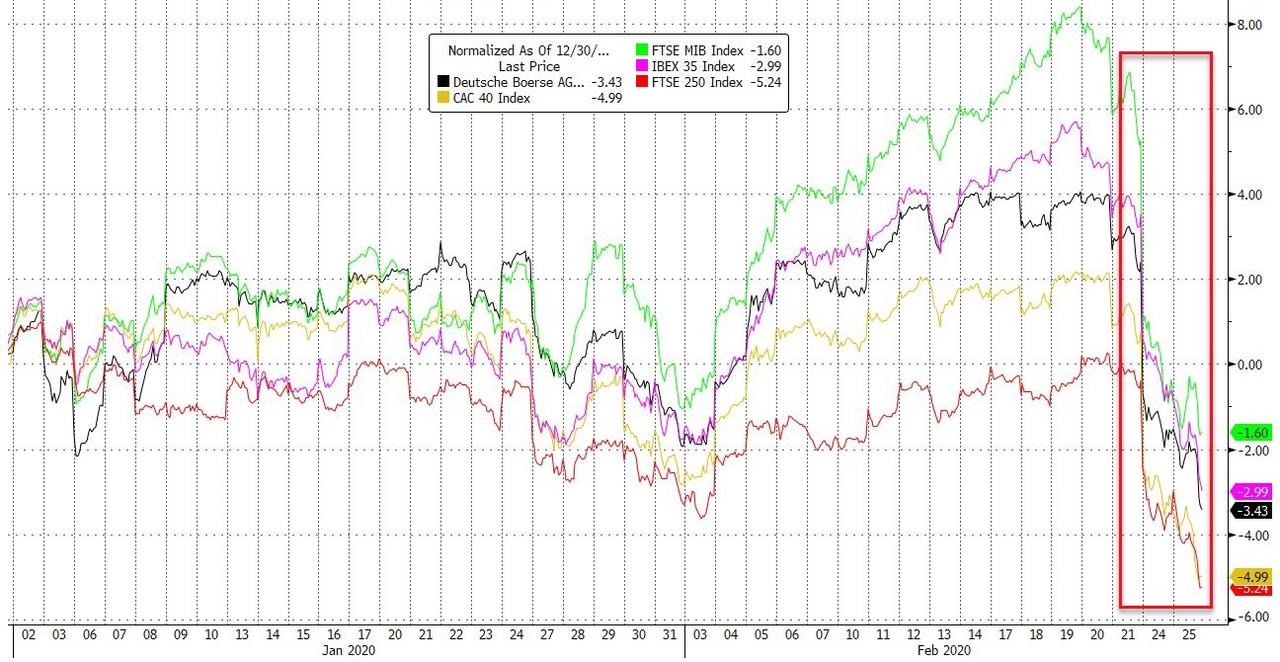
All European majors are now red for the year...
Will stock investors ever learn? As Morgan Stanley's Chris Metli warned, sentiment hasn't shifted... yet:
"...in conversations with clients yesterday and today it feels like most discretionary traders want to look through the systematic supply and any economic disruptions, and still don’t see a reason to deviate from the secular growth trade. While the market will naturally follow the macro newsflow, the fact that investors haven’t become materially more bearish and there was not a full flush of positioning makes QDS concerned about further downside moves and would be a seller of rallies more than a buyer of dips."
Nasdaq broke below 9,000 and The Dow tested down to almost a 26k handle.
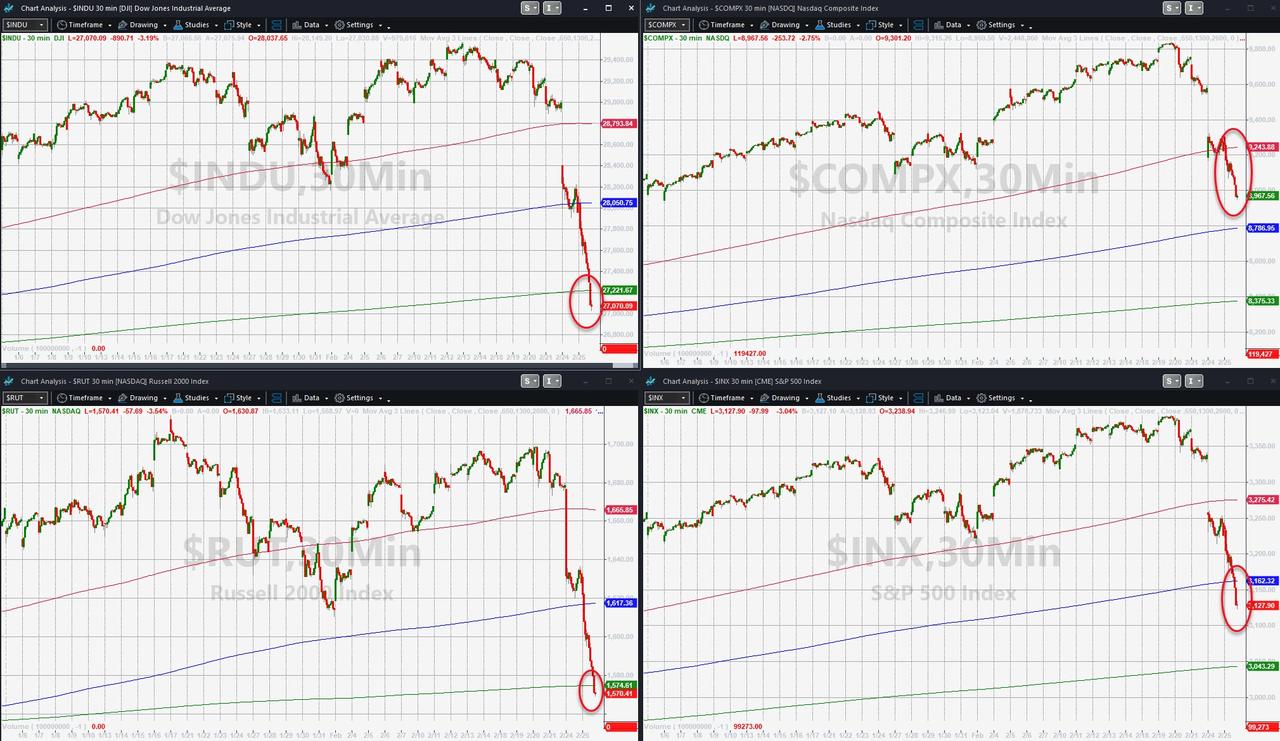
All major US equity indices tumbled through critical technical support levels. Dow and Russell 2000 broke below their 200DMA, Nasdaq well below its 50DMA, and S&P below its 100DMA...
“Those tech lines should matter -- it tells you the psychology is changing,” said Mark McCormick, global head of FX strategy at TD Securities.
“When markets are not trading on growth or fundamentals, a turn in sentiment nearly always leads to a drawdown in the things that are overbought and trading at a premium.”
The number of NYSE-traded stocks that retreated in the past two days has been the highest of the almost 12-year bull market... and worst breadth since Sept 2000...
Source: Bloomberg
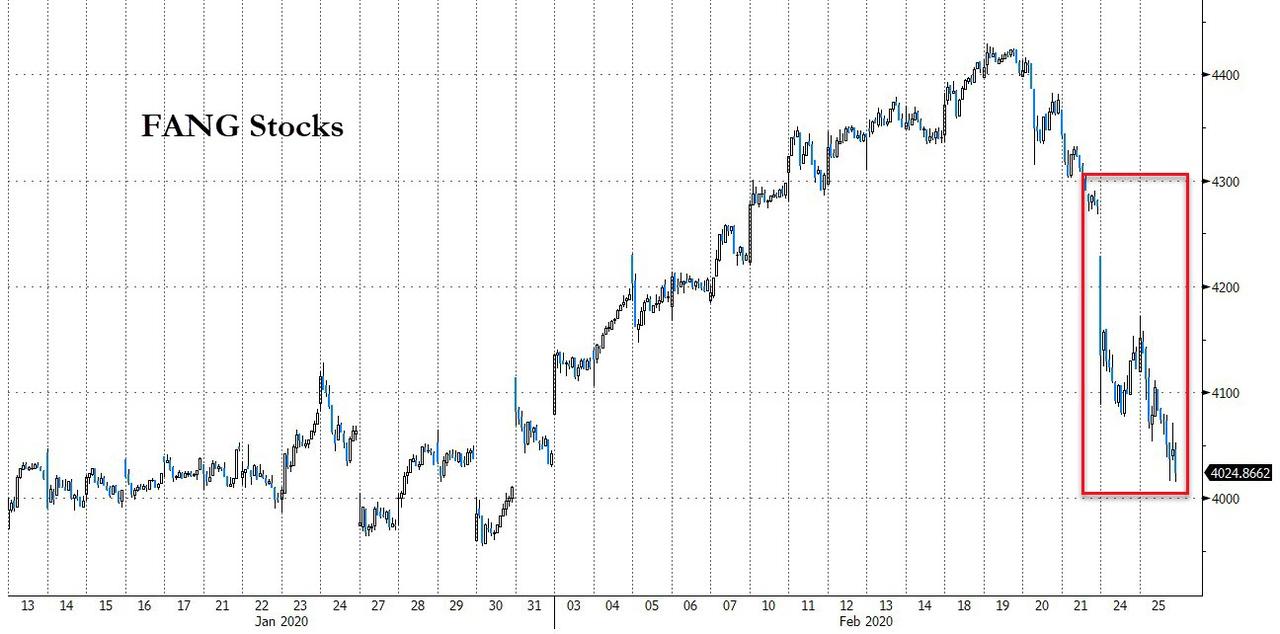
FANG Stocks crashed almost 10% from last week's highs...
Source: Bloomberg
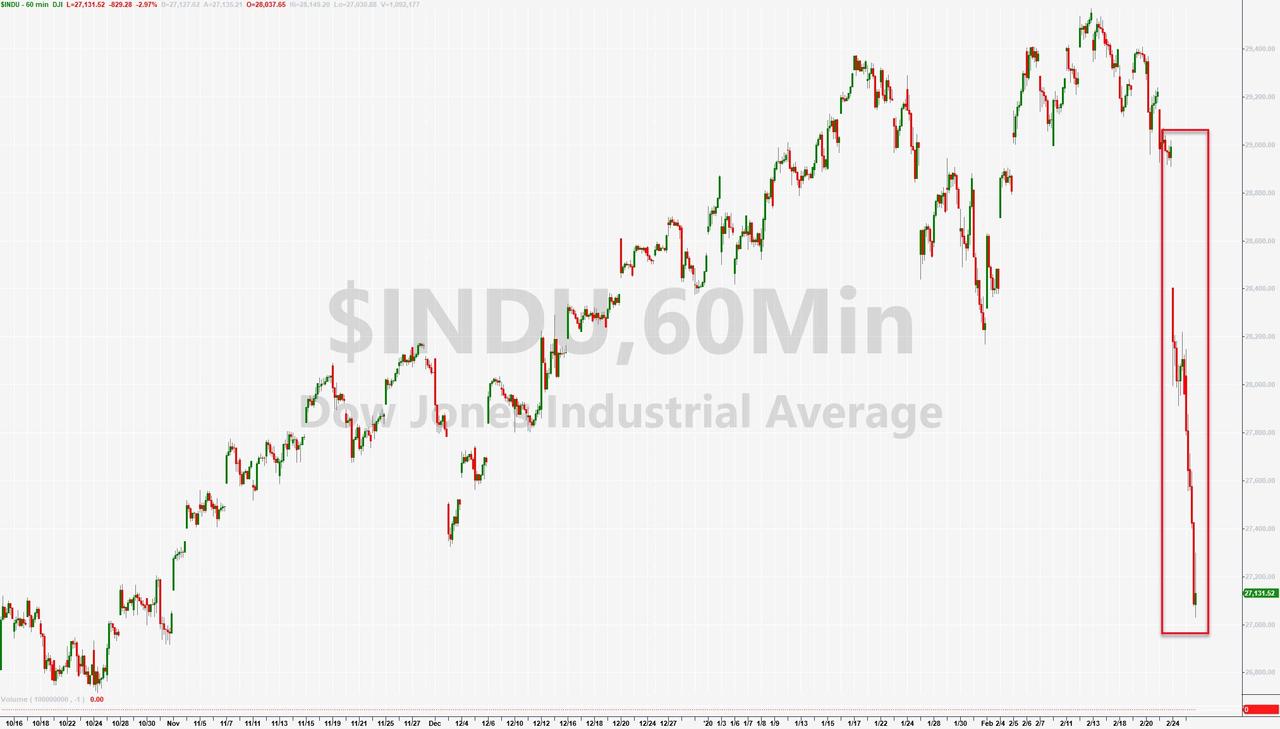
This was The Dow's biggest 2-day drop since VIXmageddon in Feb 2018
Source: Bloomberg
Nasdaq broke below 9,000, and suffered the biggest 2-day drop since June 2016's Brexit vote...
Source: Bloomberg
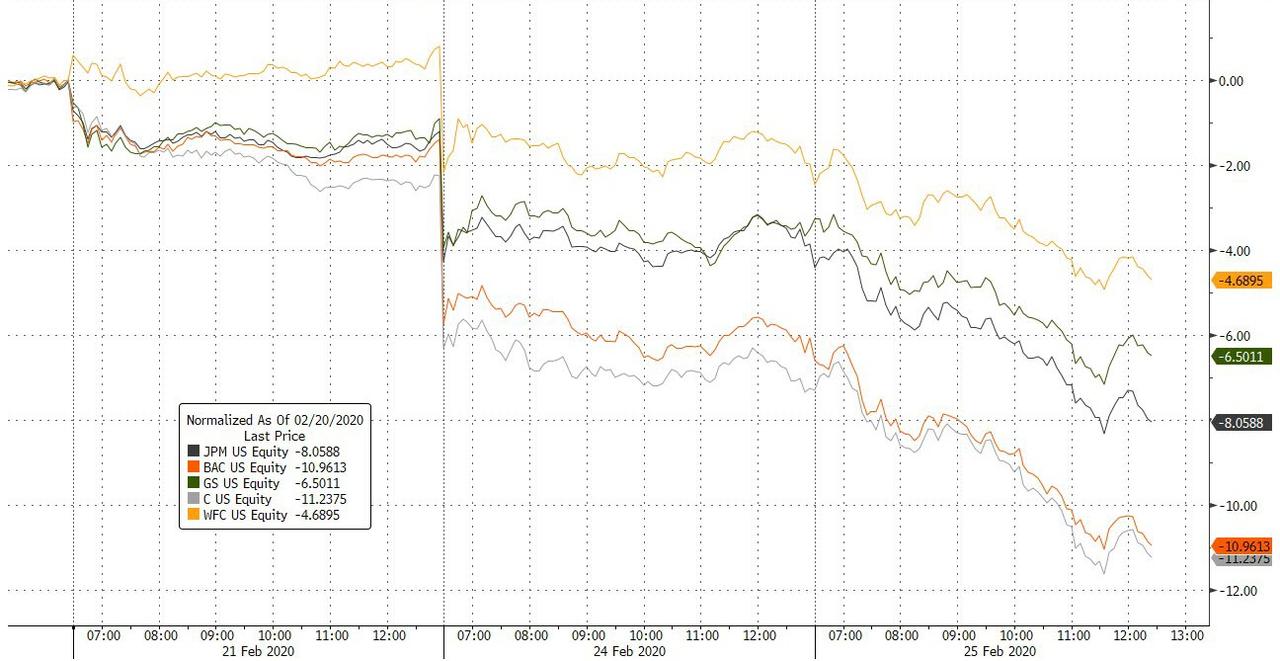
The big banks have been clubbed like baby seals, crashing over 10% in the last 3 days...
Source: Bloomberg
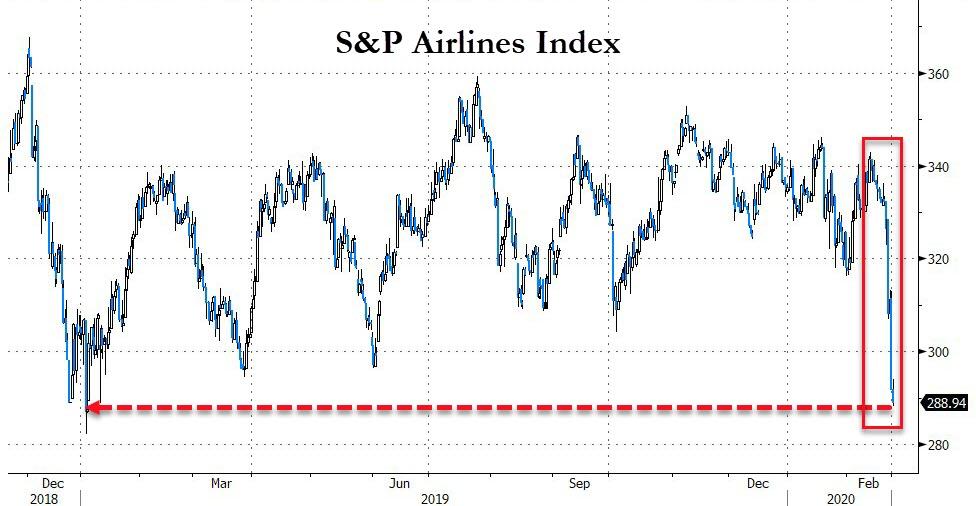
Airline stocks collapsed again - the worst 3 day drop for Airlines since Oct 2011...
Source: Bloomberg
VIX exploded higher again, pushing above 30 for the first time since Dec 2018...
HY credit extended its losses as stocks caught down to their reality...
Source: Bloomberg
Credit spreads blew out in cash and CDS markets...
Source: Bloomberg
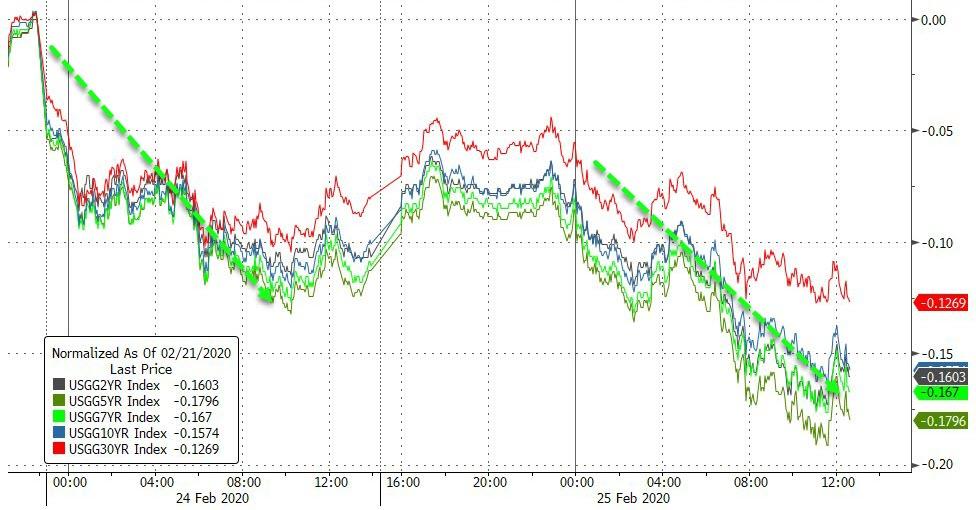
Treasury yields were down around 5bps across the curve...
Source: Bloomberg
30Y Yields extended the decline at record lows, trading with a 1.78% handle!!!
Source: Bloomberg
And the 10Y Yield just broke to a new record low at 1.3055%...
Source: Bloomberg
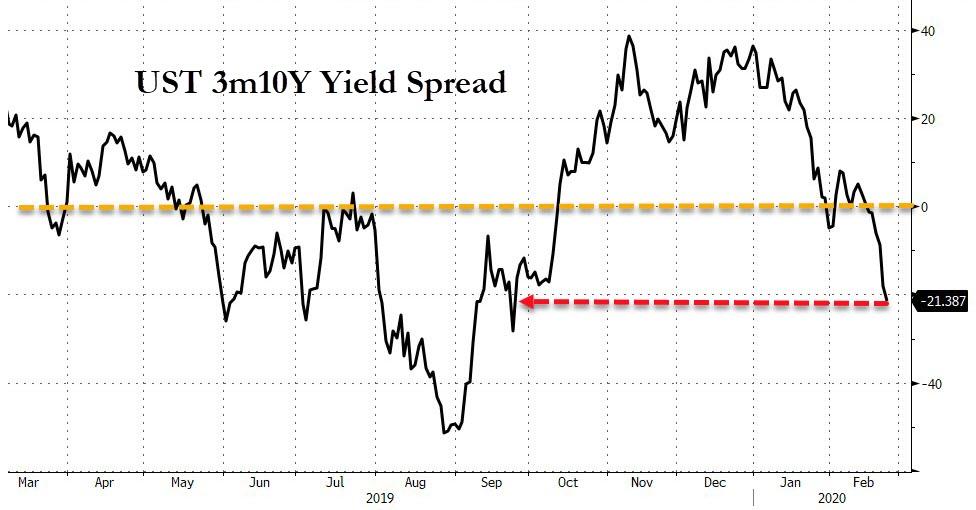
The yield curve continued to flatten dramatically...
Source: Bloomberg
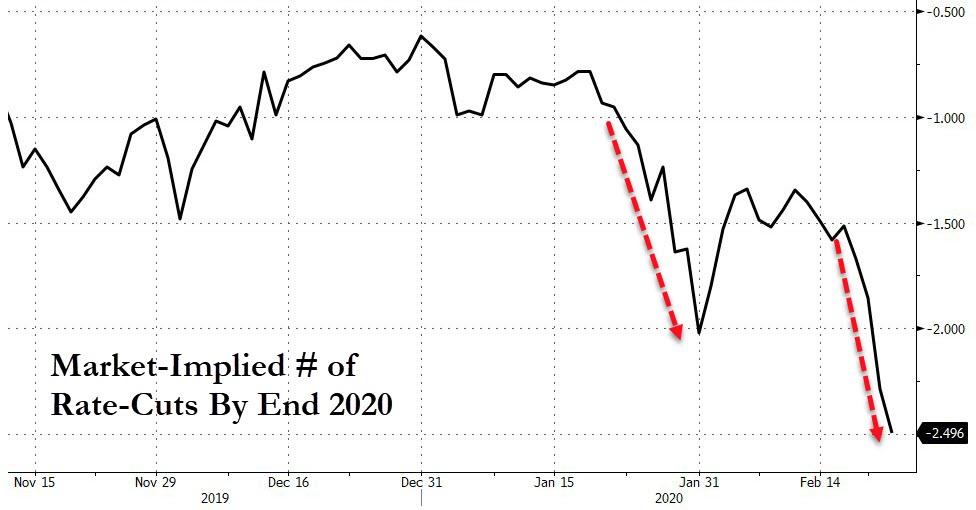
The short-end is now pricing in 2.5 rate-cuts by the end of 2020...
Source: Bloomberg
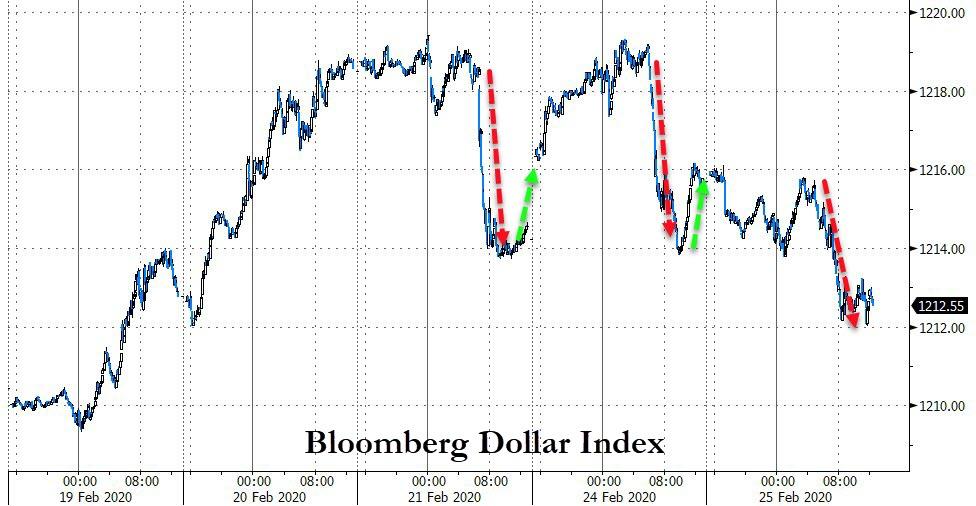
The dollar drifted lower today after two strange days...
Source: Bloomberg
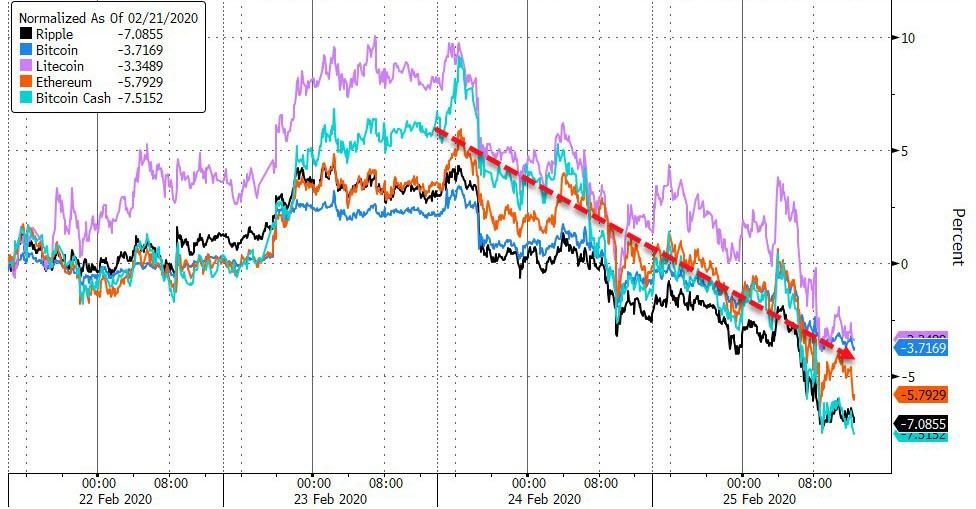
Cryptos have also been sold as stocks have tumbled

Source: Bloomberg
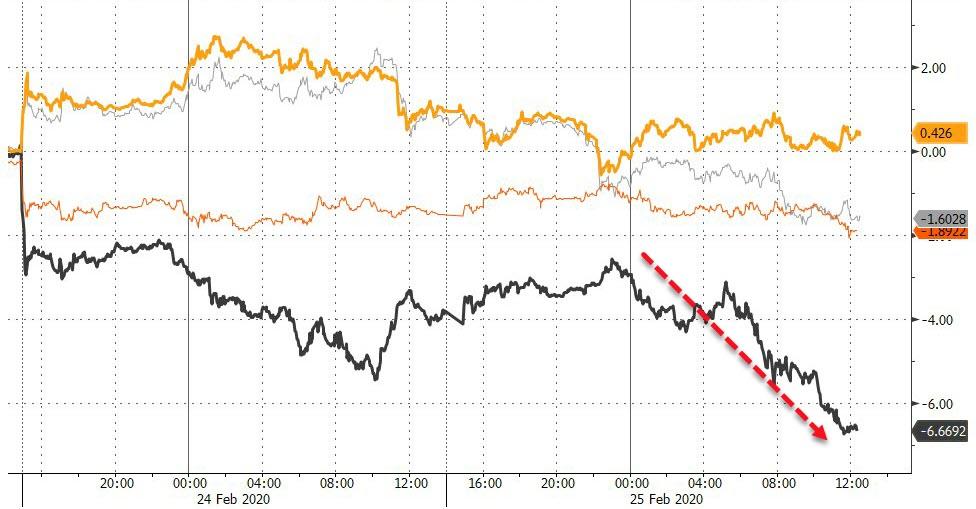
Commodities were all lower today (gold outperformed, but still fell), despite a weaker dollar...
Source: Bloomberg
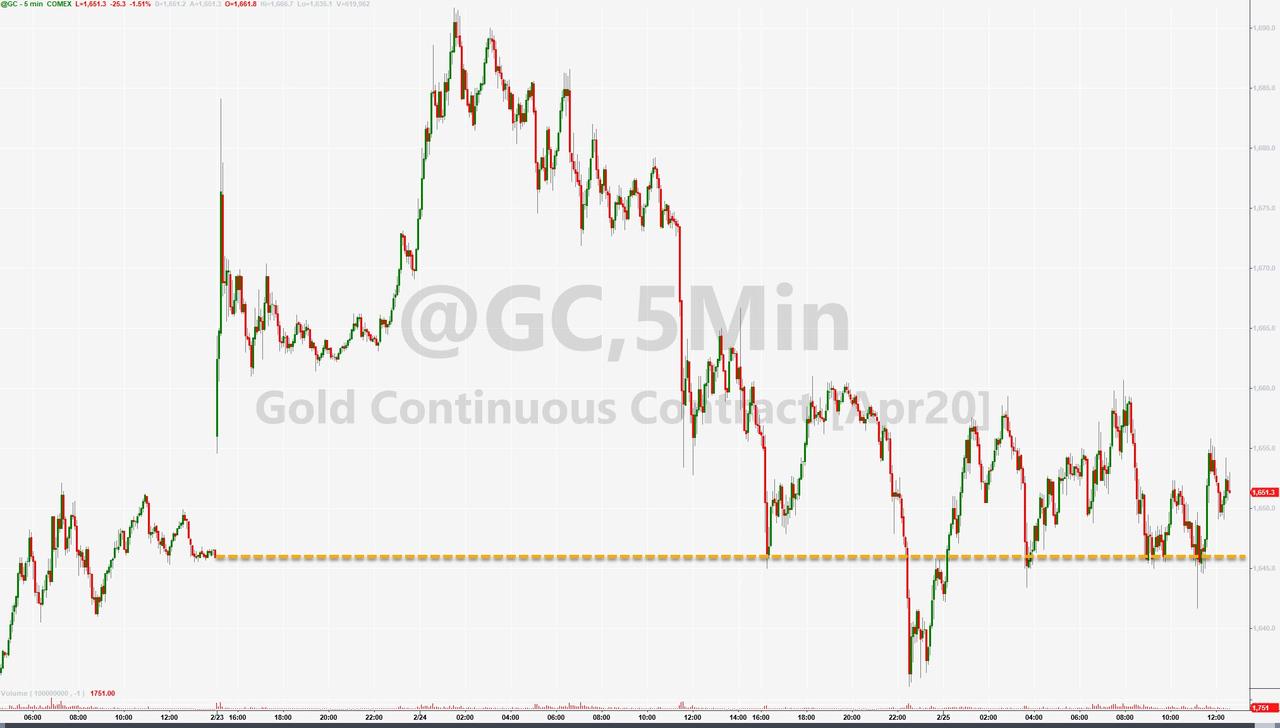
Gold managed to get back above the Friday close but was lower on the day...

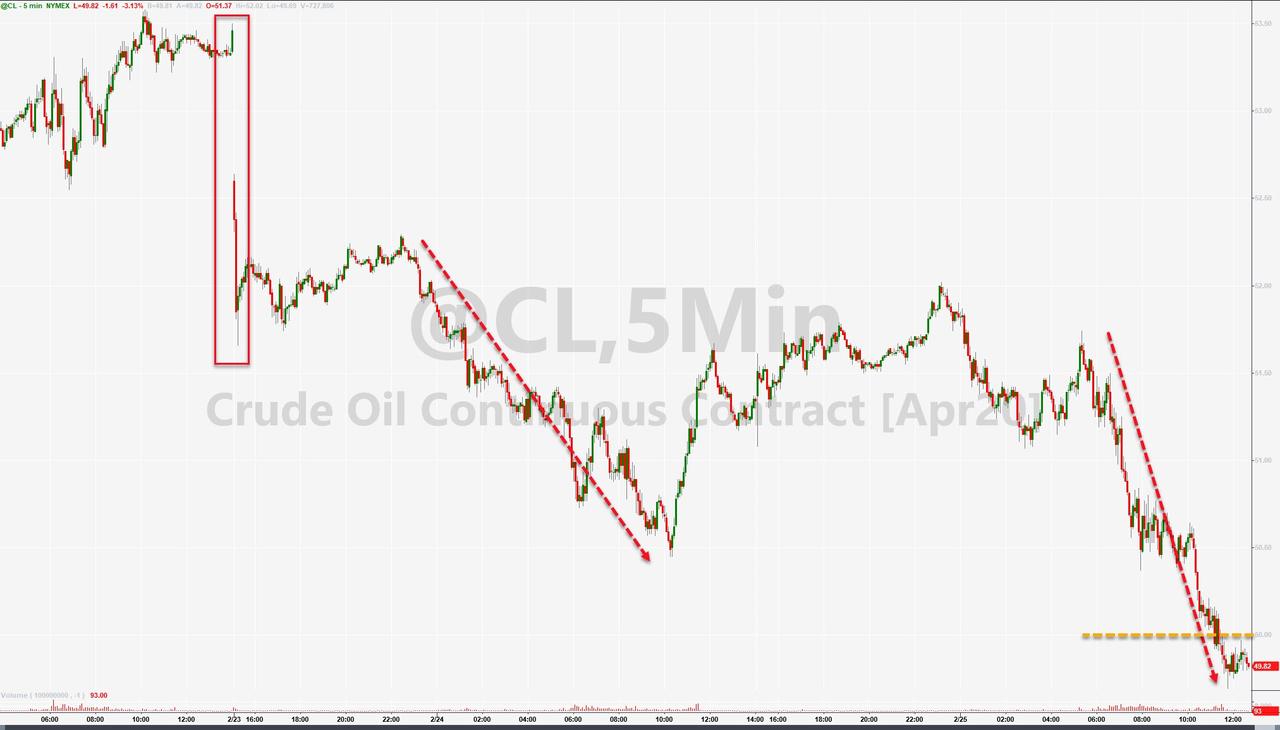
And WTI tumbled below $50
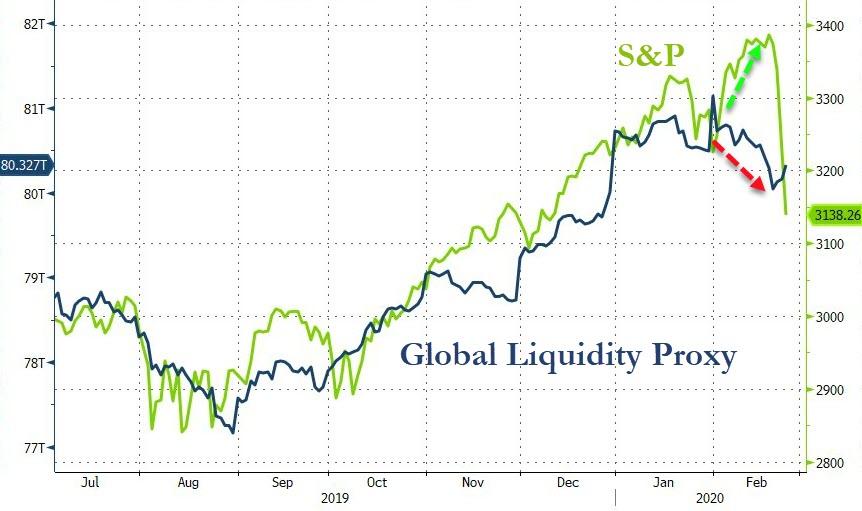
Finally, we note that stocks have played catch down to the retreat in global liquidity...
Source: Bloomberg
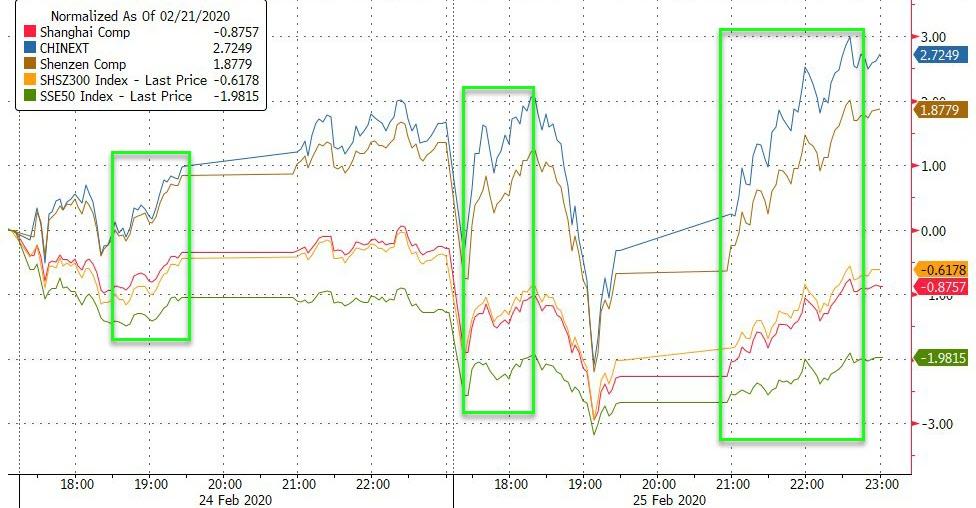
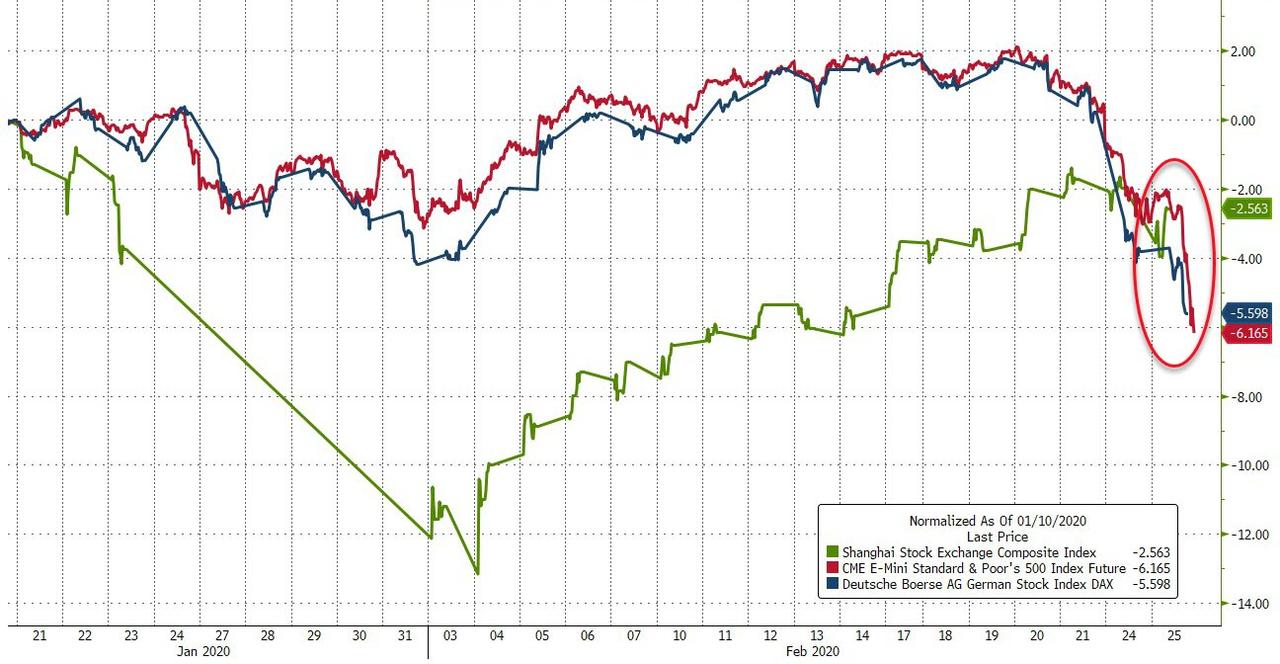
We also note that Europe and US are notably underperforming China since the Covid-19 crisis began to make headlines...
Source: Bloomberg
It is clear someone - cough, Xi, cough - doesn't want their stock market going down...
Source: Bloomberg
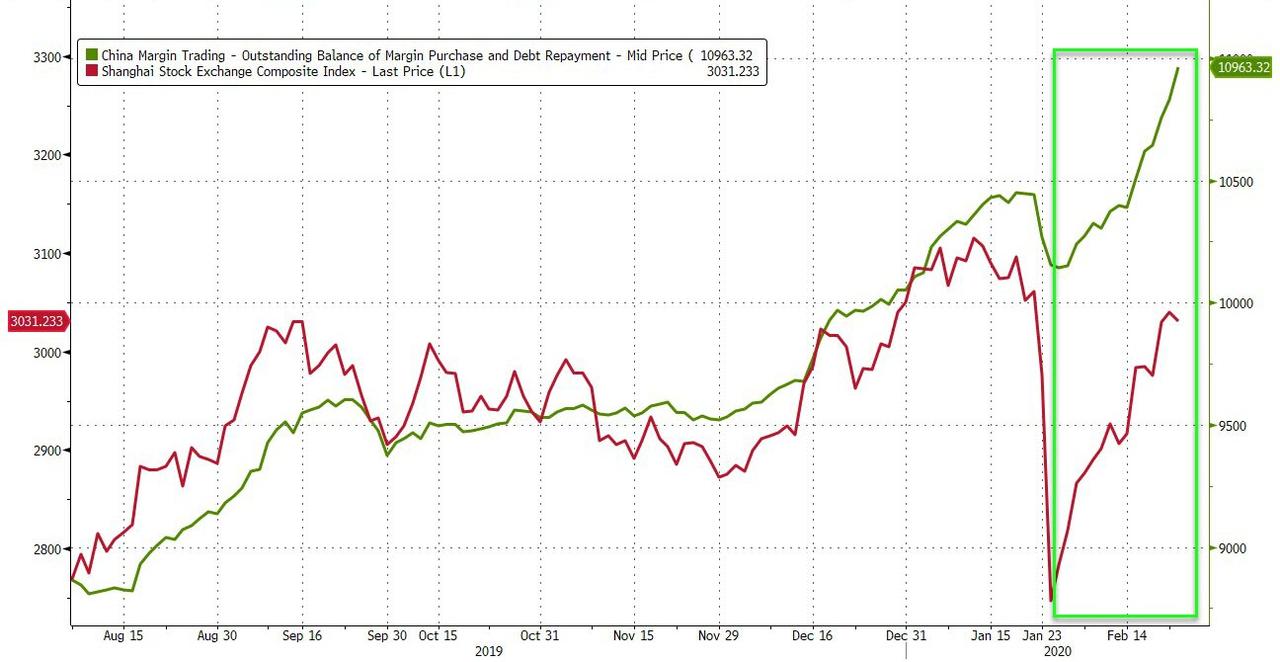
And China's resurgence is all about leverage - outstanding margin debt rose to a four-year high of 1.1 trillion yuan ($157 billion), according to data compiled by Bloomberg... that won't end well!
Source: Bloomberg
So, what happens next?
Source: Bloomberg