Showing posts with label shale. Show all posts

Thursday, 17 December 2015

UK votes for fracking under national parks

We live in such insane times that it seems that nothing needs to make financial sense - with oil at $35 a barrel, on its way to $20.

Fossil Fuel U-Turn: UK Approves Shale Gas Fracking Under National Parks

British MPs have voted to approve the use of fracking to extract shale gas and oil under national parks, only days after the UK came to an agreement with other nations to crack down on emissions and the use of fossil fuels at the Paris climate change convention.


16 December, 2015

Despite opposition from the Labour party, environmental groups and a number of Conservative party rebels, MPs voted 298 to 261 in favor of allowing fracking in national parks.

Breaking: MPs have voted in favour of allowing fracking under national parks. Details to follow soon.
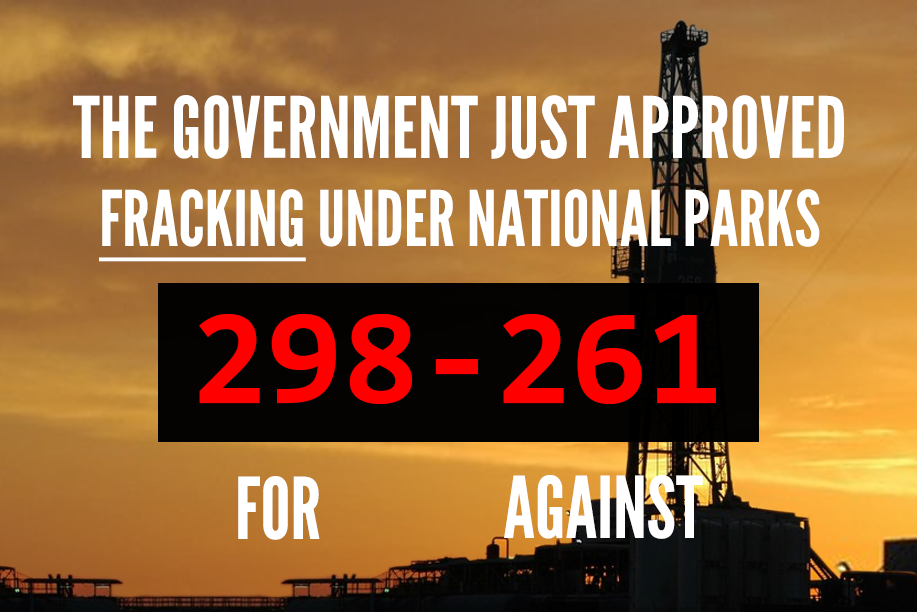
 

Embedded image permalink
The decision is also seen as a U-turn on an early law implemented by the Conservative and Lib Dem coalition in January, which imposed a ban on fracking in such areas.
While energy companies still won't be allowed to frack in national parks, they will be able to drill horizontally into deposits situated underneath protected zones, providing equipment is located outside the boundaries.
The decision has sparked outrage from environmental campaigners.
"What we have seen today is the Government breaking its promise and forcing through regulations which will allow fracking underneath some of the most fragile and treasured landscapes in Britain. These areas have been protected for a reason: stunning areas like the Peak District, the North York Moors and the South Downs," Hannah Martin, Greenpeace energy campaigner said.

Government successfully sneak through (without debate) change to allow under protected areas.Real shame 298 MPs voted for it.
'Why Should the Public Believe Them'

Ms Martin pointed to the government's slim majority on the vote to highlight the contentious nature of the issue, noting that many of Prime Minister David Cameron's own MPs voted against the bill.
"It's clear that the Tories can't even convince some of their own MPs that fracking under national parks and other areas of natural beauty is a good idea — so why should the public believe them?"
Among those was Conservative MP Andrew Turner, who rejected the government's plans.
"I voted against the proposals. Although the Government has listened to concerns raised and made a number of concessions, I do not believe that they go far enough to protect environmentally sensitive areas such as areas of outstanding natural beauty."
UK Accused of Undermining Paris Deal 

The practice of fracking — which involves drilling into shale rock and then using a high-pressure mix of water and chemicals to bring gas and oil to the surface — has been a highly contentious issue in Britain in the last few years.
Advocates say that fracking is a safer way to access shale gas and oil, arguing that it will increase jobs and reduce the UK's energy dependency on other countries.
Critics, however, have scoffed at the alleged energy benefits, arguing that fracking will have a detrimental environmental and health impact, as well as the communities affected by the drilling.
"The UK government has just participated in a historic climate agreement in Paris, but if it's to hold up its end of the bargain it has to rethink its support for fracking and back safe, cheap, clean energy instead," Hannah Martin said.
"As a result of today's vote, these places can now be fracked in all but name. Whether the fracking infrastructure is set up just outside the boundaries of national parks is a moot point: these previously protected areas could be ringed by drilling rigs, floodlights and compressors — and play host to thousands of lorry movements — meaning the most precious landscapes in our country are blighted by noise, air and light pollution."

Friday, 2 August 2013

Fracking in an earthquake zone

Oil companies begin 'fracking' in China’s most dangerous earthquake zone
The Chinese want to join the shale gas revolution, even if it means drilling for oil in China’s earthquake hot bed in the Sichuan region, where nearly 70,000 died in an earthquake in 2008.


RT,
1 August, 2013


Royal Dutch Shell Plc and China National Petroleum have started 'fracking' operations in the province.

China hopes to boost annual shale gas production to 6.5 billion cubic meters by 2015, and reserves are estimated at about 1,115 trillion cubic feet, according to the US Energy Information Administration, higher than the estimated 665 trillion gas reserves on American soil.
Europe's largest oil company plans to invest $1 billion per year in China’s shale gas industry, as part of its goal to increase global output to four million barrels of oil and gas by 2017-2018, up from current levels of 3.3 million.
Drilling for oil in the Longmenshan mountain range, where India and Asia meet, could increase tremors in the already highly-sensitive area.
The hydraulic fracturing, or 'fracking' process of extracting oil from the earth is invasive and is believed by many to be a direct earthquake instigator.
Extraction by 'fracking' involves pumping millions of gallons of water and chemicals into the ground, which creates excess hydro waste, which over time, causes tectonic stress.
We do detailed structural analysis as a routine part of our pre-drill evaluation,” Shi Jiangtao, a Shell spokesman in Beijing, said in an e-mail to Bloomberg. “This means that we evaluate the geology by using seismic, surface geology, nearby well data, etc.”
There is strong correlative evidence between deep underground wells and nearby earthquakes, both in the US and China.
An investigation by the US Geological Survey found that 'fracking' and quakes aren’t directly related, but noted, “at some locations the increase in seismicity coincides with the injection of wastewater in deep disposal wells.”
Human-induced earthquakes would be controversial in a region which experienced one of the deadliest earthquakes in China’s history, which killed nearly 70,000, including 5,335 school children in a 2008 quake in Wenchuan, Sichuan regionnds of people flock to look at the devastated town of Beichuan on May 12, 2009 which was destroyed in the May 12, 2008 Sichuan earthquake (A Photo /
Peter Parks)
The boom in oil and gas 'fracking' has led to jobs, billions in royalties and profits, and even some environmental gains.
The shale industry boom in the US may add as much as $690 billion to GDP and create 1.7 million jobs by 2020, according to a study by McKinsey and Co. The oil boom has boosted domestic employment, company profits, and GDP in the US, and China is eager to follow suit, even it means drilling in earthquake territory.
Royal Dutch Shell Plc, China National Petroleum, and China Petrochemical Corp all currently have drilling operations in the region. 
Environmental concerns

Geologists also raise concerns over the amount of water used in 'fracking', and whether China’s shale ambitions could run the water supply dry.
China, home to roughly 20 percent of the world’s population, only controls 6 percent of the world’s fresh water supply, and often experiences serious water shortages. Adding 'fracking' to this equation could only further exacerbate the problem. Toxic chemicals used in fracking alter the drinking water.
Shale gas is often found ‘in the middle of nowhere’, places that are already prone to water shortages.
Environmentalists in China have also voiced concern over contamination and pollution brought on by 'fracking' waste disposal.
Shell's earnings hit hard by shale gas

Royal Dutch Shell’s earnings fell $1.1 billion in Q2, year on year, blaming poor performance on higher operating costs, disruptions in Nigeria, and a weakening Aussie currency. Total revenue fell by 5.6 percent.
Net income fell by 57 percent in the second quarter, which was partly due to $2.2 billion the company had to write off on shale exploration and development in the United States.
China’s eagerness to exploit shale gas opens an opportunity for foreign investors looking for a start-up opportunity.
"In the next 18 months we expect to see five major project start-ups, which should add over $4bn to our 2015 cash flow," said Peter Voser, CEO of Shell, said in relation to quarterly results.
Shell is planning to sell four more oil blocks in Nigeria, and is eyeing selling other assets in the Niger Delta, where oil theft and violence has stunted revenue.
It has already sold eight Niger Delta licenses for a total $1.8bn since 2010, but has publicly announced it remains committed to operations in Nigeria.


Friday, 19 July 2013

British tax cuts for fracking

Tax cut for shale gas firms planned

The government has outlined plans to give tax breaks to companies involved in the UK's nascent shale gas industry.


BBC,
18 July, 2013


It has proposed cutting the tax on some of the income generated from producing shale gas - found in underground shale rock formations - from 62% to just 30%.


The plans would make the UK the "most generous" regime for shale gas in the world, the government said.


But they have been criticised by environmentalists, with Friends of the Earth calling them a "disgrace".


Greenpeace added that communities affected by fracking - the technique for extracting shale gas - faced a lot of disruption for very little gain.


Chancellor George Osborne said shale gas was a resource with "huge potential" for the UK's energy mix.


"We want to create the right conditions for industry to explore and unlock that potential in a way that allows communities to share in the benefits," he said.


"I want Britain to be a leader of the shale gas revolution because it has the potential to create thousands of jobs and keep energy bills low for millions of people."


The UK is believed to have large resources of shale gas.


A recent report from the British Geological Survey estimated there may be 1,300 trillion cubic feet present in the north of England alone - much of it in the Bowland Basin under Lancashire.


Drilling companies have previously estimated that they may be able to extract around 10% of this gas - far in excess of the three trillion cubic feet of gas currently consumed in the UK each year.


But currently the industry is still in its infancy with a handful of companies holding licences for shale gas exploration in the UK, none of which have begun extracting gas.


'US boom'


In backing shale gas exploration, the government points to the experience of the US, where a shale gas boom has had a dramatic effect on the energy sector.


Under its plans, the tax break would apply to a proportion of the income generated from shale gas production. What that proportion is will be determined after a consultation.


BBC industry correspondent John Moylan says the industry regards the tax incentives as necessary as costs are likely to be high during the initial exploration phase over the coming years.


The government has also confirmed plans to give communities that host shale gas sites £100,000 per site, and up to 1% of all revenues from production.


That is designed to offset some of the controversy surrounding the process of fracking.


There are concerns the process, which involves pumping high pressure water, sand and chemicals into rock to force out the gas, is related to water contamination and even earth tremors.


Environmental groups argue that investment in the industry will divert attention from the need to develop renewable sources of energy.


Andrew Pendleton, from Friends of the Earth, condemned the move.


"Promising tax hand-outs to polluting energy firms that threaten our communities and environment, when everyone else is being told to tighten their belts, is a disgrace," he said.


"Ministers should be encouraging investors to develop the nation's huge renewable energy potential. This would create tens of thousands of jobs and wean the nation off its increasingly expensive fossil fuel dependency."


Sunday, 23 June 2013

Shale gas


Shale gas won't stop peak oil, but could create an economic crisis
Overinflated industry claims could pull the rug out from optimistic growth forecasts within just five years


22 June, 2013

A new report out last week from the US Energy Information Administration (EIA) has doubled estimates of "technically recoverable" oil and gas resources available globally. The report says that shale-based resources potentially increase the world's total oil supplies by 11 per cent.

Acknowledging fault-lines in its new study, contracted to energy consulting firm Advanced Resources International Inc. (ARI), the EIA said:
"These shale oil and shale gas resource estimates are highly uncertain and will remain so until they are extensively tested with production wells."
The report estimates shale resources outside the US by extrapolation based on "the geology and resource recovery rates of similar shale formations in the United States." Hence, the EIA concedes that "the extent to which global technically recoverable shale resources will prove to be economically recoverable is not yet clear."
Two years ago, following the publication of the EIA April 2011 report a New York Times investigation obtained internal EIA communications showing how senior officials, including industry consultants and federal energy experts privately voiced scepticism about shale gas prospects.
One internal EIA document said oil companies had exaggerated "the appearance of shale gas well profitability" by highlighting performance only from the best wells, and using overly optimistic models for productivity projections over decades. The NYT reported that the EIA often "relies on research from outside consultants with ties to the industry."
The latest EIA shale gas estimates, contracted to ARI, is no exception. ARI, according to the NYT's 2011 article, has "major clients in the oil and gas industry" and the company's president, Vello Kuuskraa, is "a stockholder and board member of Southwestern Energy, an energy company heavily involved in drilling for gas in the Fayetteville shale formation in Arkansas."
Independent studies published over the last few months cast even more serious doubt over the viability of the shale gas boom.
A report released in March by the Berlin-based Energy Watch Group (EWG), a group of European scientists, undertook a comprehensive assessment of the availability and production rates for global oil and gas production, concluding that:
"... world oil production has not increased anymore but has entered a plateau since about 2005."
Crude oil production was "already in slight decline since about 2008." This is consistent with the EWG's earlier finding that global conventional oil production had peaked in 2006 - as subsequently corroborated by the International Energy Agency (IEA) in 2010.
The new report predicts that far from growing inexorably, "light tight oil production in the USA will peak between 2015 and 2017, followed by a steep decline", while shale gas production will most likely peak in 2015. Shale gas prospects outside the US are incomparable to gains made so far there "since geological, geographical, and industrial conditions are much less favourable."
Consequently, global gas prices are likely to increase rather than follow the initial US trend. In the meantime, conventional oil production will continue declining, dropping as much as 40 per cent by 2030. The upshot is that the US "will not become a net oil exporter."
The EGW report follows two other reports published earlier this year also challenging the conventional wisdom.
A Post-Carbon Institute study authored by geologist David Hughes, who worked for 32 years as a research manager at the Geological Survey of Canada, analysed US production data for 65,000 wells from 31 shale plays using a database widely used in industry and government. While acknowledging that shale has dramatically reversed "the long-standing decline of US oil and gas production", this can only:
"... provide a temporary reprieve from having to deal with the real problems: fossil fuels are finite, and production of new fossil fuel resources tends to be increasingly expensive and environmentally damaging."
Despite accounting for nearly 40 per cent of US natural gas production, shale gas production has "been on a plateau since December 2011 - 80 per cent of shale gas production comes from five plays", some of which are already in decline.
"The very high decline rates of shale gas wells require continuous inputs of capital - estimated at $42 billion per year to drill more than 7,000 wells - in order to maintain production. In comparison, the value of shale gas produced in 2012 was just $32.5 billion."
The report thus concludes:
"Notwithstanding the fact that in theory some of these resources have very large in situ volumes, the likely rate at which they can be converted to supply and their cost of acquisition will not allow them to quell higher energy costs and potential supply shortfalls."
Report author Hughes said that the main problem was the exclusion of price and rate of supply: "Price is critically important but not considered in these estimates." He added: "Only a small portion [of total estimated resources], likely less than 5-10 per cent will be recoverable at a low price...
"Shale gas can continue to grow but only at higher prices and that growth will require an ever escalating drilling treadmill with associated collateral financial and environmental costs – and its long term sustainability is highly questionable."
Another report was put out by the Energy Policy Forum, and authored by former Wall Street analyst Deborah Rogers - now an adviser to the US Department of the Interior's Extractive Industries Transparency Initiative. Rogers warns that the interplay of geological constraints and financial exuberance are creating an unsustainable bubble. Her report shows that shale oil and gas reserves have been:
"... overestimated by a minimum of 100% and by as much as 400-500% by operators according to actual well production data filed in various states... Shale oil wells are following the same steep decline rates and poor recovery efficiency observed in shale gas wells."
Deliberate overproduction drove gas prices down so that Wall Street could maximise profits "from mergers & acquisitions and other transactional fees", as well as from share prices. Meanwhile, the industry must still service high levels of debt due to excessive borrowing justified by overinflated projections:
"... leases were bundled and flipped on unproved shale fields in much the same way as mortgage-backed securities had been bundled and sold on questionable underlying mortgage assets prior to the economic downturn of 2007."
Seeking to prevent outright collapse, the report argues, the US is ramping up gas exports so it can exploit the difference between low domestic and high international prices "to shore up ailing balance sheets invested in shale assets."
Rogers, who testified last month before the Senate Committee on Energy and Natural Resources, also expressed scepticism about the EIA's latest assessment:
"The EIA actually does retrospective assessments of their forecasting and their track record is dismal... They admit that they overestimated natural gas production 66 per cent of the time and crude 59.6 per cent of the time in their March 2013 assessment for 2012."
She added that "there is definitely a bubble." Though it would not have an impact as devastating as the banking crisis, she said:
"The oil majors do have losses, but the smaller independents are being shaken out. Chesapeake and others are struggling, like Devon, Continental, Kodiak and Range. Without exception, they all have had a significant deterioration in negative free cash since 2010. This is obviously not sustainable."
The impact of this would be greater centralisation, with smaller companies and their assets being absorbed by the oil majors through mergers and acquisitions. Rogers said:
"What is most troubling to me is that there appears to be a complacency setting in about transitioning to a more sustainable energy economy. Shales should be used as a bridge. But we are hearing far too much euphoric talk about 100-200 years of natural gas. Therefore no need to worry, it can be business as usual. This is highly problematic in my opinion. We must globally transition away from hydrocarbons."

Monday, 10 June 2013

Australian shale gas

Some of us could have (and probably did) pointed this out when this was first announced. Shale needs water (lots of it).
---Seemorerocks

At least the Germans and Australians are honest about it. Judging by the mainstream US media, you'd get the impression that shale gas is profitable in the US, which it isn't (for example, see here and here).
---Rice Farmer

Cost of extracting shale gas may outweigh benefit: report

AUSTRALIA may have more than 1000 trillion cubic feet in undiscovered shale gas resource, but the enormous cost of infrastructure needed to extract it may outweigh its economic benefit unless shale gas prices rise, a new report has found.


9 June, 2013

Shale gas, which is buried further below the surface of the ground than coal seam gas, is abundant in the United States and in Australia, and is extracted using similar techniques, including fracking.

The new report, written by the Australian Council of Learned Academies, is part of Securing Australia's Future, a series of research programs selected by the Prime Ministers Science, Engineering and Innovation Council and the Chief Scientist.

The study looked at shale gas and resources, technology, monitoring, infrastructure, human and environmental impacts, issues communication, regulatory systems, economic impacts, lessons learned from the coal seam gas industry, and impacts on greenhouse gas reduction targets.

Not a cheap gas

The report found that shale gas production costs in Australia are likely to be significantly higher than those in North America.

"Shale gas will not be cheap gas in most circumstances. It will require a relatively high price to make it profitable to produce," the report said.

In Australia, shale gas will require a price of the order of $6 to $9 a gigajoule to make its production and transport profitable, the report said.

"By comparison, the wholesale gas price for long-term contracts of gas for the domestic market in eastern Australia is around $4 per gigajoule while current eastern Australia domestic wholesale prices are about $6 per gigajoule."

"Based on these estimates, development of Australian shale gas marketed on the east coast is unlikely to occur until domestic and international netback prices (around $10 per gigajoule) are equalised."

Dr Vaughan Beck, one of the authors of the report and a fellow of the Australian Academy of Technological Sciences and Engineering, said developers would also have to allow for the extra cost of transmission and processing of the product.

"So it's not currently economical in Australia, in general terms," he said.

Road and pipeline networks in North America are more developed than in Australia and the cost of developing such infrastructure would need to be factored in, the report said.

Social licence

The report said it was crucial for shale gas developers to gain community support to operate and may involve negotiating agreements with indigenous land owners.

"In order to develop effective relationships with communities potentially impacted by shale gas developments, it will be necessary to have open dialogue, respect and transparency," the report said.

Water and environment

More water may be needed for shale gas fracking than is used for coal seam gas extraction, the report said, warning that "contamination of freshwater aquifers can occur due to accidental leakage of brines or chemically-modified fluids during shale gas drilling or production; through well failure; via leakage along faults; or by diffusion through over-pressured seals."

"The petroleum industry has experience in managing these issues and remediating them, but in a relatively new shale gas industry, unanticipated problems may arise and it is important to have best practice in place, to minimise the possibility of this risk," the report said.

Using shale gas in gas turbines to produce electricity creates 20% more greenhouse gas emissions than conventional gas but between 50% and 75% of the emissions of black coal, the report found.

"Some people have raised the question 'Why extract shale gas? Why not spend the money on cleaner renewable energy?' But that is not a question that was in the terms of reference of this Review," the report said.

Uncertainty

Vlado Vivoda, a shale gas expert and Research Fellow at Griffith University said the report was timely but said he thought it was unlikely gas prices will rise.

"If massive volumes of US shale gas enters the international market as liquid natural gas (LNG) over the next decade (and mainly gets imported by Asian countries), this may challenge the prevailing LNG pricing structure in Asia, where LNG price is indexed to crude oil," he said.

"This, in fact, may be a crucial development which may affect the prospects for Australian shale gas, which is more expensive than North American shale gas."

Dr Vivoda said that given the high infrastructure costs and uncertainty about LNG prices in the region "it will be risky for investors to enter into this game."

Alarm bells

Colin Hunt, Honorary Fellow in Economics at University of Queensland said the report was a comprehensive outline of the risk and benefits of shale gas extraction in Australia.

"Alarm bells will be set ringing because of the Australian experience with the way that companies have conducted environmental impact assessments for their coal seam gas and coal mining projects.

"Best practice in controlling the volume of water use from aquifers, contamination of aquifers with produced water and fracking chemicals is advocated in the report," he said.

"However, it is worrying that a recent survey found that most environmental impact assessments were deficient in their analysis of how a project would contribute to cumulative environmental impacts of water use and disposal associated with gas and coal mining."

Dr Hunt also warned of habitat fragmentation and biodiversity risks presented by the development of shale gas infrastructure.

This story was originally published at The Conversation. You can source the original article here.

Sunanda Creagh is an editor at The Conversation. She interviewed Vlado Vivoda, research fellow at the Griffith Asia Institute at Griffith University, and Colin Hunt, honorary fellow in economics at the University of Queensland.