Showing posts with label plankton. Show all posts

Friday, 4 January 2019

The rapid decline in phytoplankton


They NEVER know WHY.

Building blocks of ocean food web in rapid decline as plankton productivity plunges
Senior DFO scientist says the cause of the collapse is unknown


CBC,
22 December, 2018

They're teeny, tiny plants and organisms but their impact on ocean life is huge.
Phytoplankton and zooplankton that live near the surface are the base of the ocean's food system. Everything from small fish, big fish, whales and seabirds depend on their productivity.
"They actually determine what's going to happen, how much energy is going to be available for the rest of the food chain," explained Pierre Pepin, a senior researcher with the Department of Fisheries and Oceans in St. John's.
Pepin says over the past three to four years, scientists have seen a persistent drop in phytoplankton and zooplankton in waters off Newfoundland and Labrador
"Based on the measurements that we've been taking in this region, we've seen pretty close to 50 per cent decline in the overall biomass of zooplankton," said Pepin. "So that's pretty dramatic."
Measuring five millimetres or less, phytoplankton contain chlorophyll to capture sunlight and use photosynthesis to turn it into chemical energy, which is later eaten by ocean creatures. (Photo courtesy of DFO)
Scientists say local testing reveals half the amount of plankton in a square metre of water today. It's not just a problem here, declining plankton numbers are a global phenomenon.
It's a difficult idea to convey to the average person who might not understand the ocean ecosystem, but Pepin likens it to walking into a grocery store and instead of seeing the shelves full, they're only half-full.
"You know if you saw half the number of birds, if you saw half the number of fish in the water you'd pay attention. Well, this is a signal to say we need to pay attention."

Alarm bells are going off 

So what's causing this dramatic decline?
Scientists here haven't detected anything in particular that can be linked to the plunge in productivity, but they are worried.
"When it persists — for in our case now for three or four years — in the back of my mind, at the very least, little alarm bells start going off because it means that something fundamental may have changed in the food web."

Pepin says it is difficult to understand how long it takes the effect of this lack of basic food to make its way through the ocean ecosystem.
Scientists have to advise managers on how to handle fish stocks but without clear evidence of causes and effects, it becomes a very difficult job.
"How do we act on this? This is a real challenge."

Tuesday, 16 October 2018

Phytoplankton being driven north into the Arctic


This needs more investigation. We have been picking up considerable areas of green in the Arctic sea and wondering if it could be algal blooms. Maybe it is phytoplankton?

ARCTIC SEA ICE DECLINE DRIVING OCEAN PHYTOPLANKTON FARTHER NORTH


15 October, 2018

WASHINGTON — Phytoplankton blooms that form the base of the marine food web are expanding northward into ice-free waters where they have never been seen before, according to new research.

A new study based on satellite imagery of ocean color reveals phytoplankton spring blooms in the Arctic Ocean, which were previously nonexistent, are expanding northward at a rate of 1 degree of latitude per decade. Although blooms, or large explosions of phytoplankton, did not previously occur in this area, phytoplankton were present in the Arctic’s central basin at low biomass. The study also found the primary productivity of the phytoplankton, or the rate at which phytoplankton are converting sunlight into chemical energy, is increasing during the spring blooms.
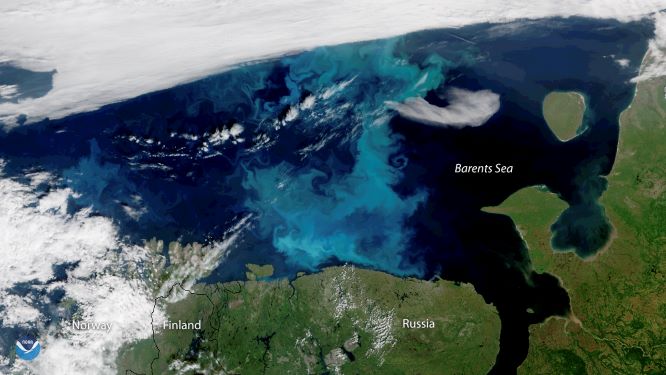
This true-color image, captured by the NOAA-20 satellite on July 30, 2018, shows a large phytoplankton bloom in the Barents Sea. Credit: NOAA Environmental Visualization Laboratory

The decline in Arctic sea ice over the past several decades has made way for areas of open water where phytoplankton can thrive, driving their northward expansion, according to the study’s authors. The researchers are unsure what effect this expansion will have on the food web, but the results suggest the decline of ice cover is impacting marine ecosystems in unforeseen ways.
 
If sea ice continues to decline, it could drive phytoplankton spring blooms farther north and increase primary productivity even more. These changes could affect the fate of the Arctic Ocean as a carbon source or a carbon sink, according to the study.

If the ice pack totally disappears in summer, there will be consequences for the phytoplankton spring bloom,” said Sophie Renaut, a Ph.D. student at Laval University in Quebec City, Canada, and lead author of the new study in Geophysical Research Letters, a journal of the American Geophysical Union. “We cannot exactly predict how it will evolve, but we’re pretty sure there are going to be drastic consequences for the entire ecosystem.”

Phytoplankton in the ecosystem

Phytoplankton are microscopic organisms that live in water, consume carbon dioxide and release oxygen through photosynthesis. In this process, they convert sunlight into chemical energy. Phytoplankton form the base of the marine food web, indirectly feeding everything from small fish to multi-ton whales.

Phytoplankton growth depends on the availability of carbon dioxide, sunlight, nutrients, water temperature and salinity, water depth and grazing animals, according to the NASA Earth Observatory. When conditions are ideal, phytoplankton population growth can explode, or bloom. While a bloom may last several weeks, the lifespan of an individual phytoplankton is seldom more than a few days.

Phytoplankton in the Arctic Ocean typically bloom every spring. In the past, phytoplankton blooms have been virtually absent from the highest Arctic latitudes, because these areas are usually covered by sea ice. In recent decades sea ice has declined, breaking up earlier in the spring or not forming at all in some areas of the Arctic.

In the new study, Renaut and her colleagues wanted to see if recent sea ice declines have had any effect on spring phytoplankton blooms. They used satellite observations of ocean color—which provide estimates of phytoplankton biomass and primary productivity—to track changes of the blooms each spring from 2003 to 2013.

They found the spring blooms are expanding farther north and increasing in primary productivity. In the spring and summer months, net primary productivity in the Arctic Ocean increased by 31 percent between 2003 and 2013, according to the study. The researchers also found that these blooms in the Barents and Kara Seas, north of Russia, are expanding north at a rate of 1 degree of latitude per decade.
Estimates of annual trends in daily flux of primary productivity (PP) during the phytoplankton spring bloom determined from satellite ocean color data. Green pixels correspond to new phytoplankton spring blooms observed since 2010. Credit: S. Renaut et al. 2018
 
Unexpected effects of sea ice decline
 
Sea ice melt occurring earlier in the season creates larger open water areas that act as incubators for phytoplankton growth and elongate their growing season, according to Renaut.

The authors suspect spring blooms could someday extend into the Arctic’s central basin, which encompasses almost everything north of 80 degrees latitude. 
Primary productivity, though, would likely remain low due to a lack of nutrients. Less ice cover means spring blooms and under-ice blooms may also have to compete for light and nutrients, thus altering the flow of the marine ecosystem. The results suggest a large change in this region, which has never been free of ice cover.

The polar regions—the Southern Ocean and the Arctic Ocean—they’re really important because they play a critical role in regulating the global climate,” Renaut said. “If sea ice disappears completely in summer in the Arctic Ocean, which is what we expect in some decades, it’s going to have an impact on the ecosystem but also likely on the climate.”

Patricia Yager, professor of Marine Sciences at the University of Georgia who was not involved with the new study, said the earlier algal bloom growth they observed in some areas could have considerable impacts if animals are not yet ready to graze on the phytoplankton.

Such a mismatch in time could cause major changes to the Arctic food web, impacting not only the local animals and the people who live there, but also the global population of migrating animals who depend on these Arctic resources,” Yager said. “What happens in the Arctic does not stay in the Arctic.”

Cecile Rousseaux, a research scientist at the Universities Space Research Association, who was not involved in the new study, said the study advances research in this area by investigating individual regions of the Arctic for phytoplankton productivity, and represents evidence of the effects that reduced ice cover have on the biochemical cycle of the Arctic Ocean. However, Rousseaux noted that the study does have limitations.

It is also important to remember that we are currently limited by the amount of data available to study these changes,” Rousseaux said. “Longer time series of satellite data will allow us to confirm whether these trends in phytoplankton productivity persist or not.”

Authors:

Sophie Renaut, Marcel Babin: Takuvik Joint International Laboratory, CNRS, Laval University, Québec, Québec, Canada;
Emmanuel Devred: Takuvik Joint International Laboratory, CNRS, Laval University, Québec, Québec, Canada and Ecosystem and Ocean Sciences Division, Bedford Institute of Oceanography, Department of Fisheries and Oceans, Dartmouth, Nova Scotia, Canada
Contact information for the authors:
Sophie Renaut: 
sophie.renaut@takuvik.ulaval.ca, +1 (418) 523-9821
Marcel Babin: marcel.babin@takuvik.ulaval.ca, +1 (418) 656-2205

Monday, 29 February 2016

Climate change decreases oxugen- Paul Beckwith

From Paul Beckwith


Oxygen Level Decrease in Air from Climate Change


Combustion of fossil fuels causes oxygen to decrease in the atmosphere/ocean system. As does deforestation, exponential population growth and phytoplankton loss in the oceans from warming stratification limiting nutrients at the surface. It is often said that the oxygen in every second breath you take is produced by photo plankton, that are the true lungs of the planet. I discuss the extend of the oxygen decrease, which is more than you want to know.

Please visit my website paulbeckwith.net and help support my videos/research (self-funded) via the Please Donate tab.


Wednesday, 10 February 2016

Phytoplanton population drops 40% since 1950

Global Ocean Phytoplankton in Severe Decline


sf9i9yr89uy8

http://paulbeckwith.net/2016/02/10/global-ocean-phytoplankton-in-severe-decline/

Global Ocean Phytoplankton in Severe Decline // Published on Feb 9, 2016

Phytoplankton are about half the global biomass, and they are the base of the ocean food chain, and produce the oxygen in every other breath you take.
In 2010 a landmark paper reported that from 1950 to 2010 the global oceans suffered a severe drop in phytoplankton of almost 1% per year (40% drop). What has happened since then; find out in this video [1].


Tuesday, 2 February 2016

The loss of phytoplankton

Phytoplankton rapidly disappearing from the Indian Ocean

Loss of mini marine plants at base of food web threatens sea’s ecology


WATER COLOR  Oxygen-producing plankton are on the decline in the western Indian Ocean, new research suggests. The work tracked changes in water color across the ocean caused by the presence — or absence — of phytoplankton, such as that seen in this swirling 2013 phytoplankton bloom.LANCE/NASA
ScienceNews,

1 February, 2016

A rapid loss of phytoplankton threatens to turn the western Indian Ocean into an “ecological desert,” a new study warns. The research reveals that phytoplankton populations in the region fell an alarming 30 percent over the last 16 years.
A decline in ocean mixing due to warming surface waters is to blame for that phytoplankton plummet, researchers propose online January 19 in Geophysical Research Letters. The mixing of the ocean’s layers ferries phytoplankton nutrients from the ocean’s dark depths up into the sunlit layers that the mini plants inhabit.
The loss of these microbes, which form the foundation of the ocean food web, may undermine the region’s ecosystem, warns study coauthor Raghu Murtugudde, an oceanographer at the University of Maryland in College Park.
If you reduce the bottom of the food chain, it’s going to cascade,” Murtugudde says. The phytoplankton decline may be partially responsible for a 50 to 90 percent decline in tuna catch rates over the last half-century in the Indian Ocean, he says. “This is a wake-up call to look if similar things are happening elsewhere.”
In the 20th century, surface temperatures in the Indian Ocean rose about 50 percent more than the global average. Previous investigations into this ocean warming’s impact on phytoplankton suggested that populations had increased. But those studies looked at only a few years of data — not long enough to clearly identify any long-term trend.
Roxy Mathew Koll, a climate scientist at the Indian Institute of Tropical Meteorology in Pune, Murtugudde and colleagues tracked the microscopic phytoplankton from space. Phytoplankton, like land plants, are tinted green. When the sea surface is filled with phytoplankton, the water takes on a lighter, greener tinge. As the phytoplankton population thins, the water turns darker and bluer.
Analyzing satellite images of ocean color collected over the last 16 years, the researchers found a 30 percent drop in the abundance of green-tinted microbes per cubic meter of water. Combining this data with computer simulations of the Indian Ocean, the researchers reconstructed the ups and downs of phytoplankton in the region over the last six decades. That work suggests that phytoplankton populations in the western Indian Ocean have declined 20 percent relative to 1950.
Warming surface temperatures resulted in the long-term drop in phytoplankton, the ocean simulations revealed. To survive, phytoplankton rely on nitrates produced by bacteria that dwell around 100 to 500 meters below the sea surface. Those nitrates are churned upward by such forces as winds blowing over the ocean surface. Warmer water is less dense and stays near the surface. As the sea surface becomes warmer relative to the deeper ocean due to climate change, the two layers become harder to mix and nutrients become scarcer in the sunlit top layer.
Upcoming ship-based studies should verify the new results, says Michael McPhaden, a physical oceanographer at the National Oceanic and Atmospheric Administration’s Pacific Marine Environmental Laboratory in Seattle. Piracy off the coast of Somalia had up until recently prevented research vessels from studying parts of the western Indian Ocean, but this year marks the beginning of a five-year Indian Ocean expedition.
This work includes logical leaps that are sensible to make based on what we know about how the system works, but you always want to go out and verify,” McPhaden says.

Phytoplankton Population Drops 40 Percent Since 1950

Researchers find trouble among phytoplankton, the base of the food chain, which has implications for the marine food web and the world's carbon cycle


The microscopic plants that form the foundation of the ocean's food web are declining, reports a study published July 29 in Nature.

The tiny organisms, known as phytoplankton, also gobble up carbon dioxide to produce half the world's oxygen output—equaling that of trees and plants on land.

But their numbers have dwindled since the dawn of the 20th century, with unknown consequences for ocean ecosystems and the planet's carbon cycle