Showing posts with label miltary. Show all posts

Wednesday, 28 November 2018

Updates on escalation on the Russia-Ukraine border


It is early yet to determine the truth of what is happening. Russia is moving its forces to the Kerch Strait but also (reportedly) to the border area.

Hal Turner below reckons that this might be indication that the Ukrainians may be right but that comes with a sense of amnesia. We have been here before. The Russians move some troops and the Ukrainians scream that the Russians are “invading”.

If I had to guess I would say that this is a reponse to the ultimate provocation and is a response.

The Russians,if they wanted to be, could be in Kiev within 72 hours but I do not believe, even after this provocation, is their intention.

Escalation on the Russia-Ukraine border


Here is a comment that I have taken from beneath one of my articles that captures the essence of the sitiuation so far,

"Heads up (video link below) - RT showing that Russia has moved to reinforce its protection of the bridge! An entire Battalion of anti-ship missiles is now being moved to Kerch to protect the bridge from any ships failing to stop (ie carrying devices).


"NATO 100% needs that bridge gone before they can move on Crimea. It is the only road, rail, water, and electric link to Crimea left - yes the bridge IS the only link as Ukraine cut off all land supply to Crimea (not reported in mainstram press) even blowing the power line pylons so they cant be restored.

"The bridge is of crucial strategic importance to keep Sevastopol supplied, hence why it is being targeted. If it all goes hot NATO will just take it down anyway, but there can only be one response to that, same as the resposnce to a US carrier being sunk - nuclear retaliation."

Here is the latest from Jake Morphonios


The airspace above Crimea will be getting very busy with US spy planes. This is described in the video above.
Contacts report USA ramping up spy plane activity over & using RQ-4 Global Hawk (seen 52k ft past Kerch near coastline) and RC-135V, & US Navy P-8A Poseidon (25k ft south of ).
 
From RT
Russian anti-ship missiles filmed moving towards Kerch after flare-up with Ukraine

The latest report from South Front

Russian Su-30 Used Missiles Against Ukainian Navy Ships Near Kerch Strait, Kiev's Chief of General Staff Says

On November 27th, Ukraine’s state security agency confirmed that its intelligence officers were among the crew of the seized Ukrainian ships.

According to the SBU’s statement the officers were fulfilling counterintelligence operations for the Ukrainian navy, in response to “psychological and physical pressure” by Russian spy services. No details were provided, however it demanded that Russia stop any such activity.
Late on November 26th, Russia’s FSB said that there were SBU officers on board the ships, saying that this is another proof of a provocation staged by Ukraine.
The Russian FSB security agency released a video of three crewmembers of the detained Ukrainian gunboats. In the interviews, the three seamen all confirmed that they violated the Russian border. Mainstream media scrutinizes the interviews, claiming that the men are talking “under duress” and that one of them “was clearly reading from a teleprompter”.
In an escalation of absurdity, Chief of the General Staff of Ukraine’s Armed Forces Gen. Viktor Muzhenko claimed that Russian aviation was used against the two gunboats and the tugboat.
Today it became known that Russian aviation was also used during the attack on the Ukrainian ships. A Su-30 fighter jet launched two missiles,” Muzhenko said.
That is unlikely, since there are only reports of several wounded sailors, who are being treated in the Kerch Pirogov hospital. If missiles were, in fact, launched at the boats they wouldn’t get tugged to the Kerch port, because they would simply be in pieces.
In the early hours of November 27, Russian President Vladimir Putin expressed his concern over the escalation with Ukraine and the martial law during a conversation with German Chancellor Angela Merkel, the Kremlin reported.
According to the statement, Putin placed all blame on Ukraine and said the escalation was caused by it due to political reasons.
Merkel’s spokesman, Steffen Seibert, said Merkel in the conversation with Putin stressed the need for de-escalation and dialogue.
The Kremlin warned that the martial law that is to go into effect on November 28th in Ukraine might cause an escalation in the country’s east.
Germany’s foreign minister is suggesting that Germany, France, Russia and Ukraine could work together to resolve tensions between Moscow and Kiev.
Foreign Minister Heiko Maas “called on Russia and Ukraine to show the greatest possible restraint, and offered to work on a solution in the Normandy Format.” He further added that “we must do everything for de-escalation, to prevent this crisis turning into an even more serious crisis for security in Europe.”
The Organization for Security and Co-operation in Europe is urging Russia and Ukraine to refrain from “any further provocations” and engage in dialogue to reduce tensions. OSCE secretary general Thomas Greminger said in a statement that “immediate de-escalation is both urgent and essential.” He, similarly, to the UN and the EU, urged Moscow and Kiev “to exercise restraint, step back from any further provocations and immediately engage in dialogue to reduce the risk of further tensions in the region.”

In general, it appears that Ukraine’s “provocation play” appears to be unraveling and come undone at the seams. Thus, Ukraine is attempting to make as many questionable and maybe even absurd claims to see what will get some traction.

Hal Turner is better for his intelligence than for his understanding of geopolitics

BREAKING: RUSSIA MOVES 500 MILITARY AIRCRAFT & 340 MILITARY HELICOPTERS TO UKRAINE BORDER


27 November, 2018

As of late Tuesday evening (Eastern U.S. Time) about 500 tactical aircraft, combat aircraft, and up to 340 helicopters of the Russian Army have been massed along the border of Ukraine. 

Yesterday, Ukraine implemented Martial Law  in its provinces bordering Russia, claiming they have intel that Russia plans an invasion.  Ukraine MAY be correct.
UPDATE 7:19 PM EST -- Panic buying has begun in local supermarkets near Kherson as martial law comes into full effect. Buckwheat, matches, and salt are purchased in large quantities, with some shortages reported.  
After a naval battle between Ukraine and Russia in the Kerch Strait on Sunday, which resulted in numerous exchanges of weapons fire, and the capture of three Ukraine vessels by Russia, things are heating-up fast in Ukraine.
On Monday, Ukraine President Poroshenko blamed Russia for "aggression" but later, Intelligence reports surfaced that the Ukrainian vessels may have been delivering a NATO device to attack and destroy the Kerch Bridge between Crimea and the Russian mainland.
Also on Monday, Ukraine's Rada (Their Parliament/Congress) approved MARTIAL LAW in Ukrainian provinces bordering Russia, called-up Military Reserves, and began deploying those Reserve Troops to areas which border Russia.
Earlier today, the Russian Foreign Ministry confirmed they have adopted greater security around the Kerch Bridge amid threats to destroy it.
Late today, Ukraine instructed its railroads to make ready for military use of all rail facilities.   
Now, we have these new developments . . .
About 500 tactical aircraft, combat aircraft, and up to 340 helicopters of the Russian Army have been massed along the border of Ukraine as of Tuesday evening, eastern US time.
This was stated at a briefing titled "Military and strategic assessment of the threat of invasion of Ukraine by the armed forces of Russia", said the representative of the Main Directorate of Intelligence of the Ministry of Defense of Ukraine Vadym Skibitsky
"Special attention is being paid to the increase of the grouping of aircraft of the airborne forces of the Russian Federation near the state border of Ukraine, and since 2013, the Russian Federation (RF) has been upgrading the entire airdrome network along the Ukrainian border, upgrading the fleet of combat aircraft, and expanding the capabilities of the military aircraft. Currently about 500 tactical aircraft combat aircraft are concentrated along the Ukrainian border. and up to 340 helicopters of the Army Aviation, "said Skibitsky.
He specified that the crews both combat helicopters and tactical aircraft took and participate in hostilities in Syria. "This means that crews have enough experience to use bombs, high-precision weapons on civilian populations," said Skibicki.
He added that the combat radius of aircraft that deployed Russia along the border with Ukraine covers the entire territory of Ukraine.
According to Skibitsky, during the period of aggressive actions of the RF against Ukraine, a significant increase in troops was made, and the formation of new unions and associations near the state border of Ukraine and in general in the European part of the Russian Federation. "Considerable attention of the Russian Federation is paid to the creation and preparation of battalion tactical groups, which are currently deployed along the border of our state. The total number of battalion tactical groups of the RF capable of carrying out combat missions in our territory is 25 units," he informed.
Skibitsky also said that during the strategic exercises of the RF Armed Forces "Kavkaz-2016", "Vostok-2018", "West-2017", issues of the creation of shock groups in the Ukrainian direction, mobilization, and the redeployment of reserve forces and means from the central regions of the Russian Federation were worked out to the borders with Ukraine.

Sudden Military "Exercise"


Russia has made a rather sudden announcement of a "Military Exercise" in its Southern Military District, which borders Ukraine.
From the Russian Ministry of Defense (MoD)
To check the readiness of more than 40 formations and military units of the Southern Military District (YuVO) to the beginning of the new school year, complex commissions started from the directorates and services of the district headquarters appointed by the commander of the Southern Military District Colonel-General Alexander Dvornikov.
Representatives of the branches of the branches of troops and services of the Southern Military District check the readiness of the training material base, weapons and military equipment, as well as the state of social facilities in the units and military units of the district subordination, combined-arms units, the Black Sea Fleet, the Caspian Flotilla and 4 air forces and armies Air Defense.
In order to organize the training process in the new academic year, more than 30 combined-arms ranges, shooting ranges, as well as more than 400 training classes and about 200 training complexes at the order base were trained in the Southern Military District.
More than 3.5 thousand targets and radio-controlled firing systems were equipped for conducting training in firing training at combined-arms ranges.
The new academic year in the troops of the Southern Military District will begin on December 1 of this year.

UPDATE  6:15 PM EST --


My sources in the US State Department confirm to me directly there was a telephone conversation earlier this afternoon between Ukrainian President Porochenko and US Secretary of State Mike Pompeo.  During that call  the U.S. Secretary of State pledged “full assistance, including military assistance,” to protect Ukrainian sovereignty.

UPDATE 6:20 PM EST -- 


USAF Global Hawk drone and US Navy P-8 Poseidon now over the Black Sea monitoring near the Kerch Strait and Crimea

UPDATE 6:27 PM EST --


Ukraine regions placed under martial law start preparing defenses: Kherson regional defense council already moved law enforcement to heightened alert, in Kharkiv military troops put to combat readiness, Mykolayiv inspecting fortifications and bomb shelters.
As of 4:40 PM EST this afternoon, Britain is sending HMS Echo - a vessel that specializes in survey exercises, so the Black Sea amid Russia-Ukraine incident.
Echo and her sister ship are designed to conduct survey operations in support of submarines or amphibious operations. She can provide almost real-time tailored environmental information, and also has a secondary role as a mine countermeasure tasking authority platform, for which she is capable of embarking a dedicated mine counter measures command team.
JUST-IN
Moscow to host meeting of the Board of the Ministry of Defense of Russia
This is a big deal.  They've called all the military big shots -- ALL OF THEM -- to Moscow on extremely short notice.  Something big is up . . . 

UPDATE 7:19 PM EST -- 


Panic buying has begun in local supermarkets near Kherson as martial law comes into full effect. Buckwheat, matches, and salt are purchased in large quantities, with some shortages reported


Thursday, 19 October 2017

The Police State in New Zealand

Operation 'Southern Katipo" is back

Why are martial law military exercises being held in Local Communities?
Forest and Bird chief executive Kevin Hague said in July that documents released under the Official Information Act indicated that ‘the scope of law and regulation that the government is proposing to suspend, to facilitate these developments, is breath-taking’.

Barbara Creswell


19 October, 2017


Residents in Tasman-Buller question the New Zealand Defence Force’s judgement in staging more huge ‘war games’ in their townships. This year’s exercise began last week and will continue until mid-November. The military exercise continues Southern Katipo, held in Nelson-Tasman-Buller-Marlborough in 2015. This year, West Coast and Kaikoura districts are included.

More than two thousand troops from New Zealand, the US, UK, Canada, Australia, the Pacific and elsewhere are involved. Some military personnel are ‘embedded’ in local communities before the exercise begins.

During the 2015 exercise, Murchison (population 500), was ‘occupied’ by international military forces for one month. While some Murchison residents were comfortable with that, others say it was a stressful ordeal.

Parks and sports areas were requisitioned by the military and declared off-limits to locals, while troops conducted armed exercises around the shopping area, on domestic streets, in rural areas and within Kahurangi National Park.

One woman said that ‘Helicopters buzzed overhead for most of the day, huge military aircraft flew low over our homes, and it was scary waking up to find armed troops running up your street.’

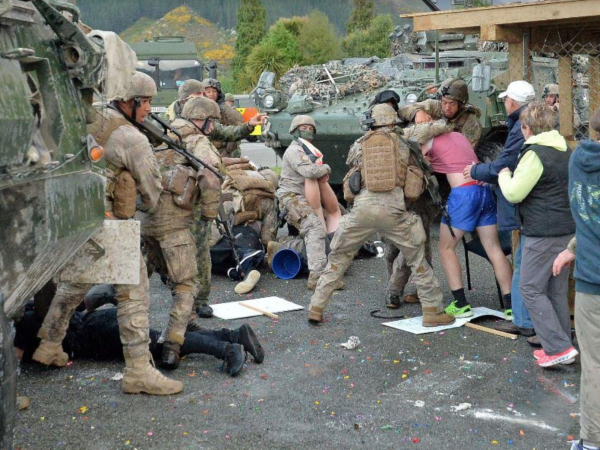
During one exercise, NZDF invited Murchison residents to volunteer to stage a mock protest against the military. Civilians, including a large number of school students, willingly took part, waving placards and throwing water bombs at troops, and they were encouraged to chant and act aggressively toward troops.

The ‘protest’ turned ugly, however, with several civilians being thrown to the ground, handcuffed and dragged away, with several sustaining injuries. One young woman reported on Facebook that she had been pulled into a tank and that she had been assaulted. After a visit from Defence personnel the post was removed.

New Zealand Defence Force director of joint exercise planning Lieutenant Colonel Martin Dransfield later described the fracas as ‘unfortunate’ and said all attempts would be made to avoid a similar outcome during this year’s operation.


Others say that is not good enough and that urban ‘war game’ exercises should be banned altogether, and that a public enquiry should be conducted into the Murchison event.

The use of civilian volunteers in ‘war-game’ activities shows a regrettable lack of judgement on the part of NZDF, and encouraging school students to take part in the exercises is simply irresponsible. One can only hope that new Health and Safety regulations will preclude civilian involvement in order to ensure their safety in the future.

The 2015 war games left an unpleasant taste in some people’s mouths. One woman who took part in an actual protest, peacefully standing with other Murchison women opposed to the military’s entry into their town, said the women were manhandled with unnecessary aggression by troops. She says the ‘war-games’ experience has left her with a lingering fear of the military, and a mistrust of the police, who worked in tandem with them for the duration of the exercise.

If the exercises had been designed solely for humanitarian purposes – support after a natural disaster, such as an earthquake or severe weather event – they would be welcome, but the exercises are fundamentally designed to quell ‘civil unrest’, and that is where the story begins to get very murky.

The military exercises are supposedly based on a fictitious scenario set in a Pacific region called Becara, which is now suffering high unemployment, due to a decline in forestry, coal and gold mining and ‘low investor confidence’. When the Becaran government proposes a new economic vision for the region, some Becarans object and form a resistance movement to oppose it.

What worries some locals is that NZDF also say that the exercises could potentially be used ‘either in New Zealand or one of our Pacific neighbours’ and it’s the admission they could be enacted in New Zealand that gives cause for concern.

Becara bears an uncanny resemblance to the southern West Coast, where the former National Government was working hard to implement ‘special economic zones’ which would allow them to bypass existing regulations in order to speed up the issuance of mining and oil exploration permits.

Forest and Bird chief executive Kevin Hague said in July that documents released under the Official Information Act indicated that ‘the scope of law and regulation that the government is proposing to suspend, to facilitate these developments, is breath-taking’.

And with off-shore oil drilling also a contentious issue in the region, is it too much of a coincidence that this year’s exercise includes a military response to ‘a dispute over offshore oil reserves’?

The Tasman-Buller-West Coast region home to numerous environmentalists who are likely to resist the development of special economic zones and offshore oil drilling, which raises the question of why NZDF specifically asked locals to pay the role of ‘protesters’ against them during the Murchison protest. Denigrating protesters by inference sets a dangerous precedence in a country like New Zealand, where the right to free speech and peaceful protest is still considered a civil right and a democratic privilege.

And finally, if five military helicopters, six airlift aircraft, two Globemasters and an Orion surveillance aircraft were not enough to worry a small town, many New Zealanders would be concerned to learn that a highly sophisticated RQ4 Global Hawk drone, remotely operated from the US Air Base in Guam, also took part in the exercise. It’s role? To capture ‘images of simulated adversary areas of interest’.

NZ Defence say the drone’s visit was in accordance with the New Zealand Search and Surveillance Act of 2012, and that owners of land in the area gave permission for imagery to be taken. This would hardly allay the fears of many New Zealanders likely to be alarmed at the surveillance role the US played in the exercise. Having a US drone this sophisticated, more commonly deployed in US war zones, tracking ‘adversaries’ – simulated or otherwise – over New Zealand land is a matter of public concern.

One local believes that actual surveillance was taking place on the ground well before, and well after, the exercise, and that some military informants were embedded as wwoofers to spy on some residents.

The decision to hold war games in residential settings are a legacy of PM John Key’s tenure, and well overdue for review. New Zealanders don’t need armed troops running up suburban streets, military helicopters buzzing overhead or school students role-playing for the army. Nor do they need foreign drones in the air or military ‘actors’ secretly embedded in their communities gathering information. It’s high time that military exercises were urgently returned to military bases local New Zealand communities allowed to get on with their peaceful lives.


Sunday, 25 August 2013

Doubts about the western narrative


Evidence Indicates that Syrian Government Did Not Launch a Chemical Weapon Attack Against Its People


24 August, 2013


CBS News reports that the U.S. is finalizing plans for war against Syria – and positioning ships to launch cruise missilesagainst the Syrian government – based on the claim that the Syrian government used chemical weapons against its people.


The last time the U.S. blamed the Syrian government for a chemical weapons attack, that claim was was debunked.


But is the claim that the Syrian government used chemical weapons against its people true this time?


It’s not surprising that Syria’s close ally – Russia – is expressing doubt.  Agence France-Presse (AFP) notes:
Russia, which has previously said it has proof of chemical weapons use by the rebels, expressed deep scepticism about the opposition’s claims.
The foreign ministry said the timing of the allegations as UN inspectors began their work “makes us think that we are once again dealing with a premeditated provocation.”
But Russia isn’t the only doubter.

AFP reports:
At the moment, I am not totally convinced because the people that are helping them are without any protective clothing and without any respirators,” said Paula Vanninen, director of Verifin, the Finnish Institute for Verification of the Chemical Weapons Convention.
In a real case, they would also be contaminated and would also be having symptoms.”
John Hart, head of the Chemical and Biological Security Project at Stockholm International Peace Research Institute said he had not seen the telltale evidence in the eyes of the victims that would be compelling evidence of chemical weapons use.
Of the videos that I’ve seen for the last few hours, none of them show pinpoint pupils… this would indicate exposure to organophosphorus nerve agents,” he said.
Gwyn Winfield, editor of CBRNe World magazine, which specialises in chemical weapons issues, said the evidence did not suggest that the chemicals used were of the weapons-grade that the Syrian army possesses in its stockpiles.
We’re not seeing reports that doctors and nurses… are becoming fatalities, so that would suggest that the toxicity of it isn’t what we would consider military sarin. It may well be that it is a lower-grade,” Winfield told AFP.

Haaretz reports:
Western experts on chemical warfare who have examined at least part of the footage are skeptical that weapons-grade chemical substances were used, although they all emphasize that serious conclusions cannot be reached without thorough on-site examination.
Dan Kaszeta, a former officer of the U.S. Army’s Chemical Corps and a leading private consultant, pointed out a number of details absent from the footage so far: “None of the people treating the casualties or photographing them are wearing any sort of chemical-warfare protective gear,” he says, “and despite that, none of them seem to be harmed.” This would seem to rule out most types of military-grade chemical weapons, including the vast majority of nerve gases, since these substances would not evaporate immediately, especially if they were used in sufficient quantities to kill hundreds of people, but rather leave a level of contamination on clothes and bodies which would harm anyone coming in unprotected contact with them in the hours after an attack. In addition, he says that “there are none of the other signs you would expect to see in the aftermath of a chemical attack, such as intermediate levels of casualties, severe visual problems, vomiting and loss of bowel control.”
Steve Johnson, a leading researcher on the effects of hazardous material exposure at England’s Cranfield University who has worked with Britain’s Ministry of Defense on chemical warfare issues, agrees that “from the details we have seen so far, a large number of casualties over a wide area would mean quite a pervasive dispersal. With that level of chemical agent, you would expect to see a lot of contamination on the casualties coming in, and it would affect those treating them who are not properly protected. We are not seeing that here.”
Additional questions also remain unanswered, especially regarding the timing of the attack, being that it occurred on the exact same day that a team of UN inspectors was in Damascus to investigate earlier claims of chemical weapons use. It is also unclear what tactical goal the Syrian army would have been trying to achieve, when over the last few weeks it has managed to push back the rebels who were encroaching on central areas of the capital. But if this was not a chemical weapons attack, what then caused the deaths of so many people without any external signs of trauma?
***
The Syrian rebels (and perhaps other players in the region) have a clear interest in presenting this as the largest chemical attack by the army loyal to Syrian President Bashar Assad to date, even if the cause was otherwise, especially while the UN inspectors are in the country. It is also in their interest to do so whilst U.S. President Barack Obama remains reluctant to commit any military support to the rebels, when only the crossing of a “red line” could convince him to change his policy.
The rebels and the doctors on the scene may indeed believe that chemical weapons were used, since they fear such an attack, but they may not have the necessary knowledge and means to make such a diagnosis. The European Union demanded Wednesday that the UN inspectors be granted access to the new sites of alleged chemical attacks, but since this is not within the team’s mandate, it is unlikely that the Syrian government will do so.

Stephen Johnson, an expert in weapons and chemical explosives at Cranfield Forensic Institute, said that the video footage looked suspect:

There are, within some of the videos, examples which seem a little hyper-real, and almost as if they’ve been set up. Which is not to say that they are fake but it does cause some concern. Some of the people with foaming, the foam seems to be too white, too pure, and not consistent with the sort of internal injury you might expect to see, which you’d expect to be bloodier or yellower.

Chemical and biological weapons researcher Jean Pascal Zanders said  that the footage appears to show victims of asphyxiation, which is not consistent with the use of mustard gas or the nerve agents VX or sarin:
I’m deliberately not using the term chemical weapons here,” he said, adding that the use of “industrial toxicants” was a more likely explanation.

Michael Rivero asks:
1. Why would Syria’s Assad invite United Nations chemical weapons inspectors to Syria, then launch a chemical weapons attack against women and children on the very day they arrive, just miles from where they are staying?
2. If Assad were going to use chemical weapons, wouldn’t he use them against the hired mercenary army trying to oust him? What does he gain attacking women and children? Nothing! The gain is all on the side of the US Government desperate to get the war agenda going again.
As I type these words, US trained and equipped forces are already across the border into Syria, and US naval forces are sailing into position to launch a massive cruise missile attack into Syria that will surely kill more Syrians than were claimed to have died in the chemical attack.
Last time there was a chemical weapon attack in Syria, Bush administration office Colonel Lawrence Wilkerson said that he thought Israel might have given chemical weapons to the Syrian rebels to frame the government.


British MP George Galloway just floated the same theory in regards to the new chemical weapon attack.


Of course, we don’t know who carried out the attack, or what weapon was used.

But given the well-documented fact that the U.S. has been planning regime change in Syria for 20 years straight – and planned to use false ploys for 50 years – it is worth being skeptical until all of the evidence is in.


Indeed, many are asking whether this is Iraq War 2.0.   For example, the Independent writes:
Pictures showing that the Syrian army used chemical weapons against rebel-held Eastern Ghouta just east of Damascus are … likely to be viewed sceptically because the claims so much resemble those made about Saddam Hussein’s possession of weapons of mass destruction (WMDs) before the US and British invasion of Iraq in 2003.
***
Like the Iraqi opposition to Saddam, who provided most of the evidence of WMDs, the Syrian opposition has every incentive to show the Syrian government deploying chemical weapons in order to trigger foreign intervention.
***
But the obvious fact that for the Syrian government to use chemical weapons would be much against their own interests does not prove it did not happen. Governments and armies do stupid things. But it is difficult to imagine any compelling reason why they should do so since they have plenty of other means of killing people in Eastern Ghouta, such as heavy artillery or small arms, which they regularly use.
***
The evidence so far for the use of chemical weapons by the Syrian army is second-hand and comes from a biased source.