
 Posts
Posts


There appears to be an effective news blackout on this in the western media.
Ukraine
To Halt Currency Trading Again Any Minute
26
February, 20145
With
Prime Minister Yatsenyuk putting his foot down and squeezing the
central bank to lift capital controls, Ukraine's currency is totally
collapsing this morning. Up
over 5 handles to a fresh record low of 33.75/USD, we suspect
currency trading will be halted any minute. While
we discussed the endgame for Ukraine last night, on
the street, things are dire with ATM lines, shelves emptied, and
local currency exchanges marking up levels dramatically more than the
'official' rates...
The
'independent' Central Bank halted currency trading, and then the
government screamed...
"I
learned this morning on the Internet that the National Bank of
Ukraine has, as usual on its own without any sort of consultations,
made the decision to close the interbank currency market, which will
absolutely not add to the stability of the national currency that the
national bank is responsible for. This situation has a very complex
and negative influence on the country's economy," Ukrainian
Prime Minister Arseniy Yatsenyuk said.
And
it was unhalted... and this happened... UAH collapsed...

The
picture is significantly worse on the street...


Mariupol
exchangers Today the dollar has broken another record. Buy 1 dollar
for 44 hryvnia can sell for 32 hryvnia, according to the city's
website 0629.com.
Related
to this is a panic in the city - in many shops in the city are buying
cereals, flour, sugar. By the way, the price of sugar already reached
18 hryvnia per kilogram. "Soon people will buy cookies to drink
tea without sugar," - joked seller.
broke
the record and the cost of a liter of gasoline - more than 26 hryvnia
per liter of A-95.
According
to experts, now the price rise for imported goods and products. For
example,the
city has increased dramatically the cost of a kilogram of herring -
up to 60 hryvnia. For the same money you can buy a kilo of meat.
It
is noteworthy that the dollar in Kiev a little different - there you
can buy a dollar for 36 hryvnia, but also to sell for 32
hryvnia. According
to the workers exchangers, such a situation has developed in Mariupol
for the area ATO.
with
lines at the ATMs
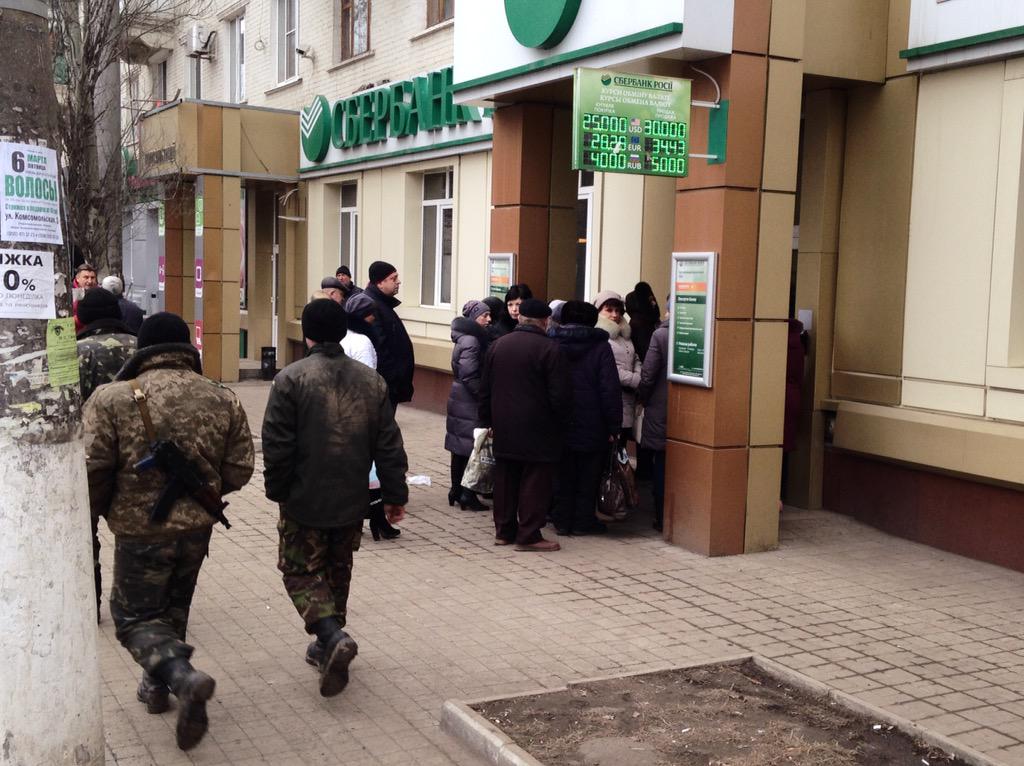
and
empty shelves...
Ukraine. The national currency has turned into paper. In Ukraine is a massive grocery psychosis. Photo (Kiev)
as
Ukrainians try to get rid of Hryvnia for real goods.
Alarming
Currency Devaluation Provokes Consumer Panic in Ukraine
The
rapid devaluation of Ukraine's currency has provoked a "consumer
panic" in the country, adding fuel to the fire of the ongoing
political and economic crisis.
 26
February, 2015
26
February, 2015
Ekaterina
Blinova – The rapid devaluation of the hryvnia has triggered a
panic amongst Ukrainian consumers, prompting people to "storm"
supermarkets and pharmacies.
The
Ukrainian currency has already lost 70 percent of its value,
triggering a "consumer panic" in the country.
Ukrainians are stockpiling food and medicine, scouring the shelves
for sugar, cooking oil, flour, canned products, cakes and frozen
chickens. Most of these products have already disappeared
from Ukrainian stores.
Local
media outlets depict a gloomy picture of people standing
in queues for hours, cursing and jostling each other. The
panic has emerged in the last few days in Kiev and other
cities of the country: cheap products such as coffee, tea
and sunflower oil have vanished from the shelves due to consumer
hysteria.
Ukrainian
stores have already introduced rationing of basic products
in order to reduce the negative impact caused by the
nationwide panic. Restrictions have been introduced for goods
like cooking oil, flour and sugar; with retailers allowed
to sell only two bottles of oil and three to five
kilograms of flour and sugar per person.
Experts
warn Ukrainian consumers against stockpiling flour and cereals,
suggesting that the cost of these products is unlikely to rise
drastically. They recommend buying caviar, medicine and alcohol –
products which are becoming more and more expensive due to the
hryvnia's continuous slide.
Meanwhile,
the exchange rate of the hryvnia is falling steadily. The gap
between the US dollar and the Ukrainian currency has widened
tremendously over the past two days. Banks are currently
buying the dollar for 32.8 hryvnias and selling it for 26.5
hryvnias, trying to slow down the speed of the
devaluation.
Ukraine
is in a deep political and economic crisis, balancing on the
brink of default. The hryvnia's sharp devaluation is only adding
fuel to the fire, making the prospects of the country's
economy bleak and unpredictable.
"I learned this morning on the Internet that the National Bank of Ukraine has, as usual on its own without any sort of consultations, made the decision to close the interbank currency market, which will absolutely not add to the stability of the national currency that the national bank is responsible for. This situation has a very complex and negative influence on the country's economy," Ukrainian Prime Minister Arseniy Yatsenyuk said.


Mariupol exchangers Today the dollar has broken another record. Buy 1 dollar for 44 hryvnia can sell for 32 hryvnia, according to the city's website 0629.com.
broke
the record and the cost of a liter of gasoline - more than 26 hryvnia
per liter of A-95.


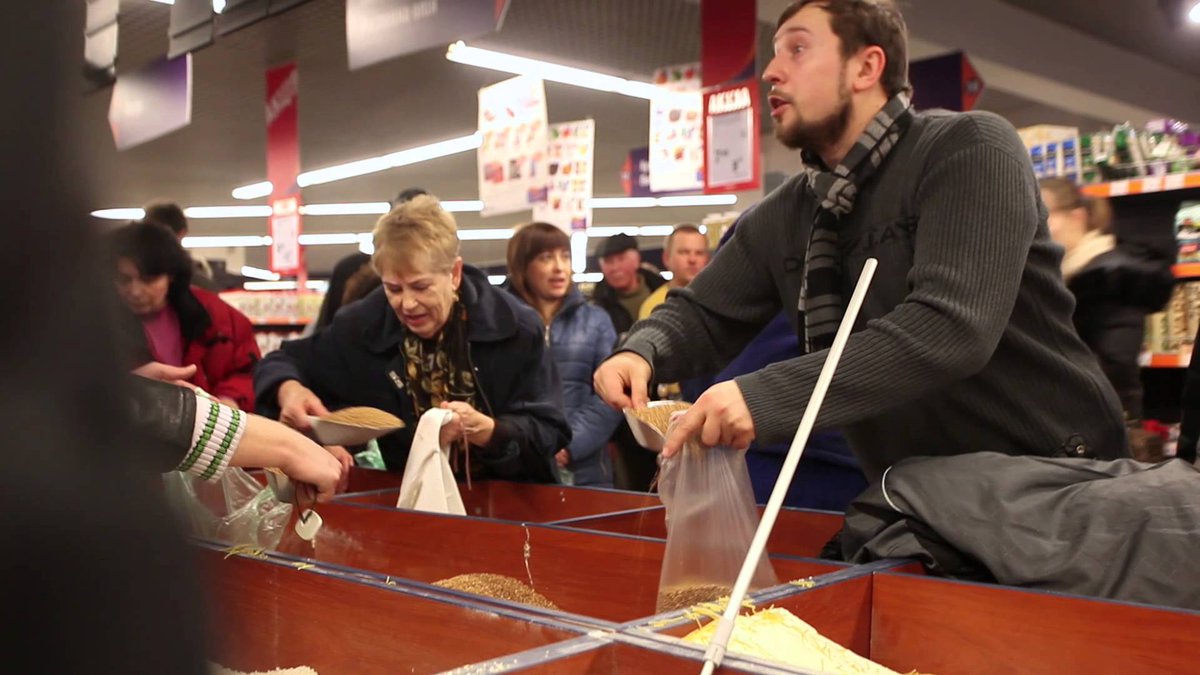


Ekaterina Blinova – The rapid devaluation of the hryvnia has triggered a panic amongst Ukrainian consumers, prompting people to "storm" supermarkets and pharmacies.
The
Ukrainian currency has already lost 70 percent of its value,
triggering a "consumer panic" in the country.
Ukrainians are stockpiling food and medicine, scouring the shelves
for sugar, cooking oil, flour, canned products, cakes and frozen
chickens. Most of these products have already disappeared
from Ukrainian stores.
Local
media outlets depict a gloomy picture of people standing
in queues for hours, cursing and jostling each other. The
panic has emerged in the last few days in Kiev and other
cities of the country: cheap products such as coffee, tea
and sunflower oil have vanished from the shelves due to consumer
hysteria.
Ukrainian
stores have already introduced rationing of basic products
in order to reduce the negative impact caused by the
nationwide panic. Restrictions have been introduced for goods
like cooking oil, flour and sugar; with retailers allowed
to sell only two bottles of oil and three to five
kilograms of flour and sugar per person.
Experts
warn Ukrainian consumers against stockpiling flour and cereals,
suggesting that the cost of these products is unlikely to rise
drastically. They recommend buying caviar, medicine and alcohol –
products which are becoming more and more expensive due to the
hryvnia's continuous slide.
Meanwhile,
the exchange rate of the hryvnia is falling steadily. The gap
between the US dollar and the Ukrainian currency has widened
tremendously over the past two days. Banks are currently
buying the dollar for 32.8 hryvnias and selling it for 26.5
hryvnias, trying to slow down the speed of the
devaluation.
Ukraine
is in a deep political and economic crisis, balancing on the
brink of default. The hryvnia's sharp devaluation is only adding
fuel to the fire, making the prospects of the country's
economy bleak and unpredictable.
"Financial Maidan" in Kiev Violently Dispersed by Riot Police

2/26/2015
By
J.Hawk
The
"Financial Maidan" was a protest staged at the National
Bank of Ukraine to protest the crash of the hryvnya and the resulting
impoverishment of masses of people. Earlier in the day, Kiev mayor
Klichko accused the demonstrators of being "Russian
provocateurs" and expressed puzzlement as to why anyone would
protest higher utility costs and prices, as well as lower wages. Then
he unleashed riot police on the demonstrators. Note that the
demonstrators are quite unlike the "European Maidan" ones,
in that you don't see masked thugs waving neo-Nazi banners, only
ordinary people suffering from the policies of the government.
Judging by the high emotions, one should expect a repeat in the
coming days. Possibly on a larger sale.
You
can sense, however, that European values have taken root in Ukraine!
Shortly after the 5:00 mark, one of the police kindly informs the
demonstrators that "if anyone hits us, we'll shoot. I'm just
telling you." No, there will be none of the Yanukovych-style
brutality.
On
the other hand, when one of the protesters asks the police "aren't
you concerned that what you are doing right now might be declared
unlawful by the next government?", the police don't seem to have
an answer..
"Кровавый режим Януковича". Реинкарнация
West-backed
Kiev regime brutally attacks peacefully protesting students on
Maidan, destroys protest camp
Bandera party in Dnepropetrovsk (video)
Andriy Porubiy and Victoria Nuland

The star crossed lovers: Neocon Nuland met Neo Nazi Parubi. The sparks flew [from the Molotovs]. They couldn't contain their lust. Cookies were in the oven. Months later, the Maidan was born.


