
 Posts
Posts


Saudi
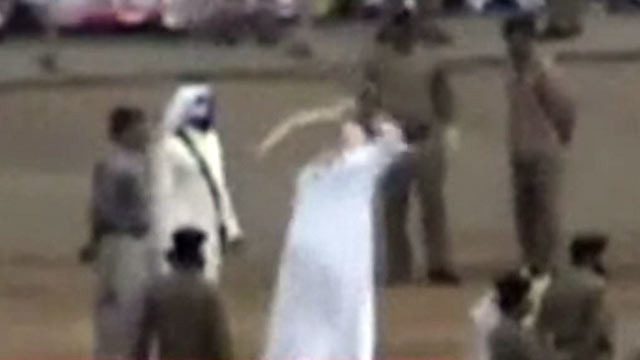
Arabia displays beheaded Yemenis in public

Saudi
Arabia on Tuesday beheaded five Yemenis and displayed their bodies in
public for killing a national and forming a gang that committed
robberies across several towns in the kingdom, the interior ministry
said.
The
five were executed in the southwestern town of Jizan, bringing the
number of people executed in the kingdom this year to 46, according
to an AFP tally.
A
witness in Jizan told AFP that the five men were displayed in public
near a university.
In
a picture on Twitter, five men are seen hanging from a rope tied to
their waists on a horizontal bar between two cranes.
The
ministry said that Khaled, Adel and Qassem Saraa as well as Saif Ali
al-Sahari and Khaled Showie al-Sahari had formed a gang which
committed "several crimes in various regions in the kingdom and
robbed stores."
The
five had killed Ahmed Haroubi, a Saudi, by beating him up and
strangling him, it said.
In
March, a Saudi firing squad executed in public seven men convicted of
armed robbery despite last-minute appeals by rights groups at the
time that their lives be spared.
In
2012, the kingdom executed 76 people, according to an AFP tally based
on official figures. The US-based Human Rights Watch put the number
at 69.
In
March of this year, seven men convicted of armed robbery were
executed in Saudi Arabia despite last-minute appeals by rights groups
that their lives be spared.
The
condemned men were similarly convicted of "forming a gang that
carried out several armed robberies and thefts with the help of other
people," the ministry said in a statement published by the
official SPA news agency.
Saudi's
authorities have frequently been criticized by rights groups for the
rate of executions and for perceived lack of fair trials of those
condemned.
Reports
by Amnesty International document a policy of forced confessions by
Saudi authorities through the use of torture, intimidation and
coercion.
Haraba,
a form of Islamic punishment used against thieves and charlatans,
involves crucifixion.
Rape,
murder, apostasy, armed robbery, drug trafficking, sorcery and
witchcraft are all punishable by death under Saudi Arabia's strict
version of sharia, or Islamic law.
U.S.
State Department “Welcomes” News That Saudi Arabia Will Head U.N.
Human Rights Panel
Glenn
Greenwald

24
September, 2015
Last
week’s announcement that
Saudi Arabia — easily one of the world’smost
brutally repressive regimes —
was chosen to head a U.N. Human Rights Council panel
provoked indignation
around the world.
That reaction was triggered for obvious reasons. Not only has
Saudi Arabia executed more than 100 people already this year,
mostly by beheading (a rate of 1
execution every two days),
and not only is it serially
flogging dissidents,
but it is reaching new levels of tyrannical depravity as it is about
to behead
and then
crucify the
21-year-old son of a prominent regime critic, Ali Mohammed al-Nimr,
who was convicted at the age of 17 of engaging in demonstrations
against the government.
Most
of the world may be horrified at the selection of Saudi
Arabia to head a key U.N. human rights panel, but the U.S. State
Department most certainly is not. Quite the contrary: its
officials seem quite pleased about the news. At a State
Department briefing yesterday afternoon, Deputy Spokesperson Mark
Toner was questioned by the invaluable Matt Lee of AP, and this
is the exchange that
resulted:
QUESTION: Change topic? Saudi Arabia.
MR. TONER: Saudi Arabia.
QUESTION: Yesterday, Saudi Arabia was named to head the Human Rights Council, and today I think they announced they are about to behead a 21-year-old Shia activist named Muhammed al-Nimr. Are you aware of that?
MR. TONER: I’m not aware of the trial that you — or the verdict — death sentence.
QUESTION: Well, apparently, he was arrested when was 17 years old and kept in juvenile detention, then moved on. And now, he’s been scheduled to be executed.
MR. TONER: Right. I mean, we’ve talked about our concerns about some of the capital punishment cases in Saudi Arabia in our Human Rights Report, but I don’t have any more to add to it.
QUESTION: So you —
QUESTION: Well, how about a reaction to them heading the council?
MR. TONER: Again, I don’t have any comment, don’t have any reaction to it. I mean, frankly, it’s — we would welcome it. We’re close allies. If we —
QUESTION: Do you think that they’re an appropriate choice given — I mean, how many pages is — does Saudi Arabia get in the Human Rights Report annually?
MR. TONER: I can’t give that off the top of my head, Matt.
QUESTION: I can’t either, but let’s just say that there’s a lot to write about Saudi Arabia and human rights in that report. I’m just wondering if you — that it’s appropriate for them to have a leadership position.
MR. TONER: We have a strong dialogue, obviously a partnership with Saudi Arabia that spans, obviously, many issues. We talk about human rights concerns with them. As to this leadership role, we hope that it’s an occasion for them to look at human rights around the world but also within their own borders.
QUESTION: But you said that you welcome them in this position. Is it based on [an] improved record? I mean, can you show or point to anything where there is a sort of stark improvement in their human rights record?
MR. TONER: I mean, we have an ongoing discussion with them about all these human rights issues, like we do with every country. We make our concerns clear when we do have concerns, but that dialogue continues. But I don’t have anything to point to in terms of progress.
QUESTION: Would you welcome as a — would you welcome a decision to commute the sentence of this young man?
MR. TONER: Again, I’m not aware of the case, so it’s hard for me to comment on it other than that we believe that any kind of verdict like that should come at the end of a legal process that is just and in accordance with international legal standards.
QUESTION: Change of subject?
MR. TONER: Sure.
That’s
about as clear as it gets. The U.S. government “welcomes” the
appointment of Saudi Arabia to a leadership position on this
Human Rights panel because it’s a “close ally.” As I documented
two weeks ago courtesy
of an equally candid admission from an anonymous “senior U.S.
official”: “The U.S. loves human-rights-abusing
regimes and always has, provided they ‘cooperate.’ … The only
time the U.S. government pretends to care in the slightest about
human rights abuses is when they’re carried out by ‘countries
that don’t cooperate.'”
It’s
difficult to know whether Mark Toner is lying when he claims
ignorance about the case of al-Nimr, the regime critic about to be
beheaded and crucified for dissident activism, which he engaged in as
a teen. Indeed, it’s hard to know which would be worse: active
lying or actual ignorance, given that much
of the world has been
talking about this
case.
The government of France formally
requested that
the Saudis rescind the death penalty. Is it really possible that the
deputy spokesperson of the U.S. State Department is ignorant of this
controversy? Either way, the reluctance of the U.S. government to
utter a peep about the grotesque abuses of its “close ally”
is in itself уgrotesque.
But
it’s also profoundly revealing. The close U.S./Saudi alliance and
the massive amount of weapons and intelligence lavished
on the regime in
Riyadh by the West is one of the great unmentionables in Western
discourse. (The
Guardian last
week published
an editorial oh-so-earnestly
lamenting the war in Yemen being waged by what it called the
“Saudi-led coalition,” yet never once mentioned the
rather important fact that the Saudis are being armed in this
heinous war by the U.S. and U.K.; it took a
letter to the editor from an Oxfam official to
tell The Guardian that
the West is not being “complacent” about the war crimes being
committed in Yemen, as The
Guardian misleadingly claimed,
but rather actively complicit.)
It’s
not hard to understand why so many of the elite sectors of
the West want everyone to avert their eyes from this deep
and close relationship with the Saudis. It’s because that
alliance single-handedly destroys almost every propagandistic
narrative told to the Western public about that region.
As
the always-expanding “War on Terror” enters its 14th year, the
ostensible target — radical, violent versions of Islam —
is fueled far more by the U.S.’s closest allies than any of
the countries the U.S. has been fighting under the “War on
Terror” banner. Beyond that, the alliance proves the
complete absurdity of believing that the U.S. and U.K.’s foreign
policies, let alone their various wars, have anything to do with
protecting human rights or subverting tyranny and fanaticism.
And it renders a complete laughingstock any attempts to depict the
U.S. government as some sort of crusader for freedom and democracy or
whatever other pretty goals are regularly attributed to it by its
helpful press.
The
evil empire of Saudi Arabia is the West’s real enemy
Saudis
are active at every level of the terror chain: planners to
financiers, cadres to foot soldiers, ideologists to cheerleaders

27
September, 2015
Iran
is seriously mistrusted by Israel and America. North Korea protects
its nuclear secrets and is ruled by an erratic, vicious man. Vladimir
Putin’s territorial ambitions alarm democratic nations. The newest
peril, Isis, the wild child of Islamists, has shocked the whole
world. But top of this list should be Saudi Arabia – degenerate,
malignant, pitiless, powerful and as dangerous as any of those listed
above.
The
state systematically transmits its sick form of Islam across the
globe, instigates and funds hatreds, while crushing human freedoms
and aspiration. But the West genuflects to its rulers. Last week
Saudi Arabia was appointed chair of the UN Human Rights Council, a
choice welcomed by Washington. Mark Toner, a spokesperson for the
State Department, said: “We talk about human rights concerns with
them. As to this leadership role, we hope that it is an occasion for
them to look into human rights around the world and also within their
own borders.”
The
jaw simply drops. Saudi Arabia executes one person every two days.
Ali Mohammed al-Nimr is soon to be beheaded then crucified for taking
part in pro-democracy protests during the Arab Spring. He was a
teenager then. Raif Badawi, a blogger who dared to call for
democracy, was sentenced to 10 years and 1,000 lashes. Last week, 769
faithful Muslim believers were killed in Mecca where they had gone on
the Hajj. Initially, the rulers said it was “God’s will” and
then they blamed the dead. Mecca was once a place of simplicity and
spirituality. Today the avaricious Saudis have bulldozed historical
sites and turned it into the Las Vegas of Islam – with hotels,
skyscrapers and malls to spend, spend, spend. The poor can no longer
afford to go there. Numbers should be controlled to ensure safety –
but that would be ruinous for profits. Ziauddin Sardar’s poignant
book Mecca: The Sacred City, describes the desecration of Islam’s
holiest site.
Even
more seriously, the pernicious Saudi influence is spreading fast and
freely. King Salman has offered to build 200 mosques in Germany for
recently arrived refugees, many of whom are Muslims. He offered no
money for resettlement or basic needs, but Wahhabi mosques, the
Trojan horses of the secret Saudi crusade. Several Islamic schools
are also sites of Wahhabism, now a global brand. It makes hearts and
minds small and suspicious, turns Muslim against Muslim, and
undermines modernists.
The
late Laurent Murawiec, a French neocon, wrote this in 2002: “The
Saudis are active at every level of the terror chain, from planners
to financiers, from cadres to foot soldiers, from ideologists to
cheerleaders.” Murawiec’s politics were odious, but his
observations were spot on. Remember that most of the 9/11 killers
were Saudi; so was the al-Qaeda hierarchy.
In
the 14 years that have followed 9/11, the Saudis have become more
aggressive, more determined to win the culture wars. They pour money
into Islamist organisations and operations, promote punishing
doctrines that subjugate women and children, and damn liberal values
and democracy. They are pursuing a cruel bombing campaign in Yemen
that has left thousands of civilians dead and many more in dire
straits.
So,
what does our ruling establishment do to stop the invisible hand of
this Satan? Zilch. The Royal Family, successive governments,
parliamentarians, a good number of institutions and people with clout
collectively suck up to the Saudi ruling clan. I have not seen any
incisive TV investigation of this regime. We know it is up to no
good, but evidence is suppressed. Some writers have tried to break
this conspiracy of obsequiousness. Craig Unger’s book, House of
Bush, House of Saud was published in 2004. It established beyond
reasonable doubt that Saudi Arabia was the nerve-centre of
international terrorism. And that the Bush family was unduly close to
the regime. Many of us believed the revelations were even more
explosive than those by the journalists Carl Bernstein and Bob
Woodward, who exposed the lies told by Richard Nixon.
This
deadly enemy will not be cowed or stopped by Trident. Our leaders
know what is going on. So what do they do? They pick on the small
people. The Government’s Prevent programme now imposes a duty on
educators to watch out for young “radicals” and nip them in the
bud. Older dissenters, too. To date, 4,000 young Muslims have been
referred for reprogramming. One was three years old. In May, a young
Muslim schoolboy talked about “eco-terrorists” and was taken away
to be interrogated about whether he supported Isis. Academics,
lawyers, doctors and nurses are also expected to become the nation’s
spies. Mohammed Umar Farooq, a student at Staffordshire University,
was accused last week of being a terrorist because he was reading a
book entitled Terrorism Studies in the library.
In
the US, 14-year-old Ahmed Mohamed was arrested because he took a
home-made clock to school. (Richard Dawkins, these days a manic tweet
preacher, questioned whether the clock was part of a “hoax”
designed to get Mohamed arrested, before backtracking.) The West, it
seems, is free only for some. And to be a Muslim is a crime.
Extremism
is a serious problem. Westernised, liberal Muslims do try to
influence feverish, hostile young Muslim minds, but we are largely
powerless. Our leaders will not confront Saudi Arabia, the source of
Islamist brainwashing and infection.
They won’t because of oil and
the profits made by arms sales. Political cowards and immoral
profiteers are the traitors, the real threat to national security,
patriotism and cohesion. How do they answer the charge?
New
Zealand not only does not condemn human rights abuses in Saudi Arabia
but buys sheep farms in the Saudi desert as a bribe to facilitate
free-trade deals.
Meanwhile
Saudi Arabia (while supporting ISIS) is America’s leading ally to
“restore democracy” to Syria
Execution
in Saudi Arabia
Martyn
Bradbury
24
September, 2015
Many
of you will have seen the horrible news that Saudi Arabia is
intending to go ahead with the planned crucifixion and execution of
Ali Mohamed al-Nimr who was arrested when he was a child.
Taken
from the UN
News site, and from the Office of the High
Commissioner for Human Rights:
“…Mr. al-Nimr, then a high school student, was arrested in 2012 when he was 17 by the Saudi authorities for his reported participation in ‘Arab Spring’ protests in Qatif, Eastern Province. The Specialized Criminal Court in May 2015 sentenced him to death for joining a criminal group and attacking police officers. He was reportedly subjected to torture and ill treatment by the General Investigation Directorate which forced him to confess the charges against him.
[…] Mr. al-Nimr’s appeal made by his lawyer was heard without prior notification and the proceedings fell short of international standards.
“Mr. al-Nimr did not receive a fair trial and his lawyer was not allowed to properly assist him and was prevented from accessing the case file. International law, accepted as binding by Saudi Arabia, provides that capital punishment may only be imposed following trials that comply with the most stringent requirements of fair trial and due process, or could otherwise be considered an arbitrary execution,” said the [Special Rapporteur] experts.
[…]
Two other individuals are at risk of an imminent execution after being arrested for their participation in Qatif when they were children. “
This
is abhorrent. I call on the New Zealand Government to formally
protest. We should call in the Saudi Consular General and
demand that this young man’s life be spared. He should be
allowed access to a free and impartial hearing.
There
are moments when it is worth saying something. This is a
moment, Minister McCully.


