Showing posts with label drougth. Show all posts

Wednesday, 12 July 2017

California heat wave kills THOUSANDS of cattle

California Heat Wave Kills Thousands of Cattle and Overwhelms Dairy Industry

  • The heat wave caused an estimated 4,000 to 6,000 livestock deaths in June.
  • The staggering number of carcasses have overwhelmed facilities that properly dispose of them.
  • A local state of emergency allowing dairy farmers to bury or compost the carcasses has been extended.

9 July, 2017

Thousands of cattle have died in California as a heat wave continues to bake the state. 

California's Central Valley has dealt with two bouts of prolonged triple-digit heat since mid-June, according to weather.com meteorologist Chris Dolce. Fresno observed nine consecutive days with afternoon readings in the 100s during the second half of June. Saturday marked the sixth day in a row with highs above the century mark in this latest heat wave to begin July, and it's expected to continue through much of the week head.

A local state of emergency allowing dairy farmers to bury or compost hundreds of carcasses was declared on June 30 in San Joaquin Valley, the Porterville Recorder reports. The order was extended due to the increase in deaths, however, which has become an overwhelming issue.

“Cow mortality, that happens every day,” Tulare County assistant agricultural commissioner Tom Tucker told the Reporter. “It’s the heat that has made it worse. 

It hasn’t stopped. We are losing our cows, and it is at an extreme.” 


An estimated 4,000 to 6,000 livestock deaths due to the heat were recorded in June, Fresno County Agricultural Commissioner Les Wesley told KGPE-TV. 

The staggering number of carcasses has caused malfunctions at rendering plants, which do daily pickups of dead livestock to convert their tissue into useful materials.

Baker Commodities, a local facility, had to stop picking up from farms due to an overload at the plant, according to the Fresno Bee. 

The facility normally processes about 1 million pounds of animal tissue per day, Fresno County Department of Public Health environmental health division manager Wayne Fox told the Bee. It had to push its capacity to 1.5 million pounds per day before a daylong machinery malfunction significantly impacted the rendering process.

Baker is the only rendering plant in the area that spans across Tulare, Fresno, Kerns, Kings and Madera counties, according to the Recorder.
Once the animals decompose to a certain point, they can no longer be rendered. If the carcasses are not properly disposed of, they can trigger a number of public health risks such as groundwater contamination. 

Rendering plants have cleared out their backlogs and have resumed their pickups, however, if the carcasses are too decomposed they will have to be taken to a local landfill, according to the Reporter. If farmers are unable to have the bodies transported to the landfill, they will either have to bury the bodies or compost them, which may require a permit. 

California livestock owners saw a similar heat-related disaster in 2006 when San Joaquin Valley farmers lost nearly $300 million in dead livestock. In Kings County, 1,834 milk cows valued at $3.7 million died, reports the Associated Press.

Officials have not yet issued a release informing farmers on the best way to get rid of the carcasses.


Thursday, 1 June 2017

Abrupt cliamte change on the indian subcontinent

For more news on the Indian subcontinent and how it is being affected GO HERE

South India's Drought Part 1: Five states face severe water crisis made worse by the onset of summer


20 May, 2017

Editor's note: This is the introductory article to a nine-part series of ground reports on the ongoing water crisis in south India. Firstpost will cover various aspects of the near-calamitous situation in Karnataka, Kerala, Tamil Nadu, Andhra Pradesh and Telangana, over the next eight days. 

South India is parched — Kerala, Karnataka and Tamil Nadu are already reeling under severe drought, and Andhra Pradesh and Telangana are on the brink — now the blistering heat waves will probably put more pressure on the existing water resources.
While Kerala and Tamil Nadu are facing an unprecedented drought – the worst ever in over a century, according to experts; Karnataka’s northern districts are without water for the third consecutive year.
In October 2016, Andhra Pradesh announced that 245 of its mandals were drought-hit due to a deficiency of 4 percent rainfall. Telangana, a perennially water-starved state, is engaged in water wars with its Telugu-speaking neighbour over allocations of Krishna and Godavari river water.

Tamil Nadu

The situation is grim in the southern-most part of the country. The North East monsoon, which is the main source of water for the state, was deficient by 62 percent last year. The year 2016 was uneventful despite the failed monsoon as the December 2015 floods filled up lakes and water bodies and recharged groundwater, bringing the water table up by 2-3 meters.

Tamil Nadu farmers during their agitation demanding loan waiver and compensation for crop failure, at Jantar Mantar in New Delhi on Wednesday. PTI
But summer has set in full force. Chennai has already experienced three days of heat wave, with temperatures crossing 40 degrees Celsius, a deviance of 3 degrees from the average at this time of the year. Experts warn that the state will reel under severe heat in the coming months, with temperatures expected to cross 50 degrees Celsius in an abnormally hot summer. Drought is adding to the state’s woes.
Authorities are at a loss as to what to do for water, considering that the neighbouring states are also reeling under drought. The state’s battle over Cauvery water has not come to much – there is hardly any water in the Cauvery for Karnataka to release. Andhra Pradesh yielded to the pleas of the then chief minister O Panneerselvam in February this year, but the 2 tmc-feet of water released was barely enough, even for Chennai. Water levels in the reservoirs of the state are at 5 percent of their total capacity, with the key reservoirs feeding Chennai – Chembarambakkam and Cholavaram – already at dead storage.
The state is now tapping water filled in mines and quarries, water released from Neyveli’s thermal power plant and desalination plants to somehow meet the needs of the thirsty population. Groundwater is being drawn at an alarming rate by the civic bodies, citizens and illegal water tankers alike. As a result, groundwater levels have fallen drastically – between 5 and 10 feet – across the state. Water supply has been rationed.
“It is a drought we have not seen in 110 years. Extreme weather events are becoming more frequent and it is due to global climate change. We may see a repeat of 2015 (floods) next year or the rains may fail again like they did in 2016. We cannot figure the weather out. But we need to ensure that we are prepared,” said S Thirunavukkarasu, retired official of the Tamil Nadu Public Works Department which is in-charge of maintaining most of the reservoirs, lakes and rivers in the state.
Kerala

The rain gods have spurned God’s Own Country. The worst drought in the state in 115 years has made the residents very anxious. With the South West monsoon being deficient by 33.7 percent (July to September) and the North East monsoon short by 61 percent (October to December), the state is floundering.
Drought has meant that the power supply too has been hit as Kerala largely depends on hydroelectric power. The Idukki hydroelectric project, which is the largest producer of power in the state, has only enough water to generate 40 percent of its total capacity. While the state annually needs 24,000 Million Units (MU) of power, only 7,100 MU are generated at home while the rest is sourced from outside. The bad news is that as the rains cease and water storage decreases, internal generation will fall to 5,200 MU. This means that close to 2,000 MU of power will have to be again bought from outside. With all the power plants put together in the state, a stock taken on 22 December, 2016, shows that only 1,988 MU of power can be generated against the previous years. While in 2015, it was 2,754 MU; in 2014, it was 3,246 MU taken on the same date.

Representational image of the Cauvery River. Karnataka might face severe water shortage if the South West monsoon fails for the fourth consecutive year. Photo courtesy: Wikimedia.

Karnataka

This year is bound to be tougher because even the Cauvery basin districts in Karnataka have gone so dry that the state might face a gigantic crisis if the South West monsoon fails for the fourth consecutive year, beginning June. The shortage of water and unemployment have already made hundreds, if not thousands, of villagers move to the cities and towns of not only Karnataka but neighbouring states as well. The reservoirs fed by the Cauvery river are at dead storage as cities like Bengaluru thirst for water.
This is because of the heat wave in north Karnataka and the third consecutive year of drought. A rainfall deficit of 35 percent in the Malnad region, the catchment area for many perennial rivers emerging from the Western Ghats, has meant that the river water too has failed the state.
What is concerning experts is the lack of vision and long-term policy and planning by state governments across south India to tackle drought. “Nobody cares about migration,” said Professor Narendra Pani of the National Institute of Advanced Studies in Bengaluru. “The government is looking for a quick fix. There is a need to set up markets for farmers and we need to have a system of aggregation. You need to bring people together and, perhaps, set up sheds for sericulture to control quality. Unfortunately, we don't even think on the lines that China has succeeded in implementing.”
Andhra Pradesh and Telangana

Andhra Pradesh’s groundwater table has dropped to 14.34 metres, following a rainfall deficit of 23 percent last year. Ideal groundwater level should be between 3 and 8 metres, as per government recommendations and the state has begun an ambitious groundwater recharging programme called 'Neeti Samrakshana Udyamam'.
Chronically drought-prone areas like the Rayalaseema districts of Anantapur and Kadapa have become more arid, with crops failing. Andhra has got a drought relief package of Rs 2,816 crores from the Centre.
While Telangana received slightly higher rainfall than the average in 2016, the state is engaged in water wars with Andhra for river water from the Krishna and the Godavari. For now, the water situation is under control in Telangana. But with heat waves predicted in both the Telugu-speaking states, the respective governments are gearing up for the summer months.
Experts are criticising the knee jerk reactions of state governments to drought, rather than planned conservation. Chennai-based economist, Venkatesh Athreya said, “You need to promote sustainable water conservation and newer methods of irrigation. Yes, there has been a collective action in desilting tanks etc. Certainly inspiring but it doesn't absolve the state of its responsibility. It is the scale that matters which only the state can do it.”
Drought In South India

Social biases are adding to the trauma of scarcity. Take for instance the illiterate and the socially-backward sections in Tamil Nadu's Cauvery Delta region. The Dalit woman is left empty-handed because the landed gentry understand the problems between Tamil Nadu and Karnataka caused by the dispute over sharing of Cauvery waters.
Not that life in the cities is any better. The job-hunter from the village expects to get the most basic requirement — water. But it has become a traumatic experience in his effort to survive the summer. Many in Chennai are forced to pay 10 times the normal amount for a pot of water.
Scarcity of water has reached such levels that even Nandan Nilekani, perhaps, did not realise that the Unique Identity (UID) card called Aadhaar would be used as a tool to ration water. Based on the Aadhaar card, people are given water cards to become eligible for a pot of water in one district of Andhra Pradesh. But, then there is a price to pay after acquiring that water card. The citizen has to pay Rs 5 per pot of water from private water suppliers.
But, the story about scarcity of water or drought in some places is not all about at what price water is sold. It is about the impact that this precious commodity has on society and on all aspects of development for the future. The effort to deal with the problems of climate change has been such that there has been no concrete measures taken by any of the state governments to prepare for the summer months which have been becoming traumatic with each passing year.
For instance, a state like Tamil Nadu has not realised that it has the longest coastline among the Indian states and the consequential adverse situations. Such situations in the future, experts believe, could be even worse than the flood havoc it faced in December 2015. It appears the state is clueless about how to safeguard itself in the future from the ubiquitous climate change. The state has not understood that the changes in the seas impact the inland.
But, it must be said that not all governments are callous about the future. Kerala has adopted a mission mode approach to reclaim dried up lakes, canals, ponds and other water bodies. It is a start but, at least, one state has begun to look at something in a mission mode.
Firstpost brings to you a series on the impact of the harshness of the summer from each of the south Indian states which, incidentally, is the most developed zone of India, along with western India, with a hope that the powers-that-be, not only the government but the powerful civil society as well, will begin to look at initiating measures to provide mission-mode programmes to reduce the agony of summer.


Thursday, 11 February 2016

The Soutwest drought in the US isn't going anywhere

Even a Monster El Nino Can’t Beat the Southwest Drought


10 February, 2016
For those who follow weather, it’s a rather strange and disturbing story.
A powerful Pacific Ocean storm forms about 500 miles south of the Aleutian Islands. Heavily laden with rains, strong winds, and trailing a long squall line, the system takes aim at the US West Coast. It’s a burly beast of a thing. Pumped up by an enormous bleed of moisture rising off of one of the mightiest El Ninos ever seen. An instance of extreme Equatorial heat that’s been firing off since October.
Another Pacific Storm Deflected
(Another Pacific Storm is deflected northward by increasingly persistent high pressure systems as the US Southwest swelters under unseasonable warmth. GFS climate reanalysis by Climate Reanalyzer shows this disturbing weather pattern again and again in the February forecast. In short, it doesn’t look like the California Drought is going to end anytime soon. Image source: Climate Reanalyzer.)

The towering El Nino-fed storm clouds chug east, steaming along toward what appears to be an inexorable collision with California, Oregon, and Washington. But, at the last moment, the storm slams into a heavy pile of atmospheric heat. Warm air building over the US Southwest and nearby ocean zones has shoved the upper air steering current called the Jet Stream pole-ward. The great storm is sucked up into this atmospheric train, delivering its rains along an arc from Washington State on northward.
And so the seemingly impossible has happened. A powerful El Nino’s rains and snows — usually bound directly for California, Oregon and Washington — have been diverted by a new kind of atmospheric pattern associated with climate change.
El Nino’s Rains Gone or Just Taking a Break?

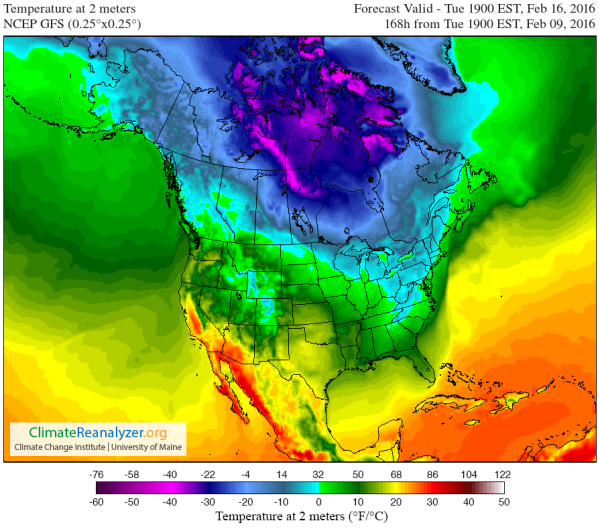
Ever since late January, strong ridges have tended to develop over Western North America. By February 4th, the National Weather Service (NWS) had begun to report on the pattern — describing  it as El Nino taking a 5-10 day break. But the ‘break’ had already begun to show up on January 26th — about ten days prior to the February 4 NWS announcement. And now, on February 10, we’ve seen two full weeks of warm, dry weather settling in over California and the US Southwest. Meanwhile, long range model forecasts indicate that the ‘break’ from El Nino conditions will continue through at least February 16h.

Upper 60s to upper 80s California and Arizona
(Temperatures in the upper 60s to upper 80s is predicted for a large sections of California and Arizona on Tuesday, February 16th. It’s the kind of hot, dry air that brings back memories of recent years when formations of strong, ridiculously resilient ridges pushed California into one of its worst drought episodes on record. Image source: Climate Reanalyzer.)

It’s all just terrible timing. First, California snow packs during December and January began to recover due to strong, El Nino associated, storm systems barreling in. However, now during what should be the peak of the Southwestern rainy season, we have what could be a month long pause in storms hitting the region. It’s as if the rainy season is being hollowed out. And not just any rainy season — a strong El Nino rainy season which should have been far, far rainier than most.

Last week, Climate Central and Peter Gleick — a climate expert at Pacific Institue — made the following warning:
…seven days of sustained warmth could melt as much as 30 percent of California’s snowpack. The hot, dry weather is exactly what baked in exceptional drought in California over the past four years. Some signs indicate the heat is driven in large part by climate change, but the role of the ridiculously resilient ridge is still an area of active investigation.

Well, by tomorrow seven days will have come and gone. But the end to the anomalous warm, dry spell is still nowhere in sight.
California Drought Really Hasn’t Budged

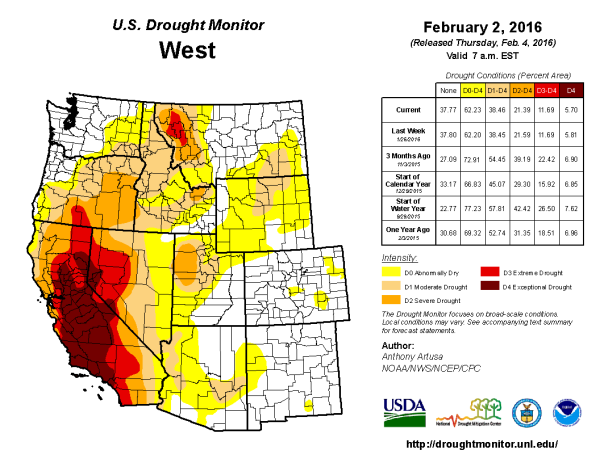
Meanwhile, a four-year-long California drought appears to be making a strong run at year five. In fact, if you look at the US Drought Monitor, you’ll find that a large swath of the West is currently suffering under moderate to exceptional drought conditions.
West Still Suffering From Drought
(Severe Drought remains in place over the US West. El Nino appears to have lost at least some of its ability to deliver heavy rains as an intensifying regime of human-forced warming pushes typical weather patterns further and further off-kilter. All bad news for an area that has been suffering from one severe drought after another since the early 2000s. Image source: Drought Monitor.)

Quite frankly, it’s insane that we’re still seeing these conditions during a monster El Nino. These droughts should be rolling back as the storm track intensifies and hurls severe weather at the US West Coast. But that’s not what’s happening. At least not consistently. Instead, we keep getting these extreme ridge patterns in the Jet Stream over western North America. We keep getting these very warm, very dry spells of weather during the wet season. And now, we have California Snowpack melting away in February of all times.
A Ridge-Trough Pattern That’s All-Too Likely Related To A Human-Forced Warming of the Arctic

The fact that these weather patterns emerged after the warmest January and lowest sea ice extents on record for the Arctic is a point that should not be missed by weather and climate analysts. It appears that what we are seeing is yet more evidence that polar amplification is driving a consistent high amplitude bulge in the Jet Stream over Western North America together with severe periods of warmth, dryness and snowpack melt during Winter. The hot side of a dipole pattern that is also setting up more extreme storm potentials as cold air is driven out of the Arctic along a deep trough over the Eastern US, slams into a record hot Gulf Stream, and then sets off a series of atmospheric bombs along a storm track running all the way across the North Atlantic and into Western Europe. Yet more evidence that what happens in the Arctic doesn’t stay in the Arctic.

Links:
Hat Tip to DT Lange
Hat Tip to Andy in San Diego
Hat


Saturday, 23 May 2015

Extreme drought on Phuket in Southern Thailand

Phuket island to collapse because of drought
The Thai mass media is concerned of a catastrophe that may come. Local meteorological services report that the island of Phuket, which is the largest island of Thailand will face an extremely dry weather in just ten days.


22 May, 2015

The island, which is known as a real paradise for tourists has already faced problems related to water supply. Hot weather along with absence of the necessary precipitation caused the situation, when the water supply in some parts of the island worked up to only 10 percent of its power.

"In case there is no rain in ten days, the whole island will be left without running water," Thavorn Jirapattanasopon, Deputy Mayor of the city of Phuket states.

Pravda.Ru has already reported on the changeable weather that the residents of the island should put up with. In March this year the jungles in the mountains of Phuket had a drought that made the island to turn into a so called "planet of monkeys." A great number of animals came down to the urban area in order to look for some water


Wednesday, 13 May 2015

New Zealand - #thegreatunravelling

“We are really facing a perfect storm that has been created by a perception that production and endless growth is good”

The average cost of production of a kg of milk solids average for New Zealand is $6.70 and the Fonterra payout $4.70. About half of dairy farms are in big trouble.

This country is deep in the shit.

"No problem", the PM will say

High dairy debt and low payout a worry
"It is likely that the number of foreclosures among (highly) indebted farms will eventually increase if weak cash flows persist for multiple seasons," the Financial Stability report says.

"It is likely that the number of foreclosures among (highly) indebted farms will eventually increase if weak cash flows persist for multiple seasons," the Financial Stability report says.

13 May, 2015


The Reserve Bank says there is a risk to the banking system from the dairy sector where payouts to farmers have slumped after a fall in international prices.

And the central bank warns that forced sales of farms could rise if dairy payouts remain low, though farmers would go to great lengths to keep paying their loans.

Many highly indebted farmers were facing "negative cash flow" Reserve Bank governor Graeme Wheeler said in the Financial Stability Report out on Wednesday.

Around 11 per cent of all farm debt was held by farmers with negative cash flow and high debt levels.

"The risks will become more pronounced if low milk prices persist beyond the current season," Wheeler said, with current milk prices near five year lows.

It was likely that dairy farmers would face "difficult conditions" for two seasons in a row.

"It is likely that the number of foreclosures among (highly) indebted farms will eventually increase if weak cash flows persist for multiple seasons," the Financial Stability report says. And bank losses because of mortgagee sales could be made worse if land values fell alongside weaker farm incomes.

Speaking at Parliament's Finance and Expenditure Select Committee hearing, Wheeler said 37 per cent of dairy farmers had negative cash flow, given the forecast payout at $4.50 a kg.

Dairy debt had trebled since 2003 to about $34 billion and about a third of that debt is held by the 10 per cent of most indebted farms.

"So that is a major concern," he said.

If the dairy payout price remained at low levels for a long time, the negative cash flow problems would get worse. As well, dairy farm prices would start to fall, compounding the problem.

The dairy sector made up about a third of New Zealand's merchandise exports, so was a big part of the economy.

The spot price for whole milk powder was now about US$2400 a tonne, and was expected to rise to about US$2700 a tonne by the end of the year.

The equilibrium price that it could settle at was between US$3200 and US$3800 a tonne he said.

New Zealand was the most efficient dairy producer in the world and a lot of international producers were not making money at current prices. They had only been supported by falling cereal prices making feed cheaper.

"The whole situation is not sustainable. It depends on what happens to inventory levels and domestic production in China," Wheeler said, among other factors.

"But if we saw another year of low prices, that would be a worry for the economy, no question, and a worry for farmers and their debt capacity" Wheeler said.

Lending to farmers was reasonably steady in recent years, though shorter term funding had increased in the face of negative cash flows.

If the payout remained low that could lead to some hard conversations with bankers.

"But there is some degree of optimism that farmers hate to walk away from the land," assistant governor Grant Spencer said.

"They won't do it lightly and will go to extraordinary lengths to service the mortgage," Spencer said.

But Wheeler added that farm incomes also depended in part on the exchange rate which had fallen about 5 per cent on a trade weighted basket measure in recent weeks.

"We still think the exchange rate is unjustified and unsustainable so we'd like to see that come down, so that will also affect the returns dairy farmers can get," he said.


Meanwhile, it seems that our scientists are, apart from in a theoretical sense, are really climate change deniers. In fact, they do not necessarily agree with what scientists from America and Australia have found that we are not only in an el-Nino, but an extremely serious one.

I remember the days when weather extremes were 'not caused by climate change but by el-Nino" (or was it la-NIna?)


Welcome to the 'Double El Niño' — and more extreme weather


We’re about to experience a “double El Niño” — a rare weather phenomenon that climatologists had warned about several months ago.

That means two consecutive years of the concentration of warm water in the Pacific Ocean that brings West Coast storms, quiet hurricane seasons in the Atlantic and busy ones in the Pacific. The danger is that this could mean more than a few months of odd weather, but instead usher in a new phase

Scientists debate El Nino likelihood

Climate scientists are at odds over whether New Zealand will suffer an El Nino this year.

Sheep flocking to water in drought stricken paddocks on a farm at Wairarapa east of Masterton.


The Australian Bureau of Meteorology yesterday announced a substantial El Nino event had begun.

During an El Nino, the west coast is wet, the east coast is dry and it's cold everywhere. Those conditions make it ripe for drought.

Victoria University climate scientist James Renwick said it would take about a month to see just how severe it would get.

"Australia feels El Ninos possibly more strongly than just about any other country but New Zealand certainly feels the effects as well. What normally happens for New Zealand is the kind of weather we've had this week with strong winds and storms and things."

The impact of dry conditions on unirrigated land, south of Timaru.A medium-scale drought classification has already been issued in parts of the South Island and is likely to remain until August or September. - Photo: Supplied


But scientists at government research agency NIWA aren't so sure.

NIWA principal climate scientist Brett Mullan did not believe there was enough evidence to support Australia's claim.

"Our view is it's maybe a little bit premature to call it more than a weak event; it's certainly premature to call it a strong event at this stage."

But Dr Mullan said NIWA believed there was an 80 percent chance of an El Nino event developing.

Drought continues in South Island


Meanwhile, Primary Industries Minister Nathan Guy has said farmers on the east coast of the South Island are still suffering the effects of drought.

Mr Guy said it was particularly bad in North Canterbury and especially in Cheviot, which missed most of the recent rain in the area.

Mr Guy said it was likely the medium-scale drought classification would remain until August or September, depending on conditions over autumn.

He said soil moisture remained well below average and there were concerns about the availability of winter stock feed.

The minister said farmers should talk to their accountants if they need help or flexibility with making tax payments, and should revise feed budgets now, as winter feed may be limited.

What is not in doubt is that large parts of the country are in drought or, (much as they don't want to tell us) temperature records are fallinglike ninepins.

Drought maintains grip in parts of south
The Primary Industries Minister says drought conditions are maintaining a tight grip on eastern parts of the South Island and they are not expected to change until later this year.

    The water supply for the North Bruce Rural Water Scheme is running critically low.

13 May, 2015

Most of the Otago region, all of Canterbury and Marlborough were declared to be in a medium scale adverse event in February this year, and Nathan Guy says the classification is likely to stay in place until August or September.

He said the area of greatest concern was north Canterbury, which had received little of the recent rain.

"What I'm hearing is that by enlarge farmers have coped very well. We made this declaration on the 12th of February, it was the East Coast of most of the South Island, those areas mainly have had reasonable rain in the last month to six weeks so their own personal situations inside the farm gate have turned around but there is this area in North Canterbury that is a concern.

"We've got Rural Support Trusts that are out there supporting farming families making the tough decisions ahead of them, we've got some flexibility available through the Inland Revenue Department, and for those farmers that are in real hardship they should also reach out to WINZ because there are support packages out there."

Mr Guy said Rural Support Trusts were out in communities and hosting social events too, because it was important for farmers to get off the farm.

He said the trusts could offer support and advice around stock numbers and winter feed.

"Very tough decisions ahead of them, whether to buy more feed in or sell capital stock.

"The concern that I've got right now is we're coming into autumn and winter's not far away and it's very hard to get enough feed reserves to get stock through in reasonable condition this winter."