Chinese nationals banned from Australia over alleged espionage and interference
Remember these days - about 3 years ago?
10-year visas for Chinese nationals to Australia now available
Chinese communist propaganda
"Zhao stressed that Australia's harassment of Chinese journalists has severely obstructed Chinese media's reporting within the country, and exposed the hypocrisy of some Australians who claimed to honor freedom of press.”
The last two Australian journalists in China have left the country.
The West has provoked China to return to its Maoist roots.
There
weren't exactly any breakthroughs at the four-way summit involving
France, Germany, Russia, and host Turkey in Istanbul on Saturday, but
the event itself was a significant victory for one side in terms of
optics.
Says
Syria expert Joshua
Landis:
"The real importance of France and Germany going to Turkey
to meet Putin and Erdogan is thatthey
are effectively hiving off from the US by joining the Astana
process." Ultimately,
according Professor Landis:
They
are breaking
the boycott of Syria,
while preserving the "need for elections" talking point.
Alas,
as the photo op of summit participants suggests, the
United States has indeed effectively been cut out of the Russia and
UN-brokered Astana processto
bring Syria's war to a close— which
has both set the terms for the current shaky Idlib ceasefire
agreement, and brought Turkey and Russia into an orbit of cooperation
to seek long-term peace and stability. Notably Germany's Merkel and
France's Macron now see the Russia-Turkey deal on Idlib as the
only workable track that could stave off another mass refugee and
jihadi influx into Europe,
already reeling from a years-long migrant crisis.
And
President Putin, sitting beside his European counterparts, still
affirmed that Russia is in the driver's seat since its 2015
intervention in the war at the request of Damascus. Putin vowed
during the summit: "Should
radicals… launch armed provocations from the Idlib
zone, Russia
reserves the right to give active assistance to the Syrian
government in liquidating this source of terrorist threat."
Image
via Global Look Press
* *
*
But
after years of calling for and at times directly assisting the West's
regime change efforts in Syria, what
is the real importance of France and Germany going to Turkey for
talks?
The
real importance of France and Germany going to Turkey to meet
Putin and Erdogan is that they are effectively hiving off from
the US by joining the Astana process. They
are breaking the boycott of Syria, while preserving the "need
for elections" talking point.
We
may safely conclude that Assad will not permit any "political
process" or constitutional committee to dislodge him or bring
members of the opposition to power in Damascus. He
has won the war.
Europe
is frightened for its security. It
does not want the refugee situation nor the Jihadi situation in
Europe to be made worse by an Idlib invasion. This is why Europe is
in Istanbul. As
Macron said, the Idlib deal may be sustained.
Russia
has reiterated that the Idlib
deal is temporary. The jihadists must be killed or arrested.
But Russia wants the EU to engage and commit
to reconstruction aid for Syria, which can help refugees return.
Europe
is angry at the U.S. for unilaterally
scuttling the Iran deal and possibly crushing the Iranian economy,
which could further destabilize the region and lead to an even
greater refugee flow toward Europe. The US policy is very bad for
Europe.
Turkey,
Syria, Iran and Russia want to drive the US out of North Syria and
end its alliance with the YPG.
There
are many competing agendas among the different sides in Istanbul, but
this is an important step forward, breaking
with America's stated goal of boycotting Syria so long as Assad
remains in power.
It
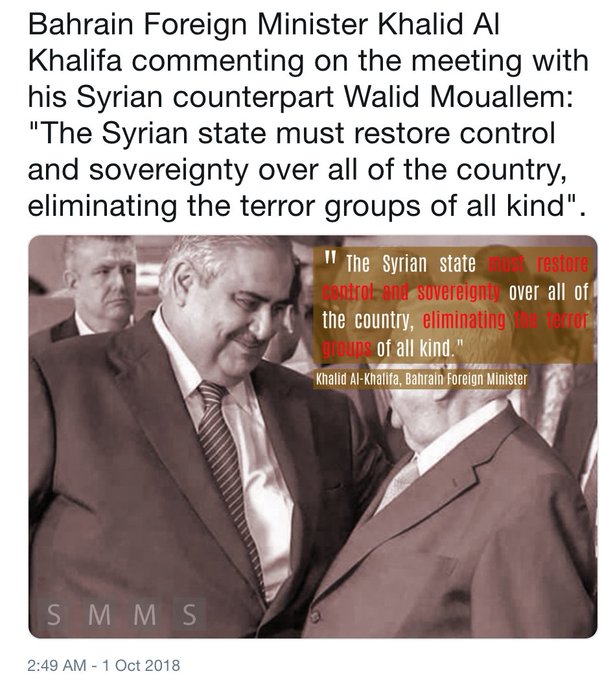
is a logical step forward after many Gulf countries, such as Bahrain
and Kuwait, took
measures to recognize the present reality of the Assad victory and
work toward the normalization of relations between their countries.
It is a logical step forward after many Gulf countries, such as Bahrain and Kuwait, took measures to recognize the present reality of the Assad victory and work toward the normalization of relations between their countries.
Below
is a quick summary of agreed upon points issued in a communique by
Turkey’s President Recep Tayyip Erdogan, Russia’s Vladimir
Putin, France’s Emmanuel Macron and German Chancellor
Angela Merkel at the conclusion of this weekend's Istanbul
summit, via
RT News:
Only
political solution for Syria:
The leaders have “expressed
their support for an inclusive, Syrian-led and Syrian-owned political
process that is facilitated by the United Nations.”
Need
to start work on constitution in Geneva:
A committee tasked with drafting a new constitution for Syria should
begin its work as soon as possible, preferably before the end of this
year.
No
to division of Syria:
Syria must continue to exist within its pre-war borders. Any
separatist movements or desires of foreign powers to occupy parts of
the country are therefore firmly rejected.
Keep
ceasefire & defeat terrorists:
The four countries have expressed their support for the Idlib
ceasefire deal, brokered earlier by Russia and Turkey. At the same
time, they emphasized the importance of fighting terrorism and
condemned the use of chemical weapons.
Boost
humanitarian aid:
The United Nations and other international organizations should
bolster aid deliveries to the war-torn country. “Swift,
safe and unhindered” flow
of humanitarian aid will provide much-needed relief to the sufferings
of the Syrian people.
Help
return of refugees:
The four leaders stressed the importance of “safe
and voluntary” return
of refugees to Syria. To facilitate the process, appropriate housing
and social care facilities must be constructed in the country.
Internationally
observed elections:
The ultimate goal of the political settlement process is holding
transparent, internationally observed elections, the statement reads.
All Syrians, including those who had to flee the country, must be
able to participate.
The
Russian trade mission in Washington has been closed and its staff
barred access, Russia’s US embassy spokesman said, adding the US
State Department is formally leading the searches in the building.
Meanwhile the BRICS are meeting in Beijing
RT: BRICS countries need to get out of the shadow of western media
The
western media is painting this as retaliation against the recent
sanctions. It is not. Russia had still to respond to the totally
illegal confiscation of Russian properties in the US on 31 December
last year.
It is, in my mind an action that is LONG overdue.
Putin: 755 US diplomats to depart Russia, time to show we won’t leave anything unanswered
More
than 750 American diplomats will have to leave Russia as a result of
Washington's own policies, Russian President Vladimir Putin has said
in an exclusive interview with the Rossiya 1 TV channel.
"The
American side has made a move which, it is important to note, hasn't
been provoked by anything, to worsen Russian-US relations. [It
includes] unlawful restrictions, attempts to influence other states
of the world, including our allies, who are interested in developing
and keeping relations with Russia,"
Putin told channel host, Vladimir Solovyov, Sunday.
"We've
been waiting for quite a long time that maybe something would change
for the better, we had hopes that the situation would change. But it
looks like, it's not going to change in the near future... I decided
that it is time for us to show that we will not leave anything
unanswered,"
the Russian president dded.
Earlier
this week, following the US Congress' approval of new sanctions
against Russia, Iran and North Korea, the Russian foreign
ministry announced that
Moscow told Washington to reduce the number of its diplomatic staff
in Russia to 455 people.
The
number of US diplomatic service staff in Russia was ordered to be
reduced in order to equal the number of Russian diplomats in the US
by September 1. As of now, it "greatly
exceeds"
the number of Russia's embassy staff in the US, the ministry said.
The American diplomatic mission includes more than 1,200 personnel.
"From
the perspective of a working diplomatic mission, [the measure] is
fairly sensitive,"
Putin said.
The
Russian leader went on to say that there is a number of "important
spheres of cooperation"
between Moscow and Washington, which he hoped would not suffer
because of America's anti-Russian policies. Those mostly include the
joint fight against terrorism, obligations in nuclear arms control,
and space projects rather than economic relations, Putin said.
Moscow
has much wider trade and economic relations with China, the EU and
other countries than with the US, the president dded
.
Putin
however underlined that Moscow and Washington had recently reached
"concrete"
results in de-escalating the crisis in war-torn Syria, which are in
the interests of the entire Middle East region.
"We
also work together on fighting illegal migration and organized crime
in a broad sense. There are also issues of cybersecurity,"
Putin pointed out, having also referred to joint Russia-US scientific
projects in space, such as plans to jointly explore Venus.
"The
main thing is, that we have a multi-faceted cooperation in many
fields. Of course, Moscow has a lot to say and there is a number of
spheres of cooperation that we could potentially cut and it would be
sensitive for the US side. But I think we shouldn't do it. It would
harm development of international relations. I hope it won't get to
that point. As of today, I'm against it."
RUSSIAN
DEPUTY FM: retaliation against US “LONG OVERDUE” (VIDEO)
Deputy
Foreign Minister Sergey Ryabkov said the sanctions bill was
"completely weird and unacceptable".
Russian
Deputy Foreign Minister Sergey Ryabkov has given an interview
during which he expressed his sorrow and anger at the US for
prolonging the problem of stolen Russian Embassy and.
In
the interview which has been broadcast on ABC news, Ryabkov stated,
“So
if the US side decides to move towards further deterioration, we will
answer, we will respond in kind. We will mirror this, we will
retaliate, but my call and my whole point is – don’t do this.
It’s to the detriment of the interest of the US and I’m hopeful
that even those who are the worst adversaries of Russia in your
country, will understand this very simple logic.
Every
child in the US knows what the words ‘no trespassing on private
property’ means. Meanwhile, we saw the US law enforcers just taking
completely unacceptable measure on private property that belongs to a
foreign state. We can’t have more evidence of a very wrong
direction in which political thinking in the US has taken in recent
time”.
Barack
Obama’s seizure of Russian Embassy property which is legally on the
soil of the Russian Federation as defined by the Vienna
Convention of international law,
was not met with an immediate Russian response as Russia was keen on
waiting for a seemingly more amicable President Trump to mend that
which Obama destroyed.
Now
however that the US Congress has passed a punitive sanctions bill
that has been globally condemned including by America’s EU
allies, Sergey Ryabkov described the situation as the straw that
broke the camel’s back after over half a year of unrequited
patience.
Now
watch Sergey Ryabkov explain why Russia has had enough.
Kim
Jong-un gets what he wants: the Russian-Chinese joint statement on
Korean conlict (full text and analysis)
Joint
Russian-Chinese statement on Korean conflict recognises North Korea's
'justified concerns', opposes military action, and effectively rules
out across-the-board sanctions.
The
Russian Foreign Ministry has now published the complete text of the
Russian-Chinese joint statement on the Korean conflict.
Since
this document is not easy to find, I set out the full text with the
key points highlighted
The
Russian Federation and the People’s Republic of China are the
Korean Peninsula’s neighbours, therefore the development of the
situation in the region concerns the national interests of both
countries.Russia
and China will closely coordinate their efforts in
order to promote a complex solution to the Korean Peninsula’s
problems, including that of the nuclear issue, for the sake of
achieving a lasting peace and stability in Northeast Asia. In the
spirit of strategic cooperation the foreign ministries of Russia and
China (hereinafter
referred to as Parties) state the following:
1.
The Parties are seriously worried by the Democratic People’s
Republic of Korea (DPRK)’s statement of July 4, 2017 about a
ballistic missile launch and consider this statement unacceptable and
in disharmony with the relevant UN Security Council resolutions.
2.
The Parties express serious concern about the development of the
situation on the Korean Peninsula and around it. Mounting political
and military tension in that region, fraught with the eruption of an
armed conflict, are calling on the international community to adopt
collective measures to
settle the situation peacefully through dialogue and
consultations. The
Parties oppose any statements or moves that might escalate tension or
aggravate the contradictions and urge all countries concerned to
maintain calm, renounce provocative moves or bellicose rhetoric,
demonstrate readiness for dialogue without preconditions and work
actively together to defuse tension.
3.The
Parties are putting forward a joint initiative, which is based on the
Chinese-proposed ideas of “double freezing” (missile and nuclear
activities by the DPRK and large-scale joint exercises by the United
States and the Republic of Korea) and “parallel advancement”
towards the denuclearisation of the Korean Peninsula and the creation
of peace mechanisms on the peninsula, and the Russian-proposed
stage-by-stage Korean settlement plan.
The
Parties propose the following:
The
DPRK, by way of a voluntary political decision, announces a
moratorium on the testing of nuclear explosive devices and ballistic
missile tests, and the United States and the Republic of Korea
should, accordingly, refrain from large-scale joint exercises.
Simultaneously, the
conflicting parties begin talks and assert common principles of their
relations,
including the non-use of force, the renunciation of aggression,
peaceful coexistence and determination to do all they can to
denuclearise the Korean Peninsula with a view to promoting a complex
resolution of all problems, including the nuclear issue. During the
negotiating process, all parties concerned push forward, in a format
suitable to them, the creation on the peninsula and in Northeast Asia
of a peace and security mechanism and consequently normalise
relations between the countries in question.
The
Parties urge the international community to support the
aforementioned initiative that paves the real way for resolving the
Korean Peninsula’s problems.
4.The
Parties are resolutely committed to the international
non-proliferation regime and are firmly aimed at the denuclearisation
of the Korean Peninsula and a comprehensive and full implementation
of the relevant UN Security Council resolutions. The Parties intend,
jointly with other parties concerned, to continue making efforts to
facilitate the balanced removal of the existing concerns via dialogue
and consultations.
The
Parties confirm that the DPRK’s justified concerns should be
respected.Other
states must make relevant efforts to have talks resumed and jointly
to create an atmosphere of peacefulness and mutual trust.
The
Parties are calling on all parties involved to comply with the
commitments formulated in the Joint Statement of September 19, 2005,
and to
re-launch, as soon as possible, the dialogue on the comprehensive
resolution of problems on the Korean Peninsula. Any possibility of
using military means to solve the problems of the Korean Peninsula
should be ruled out.
5.
The Parties express support for the North and the South of the Korean
Peninsula to conduct dialogue and consultations, display benevolence
towards each other, improve relations, cooperate in the matter of a
peaceful settlement, and play a due role in defusing the situation on
the Korean Peninsula and in resolving its problems in a proper
manner.
6.
The Parties confirm that they are paying sufficient attention tothe
maintenance of the international and regional balance and stability,
and emphasise that allied relations between separate states should
not inflict damage on the interests of third parties. They are
against any military presence of extra-regional forces in Northeast
Asia and its build-up under the pretext of counteracting the DPRK’s
missile and nuclear programmes.
The
Parties confirm that the deployment of THAAD antimissile systems in
Northeast Asia is inflicting serious damage on strategic security
interests of regional states, including Russia and China, and does
nothing to help achieve the aims of the Korean Peninsula’s
denuclearisation, nor to ensure peace and stability in the region.
Russia
and China are against the deployment of the said systems, call on the
relevant countries to immediately stop and cancel the deployment
process, and have agreed to adopt the necessary measures to protect
the two countries’ security interests and to ensure a strategic
balance in the region.
This
statement was signed on July 4, 2017, in Moscow.
For
the Ministry of Foreign Affairs
For the Ministry of Foreign Affairs
of
the Russian Federation of
the People’s Republic of China
(bold
italics dded)
The
key points to take away from this statement are the following
(1)
The Russians and the Chinese are coordinating their positions on the
Korean issue “in the spirit of their strategic cooperation” (ie.
their alliance). What this means in effect is that China can
count on Russia’s support in its dealings with the US on the Korean
issue.
(2)
The Russians and the Chinese accept that North Korea has justified
security concerns and consider that these should be respected. In
other words they both oppose regime change in North Korea.
(3)
The Russians and the Chinese categorically oppose any US military
action against North Korea. The Russians support the Chinese
initiative whereby
(i)
North Korea freezes its nuclear testing and ballistic missile
programme;
(ii)
the US and South Korea cease further joint military exercises on the
Korean Peninsula;
(iii)
the US and North Korea, and North Korea and South Korea commence
direct talks with each other aimed at a comprehensive settlement of
the conflict on the Korean Peninsula (“the comprehensive resolution
of problems on the Korean Peninsula”).
(3)
The Russians and the Chinese consider the US’s deployment of THAAD
on the Korean Peninsula destabilising and a threat to the
international balance of power.
In
comments today Russian Foreign Minister Lavrov – unquestionably
expressing the joint view of the Russian and Chinese governments
– explicitly
rejected the idea of regime change in
North Korea or of seeking to suffocate North Korea by imposing across
the board sanctions upon it.
“For
Russia and China, it is absolutely clear that any attempts to justify
a belligerent solution, using the UN Security Council’s resolutions
as a pretext, are unacceptable and will lead to unpredicted
consequences in the region, which neighbours Russia and China,”
Lavrov said, noting that theattempts
of “strangling” North Korea’s economy are unacceptable.
The
task set by the UN Security Council is to denuclearize the Korean
Peninsula, andit
should not be used as an attempt to change the regime in North Korea,
Lavrov said. “We assume that the task that has been set by the UN
Security Council is to denuclearize the whole Korean Peninsula, and
it cannot and should not be used as a pretext to try and change the
regime in North Korea,” he said
(bold
italics dded)
Right
at the start of this latest twist in the North Korean crisis I
predicted that China would refuse the Trump administration’s
request for comprehensive across-the-board sanctions on North Korea,
and that the Trump administration’s threats against North Korea
would simply
harden China’s support for North Korea.
To
the extent that it is possible to see a strategy behind the latest US
moves, it seems to be to frighten the Chinese into abandoning North
Korea by threatening them with a war in the Korean Peninsula if they
don’t, with a big trade deal thrown in as a sweetener.
This
is the sort of approach that might make sense in the cut-and-thrust
US property industry which Donald Trump knows. However the
trouble with this frankly amateur approach is that it gravely
underestimates the strength of feeling in China.
Whilst
it is doubtful that most Chinese think or care much about North
Korea, the Chinese leadership would face a severe internal crisis if
it appeared to back down in the face of US threats. An actual
or pending US attack on North Korea would therefore be far
more likely to strengthen Chinese support for North Korea than to
weaken it.
(bold
italics dded)
So
it has proved. The Chinese response to the latest North Korea
missile launch is not to threaten North Korea but to warn the US
against military action whilst ruling out across-the-board sanctions
and regime change. Moreover China – contrary to its previous
practice and its probable wishes – has been driven to state this
clearly and in public, and has enlisted Russia’s support.
Kim
Jong-un will no doubt go through the motions of rejecting China’s
proposal. He can do so in the confident knowledge that there
will be no penalty since the US will reject it also. In the
meantime he has pocketed assurances from China and Russia that they
will not impose across-the-board economic sanctions on his country.
Privately
he must be delighted with the way things are turning out.

 Posts
Posts