Showing posts with label corn. Show all posts

Saturday, 1 June 2019

Farmers are taking to Twitter to talks about the threats to US agriculture

Farmers Are Using Twitter to Document the Disastrous Effects of Climate Change on Crops
A terrible, wet planting season is threatening U.S. crops, and farmers are live-tweeting it


by Brenna Houck


29 May, 2019
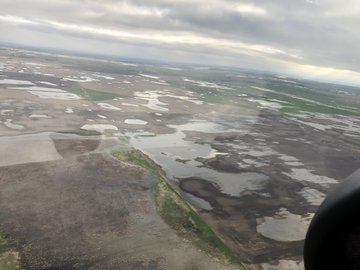
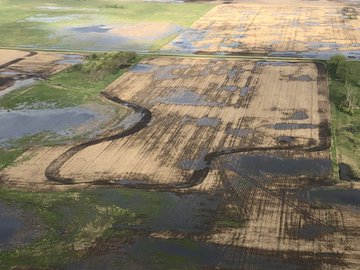
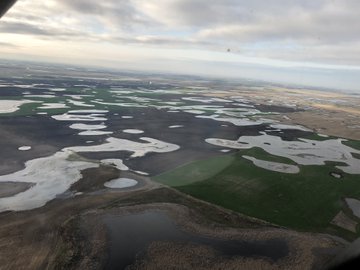
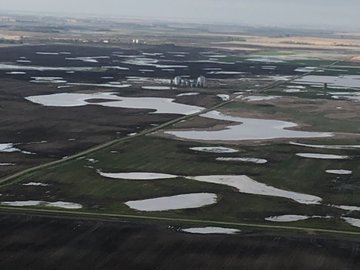
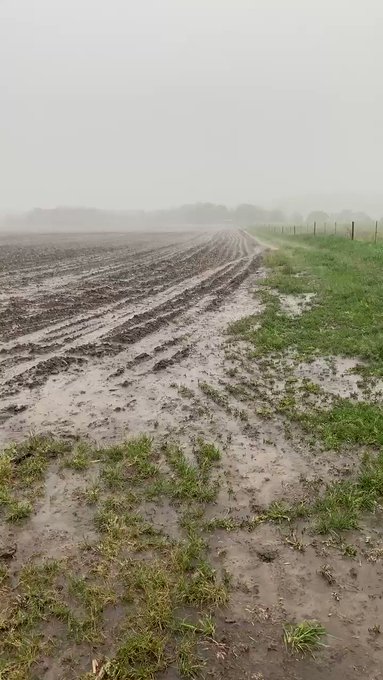
In case we need anymore evidence that the globe is disastrously warmed, a pattern of conditions is impacting the world’s agricultural systems and threatening food supplies in the U.S. and abroad. Because legislators will continue to deny the what’s literally happening before their eyes (*cough* Climate Change), U.S. farmers have now turned to the Twitter hashtag #NoPlant19 to bring attention to the extremely wet spring that’s made it difficult plant corn and soybeans.
 
The U.S. is currently in the midst of its wettest 12 months on record, with regions of the Great Plains and Midwest — where much of the nation’s corn and soy is produced — bearing the brunt of this spring’s rainfall. Not only are homes being damaged as a result of the extreme flooding, but the conditions are making it damn near impossible for farmers to plant their crops.
On average over the past four years, farmers in the states that represent a majority of the nation’s harvest would have planted 90 percent of their corn and 66 percent of their soy by May 26, according to a U.S. Department of Agriculture report. That makes a lot of sense since crop yields tend to decline when corn is planted after May 10 and farmers typically wrap up their planting efforts by May 31. However 2019’s crops are far behind schedule. As of May 26, only 58 percent of the nation’s corn had been planted and just 29 percent of its soy. Farmers are rightly worried and consumers should be too. Crop shortages will likely result in higher prices for consumers and since corn and soy are basically in every part of the American diet, that could be a real problem.
The whole issue is of course compounded by the Trump administration’s trade war. Retaliatory tariffs between China and the U.S. have made it difficult to sell soy on the international market. As a result, many farmers planned to grow more corn this year, UPI reports. Some farmers may cut their losses and turn to insurance if they’re unable to plant; however, those same people would then also face challenges in qualifying for a federal government aid package designed to ease financial strain from the U.S.-China trade war because it requires that they plant crops.
That layer of stress on the agricultural industry is only intensified when you zoom out to the international level, where farmers around the world are facing various dire situations. As one North Dakota farmer and Twitter user Jordan Gackle pointed out in a recent thread: Drought is continuing to disrupt wheat crops in Australia forcing the country to import some of its wheat from Canada. Some farmers in Canada are now reporting long stretches without rain under the hashtag #drought19. Head over to China and you’ll find that a legion of fall armyworms are spreading rapidly and devouring key grain crops.
The various international agricultural crises paint a dire picture, which is made so much worse by the climate denial by politicians who would rather invent a fake war against burgers than take profound policy action. If hashtags are the only thing standing between the world and food shortages, everyone better start tweeting.

#noplant19

Wednesday, 22 May 2019

More on plantings in the United States


I will add material as it comes to hand on the following 


"Across the United States, farmers held soybean stocks of 2.716 billion bushels as of March 1, the largest on record for the time period, the USDA said on Friday. Corn stocks were the third-largest on record." 

Is that enough to keep us going till next season?

I found the following comment interesting - 


U.S. CORN PLANTING IS WAAAAAAAAAAAAAY BEHIND, USDA SAYS

LESS THAN HALF OF THE CORN IS IN THE GROUND.

May, 2019

DES MOINES, Iowa — U.S. corn farmers have the most corn acres left to plant, on this date, than they have ever had and remain behind the trade’s expectations, as well.

CORN

In its Crop Progress Report Monday, the USDA pegged U.S. corn planting at 49% complete, behind the 80% five-year average.
The trade expected a completion rating of 53%. On this week of the planting season, the most that U.S. farmers have ever had left was 47% of the crop. In 2019, that amount is 51%, with plenty of rain in the Midwest’s forecast.
As of Sunday, Iowa farmers had 70% of that state’s corn crop planted vs. a 89% five-year average. Illinois farmers have 24% of their corn seeded, behind a 89% five-year average. Indiana has 14% planted vs. a 73% five-year average. In the eastern Corn Belt, Nebraska farmers have 70% of their corn planted vs. a 86% five-year average.
Also, 19% of the U.S. corn has emerged vs. a 49% five-year average.


SOYBEANS

In its report, the USDA pegged the U.S. soybean planting completion rate at 19% vs. a 47% five-year average.
Iowa has 27% of its soybean crop in the ground, compared with a 55% five-year average. Illinois has 9% of its crop seeded, equal to a week ago and a 51% five-year average. Indiana soybean growers have 6% of their crop in the ground vs. a 43% five-year average.
Also, 5% of the U.S. soybean crop has emerged vs. 17% five-year average.


WHEAT

In its report, the USDA pegged the U.S. winter wheat crop as 66% good/excellent vs. a 64% five-year average


GRAINS-Corn climbs on U.S. planting delays; wheat, soybeans also advance


* Forecasts call for unwanted U.S. Midwest weekend rains
* Soybeans extend rally as U.S.-China trade war fears ease
* Soy rally capped by bearish U.S. crush data
* Wheat higher; drought-hit Australia imports grain

15 May, 2019

 May 15 (Reuters) - U.S. corn futures hit a six-week high on Wednesday on forecasts for worrisome rains in the Midwest crop belt that could signal further planting delays, analysts said. Wheat and soybean futures followed the strength in corn, although gains in soy were capped as traders considered whether seeding delays in corn could prompt farmers to shift acres to soybeans, which can be planted later. As of 12:42 p.m. CDT (1742 GMT), Chicago Board of Trade July corn was up 3-3/4 cents at $3.72-1/2 per bushel after reaching $3.80, its highest since March 29. CBOT July wheat was up 4-1/4 cents at $4.52-3/4 a bushel and July soybeans were up 4 cents at $8.35-1/2 a bushel. Corn posted the biggest advance of the three commodities on a percentage basis as forecasts called for rains to return to the U.S. Corn Belt this weekend and next week, after a few dry days. “There is some planting going on, but it looks like a pretty limited window,” said Dan Cekander, president of DC Analysis. The CBOT July corn contract surged 37 cents this week, from a contract low of $3.43 on Monday to Wednesday’s high of $3.80, as U.S. planting worries prompted funds to unwind a portion of their massive net short position. “We’re a little bit over-extended on some big short-covering,” Cekander said. “But if the (weather) forecast verifies, there is going to be some significant acreage loss.” U.S. farmers seeded 30% of the U.S. 2019 corn crop by Sunday, the government said, lagging the five-year average of 66%. The soybean crop was 9% planted, behind the five-year average of 29%. CBOT soybeans extended their rally from Tuesday, after U.S. President Donald Trump eased concerns about a U.S.-China tariff war. But bearish monthly soy crushing data hung over the market, capping gains. The National Oilseed Processors Association said its U.S. members crushed 159.99 million bushels of soybeans in April, down from 170.0 million in March and below an average of analyst expectations for 161.6 million.

Also, China’s sow herd fell by 22.3% in April from a year earlier, the Ministry of Agriculture and Rural Affairs said, underscoring the effects of an epidemic of incurable African swine fever. The decrease in China’s hog herd, the world’s largest, suggests a drop in global demand for soy-based animal feed. Wheat drew support from news that drought-hit Australia will import its first shipment of wheat in more than a decade, from Canada.

CBOT prices as of 12:37 p.m. CDT (1737 GMT):

Net Pct Volume
Last change change
CBOT wheat WN9 453.25 4.75 1.1 71691CBOT corn CN9 373.75 5.00 1.4 277149CBOT soybeans SN9 836.50 5.00 0.6 152831CBOT soymeal SMN9 300.30 2.30 0.8 59086CBOT soyoil BON9 27.28 0.28 1.0 51240

NOTE: CBOT July wheat, corn and soybeans shown in cents per bushel, July soymeal in dollars per short ton and July soyoil in cents per lb.


.

Monday, 23 June 2014

US agricultural collapse

US corn’s gravy train faces derailment
The US produces enough corn in one year to fill a freight train stretching round the world, according to a recent study. But climate change and unsustainable use of water resources and fertilizers threaten this vast industry.


23 June, 2014


LONDON, 22 June, 2014 – One-third of cropland in the US is devoted to corn. It produces nearly 40% of the world’s corn, and a record harvest last year was valued at nearly $70 billion.


But now there are warnings that this mighty agricultural edifice – which supports not only farmers, but a legion of food and animal feed, transport and other companies, big and small − could be seriously damaged by a changing climate.


To make matters worse, increasingly scarce water supplies could also have an adverse effect, and so too could the intensification of growing techniques − in particular, the overuse of fertilizers and pesticides.


A study by Ceres, a US not-for-profit group that lobbies for more environmental sustainability in the business sector, looks at the risks facing one of the country’s main industries.

Negative impact

States in the American Midwest and the Great Plains region – known as the Corn Belt − account for the bulk of corn production. But the study warns: “Record-breaking weather events – including prolonged drought, intense precipitation and high temperatures – are increasingly common in the Corn Belt and are negatively impacting corn yields and corporate profits.”


Floods in 2010/11 caused millions of dollars worth of crop losses in many areas. Lands were also degraded, and erosion increased. The following year there was drought, when the rains didn’t arrive and temperatures soared.


The 2012/13 drought exemplified the vulnerability of the US corn supply chain to extreme weather,” the study says.


The bulk of US corn output goes either to animal feed or to the production of ethanol fuels, with only 10% going to food processing.


According to the report: “The 2012/13 drought had unusually severe financial impacts for many companies in the US corn value chain, hitting the meat and grain trading sectors particularly hard.


Impacts ranged from interruptions to corn supply − which affected meat processing and ethanol refining activities − to operational challenges linked to insufficient water for manufacturing facilities, to low Mississippi river water levels that restrict transport of agricultural goods.”


While the percentage of corn production shipped abroad is relatively small, the US is still the world’s biggest corn exporter. Shortages or rising prices can have an adverse impact on the developing world, with the potential for outbreaks of serious social unrest.


The study points out that extreme weather events in recent years have resulted in large-scale price volatility. This in turn has led to what it calls riskier growing practices, with farmers and the big agricultural conglomerates seeking to cash in on rises in the market by using ever more fertilizer and pesticides on their lands.


The US government’s recent National Climate Assessment said the negative effects of climate change, such as higher temperatures and drought, would outweigh any positive impacts in the Midwest and Great Plains.


The Ceres study says corn is particularly sensitive to higher temperatures, and much of the corn is grown in regions where water supplies are already limited. In future, corn growing might have to move to cooler and more water-abundant areas further north.

Northward shift

Higher temperatures and increased water stress mean that increased irrigation for corn will be required. Given limited water supply in parts of the Great Plains region, a northward shift in corn acreage is predicted, increasing the risk of stranded agricultural assets, such as processing, storage and transportation infrastructure.”


Costs, to the agricultural industry and to the US government are mounting. In 2012-13, the government’s Federal Crop Insurance Programme paid out a record $10.8 billion to farmers, mostly for reasons related to the drought.


Ceres says farmers and the large conglomerates that control increasing amounts of agricultural land must learn to farm more sustainably. In many cases, this means a less intensive crop regime.


There should be more measured use of fertilizers and pesticides. More efficient irrigations methods and charging systems that encourage less water use should also be implemented.


More mixed cropping should be introduced in order to preserve soil fertility, the report recommends. And companies should examine their supply chains, and pressure the farming sector to put in place better land practices.


Perhaps most controversially, Ceres has a simple message that is likely to cause a storm of anger across the Corn Belt: buy less corn. – Climate News Network