Showing posts with label carbon. Show all posts

Monday, 3 August 2015

What lies beneath Alaska's wildfires

Beneath Alaskan Wildfires, A Hidden Threat: Long-Frozen Carbon's Thaw
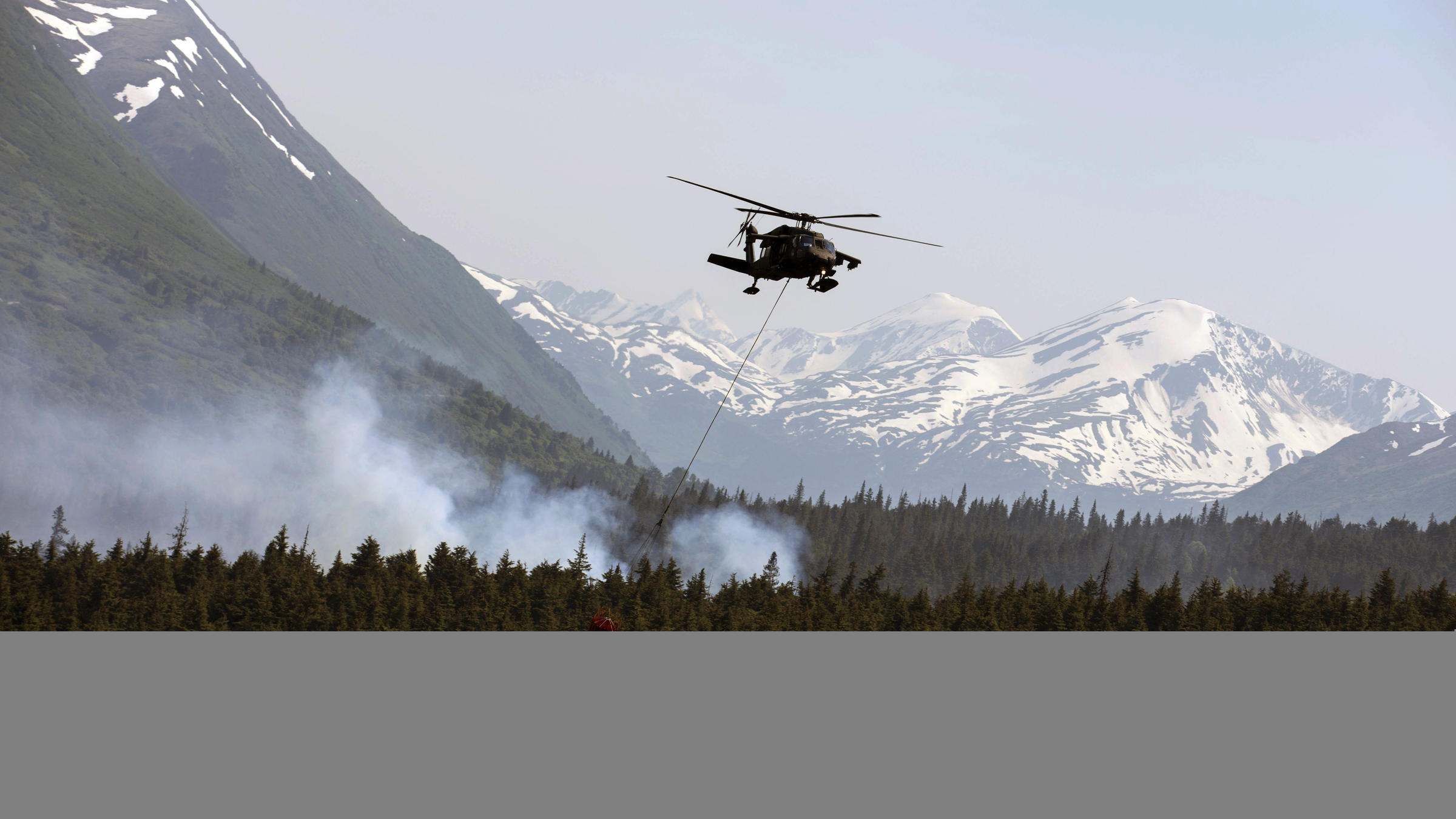
Some of Alaska's wildfires are dramatic: flames, vast plumes of smoke and firefighting battles. Here, on June 17, a helicopter releases hundreds of gallons of water onto the Stetson Creek Fire near Cooper Landing, Alaska. But even fires that look far quieter, like they're all burned out, can continue to smolder underground — and pose a dangerous threat to permafrost.
SGT


3 August, 2015


The Fish Creek Fire in Interior Alaska isn't much to look at. It's about 7,500 acres in size, sitting about an hour south of Fairbanks near the twisty Tanana River. The main fire front — the made-for-TV part, with torching trees and pulses of orange heat — flamed out more than a week ago, leaving behind a quiet charred landscape.

But the fire is far from over. It's one of nearly 300 fires still burning in Alaska, after a spectacular lightning storm late last month sparked hundreds of blazes and a wave of fire larger than any in the state's history — nearly 5 million acres in total.
And though the Fish Creek Fire looks benign, with little wisps of white smoke as its only sign of life, it's not.

A little fire like this could have a huge impact on the surrounding environment and ecosystem — not just here in Alaska, but across the planet.

Hidden Masses Of Organic Matter

"It's really a different kind of fire," says Teresa Hollingsworth, a research ecologist with the U.S. Forest Service.

The Fish Creek Fire is mostly done burning the trees and brush above ground and has moved on to the organic matter underground — organic matter that goes, Hollingsworth says, "meters and meters deep."

That's why fires in the higher latitudes, in places like Alaska, are different than other wildfires. Here, Hollingsworth explains, the vegetation above ground is just the tip of the iceberg.

There are layers and layers of organic material called duff — things like pine needles, grasses and trees — that have fallen and accumulated on the forest floor over time. They haven't fully decomposed, like they would in a place like Florida, because of the frigid temperatures.

In places, the duff can pile up to be feet deep.

Below that duff, there's permafrost — which, as the name implies, is permanently frozen ground. It can include dirt, rocks and water, as well as trees, twigs and mammoth bones.

The result, Hollingsworth says: There can be way, way more organic material, or biomass, below ground than there is above.

And all of that biomass is made up of carbon — the same carbon that's a leading cause of climate change.

A Frozen Carbon Threat

That's why ecologists and climatologists are watching this year's fire season with so much interest.

Roughly 4.7 million acres of boreal forest and land have burned in Alaska this summer. Millions more have burned in Canada, where scientists estimate half of the land is underlaid with permafrost.

In total, more than 11 million acres have burned between the two places — an area roughly the size of Connecticut.

Fires in the subarctic are nothing new. The vast majority of the land burned by wildfire in North America every year is in Alaska and Canada, far from cities and towns.

Still, Alaska has never seen that much fire so early in its fire season. And many of those fires are burning with greater intensity.

That's worrying to research ecologists like Ted Schurr, a professor at the University of Northern Arizona who spends his summers in Alaska studying permafrost.

"It's understood that there's about twice as much frozen carbon [in permafrost] as there is in the atmosphere, to the tune of about 1,700 billion tons of carbon stored frozen," he says.

Put in context, he says, there's maybe another 2,000 billion tons of carbon stored in soil and vegetation in the rest of the world.

"The Arctic and the boreal regions are a hotspot of carbon that's stored in the biosphere that has some vulnerability of ending up in the atmosphere as the climate changes," Schurr says.

One of the more rapid ways a climate or ecosystem can change, he says, is through fire.

Solid Permafrost Gone Shaky

A good example of that can be found just a half-hour drive from the Fish Creek Fire, in a wide, densely vegetated area called the Tanana Flats, south of Fairbanks.

Merritt Turetsky, a research ecologist from the University of Guelph in Canada, runs a field site there.

She kneels on the spongy, springy ground and starts sawing through the surface with a long knife, cutting away at that duff layer that's burning in many of the fires around the state.

"Feel how dry that is," she says. "I mean, we had rain last night and it's still this dry. This stuff burns like crazy."

She cuts more of the earth away, reaching into the hole up to her elbow. The dirt at the bottom is cold and wet, which means it's the layer just above intact permafrost, Turetsky says.

She grabs at a piece of the rooty soil she just cut way.

"This is 40 centimeters of a blanket that protects [permafrost] from what's happening at the surface," she says. "But when a fire comes through it might remove 15 or 25 centimeters of this organic mat."

The result is a thinner blanket — providing less protection for the permafrost below.

That's particularly problematic given the changing climate in the planet's higher latitudes. Alaska has already warmed by more than 3 degrees Fahrenheit in the past 50 years, rendering much of the permafrost here unstable.

Fire makes it even worse, Turetsky says.

For proof, she walks just 10 yards away, through thick trees to a bald patch a few acres in size. As she walks from the forested area to the open area, her steps slow and her feet sink. Each step comes with an accompanying splash.

"We call that a quaking bog," she says. "It's like you're on a waterbed."

It's a thin layer of vegetation on top of muddy, soupy water — water that was frozen in permafrost not long ago.

Can The Ecosystem Compensate?

Turetsky is here with a group of graduate students and researchers from the University of Alaska Fairbanks to determine why the permafrost thawed.

They take core samples of trees around the bald spot's perimeter and samples of the water below that thin layer of vegetation.

Nearly all of the samples show signs of a fire that burned through the area maybe 40 years ago: a fire that burned off that top layer of duff, leaving the permafrost vulnerable to the hotter temperatures of the last couple of decades.

Now, Turetsky says, all of the carbon that was trapped in that permafrost, frozen in time, is available to be put back in the atmosphere.

What that means is debatable. Some scientists think that the ecosystem will be able to compensate for all of that new carbon with new plant life. They point to an increase in the number of hardwood trees in Alaska, which grow faster and absorb more carbon, as a potential sign of that.

Other scientists, like Turetsky, are less optimistic. She does believe that the environment can compensate for the carbon that's released when a fire burns up trees and brush, and even the carbon that's been piling up for hundreds of years in duff.

The carbon that can get released from thawing permafrost, though?

"The atmosphere thought it lost that carbon and all of a sudden it's being returned to the atmosphere after a prolonged period of time," Turetsky says.

"That's the kind of carbon pulse to the atmosphere that actually can invoke additional climate change, above and beyond human emissions."

And more climate change, she says, could mean hotter temperatures, which could mean more fires, which could mean more permafrost lost.


To hear the audio GO HERE

Saturday, 18 April 2015

Scary Arctic permafrost study

Why This New Study On Arctic Permafrost Is So Scary
You can’t re-freeze the permafrost’


Greenland's permafrost could be melting faster than expected due to active microbes, according to new research.

Greenland’s permafrost could be melting faster than expected due to active microbes, according to new research. - CREDIT: SHUTTERSTOCK

8 April, 2015

Scientists might have to change their projected timelines for when Greenland’s permafrost will completely melt due to man-made climate change, now that new research from Denmark has shown it could be thawing faster than expected.

Published Monday in the journal Nature Climate Changethe researchshows that tiny microbes trapped in Greenland’s permafrost are becoming active as the climate warms and the permafrost begins to thaw. As those microbes become active, they are feeding on previously-frozen organic matter, producing heat, and threatening to thaw the permafrost even further

In other words, according to the research, permafrost thaw could be accelerating permafrost thaw to a “potentially critical” level.


The accompanying heat production from microbial metabolism of organic material has been recognized as a potential positive-feedback mechanism that would enhance permafrost thawing and the release of carbon,” the study, conducted by researchers at the University of Copenhagen’s Center for Permafrost, said. “This internal heat production is poorly understood, however, and the strength of this effect remains unclear.”

The big worry climate scientists have about thawing permafrost is that the frozen soil is chock-full of carbon. That carbon is supposed to be strongly trapped inside the soil, precisely because it’s supposed to be permanently frozen — hence, “permafrost.”

However, as temperatures in the Arctic have risen due to human-caused climate change, permafrost is thawing, and therefore releasing some of that trapped carbon into the atmosphere. It’s yet another feedback loop manifesting itself in Arctic permafrost regions — as climate change causes it to thaw, the thawing causes more climate change, which causes more thawing, et cetera, et cetera.

What makes this new research so important is that it adds to the urgency of stemming permafrost thaw. Because even without this new discovery of heat-producing microbes, estimates for carbon releases from thawing permafrost have been alarmingly large. According to the National Snow & Ice Data Center, there are about 1,700 gigatons of carbon currently frozen in permafrost — more than the total amount in the atmosphere now (Earth’s atmosphere contains about 850 gigatons of carbon, according to the Center).

Without considering microbes, the average estimate is that 120 gigatons of carbon will be released from thawing permafrost by 2100, which would raise the average global temperature 0.29 degrees. After 2100, if climate change worsens, total permafrost emissions roughly double. That’s confirmed by National Snow and Ice Data Center research scientist Kevin Schaefer’s research, which took the average of 15 peer-reviewed estimates of future carbon releases from thawing permafrost.

Schaefer, who was also one of the reviewers of the microbe study, told ThinkProgress that this is particularly alarming because emissions from permafrost are “completely irreversible.”

These are permanent emissions,” he said. “Once you thaw out that material, there’s no way to put that organic matter back into the permafrost … you can’t re-freeze the permafrost.”

It’s also unclear whether the carbon that gets released once permafrost thaws will manifest itself as carbon dioxide or methane, which has a much greater impact on climate change — specifically, for each pound emitted compared with carbon dioxide, methane has a 20 times greater impact on atmospheric warming over a 100-year period, according to the Environmental Protection Agency. The New Scientist reports that if the Arctic gets warmer and drier, the microbes trapped within the permafrost can be expected to produce carbon dioxide. But if the environment gets warmer and wetter, the microbes that thrive will tend to produce methane.

The discovery of heat-producing microbes only threatens to add more uncertainty to permafrost emissions projections. Because even though we do know they can accelerate thaw, we don’t know how much.

One of the biggest uncertainties is how much heat do the microbes generate as they eat the organic material,” Schaefer said. “It will accelerate thaw, but the question is how much. I don’t think that has been answered yet.”

So, that’s a lot of bad news when it comes to global climate change. But the good news, Schaefer said, is that accelerated thawing of Arctic permafrost can be prevented if warming is limited to a global average of 2 degrees Celsius. That 2 degree limit is, incidentally, the objective of international climate negotiations scheduled to take place at the end of this year.

If we limit the warming to 2 degrees, it will also limit the emissions from thawing permafrost,” Schaefer said. “But the more we dump into the atmosphere, the greater the emissions from permafrost will be.”


Saturday, 11 January 2014

Climate highly-sensitive to carbon

Anyone out there still need to be persuaded?


Global warming is being caused by humans, not the sun, and is highly sensitive to carbon, new research shows
New research reinforces human-caused global warming and a climate that's highly sensitive to an increased greenhouse effect


9 January, 2014

Over the past few weeks, several important new papers related to human vs. natural climate change have been published. These papers add clarity to the causes of climate change, and how much global warming we can expect in the future.

First, a paper published in the Journal of Climate by Jara Imbers, Ana Lopez, Chris Huntingford, and Myles Allen examines the recent IPCC statement that expressed with 95 percent confidence that humans are the main cause of the current global warming. One of the main challenges in attributing the causes of global warming lies in the representation of the natural internal variability of the Earth's climate.

The study used two very different representations of natural variability. The first model assumed that the present climate has a short and finite memory, and is mostly determined by the recent past. The second model assumed that the climate's internal variability has long memory and the present climate is influenced by all the previous years.

The authors then incorporated each of these representations of natural variability with a statistical approach to estimate the individual contributions of the various factors (e.g. the sun, volcanoes, greenhouse gases) to the increase in average global surface temperature. In each case, the study found that the greenhouse gas-global warming signal was statistically significant, supporting the robustness of the IPCC statement on human-caused global warming. As lead author Jara Imbers told me,

"...we investigate two extreme cases of the plausible temporal structures of the internal variability, and we find that the anthropogenic signal is robust and significant."

Second, a paper published in Nature Geoscience by Andrew Schurer, Simon Tett, and Gabriele Hegerl investigates the sun's influence on global climate changes over the past 1,000 years. Although we know the sun can't be causing the current global warming because solar activity has declined slightly over the past 50 years, "it's the sun" nevertheless remains one of the most popular climate contrarian arguments. However, in recent years, research has pointed in the direction of a relatively small solar impact on the Earth's climate changes.

It's important to realize that while the Earth is bombarded by a lot of heat from the sun, the amount of solar energy reaching the planet is relatively stable. According to the best recent estimates, it's only increased by about 0.1 percent over the past 300 years, causing a global energy imbalance less than 10 percent as large as that caused by humans over the same period.

In this study, the authors tested reconstructions that incorporated relatively large and small changes in solar activity, and compared them to northern hemisphere temperature reconstructions over the past millennium. The reconstruction using a stronger solar influence (green) was a worse fit to the temperature data (blue) than the reconstruction with the weaker solar influence (red), especially around the 12th century.

Simulations with all external climate influences including strong (green) and weak (red) solar influences, compared to the ensemble of northern hemisphere surface temperatures over the past 1,000 yeas (blue) and instrumental surface temperature measurements (black). From Schurer et al. (2013).


Simulations with all external climate influences including strong (green) and weak (red) solar influences, compared to the ensemble of northern hemisphere surface temperatures over the past 1,000 yeas (blue) and instrumental surface temperature measurements (black). From Schurer et al. (2013).

As in the Imbers paper, this study used a statistical approach to determine the contribution of each factor in the measured temperature changes. The authors conclude,

"Volcanic and GHG [greenhouse gas] forcings seem to contribute most to pre-twentieth-century climate variability, whereas the contribution by solar forcing is modest, agreeing with the simulations with low solar forcing."

The study finds that the sun is unlikely to have caused more than 0.15°C of the observed approximately 1°C warming over the past 300 years. The authors find a detectable greenhouse gas influence on the climate before the 20th century, and consistent with the IPCC and Imbers, they conclude that humans are the dominant cause of recent global warming.

"Over the twentieth century, anthropogenic forcings dominate with GHGs the largest forcing, offset by the effect of anthropogenic aerosols and land use changes"

However, the authors note that while the sun has little impact on average hemispheric and global temperatures, it does have a significant influence on regional temperatures, for example in Europe.

Finally, a paper published in Nature by Steven Sherwood, Sandrine Bony, and Jean-Louis Dufresne examines the role that clouds will play in the sensitivity of the global climate to the increased greenhouse effect. To this point, cloud responses to global warming have remained a key uncertainty.

We know that a doubling of the amount of carbon dioxide in the atmosphere will cause a bit more than 1°C global surface warming by itself, and we know that there are several feedbacks that will amplify that warming. The amount of water vapor in the atmosphere – another greenhouse gas – increases as the planet warms, amplifying that warming. This is the single largest feedback, and is increasing as climate scientists expect. We also know that melting ice makes the planet less reflective, causing it to absorb more sunlight, also amplifying global warming. And carbon released from various sources like beneath melting permafrost and from burning peatlands will also increase the greenhouse effect as another positive feedback in a warming world.

However, we know of few significant negative feedbacks that will offset these effects and dampen global warming. The reckless contrarian approach is dependent upon the climate being relatively insensitive to the increased greenhouse effect, which requires that something offset all of these warming feedbacks. Clouds, whose responses in a warming world have been difficult to pin down, were the contrarians' last and best hope. An increase in cloud cover in response to global warming would reflect more sunlight back out to space, thereby cooling the Earth and offsetting some of those positive warming feedbacks.

The authors of the Nature study examined cloud change simulations in relatively low and high sensitivity climate models. As summarized by Rob Painting, they found that the less sensitive models were incorrectly simulating water vapor being drawn up to higher levels of the atmosphere to form clouds in a warmer world. In reality (based on observations) warming of the lower atmosphere pulls water vapor away from those higher cloud-forming levels of the atmosphere and the amount of cloud formation there actually decreases, resulting in another amplifying global warming feedback. Lead author Steven Sherwood describes the study in the video below.


These results are consistent with Fasullo & Trenberth (2012), who found that only the higher sensitivity climate models correctly simulated drying in key cloud-forming regions of the atmosphere. Likewise, preliminary results by scientists at the California Institute of Technology Jet Propulsion Laboratory presented at the 2013 AGU meeting showed that higher sensitivity models do the best job simulating observed cloud changes. These results are also consistent with Lauer et al. (2010) and Clement et al. (2009), which looked at cloud changes in the Pacific, finding the observations consistent with a positive cloud feedback.

To summarize, the evidence that humans are the dominant cause of the current global warming is overwhelming (which is the reason behind the 97 percent expert consensus), and continues to grow. And while the media has lately tended to focus on the few papers that suggest climate sensitivity is relatively low, there is a growing body of evidence based on cloud observations that it's actually on the high end, above 3°C warming in response to doubled CO2, which under business as usual would lead to more than 4°C warming by 2100 – a potentially catastrophic scenario.

In short – it's us, it's bad, and if we don't change course, it's a potential catastrophe.