Showing posts with label asylum. Show all posts

Wednesday, 4 September 2013

Edward Snowden - an update


Snowden’s father has not yet been issued Russian visa – report


RT,
4 September, 2013

The father of NSA whistleblower Edward Snowden still cannot enter Moscow to visit his son because the Russian consulate needs the Foreign Ministry to sanction his visa before it can be issued, Russian media reported.

"The fact is that Lon Snowden still does not have a valid Russia visa,” a source close to Snowden Sr. said, as quoted by ITAR-TASS news agency. “When Lon’s lawyers asked for an explanation at one of the Russian consular offices, the response was that Russian Foreign Ministry needs to issue a sanction, which was not done yet, and only then a visa can be issued.”

Lon Snowden and his lawyer Bruce Fein appeared on ABC News on August 11, stating that they had received Russian visas and believed their trip would happen in the near future. Both Snowden and Fein thought the visa issue had already been resolved.

The source could not name the reasons for the delay, but did note that Snowden Sr. is still planning a trip to Moscow and is looking forward to seeing his son.

Former CIA employee and NSA contractor Edward Snowden is waiting for his father to arrive, hoping to discuss his future plans with him.

In the meantime, Snowden is spending his time traveling across Russia. He is learning about local customs and traditions through books that were passed on to him, Moskovskiy Komsomolets newspaper cited Snowden’s lawyer Anatoly Kucherena as saying.

The whistleblower is now able to speak a little bit of Russian. “Some words he can pronounce very clearly,” Kucherena said.

The lawyer added that Snowden has been receiving job offers, but has not settled on anything yet.

Snowden has been charged with espionage in his home country for leaking classified documents detailing massive electronic surveillance by the US government and foreign allies who collaborated with the NSA.

Snowden was granted temporary asylum and was allowed to enter Russia on August 1. His current location has not been made public nor will it be disclosed, according to Kucherena.

Thursday, 25 July 2013

The continuing Snowden sage

Snowden asylum still under review, stays in airport for now
NSA whistleblower Edward Snowden will have to stay at a Moscow airport for a little longer as his asylum plea is still being reviewed by Russian immigration authorities, according to his lawyer.


http://www.youtube.com/watch?v=jx9AYPBzhZU

RT,
24 July, 2013


Anatoly Kucherena said that the NSA-leaker plans to settle down in Russia. But for now, Snowden still cannot leave Moscow Sheremetyevo Airport.

As they met today, the lawyer handed Snowden the certificate proving that Russia’s Federal Migration Service is now reviewing his political asylum request.

Kucherena, who arrived at the airport at about 4pm Moscow time (12:00 GMT), had a large paper bag with him. Speculation immediately arose that he was carrying a document that would allow Snowden out of the transit zone.

The certificate is not a document, political asylum request maybe reviewed within three months,” the lawyer dispelled the rumor.

Kucherena did not give any specific date when documents should be issued. Asked about reasons for that, he explained that the delay in issuing all necessary documents to Snowden is due to the uniqueness of the situation.


#snowden advisor arrives... With paperwork?? pic.twitter.com/EtRqFud1HX


25 РЕТВИТОВ 4 ИЗБРАННЫХ


When exclusively talking to RT, Kucherena revealed that he brought him books – by Anton Chekhov, Fyodor Dostoevsky and Nikolay Karamzin - and some shirts.

He has been wearing the same clothes for about a month, so I brought some clothes for him," Kucherena said.

As he arrived at the airport, the lawyer went straight to meet the whistleblower in the transit zone without taking time to speak to the journalists, saying he would do so only after consulting with his client.

Talking to RT, Kucherena stressed that Snowden’s safety is now “top priority”.

He said Snowden is thankful for words of support and goods he is getting from Russian people. The whistleblower asked to says special thanks to girls who have been worrying about his fate.

When I told him that girls call him, he laughed and asked to give them his personal thanks for caring about him,” Kucherena said.

Snowden will meet the press as soon as the situation clears up, he added.

The lawyer said Snowden’s plans for the future include finding a job, “travel if possible and settling his life somehow.”

He’s planning to arrange his life here. He plans to get a job. And I think that all his further decisions will be made considering the situation he found himself in,” he told RT.

Edward Snowden, who has been living in the transit zone of Sheremetyevo Airport since the day he arrived from Hong Kong on June 23, applied for temporary asylum in Russia last week.

His request followed weeks of searching for a way to leave the country, which he had intended to pass through only briefly on his way to another destination. However, he became stranded because the US revoked his passport.

It took Russian immigration authorities a week for an initial assessment of the asylum request. Apparently they decided to proceed with the request and issued Snowden provisional documents to that effect.

Earlier, Kucherena said Snowden may decide to become a permanent resident in Russia rather than stay there seeking an opportunity to get asylum elsewhere. It can take up to three months to either grant or reject the asylum request. If granted, temporary asylum would allow Snowden to remain in Russia for one year and be renewed annually. If the request is rejected by the Migration Service, Snowden may appeal the decision in court.

Snowden is wanted in the US over leaking classified documents detailing the massive surveillance programs of the National Security Agency. He is facing espionage charges if handed over to US custody. The US has been applying diplomatic pressure to countries which voiced their intention to harbor the fugitive.


Wednesday, 24 July 2013

Edward Snowden saga

Snowden plans to settle and work in Russia – lawyer to RT


RT,
26 January, 2013


NSA leaker Edward Snowden plans to settle in Russia and is ready to begin a court battle if the country’s migration service denies his asylum plea, Anatoly Kucherena, a Russian lawyer who assists the whistleblower, told RT.

It’s hard for me to say what his actions would be in terms of a positive decision [on the asylum plea],” Kucherena said. “We must understand that security is the number one issue in his case. I think the process of adaptation will take some time. It’s an understandable process as he doesn’t know the Russian language, our customs, and our laws.”

He’s planning to arrange his life here. He plans to get a job. And, I think, that all his further decisions will be made considering the situation he found himself in,” he added.

Kucherena expressed hope that the whistleblower’s plea will be granted, because the reasons which prompted Snowden ask for political asylum in Russia “deserve attention.”

He fears for his health and his life. He’s afraid that if he’ll be handed to the US, torture can be used against him down to death penalty,” he said.

In case of a negative ruling on the plea, Kucherena said that Snowden has “an opportunity to go to court and appeal against the decision of the Federal Migration Service.”

He intends to do so,” the attorney stressed. “During our meeting, our dialogues, and our consultations, he made detailed inquiries on those procedures. And I informed him of what possibilities he has according to Russian law.”

Snowden still remains holed up in the international transit zone of the Moscow’s Sheremetyevo airport. His asylum plea, which was filed on July 16, has not been yet formalized by migration officials.

According to the existing practice, it may take five, seven, or eight days. I’m calling them on a daily basis. They tell me that they’re about to finish the formalization,” Kucherena said.

The NSA leaker will then be handed a paper confirming that his asylum application is being reviewed. Once this document is received, Snowden will be allowed to leave the airport where he has spent an entire month.

There are no travel restrictions. Therefore, receiving the paper will give him an opportunity to leave the transit zone of the Sheremetyevo airport and choose a place of residence – rent a hotel or a flat. [He can] live in any place within the Russian federation,” Kucherena explained.

According to the lawyer, consideration of the plea will then take up to three months. If his request is approved, Snowden will receive a certificate which will “guarantee him the same rights and freedoms possessed by the citizens of the Russian Federation.”

The temporary asylum is given on a one-year term. After it expires, the term can be prolonged for another year and this can be repeated an indefinite number of times afterwards,” he said.

Snowden arrived in Moscow from Hong Kong on June 23 after revealing secret NSA government surveillance programs to the public.

The 30-year-old whistleblower is wanted in the US on charges of espionage and theft of government property.

Several Latin American states have offered him asylum, but the whistleblower believes it is unsafe for him to leave Russia following the July 2 incident in which the Bolivian president’s plane was grounded on suspicion that Snowden was aboard the craft.


THERE ARE TWO CLEAR MESSAGES FROM THIS -- The first is the Vladimir Putin has stood up to to the United States in an irrevocable. all-in position.

The second is that, on this entire troubled and transforming planet, only Russia is capable of doing this.

Think about it.

Long live Russia... Viva!

---Mike Ruppert

Russia set to 'grant NSA whistleblower Edward Snowden political asylum' despite America's calls for his arrest
  • Snowden, 30, is expected to be allowed temporary Russian visa while his asylum application is formally considered
  • He has been inundated with offers from Russian women of a home and marriage


23 July, 2013


Russia is poised to announce it is freeing US whistleblower Edward Snowden from his airport transit zone hideaway in Moscow, allowing him into the country, it is believed.

The intelligence leaker has applied to the Kremlin for temporary political asylum after the US blocked his travel routes out of Russia.

Snowden, 30, who has been inundated with offers from Russian women of a home and marriage, may have already left Sheremetyevo Airport, where he has been living for a month since fleeing Hong Kong after the US called for him to be arrested, several unconfirmed Russian reports said on Tuesday.

He is expected to be allowed a temporary Russian visa while his asylum application is formally considered.

In Russia, Vladimir Putin has refused to hand him over to America but has also made clear he does not want Snowden to become an issue destabilising relations with Washington.

The American wants to make a permanent home in exile in South America but the US has called on countries he would overfly or transit to arrest him and hand him to the US authorities.

A spokesman at the Air Express transit hotel said Tuesday: 'He is not here.'

His lawyer Anatoly Kucherena said last night: 'As far as I know, Snowden is in Sheremetyevo's transit zone.'

Putin has denied his secret services are tapping the former CIA employee for his intelligence knowledge.

'I am receiving calls from people who ask me to convey their offers of help. Most of the girls are offering Snowden a home and marriage, and men are offering financial support,' said Kucherana.

Among those offering marriage by tweet was glamorous Russian spy Anna Chapman, expelled by the US after being arrested on espionage charges in New York.

Tuesday, 23 July 2013

Edward Snowden


I hope so!
Snowden hopes to be able to leave airport by Wednesday: lawyer
Former U.S. spy agency contractor Edward Snowden hopes to be granted papers by Wednesday allowing him to end his month-long stay in the transit area of a Moscow airport and move to the city center, his Russian lawyer said on Monday


22 July, 2013


Anatoly Kucherena, who helped the American file his bid for temporary asylum in Russia on July 16, said Snowden believed it would be unsafe to try to travel to Latin America soon because of U.S. efforts to return him to the United States to face espionage charges.

"He should get this certificate (allowing him to leave the airport) shortly," he said.

Snowden's bid for temporary asylum in Russia may take up to three months to process, but he can pass through customs based on the initial response to his request, Kucherena added.

Snowden, whose presence at Moscow's Sheremetyevo airport since June 23 has strained U.S.-Russian relations, has not ruled out seeking Russian citizenship, Kucherena said. Venezuela, Bolivia and Nicaragua have all said they would grant him political asylum, but none is reachable by direct commercial flight from Moscow.


Saturday, 20 July 2013

Kerry threatens Venezuela over Snowden

Wow!

I do believe that the USA's Skull and Bones, utterly corrupt Secretary of State has just united all of Latin America in one block, lit a huge fire under the Bolivarian movement. This is showdown time. And either the United States has the force and power to compel global submission or it has just invited a great ass whuppin. To throw down on Latin America like this can only bring one response. Is the U.S. that certain that it has the cards? Because all of the so-called non-aligned states will take sides as either slave or free.

We'll see. This isn't just a showdown between the US and Venezuela. The US is trying to make Snowden and object lesson for every nation on the planet. This is absolute criminal extortion and coercion.

The imperial arrogance of this is breathtaking. And John Kerry, here's a personal message for you, some of us will never forget how you and Daniel Sheehan sold us out over CIA and drugs during Iran Contra.

---Mike Ruppert

Kerry vows to put the screws to Venezuela over Snowden – report
US Secretary of State John Kerry has reportedly promised his Venezuelan counterpart to close NATO airspace to the country’s flights and stop crucial oil product deliveries if Caracas grants asylum to NSA leaker Edward Snowden.


RT,
26 January, 2013


Last Friday night, just hours after Venezuela agreed to provide political asylum to former NSA contractor Edward Snowden, Kerry personally called Venezuelan Foreign Minister Elias Jaua, a Spanish ABC media outlet cites a source familiar with the conversation as saying.

Kerry reportedly threatened to ground any Venezuelan aircraft in America’s or any NATO country’s airspace if there is the slightest suspicion that Snowden is using the flight to get to Caracas.
The media outlet's source said that the US’ top diplomat sent a clear signal that Venezuela’s Air Force One is not immune and President Nicolas Maduro could easily face the same fate as his Bolivian counterpart Evo Morales, whose plane was grounded for inspection in Austria earlier this month in violation of all international diplomatic agreements. 
US Secretary of State John Kerry (L) shakes hands with Venezuelan Foreign Minister Elias Jaua before a private meeting in Antigua Guatemala, 50 km southwest of Guatemala City on June 5, 2013. (AFP Photo / Johan Ordonez)


Immunity is for the president, not the plane,” the ABC source cites Kerry’s personal message to President Maduro as saying..
 
Closing all NATO member countries’ aerospace to Venezuelan flights means avoiding 26 countries in Europe and two in North America. Under this scenario, it would be safer for Snowden to fly across the Pacific from Russia’s Far Eastern city of Vladivostok instead of crossing the Atlantic.
Kerry also reportedly promised to intensify the ongoing process of revoking US entry visas to Venezuelan officials and businessmen associated with the deceased President Hugo Chavez.
Washington will also begin prosecuting prominent Venezuelan politicians on allegations of drug trafficking, money laundering and other criminal actions, Kerry allegedly said, and specifically mentioned some names in his conversation with the Venezuelan FM.
He reportedly also said that Washington is well aware of Venezuela’s dependence on the US when it comes to refined oil products. Despite being one of the world’s largest oil producers, Venezuela requires more petrol and oil products than it can produce, buying around 500,000 barrels of gasoline every month, roughly another half million barrels of fuel for power plants, and some 350,000 barrels of MTBE (Methyl Tertiary Butyl Ether) – the  additive used for to increase octane in gasoline.  
The source added that the US Secretary of State bluntly warned that fuel supplies would be halted if President Maduro continues to reach out to the fugitive NSA contractor. 
Later on Friday US State Department deputy spokeswoman Marie Harf has denied that Kerry ever touched upon the possible nature of US response to Venezuela granting asylum to Snowden in his conversation with Jaua. She dismissed the report that Kerry has threatened Venezuela as “utterly wrong.” 

However, Harf said that there would be “an appropriate response” from the US, should the South American country help the NSA leaker.
The Venezuelan Foreign Ministry have not so far commented on ABC’s report.
On July 19 President Maduro sharply criticized a statement by the Obama administration's nominee for UN envoy, Samantha Powers, who accused countries like Cuba, Iran, Russia and Venezuela of being guilty of a “crackdown on civil society”. Maduro called on Washington to retract the “despicable” statement.
I want an immediate correction by the US government,” Maduro said live on state television, as quoted by Reuters.
Power says she'll fight repression in Venezuela? What repression? There is repression in the United States, where they kill African-Americans with impunity, and where they hunt the youngster Edward Snowden just for telling the truth,” Maduro fumed.
Former CIA technician and NSA contractor Snowden remains a fugitive without a passport, as he has remained stuck in Moscow's Sheremetyevo International Airport for nearly a month. Snowden requested temporary asylum from Russia and has not officially accepted Maduro's asylum offer, WikiLeaks says. 
If extradited to the US, where Showden is wanted on espionage charges, he fears he could face inhumane treatment and even the death penalty for leaking details of the National Security Agency’s dragnet surveillance programs.


Thursday, 18 July 2013

American Tyranny - An Asylum-less World

How to Be a Rogue Superpower
A Manual for the Twenty-First Century

By Tom Engelhardt


16 July, 2013

It’s hard even to know how to take it in.  I mean, what’s really happening?  An employee of a private contractor working for the National Security Agency makes off with unknown numbers of files about America’s developing global security state on a thumb drive and four laptop computers, and jumps the nearest plane to Hong Kong.  His goal: to expose a vast surveillance structure built in the shadows in the post-9/11 years and significantly aimed at Americans.  He leaks some of the documents to a columnist at the British Guardian and to the Washington Post.  The response is unprecedented: an “international manhunt” (or more politely but less accurately, “a diplomatic full court press”) conducted not by Interpol or the United Nations but by the planet’s sole superpower, the very government whose practices the leaker was so intent on exposing.


And that’s just for starters.  Let’s add another factor.  The leaker, a young man with great techno-savvy, lets the world know that he’s picked and chosen among the NSA files in his possession.  He’s releasing only those he thinks the American public needs in order to start a full-scale debate about the unprecedented secret world of surveillance that their taxpayer dollars have created.  In other words, this is no “document dump.”  He wants to spark change without doing harm.

But here’s the kicker: he couldn’t be more aware of previous whistleblower cases, the punitive reaction of his government to them, and the fate that might be his.  As a result, we now know, he has encrypted the full set of files in his possession and left them in one or more safe places for unknown individuals -- that is, we don’t know who they are -- to access, should he be taken by the U.S.

In other words, from the time Edward Snowden’s first leaked documents came out, it was obvious that he was in control of how much of the NSA’s secret world would be seen.  It would be hard then not to conclude that capturing him, imprisoning him, trying him, and throwing away the key is likely to increase, not decrease, the flow of those documents.  Knowing that, the Obama administration and the representatives of our secret world went after him anyway -- after one man on a global scale and in a way that may not have a precedent.  No thought of future embarrassment stopped them, nor, it seems, did they hesitate because of possible resentments engendered by their heavy-handed pressure on numerous foreign governments.

The result has been a global spectacle, as well as a worldwide debate about the spying practices of the U.S. (and its allies).  In these weeks, Washington has proven determined, vengeful, implacable.  It has strong-armed, threatened, and elbowed powers large and small.  It has essentially pledged that the leaker, former Booz Allen employee Edward Snowden, will never be safe on this planet in his lifetime. And yet, to mention the obvious, the greatest power on Earth has, as yet, failed to get its man and is losing the public opinion battle globally.

An Asylum-less World
Highlighted in all this has been a curious fact of our twenty-first-century world.  In the Cold War years, asylum was always potentially available.  If you opposed one of the two superpowers or its allies, the other was usually ready to open its arms to you, as the U.S. famously did for what were once called “Soviet dissidents” in great numbers.  The Soviets did the same for Americans, Brits, and others, often secret communists, sometimes actual spies, who opposed the leading capitalist power and its global order.

Today, if you are a twenty-first-century “dissident” and need asylum/protection from the only superpower left, there is essentially none to be had.  Even after three Latin American countries, enraged at Washington's actions, extended offers of protection to Snowden, these should be treated as a new category of limited asylum.  After all, the greatest power on the planet has, since 9/11, shown itself perfectly willing to do almost anything in pursuit of its definition of “security” or the security of its security system.  Torture, abuse, the setting up of secret prisons or “black sites,” the kidnapping of terrorist suspects (including perfectly innocent people) off the streets of global cities and in the backlands of the planet, as well as their “rendition” to the torture chambers of complicit allied regimes, and the secret surveillance of anyone anywhere would only start a far longer list.

Nothing about the “international manhunt” for Snowden indicates that the Obama administration would be unwilling to send in the CIA or special operations types to “render” him from Venezuela, Bolivia, or Nicaragua, no matter the cost to hemispheric relations.  Snowden himself brought up this possibility in his first interview with Guardian columnist Glenn Greenwald.  “I could,” he said bluntly, “be rendered by the CIA.” This assumes that he can even make it to a land of exile from somewhere in the bowels of the international terminal of Moscow's Sheremetyevo airport without being intercepted by Washington.

It’s true that there remain some modest limits on the actions even of a rogue superpower.  It’s hard to imagine Washington dropping its kidnappers into Russia or China to take Snowden, which is perhaps why it has put such pressure on both countries to turn him in or hustle him along.  With smaller, weaker lands, however, non-nuclear allies or enemies or frenemies, don’t doubt the possibility for a second.
If Edward Snowden is proving one thing, it’s this: in 2013, Planet Earth isn’t big enough to protect the American version of dissidents.”  Instead, it looks ever more like a giant prison with a single implacable policeman, judge, jury, and jailer.
Deterrence Theory the Second Time Around
In the Cold War years, the two nuclear-armed superpowers practiced what was called “deterrence theory,” or more aptly MAD, short for “mutually assured destruction.”  Think of it as the particularly grim underside of what might have been but wasn’t called MAA (mutually assured asylum).  The knowledge that no nuclear first strike by one superpower could succeed in preventing the other from striking back with overwhelming force, destroying them both (and possibly the planet) seemed, however barely, to hold their enmity and weaponry at bay.  It forced them to fight their wars, often by proxy, on the global frontiers of empire.

Now, with but one superpower left, another kind of deterrence theory has come into play.  Crucial to our era is the ongoing creation of the first global surveillance state.  In the Obama years, the sole superpower has put special effort into deterring anyone in its labyrinthine bureaucracy who shows a desire to let us know what “our” government is doing in our name.

The Obama administration’s efforts to stop whistleblowers are becoming legendary.  It has launched an unprecedented program to specially train millions of employees and contractors to profile coworkers for “indicators of insider threat behavior.” They are being encouraged to inform on any “high-risk persons” they suspect might be planning to go public.  Administration officials have also put much punitive energy into making examples out of whistleblowers who have tried to reveal anything of the inner workings of the national security complex.

In this way, the Obama administration has more than doubled the total whistleblower prosecutions of all previous administrations combined under the draconian World War I-era Espionage Act.  It has also gone after Army Private Bradley Manning for releasing secret military and State Department files to WikiLeaks, not only attempting to put him away for life for “aiding the enemy,” but subjecting him to particularly vindictive and abusive treatment while in military prison. In addition, it has threatened journalists who have written on or published leaked material and gone on expeditions into the telephone and email records of major media organizations.

All of this adds up to a new version of deterrence thinking in which a potential whistleblower should know that he or she will experience a lifetime of suffering for leaking anything; in which those, even in the highest reaches of government, who consider speaking to journalists on classified subjects should know that their calls could be monitored and their whispers criminalized; and in which the media should know that reporting on such subjects is not a healthy activity.

This sort of deterrence already seemed increasingly extreme in nature; the response to Snowden's revelations took it to a new level.  Though the U.S. government pursued WikiLeaks founder Julian Assange abroad (while reportedly preparing to indict him at home), the other whistleblower cases might all be considered national security ones.  The manhunt against Snowden is something new.  Through it, Washington is now punitively expanding twenty-first century deterrence theory to the world.

The message is this: nowhere will you be safe from us if you breach U.S. secrecy.  Snowden’s will surely be a case study in how far the new global security state is willing to go.  And the answer is already in: far indeed.  We just don’t yet know exactly how far.
How to Down a Plane to (Not) Catch a Whistleblower

In this light, no incident has been more revealing than the downing of the plane of Bolivian President Evo Morales, the democratically elected head of a sovereign Latin American nation, and not an official enemy of the United States.  Angry Bolivian authorities termed it a "kidnapping" or "imperialist hijack."  It was, at the least, an act for which it’s hard to imagine a precedent.

Evidently officials in Washington believed that the plane bringing the Bolivian president back from Moscow was also carrying Snowden.  As a result, the U.S. seems to have put enough pressure on four European countries (France, Spain, Portugal, and Italy) to force that plane to land for refueling in a fifth country (Austria).  There -- again, U.S. pressure seems to have been the crucial factor -- it was searched under disputed circumstances and Snowden not found.

So much is not known about what happened, in part because there has been no serious reporting from Washington on the subject.  The U.S. media has largely ignored the American role in the downing of the plane, an incident regularly described here as if the obvious hadn’t happened.  This may, at least in part, be the result of the Obama administration’s implacable pursuit of whistleblowers and leakers right into the phone records of reporters.  The government has made such a point of its willingness to pursue whistleblowers via journalists that, as Associated Press President Gary Pruitt recently pointed out, national security sources are drying up.  Key figures in Washington are scared to talk even off the record (now that “off” turns out to be potentially very “on”).  And the Justice Department’s new "tighter" guildelines for accessing reporters’ records are clearly filled with loopholes and undoubtedly little more than window dressing.

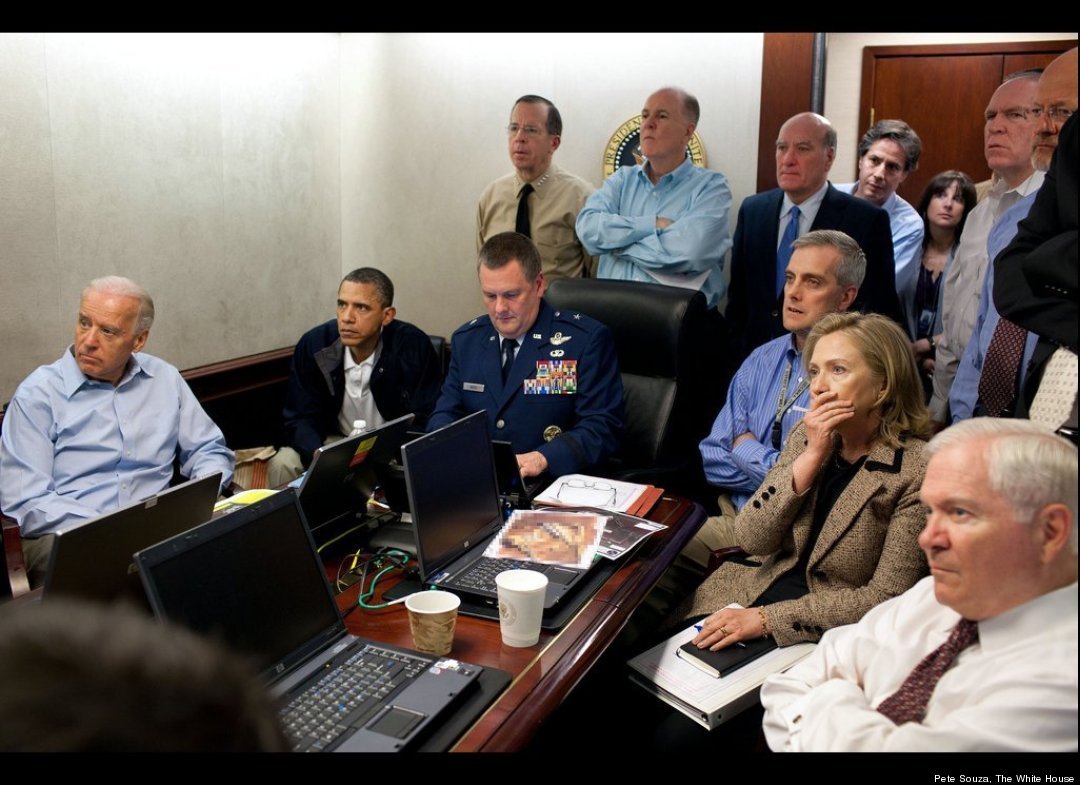
Still, it’s reasonable to imagine that when Morales's plane took off from Moscow there were top U.S. officials gathered in a situation room (à la the bin Laden affair), that the president was in the loop, and that the intelligence people said something like: we have an 85% certainty that Snowden is on that plane.  Obviously, the decision was made to bring it down and enough pressure was placed on key officials in those five countries to cause them to bow to Washington's will.

One can certainly imagine that, but know it?  At the moment, not a chance and, unlike in the raid that killed bin Laden, a triumphant situation-room photo hasn't been released, since there was, of course, no triumph.  Many questions arise.  Why, to mention just one, did Washington not allow Morales’s plane to land for refueling in Portugal, as originally planned, and simply strong-arm the Portuguese into searching it?  As with so much else, we don’t know.

We only know that, to bring five countries into line that way, the pressure from Washington (or its local representatives) must have been intense.  Put another way: key officials in those countries must have realized quickly that they stood in the way of a truly powerful urge by the planet's superpower to get one fugitive.  It was an urge so strong that it overrode any other tactical considerations, and so opened the way for Venezuela, Bolivia, and Nicaragua to offer asylum to Snowden with the support of much of the rest of Latin America.

Imagine for a moment that an American president’s plane had been brought down in a similar fashion.  Imagine that a consortium of nations pressured by, say, China or Russia, did it and that, with the president aboard, it was then searched for a Chinese or Soviet “dissident.”  Imagine the reaction here.  Imagine the shock.  Imagine the accusations of “illegality,” of "skyjacking," of “international terrorism.”  Imagine the 24/7 media coverage.  Imagine the information pouring out of Washington about what would no doubt have been termed "an act of war."

Of course, such a scenario is inconceivable on this one-way planet.  So instead, just think about the silence here over the Morales incident, the lack of coverage, the lack of reporting, the lack of outrage, the lack of shock, the lack of... well, just about anything at all.

Instead, the twenty-first-century version of deterrence theory ruled the day, even though Snowden is the proof that deterrence via manhunts, prosecution, imprisonment, and the like has proven ineffective when it comes to leaks.  It’s worth pointing out that what may be the two largest leaks of official documents in history -- Bradley Manning’s and Snowden’s -- happened in a country increasingly under the sway of deterrence theory.
Slouching Toward Washington to Be Born

And yet don’t think that no one has been affected, no one intimidated.  Consider, for instance, a superior piece of recent reporting by Eric Lichtblau of the New York Times.  His front-page story, “In Secret, Court Vastly Broadens Powers of NSA,” might once have sent shock waves through Washington and perhaps the country as well.  It did, after all, reveal how, in “more than a dozen classified rulings,” a secret FISA court, which oversees the American surveillance state, “has created a secret body of law” giving the NSA sweeping new powers.

Here’s the paragraph that should have had Americans jumping out of their skins (my italics added): “The 11-member Foreign Intelligence Surveillance Court, known as the FISA court, was once mostly focused on approving case-by-case wiretapping orders. But since major changes in legislation and greater judicial oversight of intelligence operations were instituted six years ago, it has quietly become almost a parallel Supreme Court, serving as the ultimate arbiter on surveillance issues and delivering opinions that will most likely shape intelligence practices for years to come, the officials said.”

At most moments in American history, the revelation that such a secret court, which never turns down government requests, is making law “almost” at the level of the Supreme Court would surely have caused an outcry in Congress and elsewhere.  However, there was none, a sign either of how powerful and intimidating the secret world has become or of how much Congress and the rest of Washington have already been absorbed into it.

No less strikingly -- and again, we know so little that it’s necessary to read between the lines -- Lichtblau indicates that more than six “current and former national security officials,” perhaps disturbed by the expanding powers of the FISA court, discussed its classified rulings "on the condition of anonymity.”  Assumedly, at least one of them (or someone else) leaked the classified information about that court to him.

Fittingly enough, Lichtblau wrote a remarkably anonymous piece.  Given that sources no longer have any assurance that phone and email records aren’t being or won't be monitored, we have no idea how these shadowy figures got in touch with him or vice versa.  All we know is that, even when shining a powerful light into the darkness of the surveillance universe, American journalism now finds itself plunging into the shadows as well.

What both the Morales incident and the Lichtblau article tell us, and what we’ve barely taken in, is how our American world is changing.  In the Cold War years, faced with a MAD world, both superpowers ventured “into the shadows” to duke it out in their global struggle.  As in so many wars, sooner or later the methods used in distant lands came home to haunt us.  In the twenty-first century, without another major power in sight, the remaining superpower has made those “shadows” its own in a big way.  Just beyond the view of the rest of us, it began recreating its famed tripartite, checks-and-balances government, now more than two centuries old, in a new form.  There, in those shadows, the executive, judicial, and legislative branches began to meld into a unicameral shadow government, part of a new architecture of control that has nothing to do with “of the people, by the people, for the people.”

Such a shadow government placing its trust in secret courts and the large-scale surveillance of populations, its own included, while pursuing its secret desires globally was just the sort of thing that the country’s founding fathers feared.  In the end, it hardly matters under what label -- including American “safety” and “security” -- such a governing power is built; sooner or later, the architecture will determine the acts, and it will become more tyrannical at home and more extreme abroad.  Welcome to the world of the single rogue superpower, and thank your lucky stars that Edward Snowden made the choices he did.

It’s eerie that some aspects of the totalitarian governments that went down for the count in the twentieth century are now being recreated in those shadows.  There, an increasingly “totalistic” if not yet totalitarian beast, its hour come round at last, is slouching toward Washington to be born, while those who cared to shine a little light on the birth process are in jail or being hounded across this planet.

We have now experienced deterrence theory in two centuries.  Once it was brought to bear to stop the wholesale destruction of the planet; once -- and they do say that if the first time is tragedy, the second is farce -- to deter a small number of whistleblowers from revealing the innards of our new global security state.  We came close enough to total tragedy once.  If only we could be assured that the second time around it would indeed be total farce, but at the moment, as far as I can tell, no one’s laughing.

Tom Engelhardt, co-founder of the American Empire Project and author of The United States of Fear as well as a history of the Cold War, The End of Victory Culture (just published in a Kindle edition), runs the Nation Institute's TomDispatch.com. His latest book, co-authored with Nick Turse, is Terminator Planet: The First History of Drone Warfare, 2001-2050.

[Note: Special thanks go to Irena Gross who sparked my thinking about American "dissidents" and this prison planet of ours.]