Showing posts with label TTIP. Show all posts

Thursday, 20 April 2017

Is Trump about to flip-flop on "trade deals"

Is Trump About To Flip Again: Ryan Says "TTIP Good For Global Order"

19 April, 2017


From Obamacare to NATO, and from Ex-Im Bank to Chinese currency manipulators, President Trump has shown he is comfortable changing his mind 'bigly'. Today's exuberant support for "TTIP as good for global order," from Speaker Ryan, following VP Pence's meetings in Japan, raises questions about whether Trump's executive order withdrawing from the Trans-Pacific Partnership (TPP) free trade agreement is the next big flip-flop.

During his presidential campaign, Trump often criticized the TPP agreement and called it a "terrible deal," which is harmful for US workers. On January 23, Donald Trump signed an executive order withdrawing the United States from the Trans-Pacific Partnership (TPP) free trade agreement and promised to renegotiate the North American Free Trade Agreement (NAFTA). The Trump administration was expected to at least delay talks on the TTIP deal, according to media reports.
And then today,. Speaker Ryan, according to Bloomberg News noted that "TTIP was good for global order," adding...


We are more determined than ever to lead. We don't want China to write the rules of the 21st century global economy. We want to do that. We want a level playing field for our businesses. And yes, we want free trade deals, but they have to be smart trade deals. They need to help workers and raise wages. They need to create high-paying, sustainable jobs. The good news is that these are exactly the type of jobs you get from smart free trade agreements. And we must continue to sharpen tools to combat unfair trade practices.
 
Now that Article 50 has been invoked, the UK and EU will determine the best path forward over the course of negotiations. We want the parties to come together and strike a lasting agreement. A strong UK-EU relationship is in all of our best interests.
 
In that same vein, the United States will continue to work closely with our EU friends, and chart a path forward on TTIP negotiations.

And while it's a jump from the Transatlantic Trade and Investment Partnership (TTIP) to the Trans-Pacific Partnership (TPP), as one analyst notes, given his recent backtracking, it's not beyond the realms of possibility...


"Whoever thought that Trump would let China, a rival, off the hook on currency? If he can do that with a country that's clearly not a friend, maybe he could reconsider reversing himself on TPP for a friend like Japan," Sean King, senior vice president of Park Strategies, told CNBC on Tuesday.

Japan was set to be a major beneficiary of TPP, particularly the country's auto sector that would have obtained cheaper access to U.S. markets. Tokyo, which has long lamented the trade pact would be "meaningless" without the U.S., has decided to forge ahead with the other remaining 10 participating nations to revive the deal but many are doubtful of whether the TPP will be a game-changer in Washington's absence.

Trade topped the agenda when Vice President Mike Pence holds talks with Japanese Deputy Prime Minister Taro Aso in Tokyo yesterday as part of a 10-day Asia tour. Pence focused on the prospect of a U.S.-Japan free trade agreement (FTA)."We [the U.S.] are trying to offer them a poor man's TPP with this FTA idea, but I don't think Japan has any interest in pursuing that. They want to stick with ideas and principles that were hammered out in TPP," said King, specifically referring to intellectual property rights as well as market access.
 
"I think Taro Aso is just going to hear out Pence to be nice to Trump...I don't expect much to come out of these talks, it's going to be a bunch of niceties but no real deliverables."
Trump still has time to change his mind on TPP, King warned, noting that the treaty text remains valid until February 2018.


"Trump said [TPP] was a disaster, but I'm sure the other members would be willing to make concessions to get the U.S. back in, just like South Korea was willing to make concessions to Obama for his endorsement of the U.S.-Korea [free trade agreement]," King said.
 
"He's certainly made greater reversals and claimed victory. Why not do this for our friends who want to stand with us against countries like China and North Korea? I'm all for it."
We can only imagine the reaction in the rust-belt, after being told how distastrous TPP would be for US jobs, if Trump were to spin on this topic too.

Wednesday, 11 May 2016

Testimony to the end of democracy in Europe

WATCH THIS WHILE YOU STILL CAN!!

This may well be disppeared from You Tube – I hope it will be copied many times!!

Here is more information on MEP Luke 'Ming' Flanagan


His Facebook page is HERE


Here is his message on Facebook: 

"The European Parliament have now requested that I remove the 'TTIP reading room farce' video from Facebook. 

"The basis for the request is that a member of Bernd Langes staff is identified. 


"The same staff that are already identified on the European Parliament website! 

"Please share, but be careful"


Caught On Tape: This Is What Happened When An MEP Tried To Read The TTIP Text


10 May, 2016


TTIP is just one of several phony “trade” deals written by corporate lawyers and lobbyists, and negotiated in secret between the Obama administration and various world leaders. This particular scam involves the U.S. and Europe, and it has seen increased public resistance and attention as of late, something I highlighted in the post, Leaked Documents Expose the TTIP Trade Deal as a Subversive Imperial Scam.

Now watch what happened when a MEP (member of European parliament) tried to read the thing. It’s very blurry, but you’ll get the point.


Democracy this is not

Noam Chomsky recently summarized the true purpose of these so-called “trade” deals eloquently in the following paragraph:


In the contemporary global order, the institutions of the masters hold enormous power, not only in the international arena but also within their home states, on which they rely to protect their power and to provide economic support by a wide variety of means. When we consider the role of the masters of mankind, we turn to such state policy priorities of the moment as the Trans-Pacific Partnership, one of the investor-rights agreements mislabeled “free-trade agreements” in propaganda and commentary. They are negotiated in secret, apart from the hundreds of corporate lawyers and lobbyists writing the crucial details. The intention is to have them adopted in good Stalinist style with “fast track” procedures designed to block discussion and allow only the choice of yes or no (hence yes). The designers regularly do quite well, not surprisingly. People are incidental, with the consequences one might anticipate.

Thanks for playin’ everyone.


Sunday, 20 March 2016

The Transatlantic Trade and Investment Partnership (TTIP)


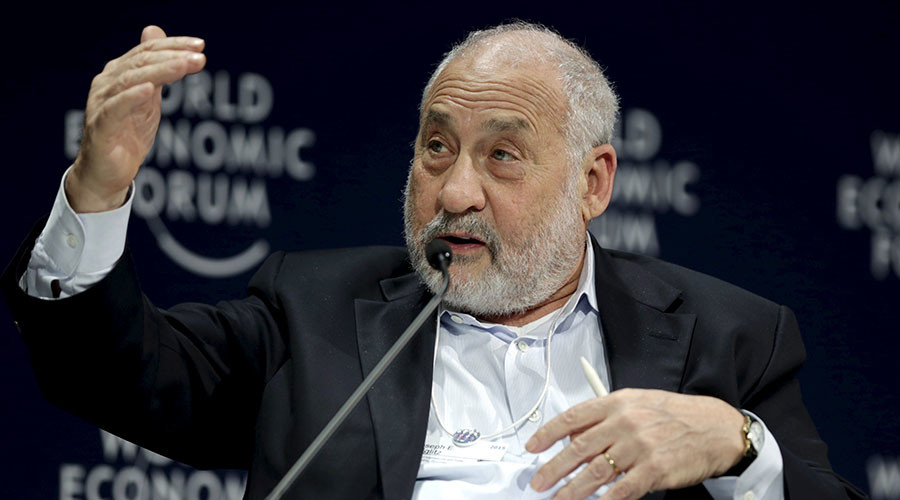
Brexit better for Britain than toxic TTIP, says Joseph Stiglitz

Joseph Stiglitz, Nobel Prize for Economics and Professor School of International and Public Affairs (SIPA), Columbia University. © Victor Ruiz Garcia

RT,
3 March, 2016


Britain would be better off leaving the European Union (EU) if the Transatlantic Trade and Investment Partnership (TTIP) is implemented, Nobel-prize winning economist Joseph Stiglitz has said.

Stiglitz made the remark at an event hosted by Labour Shadow Chancellor John McDonnell on Wednesday in central London. The evening was part of the Labour Party’s series of seminars on progressive economics.

Addressing the crowd, Stiglitz said the restrictive nature of TTIP offers grounds for a Brexit.

“I think that the strictures imposed by TTIP would be sufficiently averse to the functioning of government that it would make me think over again about whether membership of the EU was a good idea,” he said.


The US economist said TTIP represents a wholesale “rewriting of the rules with no public discussion.”

“The dangers to our society are very significant,” he added.

Eroded sovereignty

TTIP will create the world’s biggest free-trade zone, scrapping tariffs and other obstacles to the trade of goods and services. While its proponents argue the trade deal will encourage investment and create employment, its critics warn it will empower corporations to sue foreign governments that threaten their profits.

Central to the US-EU trade deal, is an Investor State Dispute Settlement (ISDS) clause that would give corporations the power to sue governments when policy-makers introduce regulations that could curb their profits. Details of such cases are often shrouded in secrecy, conducted in clandestine court settings.

Critics argue TTIP lacks transparency, impinges on sovereign governments’ right to rule in the public interest, and could result in regulators becoming captured.


United Nations (UN) figures reveal that US firms have raked in billions of dollars by suing domestic governments to date. Since 2000 alone, American firms have sued states on 130 separate occasions under free-trade agreements.

One such firm, Phillip Morris, sued Australia and Uruguay in recent years for placing health warnings on cigarette packets.

“Every time you passed a regulation against asbestos or anything else, you would be sued,” Stiglitz said.

“There’s nothing in TTIP to stop you writing the regulation. You can write the regulation. You would just have to keep writing a check to Philip Morris to make up for the profits that they would have had if they were able to kill people like they were able to in the past.”

Stiglitz was largely supportive of Britain’s EU membership, highlighting EU states such as Sweden that are part of the bloc but have agreed on separate rules. He argued EU leaders should scrap the euro but keep the union.

‘Ruthless deal’

Speaking to RT, director of UK think tank Global Justice Now (GJN) Nick Dearden said Stiglitz’s position is “largely hypothetical.”

“There’s no doubt that this toxic trade deal being cooked up in Brussels is driving a lot of people to feel that the UK would be better off outside of the EU, but there’s nothing to suggest that a Brexit wouldn’t prevent something worse taking its place,” he said.

“Cameron has been one of the biggest cheerleaders of TTIP and the UK has signed a host of ruthlessly free-market bilateral trade deals with many other countries that contain ISDS – so it’s entirely possible that there would be a push in the UK to create an even worse UK-USA equivalent of TTIP.”


Dearden said Europe’s anti-TTIP movement is inspiring.

“Millions of people have mobilized across borders to challenge the corporate power grab of TTIP,” he said.

“That’s an inspiring vision of how staying in Europe can mean people working together for progressive social change.”

‘TTIP counters public interest’

A leading aim of TTIP is to open up Europe’s public health, education and water services. Although the European Commission (EC) has said public services will be excluded from TTIP, UK Trade Minister Lord Livingston admitted that talks concerning the NHS were still on the agenda last October.

Campaigners are concerned about TTIP’s “regulatory convergence” agenda, which will seek to bring EU standards on food safety closer to those seen in the US.

Because US regulations are generally less rigid than their European counterparts, campaigners are worried about a decline in food standards across Europe. They argue European food markets could be flooded with genetically modified products and foods doused in hormones and pesticides after TTIP is implemented.


As TTIP negotiations continue to play out behind closed doors, the City of London is thought to be lobbying for US banking regulations to be softened. America’s financial regulations are more robust than those seen in Britain, and were put in place in the wake of the 2007/08 global financial crisis. Ethical finance campaigners fear TTIP will scrap these measures and restrictions, handing power back to bankers in the process.

Campaigners are also worried about rising levels of unemployment. Last year, Brussels admitted that TTIP could cause considerable levels of joblessness. It has advised EU members on how to deal with increased levels of unemployment after TTIP comes into force.

Meanwhile the following is making headlines in Britain


The Queen refuses to come to London to meet President Barack Obama next month.

Instead, accompanied by his security circus, he’ll trundle to Windsor in his bomb-proof, seven-ton limo for lunch.

He’s due to stand alongside the PM and urge Britain to stay in the EU.

‘But he’d be well advised not to give a pro-EU sermon over lunch after the row about the Queen supporting Brexit,’ says my source.


Thursday, 4 February 2016

The battle against TTIP in Europe

This on the day when the NZ government signs the nation’s sovereignty away

Investment Court Has 'No Legal Basis' in TTIP - German Magistrates Union


3 February, 2016

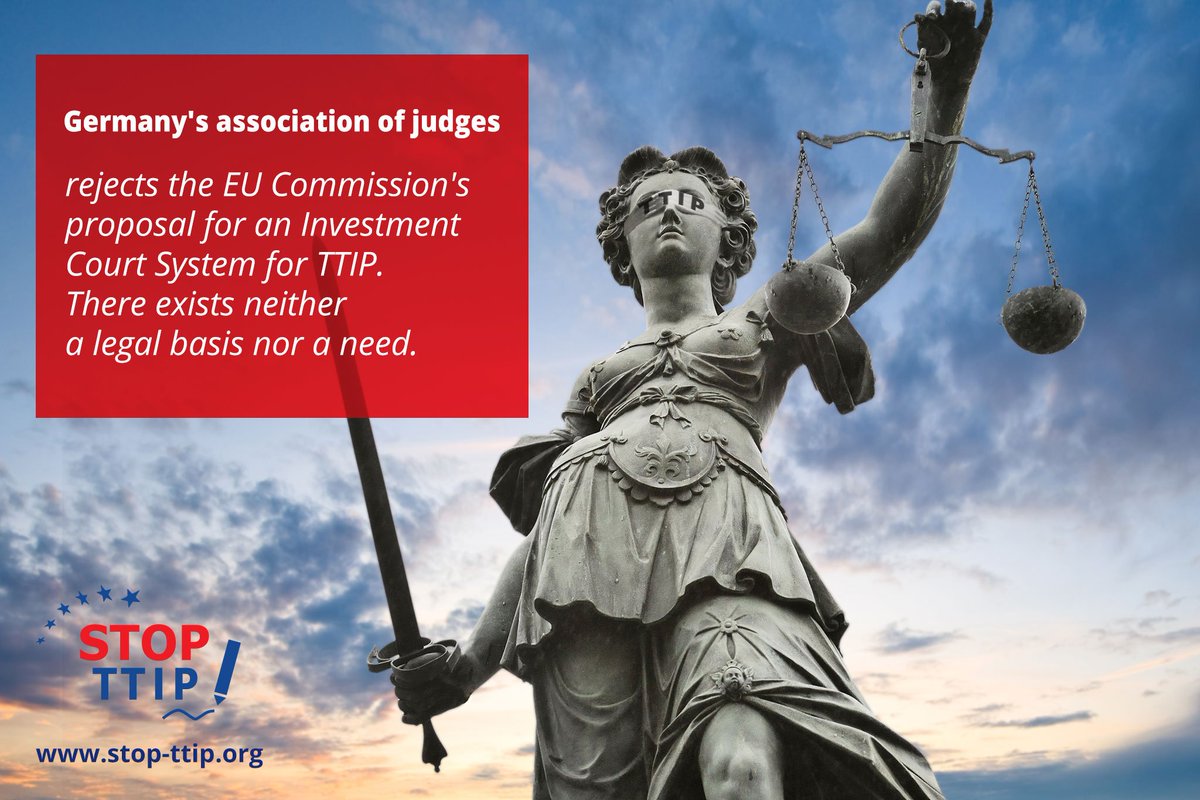
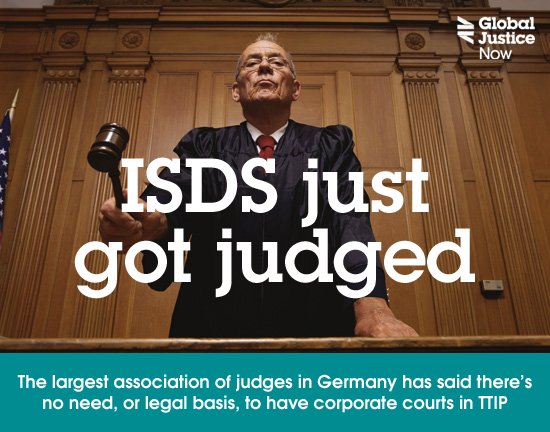
Highly controversial plans to allow multinational corporations to sue governments in the proposed TTIP trade deal have been dealt a huge blow, with Germany's largest association of judges and public prosecutors saying there was "neither a legal basis nor a need" for such measures to be introduced.


The German Magistrates Association (DRB) rejected the European Commission's 'Investment Court System' proposal, which would grant multinational corporations the right to sue national governments if they were deemed to have inhibited the investment opportunities of private companies.
Germany's Association of Judges says 's corporate courts in is the wrong way-


Embedded image permalink
The European Commission tabled the investment court system (ICS) plans as a compromise, following widespread opposition to the previously proposed Investor State Dispute Settlement (ISDS) mechanism.
ICS: 'Lacks Factual Bassi'

Chief among the DRB's concerns is the legal basis for such an investor court and whether it is actually needed in the TTIP, which is being negotiated by the EU and the US.
"The clearly implied assumption in the proposal for an International Investment Court, that the courts of the EU Member States fail to grant foreign investors effective judicial protection, lacks factual basis," the DRB said.

Largest association of judges in Germanycome out against in , stating that “neither is there a legal basis nor the necessity”.
12:36 AM - 4 Feb 2016

The magistrates association argued that any concerns or perceived weaknesses over the legal protection offered in the legal systems of member states should have been previously raised during TTIP negotiations, so the issues could have been look at internally.
"Only in this way can the full legal rights to which any law-seeking party in Germany and the European Union is entitled, be guaranteed. The creation of special courts for certain groups of litigants is the wrong way forward."
The judges also raised concerns over the court's impact on the sovereignty of TTIP signature states, questioning whether "the European Union has the competence to institute an investment court."
"An ICS would not only limit the legislative powers of the Union and the Member States; it would also alter the established court system within the Member States and the European Union. In the opinion of the German Magistrates Association, there is no legal basis for such a change by the Union."
Concerns Over Independence of Courts

The DRB also echoed the sentiment of campaigners who have raised concerns over the objectivity of the proposed investment court and whether they would meet international legal standards.
German judges have dealt a serious blow to proposal of having 'corporate courts' in


Embedded image permalink
"Neither the proposed procedure for the appointment of judges of the ICS nor their position meet the international requirements for the independence of courts. As such, the ICS emerges not as an international court, but rather as a permanent court of arbitration," the association said.
In a statement sent to Sputnik, Nick Dearden, director of UK-based anti-TTIP campaigners Global Justice Now, said the DRB's criticism justifies his group's ongoing campaigning against investment court procedures being included in trade deals like TTIP.
"This statement by German judges completely supports what campaigners have been saying: the Commission's 'compromise' proposal is actually about trying to legitimize the handing of special legal privilege to big business. It's not about making things fairer, but trying to buy off opposition. It's an assault on the sovereignty of Britain and the EU.
"But the statement proves the Commission has failed — in fact they have simply garnered new opposition. After this disastrous attempt to get themselves out of a deeper hole, we urge the Commission once again to drop their plans for this toxic trade agreement and drop TTIP altogether."