Showing posts with label Straits of Hormuz. Show all posts

Wednesday, 29 May 2019

Iran: Bolton ratchets up the tension


Bolton claims Iran 'almost certainly' behind attack on ships off UAE

Bolton claims Iran 'almost certainly' behind attack on ships off UAE
RT,
29 May, 2019

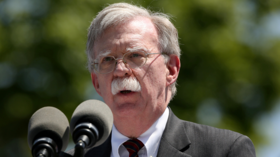
Tehran is 'most likely' responsible for sabotaging oil tankers off the coast of the United Arab Emirates two weeks ago, National Security Advisor John Bolton has alleged. He did not provide evidence to support the accusation

Bolton claimed on Wednesday that Iran was “almost certainly” behind an attack that targeted four oil tankers off the coast of Fujairah.

Speaking to journalists at a press briefing in the Emirati capital of Abu Dhabi, Bolton also alleged that Iran was behind a failed attack on the Saudi oil-port of Yanbu. Iran used “navel mines” to carry out the attack on the oil tankers, Bolton said, without providing evidence to back up his claims.

The accusations come just days after the Pentagon blamed Iran’s Revolutionary Guards for the attack.
As US ramps up military force, Iran shows leadership with regional diplomacy
Tensions between the US and Iran are on the rise after Tehran announced that it would defy US sanctions by selling its oil on the “grey market.” In response, the US sent a strike group to the Persian Gulf, describing the deployment as a “message” to Iran.

https://www.rt.com/op-ed/460447-iran-diplomacy-us-tensions/

Saturday, 23 February 2019

Iran carries out naval drills encompassing the Strait of Hormuz


Iran Navy Begins "Massive Drill" Stretching Across World's Key Oil Chokepoints


22 February, 2019

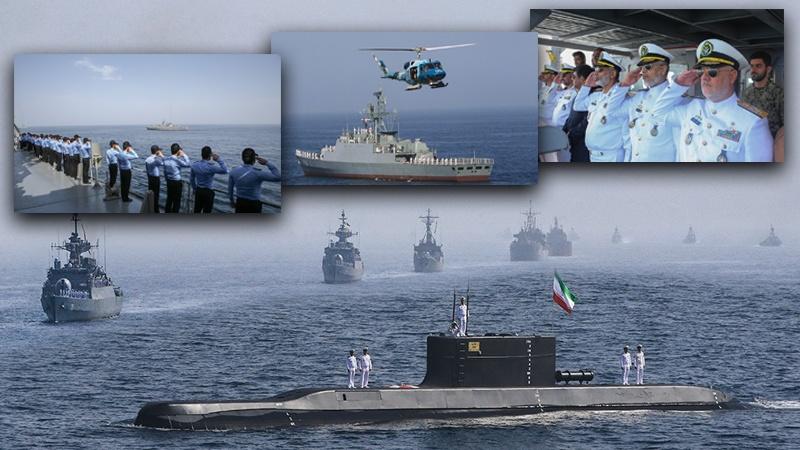
Iran's navy has begun a three day war game exercise on Friday in the Persian Gulf, in an expansive area encompassing Strait of Hormuz in the Persian Gulf, to the Sea of Oman and even stretching to northern parts of the Indian Ocean, state media reports. Some reports indicate the games could go on for as much as a week, but all emphasized the "large-scale" nature of the drills in which Iran's navy will showcase the Fateh-class submarine — a domestically built sub carrying cruise missiles and torpedoes, as well as its Sahand destroyer.

The cruise missile-firing capable Fateh, or "Conqueror", was launched for the first time at the start of this week and has been touted as "state-of-the-art" and with the ability to stay underwater for five weeks at a time. Crucially, the large exercises come after last week's US-sponsored Warsaw conference in which both Israeli and US officials made threats of war with Tehran. Indeed during the conference Israeli PM Benjamin Netanyahu openly stated that he was attending the summit with an aim to "advance the common interest of war with Iran."

Iran state media montage from the first day of the military games. 

The games also come at a time when even foreign policy establishment insiders, such as the Council on Foreign Relation's Steven Cook, increasingly acknowledge that the White House's "march to war against Iran" is now "echoing the drumbeats" of the lead up to the 2003 Iraq invasion.

Writing in Foreign Policy, Cook warns
Taken together—the Warsaw conference, Pence’s bullying of the Europeans, Bolton’s threatening video, and the broader background noise in Washington—the events of the past week were familiar in a foreboding way. The chatter about Iran has not become the war fever that gripped Washington in 2002 over Iraq, but the echoes of that year are not hard to miss in the Trump administration’s effort to shape the domestic and international debate about Iran.
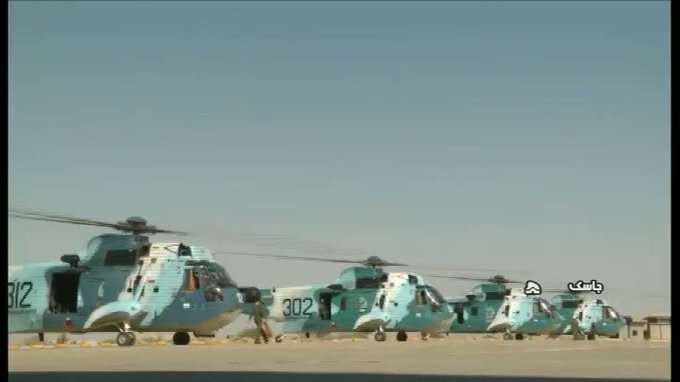
Iran's drills in the coming days will further involve battleship exercises and amphibious and anti-amphibious warfare maneuvers, according to Iranian military statements. 


: Navy is now testing its new weapons including new Fateh-Class submarine during exercise "Velayat-97" in Oman Sea close to territorial waters. First stage of the exercise is a counter-amphibious assault operation for protecting the shores of .

41 people are talking about this
Though there's general agreement that Iran's navy poses no match of US superiority on the sea and in the skies, Iran seeks to be a significant disruptor of American Persian Gulf capabilities. 

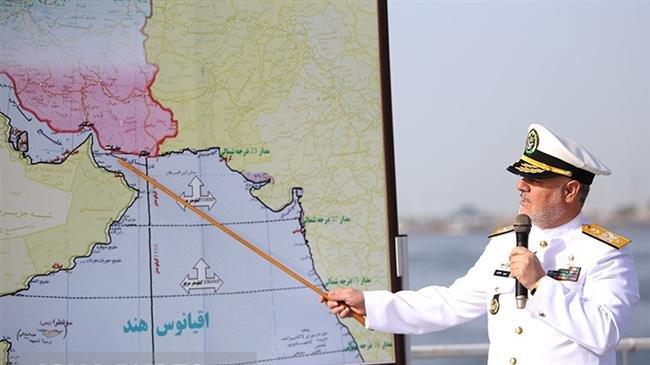
Rear Admiral Hossein Khanzadi, commander of Iran's navy, reflected this in comments announcing the inauguration of the games: "For the first time, these weapons will be tested seriously and we can make the maritime region unsafe for the enemy in any way possible," he said. He said the games, formally called "Velayat 97," will begin 2km from the Strait of Hormuz and extend 10 degrees north of the Indian Ocean, in an extended zone some analysts worry may indicate broader intentions regarding Oman and Yemen

Iranian Navy Commander Rear Admiral Hossein Khanzad describing the extent of the "Velayat 97" games.

As the Jerusalem Post summarizes of this concern, "In Yemen Iran has supported the Houthi rebels who have used Iranian technology to target Saudi Arabia with ballistic missiles." And recently, "In addition Oman enjoys decent relations with Iran but Oman also hosted Prime Minister Benjamin Netanyahu last year and has sought to play a role in the Israel-Palestinian peace efforts."


In the past, Iranian war games have resulted in close encounters with US warships traversing parts of the Persian Gulf. But this somewhat "routine" occurrence could potentially spark a major incident considering the high level of aggressive rhetoric coming out of Washington at this time. 

Wednesday, 5 December 2018

Rouhani threatens to close the Strait of Hormuz,


Iran Again Threatens To Block Key Oil Transit Choke Point As U.S. Aircraft Carrier En Route


4 December, 2018


Here we go again: Iranian President Hassan Rouhani has once more threatened to close the Strait of Hormuz, which is vital to up to one-third of all global oil shipping as it's a key transit choke point in the Persian Gulf. 

On Tuesday Iranian state broadcasts carried his words, saying if someday, the United States decides to block Iran’s oil (exports), no oil will be exported from the Persian Gulf.” He further vowed that the United States will not be able to prevent Iran from exporting its crude — something the White House has repeatedly pledged to take down to zero exports through international allies and economic blockade through sanctions. 

 
A prior Iranian Navy drill off the Strait of Hormuz, RFE/RL

The threat comes less than 24 hours after US officials told the Wall Street Journal that an aircraft carrier group led by the USS John C. Stennis is set to arrive in the Persian Gulf "within days" — which will bring a close what's been described as the longest period in two decades that a carrier group was absent from the region. Specifically the unnamed officials identified the purpose as to "exhibit a show of force against Iran".

The carrier deployment, though previously scheduled, was announced after the US condemned Iran's test firing a medium-range nuclear capable ballistic missile on Sunday.
The United States should know that we are selling oil and we will sell our oil and it cannot block Iran’s oil export,” he said on Tuesday addressing the people of Shahroud in Semnan province broadcast live on state TV. 
The United States and the Israeli regime cannot stand the idea of a powerful and dignified Iran, and the Iranian nation will not bow to them, Rouhani highlighted, adding, “the United States failed in launching a coup in our country. They were after separating Khuzestan province, imposing sanctions against the country, and undermining Iran’s power, but they failed. It should be studied why the US is angry with Iran and Iranians.” MEHR News Agency

Though it's not the first time such a threat was made, tensions have never been higher as less than a day prior Israeli Prime Minister Benjamin Netanyahu met with Secretary of State Mike Pompeo in Brussels to discuss ways to halt together Iranian aggression in the region”. Hours after the meeting the Israeli Defense Forces launched 'Operation Northern Shield' along the Lebanese border to “expose and thwart” what officials have dubbed "terror tunnels" stretching from Lebanon into northern Israel 

According to the AP, President Rouhani's threat was welcomed by hardline clerics and military officials, including Gen. Qassem Soleimani, the commander of the Revolutionary Guard’s elite Quds Force.
USS John C. Stennis nuclear-powered aircraft carrier, via Defence Blog


In early November, for example, a prominent hardline cleric told a Friday prayer gathering in Mashhad, considered Iran's spiritual capital, that Iran has the power to "instantly" create conditions for $400 a barrel oil prices if it decides to act in the Persian Gulf. 

Shia cleric Ayatollah Ahmad Alamolhoda grabbed headlines at the time by declaring, "If Iran decides, a single drop of this region's oil will not be exported and in 90 minutes all Persian Gulf countries will be destroyed."

 
And during the prior summer, after similar threats were issued from Tehran the spokesman for the US military's Central Command, Captain Bill Urban, told the Associated Press that US sailors and its regional allies "stand ready to ensure the freedom of navigation and the free flow of commerce wherever international law allows".

It appears the presence of the USS John C. Stennis is aimed at preventing such a possibility of Iran blocking the Strait of Hormuz from happening. Officials also said the carrier group will support the US war in Afghanistan as well as operations against remnant ISIS pockets in Iraq and Syria. But despite current tensions with Iran, Pentagon officials have underscored that the carrier mission was previously scheduled, while also touting its Iranian deterrent mission. 
 

In recent comments over Iran's developing ballistic missile program, the State Department's special representative on Iran, Brian Hook, said the "military option" is on the table

We have been very clear with the Iranian regime that we will not hesitate to use military force when our interests are threatened. I think they understand that. I think they understand that very clearly,” Hook said late last week.
   
I think right now, while we have the military option on the table, our preference is to use all of the tools that are at our disposal diplomatically,” he added.


Monday, 14 January 2013

Iranian military maneuvers in Straits of Hormuz


Iran stages ‘modern warfare’ drill in Strait of Hormuz


File photo shows Iranian Navy boats taking part in maneuvers near Strait of Hormuz. (Reuters)
RT,
13 January, 2013

Iran claims its capability to defend itself is growing and the Islamic republic is “prepared for any threat”. The statement follows tests of “modern warfare” capabilities and exercises to hone battle tactics in the strategic Strait of Hormuz.

The naval force of Iran's Islamic Revolutionary Guard Corps (IRGC), which is in charge of maintaining security in the Persian Gulf area, held exercises near the port city of Bandar Abbas, which holds a strategic position on the Strait of Hormuz. The main aim was to boost its forces combat readiness, familiarize them with the latest drills, and increase their response time.

The drills also tested well-timed responses to natural and manmade disasters, and allowed IRGC forces to operate new weapons, Iranian Press TV reported. 

Our present capabilities are incomparable to the past. Today, our youth, banking on the past experiences and modern science, have managed to show their capabilities to the world and be prepared for any threat,” IRGC Navy Commander Rear-Admiral Reza Torabi was quoted as saying.

This was the fifth such tactical exercise held by Tehran, however nothing was officially said about the previous tests. 

Over the past few years, Iran has held several military drills to enhance the defensive capabilities of its armed forces and to test modern military tactics and equipment.


One of the latest tests took place in December 2012, when Iran’s Navy held a six-day naval drill aimed to show "the armed forces' military capabilities" in confronting enemy threats. 

The maneuver also took place in the Strait of Hormuz, a key shipping route that accounts for more than a third of the world's seaborne oil exports, and involved testing warships, submarines, jet fighters and hovercrafts.

Iran has been constantly upgrading its military capabilities lately. In recent years, Iran declared it had made great achievements in the defense sector and attained self-sufficiency in essential military equipment and systems. The country produces its own tanks, self-propelled guns and multiple rocket launchers. This September, Iran's navy announced the launch of the overhauled super-heavy Tareq 901 submarine. Iran is also actively engaged in missile development. Its Shahab-3 long-range ballistic rocket has a range of 5,000km – meaning it could reach Israel and all US military bases in the Persian Gulf.


Wednesday, 26 December 2012

Naval drills in Straits of Hormuz


Iran Launches Week-Long Straits Of Hormuz Naval Drill On Friday, Next To US Aircraft Carrier


25 December, 2012


With the market still hopeful of some deus ex resolution to the Fiscal Cliff will take place in the last few trading sessions of the year (one where the market itself will not have to be the catalyst for such a resolution, because once the selling starts in earnest, who knows if and when it stops, hence the loading up on prodigious amounts of puts), here is Iran out of left field, adding yet another known unknown to the inequality, announcing that it will begin six days of naval drills in the Straits of Hormuz on Friday. In other words a one year flashback deja vu, as Iran held a similar 10-day drill last December, when everyone was expecting an imminent escalation out of the endless Israel-Iran foreplay and was analyzing which were the new moon days allowing Israel unobstructed access to the greatest distraction of all - Iran's nuclear facility being moved under a mountain: a catalyst which Israel repeatedly said is the only reason to attack a weaponizing, nuclear Iran, and which took place some time in 2012. Now that the official window of opportunity is closed, will Israel tone back on the aggressive rhetoric? Hardly: after all that is precisely why the Syrian "outlet valve" has been put in play over the past 6 months.

From Reuters:


Iran will begin six days of naval drills in the Strait of Hormuz at the end of this week, an Iranian naval commander said on Tuesday, an exercise meant to showcase its military capabilities in what is a vital oil and gas shipping route.
 
The "Velayat 91" drills will be held from Friday to Wednesday across an area of about 1 million square kilometres in the Strait of Hormuz, the Gulf of Oman and northern parts of the Indian Ocean, said Habibollah Sayyari, according to Iranian media.
 
Iranian officials have often said that Iran could block the strait - through which 40 percent of the world's sea-borne oil exports pass - if it came under military attack over its disputed nuclear programme.
 
Sayyari was quoted as saying the new drill would test the navy's missile systems, combat ships, submarines and patrol and reconnaissance methods.
 
"In this exercise we will use the navy's newest weapons and tactics," Sayyari said. "Certainly we will observe the marine borders of neighbouring states and will carry out our exercises according to international laws and regulations."
 
A heavy Western naval presence in the Gulf is meant to deter any attempt to block the waterway.


And making sure there is no chance of escalation, the aircraft carrier Stennis, CVN-74, as shown in the US naval update map courtesy of Stratfor will be right there, quietly watching every move of the Iranian navy, often times smack in the middle of the drills.


And just to get the blood really going, Iran media has reported that there has been another Stuxnet-based attempt to cripple Iranian infrastructure. As a reminder, Stuxnet is the computer "virus" which crippled the Iranian nuclear power plant and set back the project by months. Via AP:


An Iranian semi-official news agency says there has been another cyberattack by the sophisticated computer worm Stuxnet, this time on the industries in the country's south.
 
Tuesday's report by ISNA quotes provincial civil defense chief Ali Akbar Akhavan as saying the virus targeted a power plant and some other industries in Hormozgan province in recent months. Akhavan says Iranian computer experts were able to "successfully stop" the worm.
 
Iran has repeatedly claimed defusing cyber worms and malware, including Stuxnet and Flame viruses that targeted the vital oil sector, which provides 80 percent of the country's foreign revenue.
 
Tehran has said both worms are part of a secret U.S.-Israeli program that seeks to destabilize Iran's nuclear program. The West suspects Iran is pursuing a nuclear weapons program, a charge Tehran denies.

Has the time come for perfectly inexplicable bid-hitting attacks (thanks BIS) to start targeting the Brent complex just as geopolitical tensions threaten to push it far higher once more?  The good news is that at least silver may be allowed to crawl out above $30 now that central banks are certain to not pump about $2 trillion in 2013. Oh wait...