I
was caught in a twitterstorm of hatred yesterday, much of it led by
mainstream media journalists like David Aaronovitch and Dan Hodges,
for daring to suggest that the basic elements of Boshirov and
Petrov’s story do in fact stack up. What became very plain quite
quickly was that none of these people had any grasp of the detail of
the suspects’ full
twenty minute interview,
but had just seen the short clips or quotes as presented by British
corporate and state media.
As
I explained in my last post, what first gave me some sympathy for the
Russians’ story and drew me to look at it closer, was the raft of
social media claims that there was no snow in Salisbury that weekend
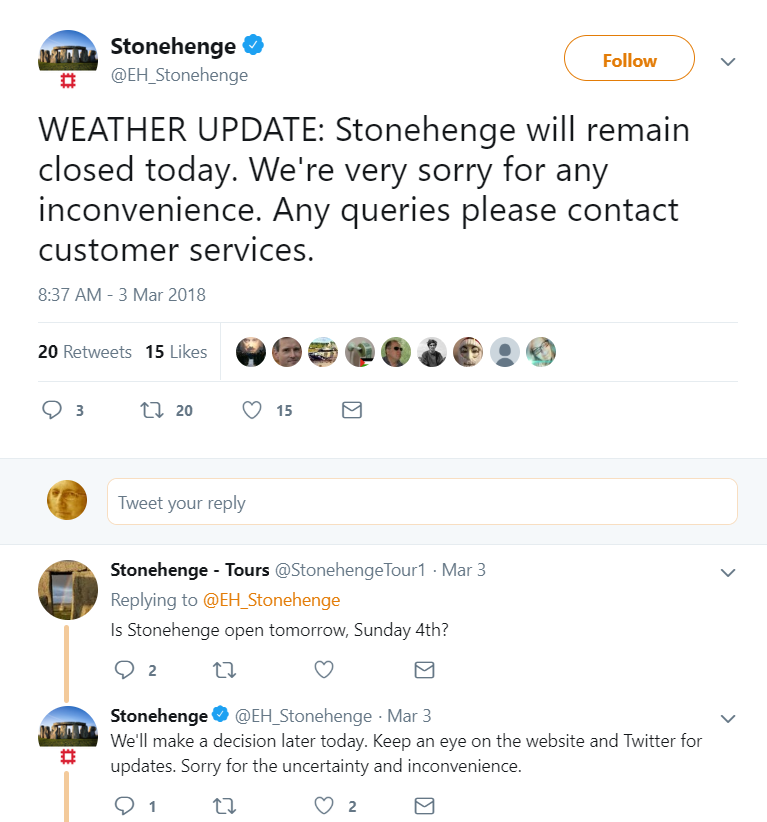
and Stonehenge had not been closed. In fact, Stonehenge was indeed
closed on 3 March by heavy snow, as confirmed by English Heritage. So
the story that they came to Salisbury on 3 March but could not go to
Stonehenge because of heavy snow did stand up, contrary to almost the
entire twittersphere.
Once
there was some pushback of truth about this on social media, people
started triumphantly posting the CCTV images from 4 March to prove
that there was no snow lying in Central Salisbury on 4 March. But
nobody ever said there was snow on 4 March – in fact Borisov and
Petrov specifically stated that they learnt there was a thaw so they
went back. However when they got there, they encountered heavy sleet
and got drenched through. That accords precisely with the
photographic evidence in which they are plainly drenched through.
Another
extraordinary meme that causes hilarity on twitter is that Russians
might be deterred by snow or cold weather.
Well,
Russians are human beings just like us. They cope with cold weather
at home because they have the right clothes. Boshirov and Petrov
refer continually in the interview to cold, wet feet and again this
is borne out by the photographic evidence – they were wearing
sneakers unsuitable to the freak weather conditions that were
prevalent in Salisbury on 3 and 4 March. They are indeed soaked
through in the pictures, just as they said in the interview.
Russians
are no more immune to cold and wet than you are.
Twitter
is replete with claims that they were strange tourists, to be
visiting a housing estate. No evidence has been produced anywhere
that shows them on any housing estate. They were seen on CCTV camera
walking up the A36 by the Shell station, some 400 yards from the
Skripals’ house, which would require three turnings to get to that
– turnings nobody saw them take (and they were on the wrong side of
the road for the first turning, even though it would be very close).
No evidence has been mentioned which puts them at the Skripals’
House.
Finally,
it is everywhere asserted that it is very strange that Russians would
take a weekend break holiday, and that if they did they could not
possibly be interested in architecture or history. This is a simple
expression of anti-Russian racism. Plainly before their interview –
about which they were understandably nervous – they prepared what
they were going to say, including checking up on what it was they
expected to see in Salisbury because they realised they would very
obviously be asked why they went. Because their answer was prepared
does not make it untrue.
That
literally people thousands of people have taken to twitter to mock
that it is hilariously improbable that tourists might want to visit
Salisbury Cathedral and Stonehenge, is a plain example of the
irrationality that can overtake people when gripped by mob hatred.
I
am astonished by the hatred that has been unleashed. The story of
Gerry Conlon might, you would hope, give us pause as to presuming the
guilt of somebody who just happened to be of the “enemy”
nationality, in the wrong place at the wrong time.
Despite
the mocking mob, there is nothing inherently improbable in the tale
told by the two men. What matters is whether they can be connected to
the novichok, and here the safety of the identification of the
microscopic traces of novichok allegedly found in their hotel bedroom
is key. I am no scientist, but I have been told by someone who is,
that if the particle(s) were as the police state so small as to be
harmless to humans, they would be too small for mass spectrometry
analysis and almost certainly could not be firmly identified other
than as an organophosphate. Perhaps someone qualified might care to
comment.
The
hotel room novichok is the key question in this case.
Were
I Vladimir Putin, I would persuade Boshirov and Petrov voluntarily to
come to the UK and stand trial, on condition that it was a genuinely
fair trial before a jury in which the entire proceedings, and all of
the evidence, was open and public, and the Skripals and Pablo Miller
might be called as witnesses and cross-examined. I have no doubt that
the British government’s desire for justice would suddenly move
into rapid retreat if their bluff was called in this way.
As
for me, when I see a howling mob rushing to judgement and making at
least some claims which are utterly unfounded, and when I see that
mob fueled and egged on by information from the security services
propagated by exactly the same mainstream media journalists who
propagandised the lies about Iraqi WMD, I see it as my job to stand
in the way of the mob and to ask cool questions. If that makes them
hate me, then I must be having some impact.
So
I ask this question again – and nobody so far has attempted to give
me an answer. At what time did the Skripals touch their doorknob?
Boshirov and Petrov arrived in Salisbury at 11.48 and could not have
painted the doorknob before noon. The Skripals had left their house
at 09.15, with their mobile phones switched off so they could not be
geo-located. Their car was caught on CCTV on three cameras heading
out of Salisbury to the North East. At 13.15 it was again caught on
camera heading back in to the town centre from the North West.
How
had the Skripals managed to get back to their home, and touch the
door handle, in the hour between noon and 1pm, without being caught
on any of the CCTV cameras that caught them going out and caught the
Russian visitors so extensively? After this remarkably invisible
journey, what time did they touch the door handle?
I
am not going to begin to accept the guilt of Boshirov and Petrov
until somebody answers that question. Dan Hodges? David Aaronovitch?
Theresa May? Anybody?
Like
many, my first thought at the interview of Boshirov and Petrov – which
apparently are indeed their names – is that they were very unconvincing.
The interview itself seemed to be set up around a cramped table with a
poor camera and lighting, and the interviewer seemed pretty hopeless at
asking probing questions that would shed any real light.
I had in fact decided that their story was highly improbable, until I started seeing the storm of twitter posting, much of it from mainstream media journalists, which stated that individual things were impossible which were, in fact, not impossible at all.
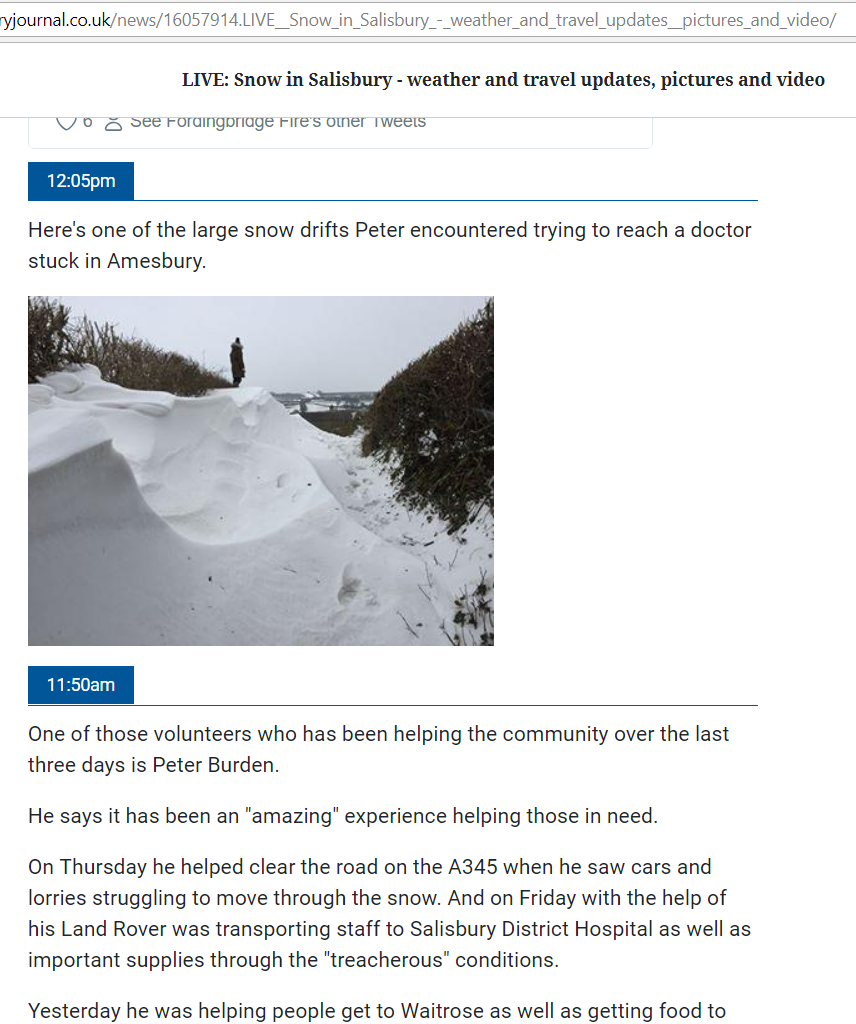
The first and most obvious regards the weather on 3 and 4 March. It is in fact absolutely true that, if the two had gone down to Salisbury on 3 March with the intention of going to Stonehenge, they would have been unable to get there because of the snow. It is therefore perfectly possible that they went back the next day to try again; and public transport out of Salisbury was still severely disrupted, and many roads closed, on 4 March. Proof of this is not at all difficult to find.
This image is from the Salisbury Journal’s liveblog on 4 March.
Those mocking the idea that the pair were blocked by snow from visiting Stonehenge have pointed to the CCTV footage of central Salisbury not showing snow on the afternoon of 4 March. Well, that is central Salisbury, it had of course been salted and cleared. Outside there were drifts.
So that part of their story in fact turns out not to be implausible as social media is making out; in fact it fits precisely with the actual facts.
The second part of their story that has brought ridicule is the notion that two Russians would fly to the UK for the weekend and try to visit Salisbury. This ridicule has been very strange to me. Weekend breaks – arrive on Friday and return on Sunday – are a standard part of the holiday industry. Why is it apparently unthinkable that Russians fly on weekend breaks as well as British people?
Even more strange is the idea that it is wildly improbable for Russian visitors to wish to visit Salisbury cathedral and Stonehenge. Salisbury Cathedral is one of the most breathtaking achievements of Norman architecture, one of the great cathedrals of Europe. It attracts a great many foreign visitors. Stonehenge is world famous and a world heritage site. I went on holiday this year and visited Wurzburg to see the Bishop’s Palace, and then the winery cooperative at Sommerach. Because somebody does not choose to spend their leisure time on a beach in Benidorm does not make them a killer. Lots of people go to Salisbury Cathedral.
There seems to be a racist motif here – Russians cannot possibly have intellectual or historical interests, or afford weekend breaks.
The final meme which has worried me is “if they went to see the cathedral, why did they visit the Skripal house?” Well, no evidence at all has been presented that they visited the Skripal house. They were captured on CCTV walking past a petrol station 500 yards away – that is the closest they have been placed to the Skripal house.
The greater mystery about these two is, if they did visit the Skripal House and paint Novichok on the doorknob, why did they afterwards walk straight past the railway station again and head into Salisbury city centre, where they were caught window shopping in a coin and souvenir shop with apparently not a care in the world, before eventually returning to the train station? It seems a very strange attitude to a getaway after an attempted murder. In truth their demeanour throughout the photographs is consistent with their tourism story.
The Russians have so far presented this pair in a very unconvincing light. But on investigation, the elements of their story which are claimed to be wildly improbable are not inconsistent with the facts.
There remains the much larger question of the timing.
The Metropolitan Police state that Boshirov and Petrov did not arrive in Salisbury until 11.48 on the day of the poisoning. That means that they could not have applied a nerve agent to the Skripals’ doorknob before noon at the earliest. But there has never been any indication that the Skripals returned to their home after noon on Sunday 4 March. If they did so, they and/or their car somehow avoided all CCTV cameras. Remember they were caught by three CCTV cameras on leaving, and Borishov and Petrov were caught frequently on CCTV on arriving.
The Skripals were next seen on CCTV at 13.30, driving down Devizes road. After that their movements were clearly witnessed or recorded until their admission to hospital.
So even if the Skripals made an “invisible” trip home before being seen on Devizes Road, that means the very latest they could have touched the doorknob is 13.15. The longest possible gap between the novichok being placed on the doorknob and the Skripals touching it would have been one hour and 15 minutes. Do you recall all those “experts” leaping in to tell us that the “ten times deadlier than VX” nerve agent was not fatal because it had degraded overnight on the doorknob? Well that cannot be true. The time between application and contact was between a minute and (at most) just over an hour on this new timeline.
In general it is worth observing that the Skripals, and poor Dawn Sturgess and Charlie Rowley, all managed to achieve almost complete CCTV invisibility in their widespread movements around Salisbury at the key times, while in contrast “Petrov and Boshirov” managed to be frequently caught in high quality all the time during their brief visit.
This is especially remarkable in the case of the Skripals’ location around noon on 4 March. The government can only maintain that they returned home at this time, as they insist they got the nerve agent from the doorknob. But why was their car so frequently caught on CCTV leaving, but not at all returning? It appears very much more probable that they came into contact with the nerve agent somewhere else, while they were out.
I shall write a further post on these timing questions shortly.
Skripal
Suspects Appear For First Time In Shocking Interview: We Are "Framed
Tourists"
The
same day the US announced it
plans a second round of "very severe" sanctions on Russia
over the use of a nerve agent in connection to the West's
allegations surrounding the Skripal poisoning, the
alleged perpetrators of the poison attack have appeared on RT News
for an exclusive interview with RT's Editor-in-Chief Margarita
Simonyan.
Suffice
it to say the whole strange Skripal saga just got a lot more bizarre.
The pair told Simonyan in the televised interview that they had
nothing to do with it, but were very excited to visit the famous
Salisbury cathedral as mere sightseers and were in the Salisbury town
briefly on two consecutive days, but
that they are not GRU agents or Russian spies.
"Our
friends had been suggesting for a long time that we visit this
wonderful town," they
said,
and explained that after the short visit, their"whole
lives were turned upside down" as they suddenly
became "framed tourists" caught up in the Skripal
cause after being falsely accused by UK authorities.
The
pair sat stone-faced throughout the
interview and
delivered brief, concise answers to RT's questions, while
consistently claiming to have been visiting Britain as tourists, but
while also acknowledging it
was indeed them that appeared in CCTV footage published by the UK
authorities.
“Salisbury?
A wonderful town?” RT's Margarita Simonyan asked. “Yes,” Petrov
answered tersely. “It is a tourist town,” Boshirov
offered. “There’s a famous cathedral there... It is famous
not just in Europe, but in the whole world. It’s famous for its
123-metre spire, it’s famous for its clock, the first one [of its
kind] ever created in the world, which is still working.”
Upon
the start of the interview wherein the two confirm their
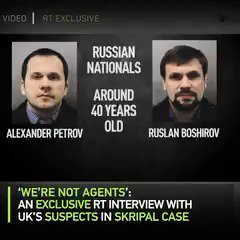
true identities as Alexander Petrov and Ruslan Boshirov to
RT's Simonyan, the
interview proceeds:
SIMONYAN:
The guys we all saw in those videos from London and Salisbury,
wearing those jackets and trainers, it's you?
PETROV:
Yes, it’s us.
SIMONYAN:
What were you doing there?
PETROV:
Our friends have been suggesting for quite a long time that we visit
this wonderful city.
SIMONYAN:
Salisbury? A wonderful city?
PETROV:
Yes.
SIMONYAN:
What makes it so wonderful?
BOSHIROV:
It’s a tourist city. They have a famous cathedral there, Salisbury
Cathedral. It’s famous throughout Europe and, in fact, throughout
the world, I think. It’s famous for its 123-meter spire. It’s
famous for its clock. It’s one of the oldest working clocks in the
world.
Petrov
then explains that the pair planned to visit famous tourist sites in
London and in and around Salisbury, but parts of their trip were cut
short because of heavy snowfall and inclement weather.
The
pair say they only spent three days total in England, due their
decision to cut it short, but were in Salisbury for some of that
time, on two consecutive days:
SIMONYAN:
So, you travelled to Salisbury to see the clock?
PETROV:
No, initially we planned to go to London and have some fun there.
This time, it wasn’t a business trip. Our plan was to spend some
time in London and then to visit Salisbury. Of course, we wanted to
do it all in one day. But when we got there, our plane couldn't land
on its first approach. That’s because of all the havoc they had
with transport in the UK on March 2 and 3. There was heavy snowfall,
nearly all the cities were paralyzed. We were unable to go anywhere.
BOSHIROV:
It was in all the news. Railroads didn't work on March 2 and 3.
Motorways were closed. Police cars and ambulances blocked off
highways. There was no traffic at all – no trains, nothing. Why is
it that nobody talks about any of this?
SIMONYAN:
Can you give a time line? Minute-by-minute, or at least hour-by-hour,
or as much as you can remember. You arrived in the UK – like you
said, to have some fun and to see the cathedral, to see some clock in
Salisbury. Can you tell us what you did in the UK? You spent two days
there, right?
PETROV:
Actually, three.
SIMONYAN:
OK, three. What did you do for those three days?
PETROV:
We arrived on March 2. We went to the train station to check the
schedule, to see where we could go.
BOSHIROV:
The initial plan was to go there for a day. Just take a look and
return the same day.
PETROV:
To Salisbury, that is. One day in Salisbury is enough. There’s not
much you can do there.
BOSHIROV:
It’s a regular city. A regular tourist city.
SIMONYAN:
OK, I get that. That was your plan. But what did you actually do? You
arrived. There was heavy snowfall. No trains, nothing. So, what did
you do?
PETROV:
No, we arrived in Salisbury on March 3. We wanted to walk around the
city but since the whole city was covered with snow, we spent only 30
minutes there. We were all wet.
In
comments that will likely be able to be easily proven or disproven,
he followed with: "There are no pictures. The media,
television – nobody talks about the fact that the transport system
was paralyzed that day. It
was impossible to get anywhere because of the snow. We were drenched
up to our knees."
In
Salisbury, Petrov continued, the two intended "to see
Stonehenge, Old Sarum, and the Cathedral of the Blessed Virgin Mary.
But it didn’t work out because of the slush." But they blame
the harsh conditions for quickly canceling their plans and "transport
collapse", and they returned the train station after their
initial arrival in the town via train from London.
SIMONYAN:
All right. You went for a walk for 30 minutes, you got wet. What
next?
PETROV:
We travelled there to see Stonehenge, Old Sarum, and the Cathedral of
the Blessed Virgin Mary. But it didn’t work out because of the
slush. The whole city was covered with slush. We got wet, so we went
back to the train station and took the first train to go back. We
spent about 40 minutes in a coffee shop at the train station.
BOSHIROV:
Drinking coffee. A hot drink because we were drenched.
PETROV:
Maybe a little over an hour. That’s because of large intervals
between trains. I think this was because of the snowfall. We went
back to London and continued with our journey.
BOSHIROV:
We walked around London…
SIMONYAN:
So, you only spent an hour in Salisbury?
PETROV:
On March 3? Yes. That’s because it was impossible to get anywhere.
SIMONYAN:
What about the next day?
PETROV:
On March 4, we went back there, because the snow melted in London, it
was warm.
BOSHIROV:
It was sunny.
PETROV:
And we thought – we really wanted to see Old Sarum and the
cathedral. So we decided to give it another try on March 4.
SIMONYAN:
Another try to do what?
PETROV:
To go sightseeing.
BOSHIROV:
To see this famous cathedral. To visit Old Sarum.
SIMONYAN:
So, did you see it?
BOSHIROV:
Yes, we did.
PETROV:
On March 4, we did. But again, by lunchtime, there was heavy sleet.
BOSHIROV:
For some reason, nobody talks about this.
PETROV:
So we left early.
In
total, the
pair say they spent only an hour on their first day
in Salisbury "because
it was impossible to get anywhere," before taking a train
back to London. The
men say this all happened on March 3rd, the day before the alleged
poisoning of Sergei Skripal,
a former Russian military officer and double agent for the UK's
intelligence services, and his daughter Yulia Skripal, in the same
town.
However,
they say they
returned to sightsee in Salisbury the next day, March 4,
on the day of the Skripal attack.
And
continuing, RT's Simonyan asked them to divulge proof that they
took photographs of the sites. The pair agreed they would provide
their tourist photographs to the media as proof of their story.
SIMONYAN:
Is it beautiful?
BOSHIROV:
The cathedral is very beautiful. There are lots of tourists, lots of
Russian tourists, lots of Russian-speaking tourists.
PETROV:
By the way, they should have a lot of pictures from the cathedral.
SIMONYAN:
Your pictures, you mean?
PETROV:
They should show them.
SIMONYAN:
I assume you took some pictures while at the cathedral?
PETROV:
Of course.
BOSHIROV:
Sure, we did. We went to a park, we had some coffee. We went to a
coffee shop. We walked around, enjoying those beautiful English
Gothic buildings.
PETROV:
For some reason, they don’t show this. They only show how we went
to the train station.
SIMONYAN:
If you give us your pictures, we can show them. So, while you were in
Salisbury, did you go anywhere near the Skripals home?
PETROV:
Maybe. We don’t know.
BOSHIROV:
What about you? Do you know where their house is?
SIMONYAN:
I don’t. Do you?
BOSHIROV:
We don't either.
PETROV:
I wish somebody told us where it was.
And
Boshirov added after the series of questions concerning the Skripal
residence: "Maybe
we passed it, or maybe we didn’t. I’d never heard about them
before this nightmare started. I’d never heard this name before. I
didn’t know anything about them."
On
the issue of the alleged "perfume bottle" the UK
police claim to have identified as used for delivery of the nerve
agent, the two accused men said the prospect is "absurd".
SIMONYAN:
When you arrived in the UK, when you were in London or in Salisbury,
throughout your whole trip, did you have any Novichok or some other
poisonous agent or dangerous substance with you?
BOSHIROV:
No.
PETROV:
It’s absurd.
SIMONYAN:
Did you have that bottle of Nina Ricci perfume which the UK presents
as evidence of your alleged crime?
BOSHIROV:
Don’t you think that it’s kind of stupid for two straight men to
be carrying perfume for ladies? When you go through customs, they
check all your belongings. So, if we had anything suspicious, they
would definitely have questions. Why would a man have women's perfume
in his bag?
PETROV:
Even an ordinary person would have questions. Why would a man need
perfume for women?
And
on the issue of the widely circulated and somewhat mysterious
(considering the same exact time stamp for each) security camera
photographs at Gatwick airport...
SIMONYAN:
Right. Here’s the photo that’s got the whole world puzzled.
Gatwick. You’re going through the gate at the same time, even at
the same second. How do you explain that?
BOSHIROV:
I think it’s for them to
explain.
PETROV:
How can we explain
it?
CCTV
images of Petrov and Boshirov at Gatwick airport on 2 March 2018.
BOSHIROV:
We always go through the gate together. Through the same gate, with
the same customs officer. One after another. We walked through that
corridor together. We’re always together. As to how it happened –
us walking there at the same second and then separately – I think
it’s a question that should be put to them.
PETROV:
Yeah, on the point of us always going through it together – my
English is a bit better, so if any problem crops up, I’m there to
help Ruslan out.
SIMONYAN:
So you went through together? You didn’t take different corridors?
PETROV:
No, we never go through separately.
BOSHIROV:
No, never.
SIMONYAN:
So what about these photos then? You say it never happened? Or were
they doctored?
BOSHIROV:
Well, I don’t really know…
PETROV:
It’d be a good thing if we could actually remember it…
BOSHIROV:
… how they do these things over there. When you arrive at an
airport, or leave one, when you go somewhere or other, you never
think about the cameras… There’s nothing interesting about them.
How they film, or what, or where – I’m not interested in any of
that and so I never took any notice. Given that it was them who
published these photos with this time on them and all, I think the
best thing to do would be to ask them.
Near
the end of the interview, the two men explicitly
denied working for GRU and
demanded a formal apology from the UK government over the whole
gambit of accusations.
But
when pressed further about how they know each other and their past,
said they preferred not give too many public details about their
lives, but explained they worked as part of a fitness nutrition
supplements business.
Simonyan
Sniffs Out the Spies! What Do You Know, Turns Out Someone Was Lying..
The
time that “Boshirov and Petrov” were allegedly in Salisbury
carrying out the attack is all entirely within the period the
Skripals were universally
reportedto
have left their home with their mobile phones switched off.
A
key hole in the British government’s account of the Salisbury
poisonings has been plugged – the lack of any actual suspects. And
it has been plugged in a way that appears broadly convincing –
these two men do appear to have traveled to Salisbury at the right
time to have been involved.
But
what has not been established is the men’s identity and that they
are agents of the Russian state, or just what they did in Salisbury.
If they are Russian agents, they are remarkably amateur assassins.
Meanwhile the new evidence throws the previously reported timelines
into confusion – and demolishes the theories put out by “experts”
as to why the Novichok dose was not fatal.
At
09.15 on Sunday 4 March the Skripals’ car was seen on CCTV driving
through three different locations in Salisbury. Both Skripals had
switched off their mobile phones and they remained off for over four
hours, which has baffled geo-location.
There
is no CCTV footage that indicates the Skripals returning to their
home. It has therefore always been assumed that they last touched the
door handle around 9am.
But
the Metropolitan Police state that Boshirov and Petrov did
not arrive in
Salisbury until 11.48 on the day of the poisoning. That means that
they could not have applied a nerve agent to the Skripals’ doorknob
before noon at the earliest. But there has never been any indication
that the Skripals returned to their home after noon on Sunday 4
March. If they did so, they and/or their car somehow avoided all CCTV
cameras. Remember they were caught by three CCTV cameras on leaving,
and Borishov and Petrov were caught frequently on CCTV on arriving.
The
Skripals were next seen on CCTV at 13.30, driving down Devizes road.
After that their movements were clearly witnessed or recorded until
their admission to hospital.
So
even if the Skripals made an “invisible” trip home before being
seen on Devizes Road, that means the very latest they could have
touched the doorknob is 13.15. The longest possible gap between the
novichok being placed on the doorknob and the Skripals touching it
would have been one hour and 15 minutes. Do you recall all those
“experts” leaping in to tell us that the “ten times deadlier
than VX” nerve agent was not fatal because it had degraded
overnight on the doorknob? Well that cannot be true. The time between
application and contact was between a minute and (at most) just over
an hour on this new timeline.
In
general it is worth observing that the Skripals, and poor Dawn
Sturgess and Charlie Rowley, all managed to achieve almost complete
CCTV invisibility in their widespread movements around Salisbury at
the key times, while in contrast “Petrov and Boshirov” managed to
be frequently caught in high quality all the time during their brief
visit.
This
is especially remarkable in the case of the Skripals’ location
around noon on 4 March. The government can only maintain that they
returned home at this time, as they insist they got the nerve agent
from the doorknob. But why was their car so frequently caught on CCTV
leaving, but not at all returning? It appears very much more probable
that they came into contact with the nerve agent somewhere else,
while they were out.
“Boshirov
and Petrov” plainly are of interest in this case. But only Theresa
May stated they were Russian agents: the police did not, and stated
that they expected those were not their real identities. We do not
know who Boshirov and Petrov were. It appears very likely their
appearance was to do with the Skripals on that day. But they may have
been meeting them, outside the home. The evidence points to that,
rather than doorknobs. Such a meeting might explain why the Skripals
had turned off their mobile phones to attempt to avoid surveillance.
It
is also telling the police have pressed no charges against them in
the case of Dawn Sturgess, which would be manslaughter at least if
the government version is true.
If
“Boshirov and Petrov” are secret agents, their incompetence is
astounding. They used public transport rather than a vehicle and left
the clearest possible CCTV footprint. They failed in their
assassination attempt. They left traces of novichok everywhere and
could well have poisoned themselves, and left the “murder weapon”
lying around to be found. Their timings in Salisbury were extremely
tight – and British Sunday rail service dependent.
There
are other possibilities of who “Boshirov and Petrov” really are,
of which Ukrainian is the obvious one. One thing I discovered when
British Ambassador to Uzbekistan was that there had been a large
Ukrainian ethnic group of scientists working at the Soviet chemical
weapon testing facility there at Nukus. There are many other
possibilities.
Yesterday’s
revelations certainly add to the amount we know about the Skripal
event. But they raise as many new questions as they give answers.

 Posts
Posts