
 Posts
Posts


Is Europe developing some balls?
Meanwhile the G20 has given a chance to pretend the world is not headed to wall.
Western, corporate media does nothing but pretend.
This is EXTREMELY serious unless someone backs down.
Trump To Unleash Hell On
Europe: EU Announces
Channel To Circumvent
SWIFT And Iran Sanctions Is
Now Operational

28
June, 2019
With
the world waiting for the first headlines from the Trump-Xi meeting,
the most important and unexpected news of the day hit moments ago,
when Europe announced that the special trade channel, Instex,
that will allow European firms to avoid SWIFT and bypass American
sanctions on Iran, is now operational.
Following
a meeting between the countries who singed the Iran nuclear deal,
also known as the Joint Comprehensive Plan of Action (JCPOA), which
was ditched by US, French, British and German officials said the
trade mechanism which was proposed last summer and called Instex, is
now operational.
As
a reminder, last September, in order to maintain a financial
relationship with Iran that can not be vetoed by the US, Europe
unveiled a "Special Purpose Vehicle" to bypass SWIFT. The
mechanism would facilitate transactions between European and Iranian
companies, while preventing the US from vetoing the transactions and
pursuing punitive measures on those companies and states that defied
Trump. The payment balancing system will allow companies in Europe to
buy Iranian goods, and vice-versa, without actual money-transfers
between European and Iranian banks.
The
statement came after the remaining signatures of JCPOA gathered in
Vienna for a meeting that Iranian ministry spokesman Abbas Mousavi
called "the
last chance for the remaining parties...to gather and see how they
can meet their commitments towards Iran."
Until
today, Tehran was skeptical about EU's commitment to the deal and
threatened to exceed the maximum amount of enriched uranium allowed
it by the deal after US had imposed a series of sanctions on the
country.
Meanwhile,
opponents of Instex - almost exclusively the US - have argued that
the mechanism is flawed because the Iranian institution designated to
work with Instex, the Special Trade and Finance Instrument, has
shareholders with links to entities already facing sanctions from the
U.S.
The
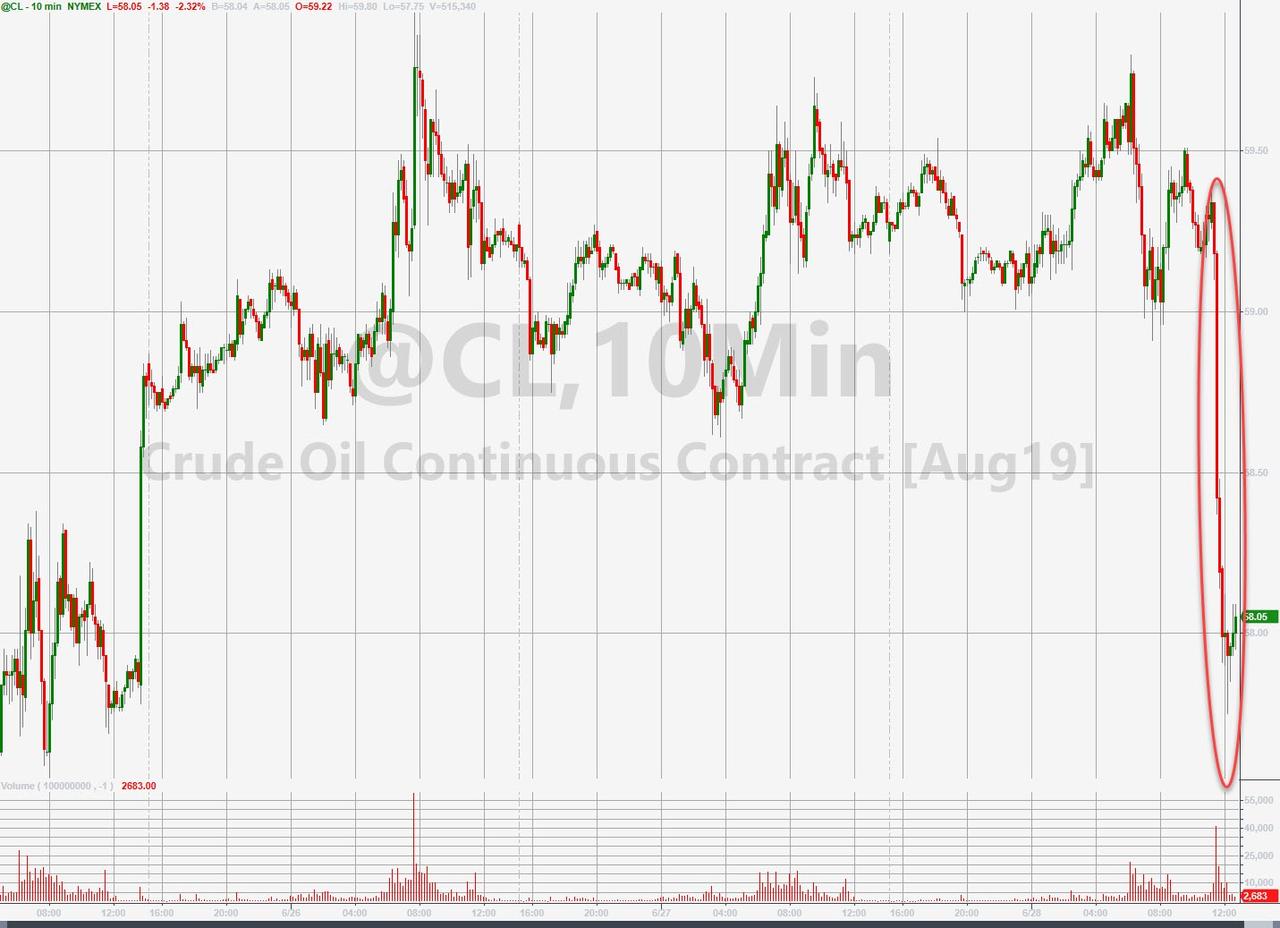
announcement sent oil sharply lower, with crude futures falling about
$1/bbl in closing minutes before settlement, extending daily loss, as
it means Iran now has a fully functioning pathway to receive payment
for oil it exports to anyone it chooses.
The
announcement will likely send president Trump off the rails, because
in late May Bloomberg reported that as part of Trump's escalating
battle with "European allies" over the fate of the Iran
nuclear accord, he was "threatening penalties against the
financial body created by Germany, the U.K. and France to shield
trade with the Islamic Republic from U.S. sanctions" including
the loss of access to the US financial system.
Germany,
France and the U.K. finalized the Instex system in January, allowing
companies to trade with Iran without the use of U.S. dollars or
American banks, allowing them to get around wide-ranging U.S.
sanctions that were imposed after the Trump administration abandoned
the 2015 Iran nuclear deal last year.
“This
is a shot across the bow of a European political establishment
committed to using Instex and its sanctions-connected Iranian
counterpart to circumvent U.S. measures,” said Mark Dubowitz, the
chief executive officer of the Foundation for Defense of Democracies
in Washington.
*
* *
When
asked to comment on the letter, the Treasury Department issued a
statement saying “entities that transact in trade with the Iranian
regime through any means may expose themselves to considerable
sanctions risk, and Treasury intends to aggressively enforce our
authorities.”
The
US ire was sparked by the realization - and alarm - that cracks are
appearing in the dollar's reserve status, opponents of Instex argue -
at least for public consumption purposes - that the mechanism is
flawed because
the Iranian institution designated to work with Instex, the Special
Trade and Finance Instrument, has shareholders with links to entities
already facing sanctions from the U.S
.
Separately,
during a visit to London on May 8, Mike Pompeo also warned that
there was no need for Instex because the U.S. allows for humanitarian
and medical products to get into Iran without sanction.
“When
transactions move beyond that, it doesn’t matter what vehicle’s
out there, if the transaction is sanctionable, we will evaluate it,
review it, and if appropriate, levy sanctions against those that were
involved in that transaction,” Pompeo said. “It’s very
straightforward.”
In
conclusion, one month ago we said that "In 2018, Europe made a
huge stink about not being bound by Trump's unilateral breach of the
Iranian deal, and said it would continue regardless of US threats.
But now that the threats have clearly escalated, and Washington has
made it clear it won't take no for an answer, it will be interesting
to see if Europe's resolve to take on Trump - especially in light of
the trade war with China - has fizzled. "
The
answer, it appears is that Europe felt unexpectedly emboldened, just
hours before Trump's meeting with Xi, and that it is ready and
willing to call Trump's bluff; it goes without saying, that if the US
does indeed retaliate and proceed with sanctions against European
banks, than the global trade war is about to turn far, far uglier.
Europe Activates "INSTEX" to Trade with Iran; US Threatens Sanctions - EUROPE THREATENS TO PULL ALL FUNDS FROM U.S. BANKS!
Hal Turner,
28 June, 2019
With the world waiting for the first headlines from the Trump-Xi meeting, the most important and unexpected news of the day hit moments ago, when Europe announced that the special trade channel, Instex, that will allow European firms to avoid SWIFT and bypass American sanctions on Iran, is now operational.
Following a meeting between the countries who singed the Iran nuclear deal, also known as the Joint Comprehensive Plan of Action (JCPOA), which was ditched by US, French, British and German officials said the trade mechanism which was proposed last summer and called Instex, is now operational.
As
a reminder, last September, in order to maintain a financial
relationship with Iran that can not be vetoed by the US, Europe
unveiled a "Special Purpose Vehicle" to bypass SWIFT. The
mechanism would facilitate transactions between European and Iranian
companies, while preventing the US from vetoing the transactions and
pursuing punitive measures on those companies and states that defied
Trump. The payment balancing system will allow companies in Europe to
buy Iranian goods, and vice-versa, without actual money-transfers
between European and Iranian banks.
The
statement came after the remaining signatures of JCPOA gathered in
Vienna for a meeting that Iranian ministry spokesman Abbas Mousavi
called "the last chance for the remaining parties...to
gather and see how they can meet their commitments towards Iran."
Until
today, Tehran was skeptical about EU's commitment to the deal and
threatened to exceed the maximum amount of enriched uranium allowed
it by the deal after US had imposed a series of sanctions on the
country.
Meanwhile,
opponents of Instex - almost exclusively the US - have argued that
the mechanism is flawed because the Iranian institution designated to
work with Instex, the Special Trade and Finance Instrument, has
shareholders with links to entities already facing sanctions from the
U.S.
The
announcement will likely send president Trump off the rails, because
in late May Bloomberg reported that as part of Trump's escalating
battle with "European allies" over the fate of the Iran
nuclear accord, he was "threatening penalties against the
financial body created by Germany, the U.K. and France to shield
trade with the Islamic Republic from U.S. sanctions" including
the loss of access to the US financial system.
According
to Bloomberg, the Treasury Department’s undersecretary for
terrorism and financial intelligence, Sigal Mandelker, sent a letter
on May 7 warning that Instex, the European SPV to sustain trade with
Tehran, and
anyone associated with it could be barred from the U.S. financial
system if it goes into effect.
“I
urge you to carefully consider the potential sanctions exposure of
Instex,” Mandelker
wrote in an ominous letter to Instex President Per Fischer. "Engaging
in activities that run afoul of U.S. sanctions can result in severe
consequences, including a loss of access to the U.S. financial
system."
Germany,
France and the U.K. finalized the Instex system in January, allowing
companies to trade with Iran without the use of U.S. dollars or
American banks, allowing them to get around wide-ranging U.S.
sanctions that were imposed after the Trump administration abandoned
the 2015 Iran nuclear deal last year.
“This
is a shot across the bow of a European political establishment
committed to using Instex and its sanctions-connected Iranian
counterpart to circumvent U.S. measures,” said Mark Dubowitz, the
chief executive officer of the Foundation for Defense of Democracies
in Washington.
Here
is a simpler summary of what just happened: this
was the first official shot across the bow of the USD status as a
global reserve currency, and not by America's adversaries but by its
closest allies.
And once those who benefit the most from the status quo openly revolt
against it, the countdown to the end of the USD reserve status
officially begins.
When
asked to comment on the letter, the Treasury Department issued a
statement saying “entities that transact in trade with the Iranian
regime through any means may expose themselves to considerable
sanctions risk, and Treasury intends to aggressively enforce our
authorities.”
The
US ire was sparked by the realization - and alarm - that cracks are
appearing in the dollar's reserve status, opponents of Instex argue -
at least for public consumption purposes - that the mechanism is
flawed because
the Iranian institution designated to work with Instex, the Special
Trade and Finance Instrument, has shareholders with links to entities
already facing sanctions from the U.S.
Separately,
during a visit to London on May 8, Mike Pompeo also warned that
there was no need for Instex because the U.S. allows for humanitarian
and medical products to get into Iran without sanction.
“When
transactions move beyond that, it doesn’t matter what vehicle’s
out there, if the transaction is sanctionable, we will evaluate it,
review it, and if appropriate, levy sanctions against those that were
involved in that transaction,” Pompeo said. “It’s very
straightforward.”
In
conclusion, one month ago we said that "In 2018, Europe made a
huge stink about not being bound by Trump's unilateral breach of the
Iranian deal, and said it would continue regardless of US threats.
But now that the threats have clearly escalated, and Washington has
made it clear it won't take no for an answer, it will be interesting
to see if Europe's resolve to take on Trump - especially in light of
the trade war with China - has fizzled. "
The
answer, it appears is that Europe felt unexpectedly emboldened, just
hours before Trump's meeting with Xi, and that it is ready and
willing to call Trump's bluff; it goes without saying, that if the US
does indeed retaliate and proceed with sanctions against European
banks, than the global trade war is about to turn far, far uglier.
LATE
BREAKING UPDATE 6:26 PM EDT -- Europe
has told the US Treasury that if the United States begins sanctioning
any European country or company over Iran trade, European entities
will WITHDRAW their funds from US Banks and Financial Markets,
sending certain banks into collapse immediately
And from Iran's Press TV

Iran's
deputy foreign minister says progress has been made in Vienna talks
aimed at saving the 2015 nuclear deal with world powers but the
demands of the Islamic Republic are yet to be met.
"It
was a step forward, but it is still not enough and not meeting Iran’s
expectations," Abbas Araqchi told reporters on Friday after
almost four hours of talks with senior diplomats from Britain, China,
France, Germany and Russia.
On
Friday, the remaining signatories of the nuclear agreement met in the
Austrian capital as a last-ditch effort to save the accord after the
US withdrew last year.
US
President Donald Trump withdrew Washington in May 2018 from the
multilateral nuclear accord, officially known as the Joint
Comprehensive Plan of Action (JCPOA), which was reached between Iran
and six world powers in 2015.
Afterwards,
Washington re-imposed unilateral sanctions on Iran that had been
lifted under the deal.
European
signatories to the nuclear deal are facing a two-month ultimatum to
help Iran navigate US sanctions or see Tehran take the second step of
reducing its commitments on July 7.
In
early May, Tehran suspended limits on its production of enriched
uranium and heavy water, moves that did not technically violate the
deal but signaled that its patience was wearing thin.
Referring
to Iran's decision to go over the deal's core atomic restrictions,
Araqchi said, "The decision to reduce our commitments has
already been made in Iran and we continue on that process unless our
expectations are met."
"I
don’t think the progress made today will be enough to stop our
process but the decision will be made in Tehran," he added.
Iran
says it will take the second step in reducing its commitments under
the 2015 nuclear deal more “firmly” if a European payment system
designed to bypass sanctions proves to be "superficial".
'INSTEX
operational'
Araqchi
said the Europeans have confirmed that the planned INSTEX trade
mechanism is now “operational” and the first transactions are
already processed.
However,
the Iranian official added that this was still insufficient because
European countries were not buying Iranian oil.
"For
INSTEX to be useful for Iran, Europeans need to buy oil or consider
credit lines for this mechanism otherwise INSTEX is not like they or
us expect," he said.
The
European Union also issued a statement, saying the special trade
channel was up and running
"France,
Germany and the United Kingdom informed participants that INSTEX had
been made operational and available to all EU member states and that
the first transactions are being processed," sad the statement.
The
trade mechanism was established last year after the US' withdrawal
from the JCPOA.
France,
Germany and Britain had been tinkering with INSTEX for months without
making it operational, leaving Iran wondering whether they are
serious about the idea.
In
a joint statement earlier on Friday, Austria, Belgium, Finland, the
Netherlands, Slovenia, Spain and Sweden, said they were working with
the E3 to develop trade mechanisms.
Araqchi
said all the parties in Vienna had agreed to hold a ministerial
meeting "very soon."
China
to continue to import Iranian oil
China
has rejected the imposition of unilateral US sanctions on Iran,
saying it would import Iranian oil in defiance of Washington’s bans
on Tehran.
"We
reject the unilateral imposition of sanctions," said Fu Cong,
the director general of the Chinese Foreign Ministry's Department of
Arms Control, on Friday.
Cong
made the remarks a day before US and Chinese leaders are to meet on
the sidelines of the G20 summit in Japan in an attempt to resolve
trade disputes.
"For
us energy security is important and the importation of oil is
important to Chinese energy security and also to the livelihood of
the people," said Cong.
American
special envoy for Iran Brian Hook has said the US will sanction any
country that imports oil from the Islamic Republic and there are no
exemptions in this regard
The
Trump administration said on April 22 that, in a bid to reduce Iran's
oil exports to zero, buyers of Iranian oil must stop purchases by May
1 or face sanctions. The move ended six months of waivers, which
allowed Iran’s eight biggest buyers -- Turkey, China, Greece,
India, Italy, Japan, South Korea and Taiwan -- to continue importing
limited volumes.
"We
do not accept this so-called zero policy of the United States,"
said Cong, who was speaking on the sidelines of a meeting on the
implementation of the Iranian nuclear deal.
The
United States' insistence on zeroing out Iran's oil exports has
caused many problems in the global market, keeping confused both
experts and buyers as they look straight into what is shaping up to
be a chaotic chapter for the petroleum industry.
China and several other major purchasers of Iranian oil have already complained to the US about the decision.


