Showing posts with label Nelson. Show all posts

Sunday, 27 December 2020

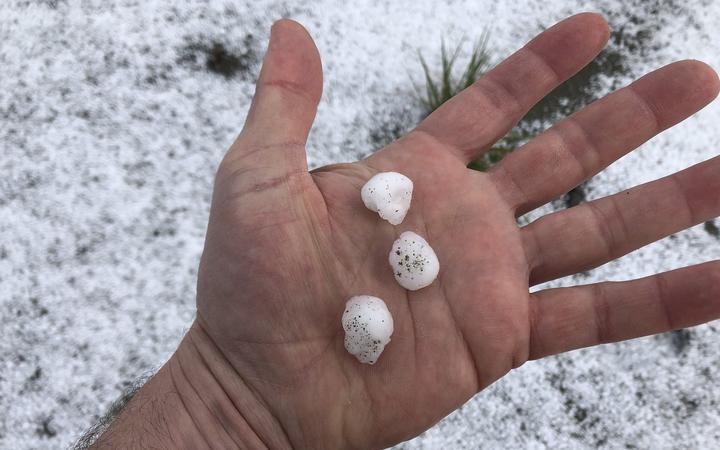
Whole fruit crops destroyed in hail storm in New Zealand

 I have not encountered an early-summer like this ever - there has been no sun for weeks and temperatures are up to 8C cooler than average.

Some Motueka fruit growers lose entire crop in hailstorm

A Motueka fruit growers association says the millions of dollars worth of fruit that is ruined following a devastating hail storm that hit the Nelson region yesterday is a bitter pill to swallow.
No caption

Hail in Motueka yesterday. Photo: Twitter / Ben Hodges

Richard Clarkson, president of the Motueka Fruit Growers Association, said some growers, depending on where they are based, had lost their entire crop due to the storm.

He said the storm had wiped out so much fruit that the labour shortage crisis was somewhat averted.

"There's orchards out there that are going to be in that 80 to 100 percent loss of crop, which is huge in terms of income," Clarkson said.

"We're not only talking apples, but we're talking about kiwifruit [and] hop growers, which have been hit quite hard It's widespread, and you'll find even some of the local vegetable growers have been hit as well."

Clarkson said the storm would cost "millions of dollars", with the district and entire country feeling the impact.

"We only get one bite at the cherry of earning money as orchardists, especially apples, kiwifruit and hops. We only have one opportunity a year to make money, and that's once it's picked and sold.

"For a lot of us we won't know what that looks like until we get through out the other side and assess the damage."

Clarkson said growers had begun to assess the damage, which would take two or three days to fully get across.

"As growers, we're going to have to look at which blocks we walk away [from], what we do with the fruit currently on the tree.

"Anything that's been lightly hit with hail takes a good couple of days to see the impact on fruit, but where we've got heavy damage you can see it now."

He said growers already had spent a significant amount of money getting the crop to where it was, from winter pruning to spring spray season.

"It's definitely a hard pill to swallow. [The weather] is one thing you can't control. When it has a devastating impact like it has, it's a bitter pill to swallow."

The storm follows what Clarkson said had been a "challenging" year for growers.

While they were allowed to operate during the Covid lockdowns, he said getting labour into the country and complying with alert levels regulations had been difficult.

Sad ending to 2020

Meanwhile, Tasman District councillor Barry Dowler said the storm has delivered a sad end to the year for the region.

"There's going to be a lot of people not getting the employment they normally would," Dowler said.

"Unfortunatley there's been quite a few business buildings damaged as well with the weight of the hail after the buildup in the spoutings."

He said that meant some people would not be allowed to return to their worksites, until assessors could look at the damage.

He hopes the government will step in and assist hard-hit growers.


New Zealanders hoping to see the year out with sunny weather are all out of luck – as most of the country continues to feel the consequences of a cold front.

MetService meteorologist Mmathapelo Makgabutlane said the day would be “quite cold" for most of the country.

“Those temperatures will be noticeably cooler than what they’ve been over the last couple of weeks," she said.

Wellington is only forecast to reach 13 degrees Celsius, while a grey and rainy Christchurch is only expected to hit 15 degrees

https://www.stuff.co.nz/national/weather-news/123822875/new-zealand-in-for-more-quite-cold-weather

Sunday, 5 May 2019

More on tree deaths across New Zealand

When I made the following video last night I had not seen the following item.


Tree deaths across New Zealand after dry conditions followed wet
Widespread tree deaths nationwide affecting whole hillsides have been reported to the Department of Conservation (DOC), after dry conditions followed a wet winter.

The usually lush Clutha Southland region has faced very dry conditions this summer. Photo: RNZ / Tim Brown

2 May, 2019

DOC botanist Shannel Courtney said the deaths covered a lot of the northern South Island.

"There seems to be quite widespread deaths of trees in the Marlborough Sounds and through the Pelorus catchment, right through into Kahurangi National Park and down into Nelson Lakes National Park," he said.

The species affected and the extent of the damage varied from place to place, with native black beech and hard beech trees - which make up most of the northern South Island forests - worst hit after the dry season because they grow along ridges and exposed areas.

Another species, Mahoe, was also dying "en masse", he said.

"I've also seen instances where a whole hillside has been affected, like in the upper Takaka Valley where the young tōtara appear to have died," he said.

"We think that the contrast of the really wet winter followed by an exceptionally dry summer - where we didn't have rain effectively for three months - that those extremes have predisposed many trees to be more susceptible to drought and they weren't conditioned for drought before the drought hit," he said.

Mr Courtney said root stress from a very wet winter and spring last year had weakened the trees and caused root damage, and the extremely dry conditions that followed were now proving fatal.

He said in some places it looked as bad, if not worse, than the 2001 drought. Mr Courtney said the effects were still unfolding and we may not see the full extent for months or another year.

Nelson helicopter pilot Matt Gibb told the department it was the first time he had seen so many dead native trees in 25 years of flying around the area.

"The ridges especially are speckled with dead trees, including in the Wairoa Valley and the Wangapeka area of Kahurangi National Park," he said. "They are becoming very noticeable."

He said as the country would likely experience more droughts due to climate change, we could "expect to see vegetation dieback like this happening more often".

Regeneration would only be possible in places where trees were in good health prior to periods of drought, Mr Courtney said.

The ability of a forest to bounce back from a drought is reduced if the underlying vegetation had disappeared due to goats, deer and possums.


Saturday, 4 May 2019

Trees are dying at the top of the South Island of New Zealand


Short reports like this one from Radio NZ provide warning of what is up ahead for us in this country, surrounded as it is by ocean on all sides.

There are high numbers of dead native trees at the top of South Island NZ


California has 149 million dead trees ready to ignite like a matchbook


***

And across Cook Strait the Department of Conservation says the high number of dead native trees being seen across the top of the South Island is likely caused by drought stress. Areas affected include the Wairoa Valley and the Wangapeka area of Kahurangi National Park. Dead trees have also been reported in the Murchison and Nelson Lakes area, the Wairau Valley in Marlborough, the Marlborough Sounds and the Takaka area in Golden Bay.

DOC staff have seen extensive areas of dead mahoe in Abel Tasman National Park's Wainui Inlet, browning rimu trees on dry ridges near the Heaphy Track, and dead beech trees particularly in places where they grow on thin or stony soils along the banks of the Buller River. Introduced species, including pines and eucalyptus, have also died.


Wednesday, 27 February 2019

Drought and fires continue in New Zealand along with summer snow


Evacuate now: Warning after new forest fire in Moutere, Tasman


27 February, 2019
Crews are still working to fight the fire that broke out at Redwood Valley in Moutere on Wednesday.
Anyone who self evacuates is being asked to register with the Welfare Centre at New Life Church on 85 Wensley Rd, Richmond.
Police are telling residents to evacuate as a fire threatens Moutere in Tasman.
The fire has now reached 4 hectares and spreading rapidly.
Smoke is also spreading fast.
Metservice meteorologist Georgina Griffiths says the weather will be little help in controlling the blaze.
"This evening's front produces very little for Nelson. Some in the Nelson region will get a sprinkle but it will be so little," she said in a statement on Wednesday
"Basically in the next five days there's virtually nothing of note for Nelson in terms of rain. It looks very dry."
January and February have been the driest months on record for the region, and that looks set to continue through March.


Police are evacuating areas of Moutere Highway, and five helicopters are responding to the fire with more en route.
The blaze broke out at Redwood Valley on Wednesday afternoon, potentially putting property at risk.
"Due to a fire, residents living on a stretch of Moutere Highway should self-evacuate. This affects properties between Old Coach Road and Maisey Road," police posted to Twitter.
"Police are following up with evacuation patrols."


Fire and Emergency is responding to the fire both on the ground and in the air.


"The fire has been confirmed at Cut Hill Road, Moutere," Fire and Emergency posted on Facebook.

"There are currently 16 appliances plus support vehicles (pumps and tankers) at the site with helicopters en route."

Weather: 'Unseasonable' snow and 'severe' drought hit New Zealand


26 February, 2019
Two new regions have been declared drought affected on Tuesday - Nelson and far western Marlborough.
The weekend may have brought a little rain to some parts of the country but not enough to relieve the drought in the upper South Island.
Drought has been declared in Nelson and far western Marlborough, to add to that already in Buller District, Tasman, Taranaki and the far north.
Pockets of Tasman are described as severe, and as a result some growers are already cutting their losses.
Julian Raines grows boysenberries, apples and gold kiwifruit, and the drought is hitting him hard.
"We've lost size in our fruit and we're making decisions, based on the return, which crop we water and which we don't," Julian Raine, an orchardist in Waimea Plains.
Some are taking drastic measures, taking land out of production or hoeing vegetables in because they don't have enough water to keep them going.
"The financial cost will really come in fruit size and not meeting expected yields, through to implications for return bloom next year," Mr Raine says.
The critical water shortage continues in Tasman, with most outdoor water use prohibited and a call for a 25 percent cut in use by businesses. And the forecast into March offers little hope, with summer-like conditions returning for many areas.
Further down the South Island Christchurch also had a dry hot summer - but a recent cold blast has prompted the arrival of an unexpected winter activity.
It's the end of February and Mt Hutt is covered top to toe in snow. In fact this is so unseasonal it's hard to figure out the date.
Workers are now out grooming the large drifts because the mountain has an open day this Saturday. It was planned for months but skiing wasn't originally on the menu.
So if any public want to head to Mt Hutt this Saturday, the field will be open with snow.
Newshub.


Monday, 25 February 2019

A strange weekend's weather brings no drought relief


Cyclone Oma, where have you gone?


Things just get stranger and stranger

Cyclone Oma, the day before yesterday billed as “the most dangerous cyclone to threaten Australia” yesterday disappeared into thin air.

Last night they were predicting frigid conditions around the country. We do have a wind here, blowing from the south, but it is warm! Last time I looked it was 18 deg.C. (Just below 60F)

Another view.   Cyclone Oma where are you


Just 24 hours ago they were predicting temperatures near zero.


These are the temperatures they were promising. 


On a walk today the wind was indeed coming from the south bu tit was a WARM WIND and temperatures late morning were 18 degrees Celsius!

This is what Google told us 


Not 18 hours later they changed their forecast yet again!


If you think this is going to do anything for the region's drought not a day has gone by and the Hutt River is back down to 13 m3/sec!


It cerrtainly hasn't helped Nelson!

I'm no meteorologist but I did predict that this "extreme weather event" would not amount to anything.

I think I was more right than the weather pundits. Perhaps that's because I read the signs and take abrupt climate change (and possible weather manipulation) into account.

***
As a postscript, I have been in email contact with Dane Wigington and received the following email.  He is a far more decent and polite person than many I could mention:

I appreciate the forward, Robin. On that note, if you have an email list that you forward your posts to, I would be grateful to be included. About the cyclone, the geoengineers can make or break the almost at will. When they suppress the convection, they diminish rotation and strength. There are weather monitoring loops available that clearly reveal an ionosphere heater down burst, the recent cyclone that was threatening military bases in Hawaii, and then disintegrated, is another example. Cyclonic rotations can also be steered via RF / microwave transmissions, and aerosol dispersions (which impact convection / pressure zones).


The power being wielded by the weather makers is truly difficult to truly comprehend.


Then there is the endless list of other anthropogenic factors that are decimating the biosphere and climate, what a dark corner the human race has painted itself into. All I wanted was to restore damaged forest lands (from ruthless logging) for the rest of my life. To plant trees and watch them grow. I often planted up to 300 a day, with a 95% success rate for the first year. Now, nothing lives through the first year (saplings), nothing). I was forced into this battle (for the last 15 years), I could not remain working alone in the forest knowing what was occurring in our skies.


I believe you feel the same about the natural world, Robin, I am grateful to you for all your work. No nature, no us, how can so many not understand that? 
I would gladly live in a teepee and subsist on acorns if I could live on a healthy planet.


More on the cyclones below, just FYI examples


https://www.geoengineeringwatch.org/engineered-climate-cataclysm-hurricane-harvey/

https://www.geoengineeringwatch.org/hurricane-maria-weather-warfare-and-military-bases/

Stay strong, Robin,
Dane

****

For what it is worth this Is what I've worked out for myself:

  • Geoengineering is real and going on
  • It is making an already terrible situation worse
  • it is not far worse than 200 years of human industrial pollution
  • Removing geoengineering is NOT a solution to anything. The moment that happens plus removing particulate pollution will result in an immediate and sharp increase in global temperatures with even more catastrophic results than now, if that is possible
  • Short lesson - we’re all going to hell in a handbasket


Sunday, 17 February 2019

Tasman's drought


Tasman facing worst drought since 2001 - 'We have three weeks of water before it goes from bad to dire'


TVNZ,
16 February, 2019


First there were floods, then fire and now drought.

The Waimea Plains, cradled between two mountain ranges, are usually immune to such extremes in the weather.

But a Tasman District Council water scientist says the wider area is facing its worst drought since 2001.

Joseph Thomas met with MPs and opposition leader Simon Bridges today on the Waimea River bed, which is now flowing at its lowest level in decades.

The region hit by two large ex-tropical cyclones a year ago, which sluiced out hillsides and tore through homes and crops, has been stricken by a large wildfire over the past 10 days.

Now it's as dry as a bone, with no immediate relief in sight.

Mr Thomas, who has been working as water scientist in Tasman since 1992, said the situation is now dire.

"This is as bad as I've seen it since 2001. Back then the river went dry, but a lot later - we're earlier by a month so if it doesn't rain we'll be in a dire situation."

Mr Thomas said it was not only the Waimea basin but the whole district was extremely dry, right across to Golden Bay.

He said from Monday, water cuts on the Waimea Plains would increase from the current 50 percent to 65 percent.

"Based on the flow monitoring we'll do on Monday and Tuesday, there will be another meeting of the Dry Weather Taskforce and a decision will be made as to what further action may need to be taken in terms of cut backs."

Mr Thomas said for householders, there was now a complete hosing ban - meaning no watering of gardens, and the worst-case scenario was water being delivered to homes by tankers and people having to collect water in buckets.

"We have three weeks of water before the Waimea goes from bad to dire in terms of river flows."

For local iwi, the situation has brought not only cultural consequences, but economic distress through the effects on businesses owned by Wakatu Incorporated.

Te Tau Ihu iwi (top of the south) are shareholders in Wakatu, and collectively own and operate a number of orchards, vineyards and farms now affected by the dry weather.

Iwi spokesman Barney Thomas said the biggest issue was the life-force of the river.

"To run that river dry is going to kill the river."

Mr Thomas said iwi needed to be around the table with council, and needed to be part of the decision-making.

"Our councils and authorities are driven legislatively, whereas we come from a cultural perspective and if we had anything to do with this, the restrictions would be harder, so the water and the life-force of the river would be maintained."

Mr Thomas said he had not seen the river in such a state, but the problem extended further.

"It all flows into the hinterland, so what happens to the river happens to the land and that needs to be taken into consideration."

Without drastic steps now, the district would be without water, he said.

"As kaitiaki we have that responsibility for our generation, and our future generations."

Joseph Thomas said the challenge is also keeping salt water out, from the large tides which can make their way high up the Waimea River when its level was so low.

For the first time an emergency bund has been built in the river's lower reaches.

"We're trying our best with this bund to keep out the king tides. We will know late next week, if we don't get rain, our monitoring will show how much worse it's going to get."

rnz.co.nz - Tracy Neal

Weather: New Zealand to 'bounce back' to warm temperatures next wee


16 February, 2019


Weeks of hot weather has been interrupted by a recent cold front, but it's only a temporary reprieve before the heat strikes again.

"The cold front that moved over the country last night has brought down the overnight low temperatures. Some relief from the higher numbers we have been seeing in the last few days," MetService posted on Sunday.


Overnight temperatures last night were expected to drop as low as 5degC in Alexandra, with many other cities dropping below the double-digit mark as well.

However temperatures should bounce back next week as the ridge of high pressure moves firmly over the country, bringing calm and settled conditions for most parts of the country.

"Generally settled and warm conditions will return next week with only the far north and south of the country seeing some wet weather," says MetService meteorologist Mark Bowe.

At the end of next week, Weather Watch warns Cyclone Oma could connect with a cold front moving up New Zealand to create a small area of low pressure (known as a trough) around northern areas.


"Basically this acts as a bit of a link from that NZ cold front to the tropical storm, and it helps feed bigger rain clouds - this is definitely not a storm, it's a rain event only," the forecaster says.


"It's too far out to lock in - but the latest data does suggest it may influence rain clouds in the New Zealand area next weekend which would be great news for a lot of farmers and growers - not so great for all the outdoor events and festivals coming up adding some uncertainty there."