Showing posts with label Mohammed Morsi. Show all posts

Sunday, 17 May 2015

Mohammed Morsi sentenced to death

Mohammed Morsi, Egypt's ex-leader, sentenced to death


16 May, 2015

An Egyptian court has sentenced ex-President Mohamed Morsi to death over a 2011 mass prison break. The verdict will now be handed over to the country’s Grand Mufti and a final decision will be reached on June 2.

Morsi is among a total of 106 Muslim Brotherhood members sentenced to capital punishment over the incident. The Wadi al-Natrun prison break took place during the 2011 January revolution and eventually led to the deposition of Hosni Mubarak.

On January 28, 2011, Morsi was arrested along with 24 Muslim Brotherhood leaders and put into Wadi al-Natrun prison in Cairo, but he escaped two days later. Following the prison break, several other prisons saw multiple riots and thousands of inmates escaped.

According to prosecutors, the prisons were attacked by members of the Muslim Brotherhood, Hamas and Hezbollah, intending to free Islamist inmates.

Some outlets previously reported Morsi was sentenced to death for passing state secrets to foreign groups, including the Palestinian militant Hamas group and Lebanon's Hezbollah, during his one year in office. However, that verdict does not include his name.

An official from the Muslim Brotherhood, Amr Darrag, has urged the international community to bring pressure to bear to prevent the ex-president’s death sentence.

"This is a political verdict and represents a murder crime that is about to be committed, and it should be stopped by the international community," Darrag told Reuters.

The court is also seeking the death penalty for Khairat Shater, a leading member of the Muslim Brotherhood for conspiring with foreign militant groups, according to Reuters.

Many of those 122 sentenced to death were tried in absentia, including Yusuf Qaradawi, an Egyptian Islamic theologian, who is now living in Qatar.

All the cases will now be referred to the country’s Grand Mufti, Shawki Ibrahim Abdel-Karim Allam, the highest official of religious law, who will issue a final legal opinion.

Amnesty International has condemned Morsi’s death sentence, calling it "a charade based on null and void procedures." The group demanded the immediate release of Egypt’s former president.

Turkish President Tayyip Erdogan also slammed the court decision and accused Western countries of hypocrisy, the Anatolian news agency reported.

"While the West is abolishing the death penalty, they are just watching the continuation of death sentences in Egypt. They don't do anything about it," he said.

The ousted leader is already serving a 20-year sentence. On April 21, he was convicted on charges linked to the killing of protesters outside Cairo’s presidential palace in December 2012.

Egypt first fell into turmoil four years ago with the onset of the Arab Spring and the ouster of Hosni Mubarak who ruled the country from 1981 to 2011. During the revolution headed by the Muslim Brotherhood, about 1,000 people were killed and more than 6,000 injured.

Morsi himself was then removed by Field Marshal Abdel Fattah el-Sisi in June 2013. Opponents had been accusing him of trying to monopolize political power by proposing an openly Islamist constitution, stuffing the bureaucracy with his associates and banning the courts from overruling his decisions.


The unrest that followed those events killed over 1,000, including women and children, according to HRW.


Egyptian judges shot dead in Sinai hours after Mohamed Morsi sentenced to death


Three Egyptian judges have been shot dead hours after deposed former president Mohamed Morsi was sentenced to death.

Police said the judges were travelling in a car in the city of al-Arish, Sinai, when it was attacked by suspected Islamist gunmen.

An fourth person was killed and at least three more were injured in the assault.


Spy Cables: Mossad's questionable questions about Morsi


Analysis: Israel's spies sought detailed information on Egypt's Muslim Brotherhood - to what end?

Tuesday, 5 November 2013

Egypt - Morsi appears in court


Trial adjourned as Morsi claims case illegitimate

Deposed Egyptian President Mohamed Morsi has told a court in Cairo the case against him is illegitimate as he remains president.

5 November, 2013


Mr Morsi and 14 other Muslim Brotherhood figures face charges of inciting the killing of protesters outside the presidential palace in 2012. Mr Morsi was ousted by the military in July this year after protests against his rule.

As he entered the courtroom, Mr Morsi refused to remove his blue suit and put on the required white prison uniform, and, when asked to give his name, said he was Egypt's legitimate president. "You have no right to conduct a trial into presidential matters," he said.

The judge twice temporarily halted proceedings before adjourning the case until January.

Ousted president Mohamed Morsi (centre) arrives in court .Ousted president Mohamed Morsi (centre) arrives in court .
AFP / EGYPTIAN TV
The former president was then flown to Burj al-Arab prison in Alexandria. Security officials told the BBC Mr Morsi was transferred after registration to the prison hospital for a routine medical check.

He is awaiting a medical report which will determine whether he will be sent to a cell or kept at the hospital, they added.

Protests took place outside the court and elsewhere in Cairo.


Sunday, 28 July 2013

Violence in Egypt

Egypt: scores killed as army launches offensive against Muslim Brotherhood
Over 100 supporters claimed dead as soldiers are accused of shoot-to-kill policy to clear protest urging Morsi's release


http://www.youtube.com/watch?v=5Wwvss3G17M


27 July, 2013

Egyptian security forces and armed men in plain clothes killed scores of Muslim Brotherhood protesters on Saturday as the brutal and organised crackdown on the Islamist party and its supporters appeared to be gathering pace.

In what is the worst single mass killing in Egypt since the fall of president Hosni Mubarak two-and-a-half years ago, a Brotherhood spokesman said 66 of the party's supporters were shot and killed on the fringes of a sit-in at a Cairo mosque demanding the return of former president Mohamed Morsi, who was deposed on 3 July, and another 61 were "brain dead" on life-support machines. Government officials claim that the number of dead was 65, a death toll greater than the Republican Guards massacre on 8 July that saw 51 killed.

The deaths came as men in helmets and black police fatigues fired on crowds gathered before dawn on the fringes of a round-the-clock sit-in near a mosque in north-east Cairo, Morsi's Muslim Brotherhood movement said.

"They are not shooting to wound, they are shooting to kill," said Brotherhood spokesman Gehad el-Haddad. "The bullet wounds are in the head and chest."

The latest violence came amid the continuing sharp polarisation within Egyptian society that has made the country increasingly ungovernable. Elsewhere on Friday, eight people were reported killed in clashes in Alexandria.

The latest violence was condemned by members of the international community. The head of European Union foreign policy, Baroness Ashton, said she "deeply deplored" the latest deaths, while Britain's foreign secretary William Hague said: "Now is the time for dialogue, not confrontation. It is the responsibility of leaders on all sides to take steps to reduce tensions."

The dead and injured were ferried into a makeshift field hospital near the Rabaa al-Adawiya mosque, where the floor was slick with blood.

In a bizarre episode, most western journalists in the country were invited on a helicopter ride over Cairo's Tahrir Square an hour before the massacre began. After the killings, the ministry of the interior denied it had used live ammunition on demonstrators, despite eyewitness accounts from journalists, including BBC correspondents, who were present during the killings.

"There must have been an injury every minute," said Mosa'ab Elshamy, a photojournalist unaffiliated with the Brotherhood, who photographed the attack for half an hour at around 4am.

"I did not see any Morsi supporters with [firearms] at this point," he added. "I hid behind a tree, and all I saw were Morsi supporters throwing stones, or fireworks, or throwing teargas canisters."

The shootings occurred as the interior minister, Mohamed Ibrahim, said that Morsi – who has been held incommunicado at an army base for the last three weeks – was being moved to Torah prison, where Mubarak is also being held. He added, chillingly, that the pro-Morsi sit-ins in Cairo would be "God willing, soon … dealt with. With regards to the timing to disperse the protesters, there is complete co-ordination between us and the armed forces."

On Friday, civilian prosecutors announced they had launched an investigation into Morsi on charges of murder and conspiring with the Palestinian militant group Hamas. At the heart of the case are allegations that Morsi and the Brotherhood worked with Hamas to carry out an attack on a prison that succeeded in breaking Morsi and around 30 other members of the group out of detention during the 2011 uprising against Mubarak. The attack killed 14 inmates.

During the three weeks Morsi has spent in secret detention, he has been extensively interrogated by military intelligence officials about the inner workings of his presidency and of the Brotherhood. They have been seeking to prove that he committed crimes, including handing state secrets to the Islamist group. According to the Associated Press, briefed by unidentified military officials, Morsi has been moved three times under heavy guard and is currently in a facility outside Cairo.

The lethal assault on the Muslim Brotherhood's supporters came after national demonstrations called by the chief of the army, General Abdel Fatah al-Sisi, to give him backing to confront "violence" and "terrorism" – understood by many to be a thinly veiled code for a crackdown on the Brotherhood.

Although there is bitter dispute over how the violence began, and whether some of the Brotherhood supporters had weapons, most independent witnesses reported that most of the gunfire was being directed at those associated with the sit-in.

A leading figure in the Brotherhood, Mohamed el-Beltagy, has blamed the violence on Sisi's call for demonstrations on Friday.

"This is the mandate Sisi took last night to commit massacres and bloodshed against peaceful protesters denouncing the military coup," el-Beltagy said in a statement on his Facebook page.

On Saturday afternoon police released helicopter footage purporting to show Muslim Brotherhood members firing sporadically on police.

The clashes began after hundreds of Morsi supporters moved out of their encampment outside the Rabaa al-Adawiya mosque late on Friday and towards a bridge in central Cairo.

One group began to set up tents on an adjoining boulevard, where they were planning to stay for at least three days, said Mahmoud Zaqzouq, a Muslim Brotherhood spokesman.


Opponents of deposed Egyptian President Mohamed Mursi throw stones at his supporters during clashes in Nasr city area, east of Cairo July 27, 2013. (Reuters/Asmaa Waguih)


Saturday, 27 July 2013

Civil unrest in Egypt


Violence deepens Egypt turmoil, deposed leader probed for murder
Nine people were killed and hundreds wounded in Egypt during rival mass rallies for and against the army overthrow of President Mohamed Mursi, who was placed under investigation for murder in an escalating showdown with his Islamist backers.


26 July, 2013


The new bloodshed deepened the turmoil convulsing the Arab world's most populous country, and could trigger a decisive move by the military against Mursi's Muslim Brotherhood three weeks after it was shunted from power.


In the sprawling capital, hundreds of thousands of Egyptians heeded a call by army chief General Abdel Fattah al-Sisi to give him a popular mandate to confront violence unleashed by his July 3 overthrow of Egypt's first freely elected president.


The Brotherhood mounted counter-demonstrations, swelling a month-long vigil in northern Cairo before violence erupted. A Reuters reporter saw heavy exchanges of gunfire in the early hours of Saturday between security forces and Mursi supporters, who tore up pavement concrete to lob at police.


Quoting an unnamed security official, the MENA state news agency reported nine people killed in violence nationwide and at least 200 wounded.


Most of the deaths were in Egypt's second city of Alexandria, on the Mediterranean coast, where hundreds of people fought pitched battles, with birdshot fired and men on rooftops throwing stones at crowds below.


Several of those killed were stabbed, hospital officials said, and at least one was shot in the head.


Following Sisi's summoning of protests, news of the investigation against Mursi over his 2011 escape from jail signaled a clear escalation in the military's confrontation with the deposed leader and his Islamist movement.


MENA said Mursi, who has been held incommunicado at an undisclosed military facility since his overthrow, had been ordered detained for 15 days pending the inquiry.


Egypt's army-installed interior minister, Mohamed Ibrahim, said month-old Cairo vigils by Mursi supporters would be "brought to an end, soon and in a legal manner," state-run al Ahram news website reported.


On Facebook, the Brotherhood said the army had stormed its vigil overnight, triggering the violence. An army official, who declined to be named, denied this. He said the clashes were "near the Brotherhood's sit-in area, but not at it. There is and will not be any attempt to attack the sit-in or evacuate it tonight."


SISI'S RISING STAR


The Brotherhood is bracing for a broad crackdown by the army to wipe out a movement that emerged from decades in the shadows to take power after Egypt's 2011 Arab Spring uprising against autocrat Hosni Mubarak, only to be deposed after a year in government.


There is deepening alarm in the West over the army's move against Mursi, which has triggered weeks of violence in the influential Arab state bordering U.S. ally Israel. Close to 200 people have died.


The country of 84 million people forms a bridge between the Middle East and North Africa and receives $1.5 billion a year in mainly military aid from Washington.


Fireworks lit up the night sky over Cairo's central Tahrir Square, where army supporters rallied clutching posters of Sisi in full ceremonial uniform.


In a sign of the general's rising political star, many of the posters depicted him alongside Gamal Abdel Nasser and Anwar Sadat, former military officers who went on to become presidents of Egypt.


"The Brothers stole our revolution," said Salah Saleh, a horse trainer at the Cairo rally, voicing widespread criticism that Mursi refused to share power after taking office, and then failed to tackle Egypt's many problems.


"They came and sat on the throne and controlled everything."


Interior Minister Ibrahim said authorities would act on complaints filed by Cairo residents against the Brotherhood vigils. Many thousands of men, women and children joined Brotherhood supporters at the group's main round-the-clock sit-in in northeast Cairo.


"It is either victory over the coup or martyrdom," senior Brotherhood politician Mohamed El-Beltagy told the pro-Mursi rally. "Our blood and our souls for Islam!" the crowds chanted.


The Brotherhood accuses the army and hired thugs of stoking trouble to justify a move against the Islamists.


Helicopters repeatedly buzzed low over the pro-Mursi vigil before flying around Tahrir Square, scattering Egyptian flags over the packed supporters.


MURSI CHARGES


"The Muslim Brotherhood has deviated from the path of real Islam," said Gamal Khalil, a 47-year-old taxi driver. "The army is the only honest institution in the country."


The investigation into Mursi centers on accusations that he conspired with the Palestinian Islamist group Hamas to escape from jail during the 2011 uprising, killing some prisoners and officers, kidnapping soldiers and torching buildings.


Mursi has said local people helped him escape during the upheavals, and the Muslim Brotherhood denounced the accusations leveled against him. Hamas challenged investigators to find "one piece of evidence" that it had meddled in Egyptian affairs.


"At the end of the day, we know all of these charges are nothing more than the fantasy of a few army generals and a military dictatorship," Brotherhood spokesman Gehad El-Haddad said. "We are continuing our protests on the streets."


Convulsed by political and economic turmoil, Egypt is deeply polarized, struggling to make the transition from the autocratic rule of Mubarak to a free and open democracy.


State television screened images on Friday of the celebrations that erupted the night Sisi announced Mursi had been deposed. The narrator declared it "the day of liberation from the Brotherhood occupation."


"Egypt against terrorism," declared a slogan on the screen.


The army has appointed an interim government tasked with preparing for parliamentary elections in about six months followed by a new presidential vote. The Brotherhood says it will not join the process.


Clashes in Egypt

Clashes, helicopters, tear gas as tens of thousands take to streets of Egypt
Tens of thousands of people took to the streets of Egypt on Friday, following the army’s call for an end to “violence and terrorism.” Fatalities and injuries were reported as clashes broke out between supporters and opponents of ousted President Morsi


http://www.youtube.com/watch?v=QniI5EtGYDk

RT,
26 July, 2013


Over 100 people were reportedly injured across the country, as Egypt's two opposing political camps took to the streets. At least five people were killed in the city of Alexandria, according to the Interior ministry.

As numerous rallies took place across the troubled nation, thousands of pro-military protesters gathered in Cairo’s Tahrir Square in support of the army-backed government. A number of high ranking police officers joined the protesters, Ahram online reported.  


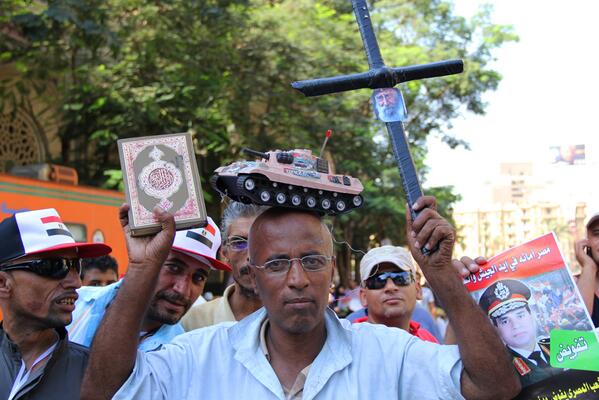
Man holds Quran and cross, symbolising unity at where people chant in support of the military & police pic.twitter.com/RKq3voUu1y
Посмотреть изображение в Твиттере

Demonstrators carried posters with photographs of army chief and defense minister General Abdel Fattah El-Sisi, who on Wednesday called for Egyptian citizens to take to the streets to give the army a mandate to fight “terrorism and violence.”
As helicopters flew low, protesters chanted slogans such as, "This night there will be no more Muslim Brotherhood," and "The army, the police, and the people are one hand.”
Anti-Mursi protesters carrying posters of army chief Abdel-Fattah El-Sisi chant slogans as they start to gather for a mass protest to support the army in Tahrir square, Cairo, July 26, 2013.(Reuters / Asmaa Waguih)

"It's a wonderful day. We lost a year of Egypt under Mohamed Morsi who only brought us injustice; he destroyed tourism, the media, and the economy,” said protester Khaled Mostafa, a justice ministry employee, as quoted by Ahram Online. 


Outside the square, clashes broke out between supporters and opponents of ousted President Mohamed Morsi in the neighborhood of Shubra. Ten people were injured in the violence. According to security sources, the demonstrators suffered bruises, fractures, and birdshot wounds. 
Two marches comprising of hundreds of Morsi supporters from across Egypt's provincial towns gathered for prayers at Cairo mosques. The groups marched to Rahman Raheem mosque on Salah Salem Street and Rashdan mosque in Nasr City, Al-Masry Al-Youm news agency reported. 


rally in besides mosque w/ extra photos pic.twitter.com/Q5Jw4jIo1s
Посмотреть изображение в Твиттере

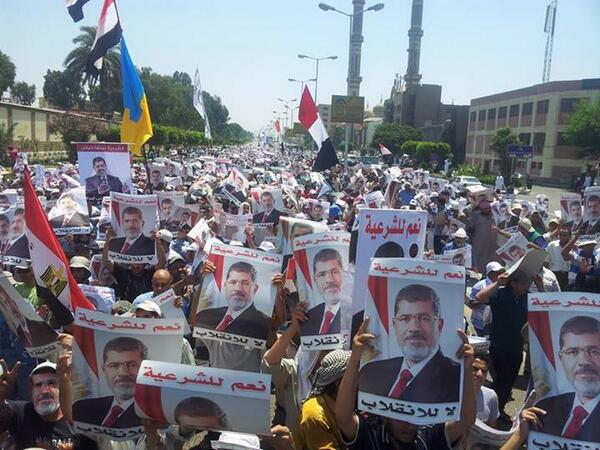
There, protesters chanted anti-military, pro-Morsi slogans. Demonstrators carried photos of the ousted president, as well as pictures of the Egyptian and black Islamist flags. Morsi’s supporters also staged a sit-in at nearby Rabea al-Adaweya mosque. The venue has been used as a tent camp for almost a month. 
Military armored vehicles were positioned outside the Ittihadiya presidential palace and around Tahrir Square, Ahram Arabic news website reported. 

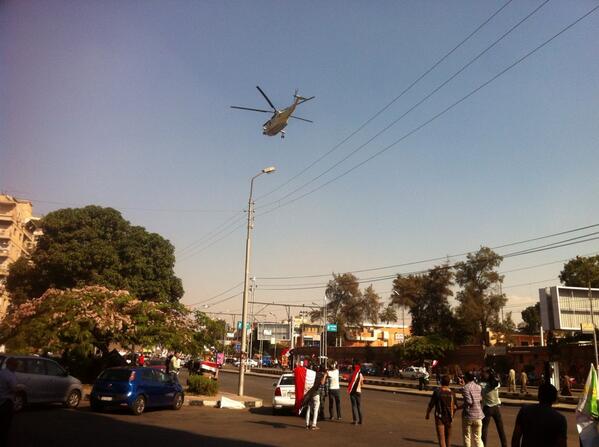
As the day goes on, helicopters are getting lower. This one at Itehadyia where pro-Sisi crowd is gathering. pic.twitter.com/cGqf2hUIYN
Посмотреть изображение в Твиттере


Violent clashes erupted in the northern city of Alexandria, killing five people and wounding at least 86 more, according to media reports. Medics said that most of the injuries were results of bird shots and wounds from sharp objects. Police reportedly fired tear gas near Qaed Ibrahim Mosque to disperse crowds. 
Injuries were also reported in the Nile Delta city of Gharbiya and the port city of Damietta.
On Thursday, Egypt's military leaders gave the Muslim Brotherhood 48 hours to sign up to political reconciliation. However, the army now denies that it intends to launch a crackdown on the Muslim Brotherhood and its supporters.

Anti-Mursi protesters shout slogans as they wave Egyptian national flags during a rally and march around El-Thadiya presidential palace in Cairo July 26, 2013.(Reuters / Amr Abdallah Dalsh)


The Muslim Brotherhood argues that the military-backed deposition of Morsi on July 3 was an illegitimate coup. But the army says that it responded to the calls of the Egyptian people who protested against the country’s political and economic turmoil and demanded an end to Morsi’s administration.

The Egyptian army was initially holding the ousted President in detention “for his safety.” But on Friday, an Egyptian court issued Morsi’s arrest order on charges of conspiring with the Palestinian Islamist group Hamas - killing prisoners and officers "deliberately with prior intent,” kidnapping officers and soldiers, and setting fire to Wadi el-Natroun prison.


Friday, 5 July 2013

Backlash in Egypt

Egypt prepares for backlash as Morsi allies reject new regime

Ousted Muslim Brotherhood mobilises for day of protest as hundreds of party's members are seized

Egypt's new interim president Adly Mansour has launched a widespread crackdown on the Muslim Brotherhood's leadership. Photograph: Khaled Desouki/AFP/Getty


4 July, 2013


Egypt is braced for further dramatic events on Friday as the vanquished Muslim Brotherhood called for a "day of rejection" following a widespread crackdown on its leadership by the country's new interim president, Adly Mansour.

Supporters of the ousted president Mohamed Morsi, still reeling from the military coup that removed their leader from power, are expected to take to the streets after Friday prayers following a series of raids and arrests that decimated the Muslim Brotherhood's senior ranks and consolidated the miltary's hold on the country.

In a stark sign of Egypt's new political reality, the group's supreme leader, Mohamed al-Badie, who was untouchable under Morsi's rule, was one of those arrested.

Gehad el-Haddad, a spokesman for the Muslim Brotherhood, said: "We are being headhunted all over the country. We are holding a mass rally after Friday prayers to take all peaceful steps necessary to bring down this coup." He called for demonstrations to be peaceful, despite fears that anger may spill over into violence.

State prosecutors announced on Thursday that Morsi, who is in military custody, would face an investigation starting next week into claims that he had "insulted the presidency" – a move that would appear to put an end to any hopes of a political resurrection.

At his inauguration on Thursday, Mansour, who was appointed as head of the constitutional court on Sunday, said this week's protests had "corrected the path of the glorious revolution that took place on 25 January 2011", and that continued revolution was needed until "we stop producing tyrants."

He also reached out to members of the Muslim Brotherhood, calling the organisation "part of the fabric of Egyptian society".

"They are just one of its parties and they are invited to integrate. If they answer the call, they will be welcomed," he told Channel 4 in his first interview.

But the severity of the crackdown on the Brotherhood leadership suggests that the overture will not be well received. Besides Badie, security officials also arrested his predecessor, Mahdi Akef, and one of his two deputies, Rashad Bayoumi, as well as Saad el-Katatni, head of the Brotherhood's Freedom and Justice Party, and the ultraconservative Salafi figure Hazem Abu Ismail, Associated Press reported.

Badie was arrested late on Wednesday from a villa where he had been staying in the Mediterranean coastal city of Marsa Matrouh and flown by helicopter to Cairo, security officials told AP.

The arrests of up to 300 Muslim Brotherhood officials are believed to have been ordered since the country's military commander, General Abdel Fatah al-Sisi, brought an end to Morsi's presidency on Wednesday night, a little over a year since he was inaugurated as the country's first democratically-elected leader.

The shockwaves have resounded in Egypt since then, with scenes of euphoria in the capital being met with foreboding in some towns and provinces, particularly in impoverished areas that had remained loyal to Morsi throughout the past turbulent year.

Hostility between the judiciary and Morsi's office had been a defining theme of his presidency. He had clashed heatedly with judicial leaders over the drafting of a new constitution, which was set aside yesterday.

Barack Obama said that he was troubled by Morsi's removal, and warned that US authorities were reviewing aid to Egyptian military – but he stopped short of calling the army's intervention a coup. He also condemned the arrest of Morsi and members of the Muslim Brotherhood.

The US president had invested political capital in establishing Morsi's democratic credentials, while maintaining ties to the Egyptian military, which had been the main beneficiary of $1.3bn (£850m) in US aid.

However, Egyptian military leaders also hold leverage over the US, primarily by maintaining a peace treaty with Israel as well as keeping the Suez Canal open and patrolling the strategically sensitive Sinai Peninsula.

Obama said: "We are deeply concerned by the decision of the Egyptian armed forces to remove President Morsi and suspend the Egyptian constitution. I now call on the Egyptian military to move quickly and responsibly to return full authority back to a democratically elected civilian government as soon as possible through an inclusive and transparent process, and to avoid any arbitrary arrests of President Morsi and his supporters."

One of the most senior Muslim Brotherhood members remaining at liberty also slammed the new military-backed order. "We declare our complete rejection of the military coup staged against the elected president and the will of the nation," said Abdel-Rahman el-Barr to the thousands gathered at a pro-Morsi demonstration in east Cairo. "We refuse to participate in any activities with the usurping authorities."

The place where it all began last Sunday, Tahrir Square, was quieter than at any time since on Sunday, with a sense of calm and normality returning to the area that had hours earlier been the scene of some of the biggest celebrations Egypt had ever witnessed.

Military jets flew a series of overflights in formation, an apparent display of triumph as much as support. A police helicopter also hovered over the square around the square for the first time since protests began, it's pilot waving from the window at a cheering crowd below.

Helicopters also circled the Rabaa mosque in the east of Cairo, where Brotherhood supporters appear to be preparing for a long stay, despite the presence of military armoured columns not far away.


Men in hard hats, carrying improvised clubs and shields are guarding main entrances to the mosque area. "We are only here to defend ourselves," said Mohammed Ahmed, 35. "After what happened on Wednesday, anyone may come for us. Gangs, the police, the army. We will not let them win."


Cairo celebrates end of Islamists rule on 2nd day


http://www.youtube.com/watch?v=oZD6DKBarIY


"NATO and the United States should change their policy because the time when they dictate their conditions to the world has passed," Ahmadinejad said in a speech in Dushanbe, capital of the Central Asian republic of Tajikistan

US presses Egypt to avoid 'arbitrary arrests' of Muslim Brotherhood officials
The United States has asked Egyptian officials to stop cracking down on the members of the Muslim Brotherhood a day after the democratically-elected government of Mohammed Morsi was toppled in a military coup


5 July, 2013


In contacts with Egyptian officials in Cairo, members of President Barack Obama’s national security team pressed them to avoid “the arbitrary arrests” of Morsi and his supporters and called for a "quick and responsible return" to elected civilian government, a White House official said on Thursday.

"Members of the president's national security team have been in touch with Egyptian officials and our regional partners to convey the importance of a quick and responsible return of full authority to a democratically elected civilian government as soon as possible," the official said.

U.S. officials, including the president, have carefully avoided using the workd 'coup' in reference to the military’s toppling of Morsi, knowing that according to the laws, the US government is prohibited from giving aid to "the government of any country whose duly elected head of government is deposed by military coup d'état or decree or … a coup d'état or decree in which the military plays a decisive role."

However, U.S. officials had warned that any political crackdown on Morsi's supporters could endanger the $1.3 billion military aid to Egypt. The amount is nearly 20% of Egypt's military budget.

After Israel, Egypt is the second biggest recipient of U.S. foreign assistance.

Many senior Egyptian officers are trained in the U.S. and the U.S. has a lot of clout within the Egyptian army.

Muslim Brotherhood's Supreme Leader Mohammed Badie was arrested on Thursday by Egyptian military police in a resort village in the western city of Marsa Matrouh. Morsi himself is reportedly under a house arrest.


State media reported that arrest warrants have been issued for a total of 300 Brotherhood officials.