Showing posts with label Miami. Show all posts

Friday, 6 October 2017

Miami floods with king tides

Miami Mayor: City Flooding "Like a Hurricane" Again Today Thanks to King Tides


6 October, 2017


Thanks to sea-level rise, Florida's unique topography, and poor city planning, areas of Miami-Dade County look like a hurricane hit them today. But there's not even a tropical storm in town. Instead, mere weeks after a real hurricane did damage major parts of South Florida, the Miami area is massively flooding again today thanks to a combination of some moderate storms hitting during King Tides, when the sea is at its highest point all year.

Photos of Miami circulating online today are hard to distinguish from the city during Hurricane Irma. And the high tides aren't just limited to Miami Beach. On the mainland, City of Miami Mayor Tomas Regalado, who is currently pushing a $200 million sea-level-rise mitigation and resiliency plan, has been driving around town all day taking note of the flooding. He's not pleased.

"Today, Miami is flooding as if a hurricane went through it," Regalado tweeted just before noon.

This is bad. We're only beginning to see the impacts of climate change in Miami, and flooding is already shutting the city down multiple days per year. The National Weather Service says a flooding advisory will remain in effect across most of mainland Miami until 2:15 p.m., thanks to poorly designed city drainage systems.

are happening now. Please avoid areas if possible. This is NW 6th Street and 7th Avenue in
0:27
At around 10 a.m., the City of Miami issued a warning to residents, which basically told them to avoid trying to drive downtown. A map the city released warned that streets along the major Biscayne Boulevard corridor from the Upper Eastside south to Downtown could become too flooded to drive through. The city said the same could be true for portions of the Venetian Causeway into Miami Beach.


View map for areas. Driving through floodwater NOT advisable. It may be deeper than appears & unseen debris can cause flat tires
 

Naturally, Miami Beach is pretty much a no-go zone all day today, too. Miami Herald reporter Joey Flechas has snapped multiple images of flooded roads and streets across the island — he also noted online that the flooding is comparable to what happened when Irma hit.


Barring major changes, this is the new normal in Miami. The dire, city-sinking-into-Atlantis warnings that countless scientists and major magazines have predicted is not coming in the future — it's already here, and city officials are struggling to react. The same areas of the county that flooded today were also inundated when the remnants of Tropical Storm Emily hit in August.

Miami Beach is rushing to complete a $400 million stormwater-pumping program designed to mitigate the impacts of tidal-flooding events like this. Since the Emily flooding fiasco, where multiple pumps in Sunset Harbor neighborhood failed due to power outages, Levine has repeatedly gone on the defensive, reminding the public that only 15 percent of the pump-upgrades have been installed so far. Moreover, the city said those pumps aren't even designed to fight against flooding from major storms and hurricanes, which are likely to knock power out to the systems — a statement that angered many residents.

But there isn't that much local city leaders can really do. They're not in a position to, say, force major polluters to stop spewing carbon into the air or broker emissions deals with the Indian and Chinese governments.

Regalado is now pushing his own upgrade-plan for the city, campaigning to convince residents to vote for the $400 million "Miami Forever" proposal in November. Half of that money would go toward drainage-improvement and stormwater pumping projects in areas like Downtown and Brickell, which are underwater again today. The plan would also pay for Miami to raise its seawalls. Regalado tweeted earlier today that the existing walls were swallowed this morning by the King Tides.


Monday, 11 September 2017

Hurricane Irma strikes Miami

Shocking video of Miami River flooding skyscrapers looks like a real-life disaster movie


Video posted on Sunday showed skyscrapers bordering the Miami River being flooded as Hurricane Irma made landfall.

Twitter user Killarney Knight‏ posted the video, which shows area buffeted by the incoming storm surge.
Some Twitter users pointed out, however, that Knight‏’s approximation to the Miami River made the flooding seem worse than it was, and that other parts of the city were in better shape.
Miami downtown underwater 😵😵😵

Water empties from bay in Tampa, but folks warned: stay out


10 September, 2017


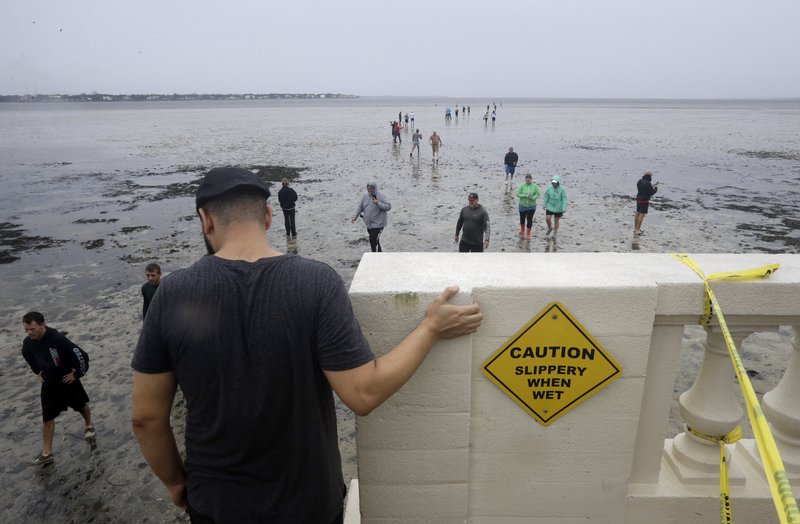
TAMPA, Fla. (AP) — Hurricane Irma has pushed water out of a bay in Tampa, but forecasters are telling people not to venture out there, because it’s going to return with a potentially deadly vengeance.


On Bayshore Boulevard in Tampa, about 100 people were walking Sunday afternoon on what was Old Tampa Bay — a body of water near downtown. Hurricane Irma’s winds and low tide have pushed the water unusually far from its normal position. Some people are venturing as far as 200 yards (180 meters) out to get to the water’s new edge. The water is normally about 4 to 5 feet (1 to 1.5 meters) deep and reaches a seawall.


The U.S. Hurricane Center has sent out an urgent alert warning of a “life-threatening storm surge inundation of 10 to 15 feet (3 to 5 meters) above ground level” and telling people to “MOVE AWAY FROM THE WATER!”


The waters retracted because the leading wind bands of Irma whipped the coastal water more out to sea. But once the eye passes and the wind reverses, the water will rush back in.

Hurricane IRMA Devastation | Key Largo,Florida | Ocean Gone


Paraquota Bay in the British Virgin Islands

http://www.telegraph.co.uk/news/2017/09/05/hurricane-irma-heads-towards-florida-caribbean-pictures/pleasure-craft-lie-crammed-against-shore-paraquita-bay-eye-hurricane/


Sunday, 10 September 2017

Poo-laden water around the streets of Miami

I suspect this might be the least of it.


Hurricane Irma will likely cover South Florida with a film of poop

9 September, 2017

South Floridians are bracing for Hurricane Irma’s potentially catastrophic damage. Weather advisories are warning of massive flooding, which will likely render roads impassable and homes uninhabitable.

They also face a less visible, yet frightening, potential consequence: contamination from uncontained poop.

Just as it downs electricity poles and submerges streets above ground, the avalanche of water unleashed by a hurricane disrupts the order of things down below, where waste goes after you flush. South Florida’s sewer infrastructure is particularly vulnerable. Like many urban areas across the US, its wastewater lines are rickety. On top of that, many locals store their sewage in underground septic tanks, whose contents are prone to escape during storms.

The prospect of poop-laden water pooling around in the streets of Miami is scary enough, yet it’s just a symptom of a much bigger problem that plagues hurricane-prone Florida. Rising sea levels are upending its ability to deal with floodwater—and both sea levels and flood-inducing storms will get worse with climate change.
That’s the real horror story.


Draining the swamp


The only reason the naturally swampy terrain of South Florida can sustain more than six million people today is because its previous residents dredged and drained it. The operations started in the late 1800s, and by the 1970s Floridians had built an expansive network of canals, levees, and pumping stations to keep water at bay. The system, which was designed to let gravity drag groundwater downstream to the ocean, was based on 1930s sea levels, as Frederick Bloetscher, a water-management expert, pointed out during a 2014 US Senate hearing on Florida’s changing coastline.

Fast forward nearly 90 years, and sea levels are higher. The rise “kind of frustrates that initial goal, and as a result we see more frequent flooding not only on the coast but inland, because inland doesn’t discharge as easily,” Bloetscher told Congress.

The swelling oceans are also complicating draining by seeping into Florida’s porous limestone floor and raising groundwater levels as well. The water coming in from below is also drenching the soil, reducing its ability to collect water coming from above.

So in some parts of Florida, such as Miami Beach, the barrier island dangling off the Miami coast, flooding has become a near daily part of life.

Mixed waters

Backed up toilets are also becoming a more common occurrence. The waste produced by about a third of the people going to the bathroom any given day in Florida (that includes tourists) goes into a septic tank. In order for a tank to do its job, there needs to be room for the liquid portion of the waste to slowly filter down into the ground. When groundwater levels go up, though, they push the waste back up, sometimes resulting in a poop flood.

The area’s creaky sewer system is another potential source of fecal contamination. It was in such bad shape that the US Environmental Protection Agency sued Miami-Dade County in 2012 for violating various water pollution laws. The county made notable improvements last year, reducing the volume of spilled sewage by 55%, or roughly 1.5 million gallons, according to its 2016 annual report to federal regulators. But a single spill this year, amounted to half of that. To Kelly Cox, staff attorney at Miami Waterkeeper, a clean-water advocacy group, that’s evidence that “the water infrastructure is at risk and could be easily compromised by a storm the size of Irma.”

But leaky pipes could be a minor problem compared to the flooding of one of Miami-Dade’s three water treatment plants, two of which are vulnerable because they lie low-coastal areas, says Cox.

As Hurricane Sandy showed, that can have some nasty consequences. During that storm, the surging ocean dumped nine feet of water on the pumping system engines of the Bay Park treatment plant, in Nassau County, NY. The resulting raw sewage backlog made its way into channels, streets, and people’s houses homes, according to Arcadis, the international engineering firm that helped repair the plant.

On top of the pollution, Sandy put the plant out of commission for two weeks. So even as the floodwater receded, people still couldn’t flush their toilets. It’s a scenario that could unfold in Florida in the aftermath of Irma, says Edgar Westerhof, Arcadis’s national director for flood risk and resiliency.

Pump it out

Waste appears to filtering into the floodwater even without a single drop of drain. In Miami Beach, an exceptionally high, or king, tide is enough to cause a flood. To deal with the water rush, the city has been installing an expensive system of pumps. That gets the problem out of the streets, and dumps it straight into the ocean.

Sewage contamination in water leads to algal blooms, which can have a host of dire consequences that threaten humans, wildlife, and Florida’s multi-billion dollar tourism industry.

The water that Miami Beach pumped into Biscayne Bay in 2014 and 2015 after king tides had live fecal bacteria that significantly exceeded regulatory limits, according to a study by researchers from the US National Oceanic and Atmospheric Agency and several Florida Universities. Much of it came from humans. “This most likely comes from tidal floodwater flushing of old and leaking underground sewage and septic infrastructure in the interior of the island,” the authors concluded.


Local authorities dismissed the study’s results, calling them sloppy science. It will be more difficult to dismiss whatever evidence about Florida’s vulnerable sewer system Irma washes up

Thursday, 7 September 2017

What Irene may have in store for Miami


Miami is unable to deal with flooding after a downpour already.

Here are 6 terrifying reasons to fear Miami ‘won’t survive’ Hurricane Irma


6 September, 2017


Hurricane Harvey was a tragic nightmare that hit the Texas shores with force and then lingered for days dumping massive amounts of rain on a city ill-equipped to handle it. Florida is next and if predictions are accurate, Hurricane Irma is going to be far worse than Houston and worse than anyone has prepared for.
Already, Irma is setting records and being named the strongest storm the Atlantic Ocean has seen on record. Here is a short list of things meteorologists and experts at the Hurricane Center have already seen from Irma that should give everyone pause:


1. The wind speeds broke the measuring tool:
The wind was so strong when Irma passed over Barbuda the monitoring equipment used to measure the wind was damaged and couldn’t report an accurate account of the wind speed. It tapped out at 151 mph.
2. What 185 mph wind looks like should strike fear into the hearts of anyone.

The gusts for the Category 5 storm have reached 185 mph. That’s the equivalent of an EF4 tornado sitting on an area – nonstop for hours. To put that into perspective, the photo below is of the damaged sustained by residents of Garland/Rowlett, Texas after an EF4 tornado blew through in 2015.
Hurricane Harvey was a tragic nightmare that hit the Texas shores with force and then lingered for days dumping massive amounts of rain on a city ill-equipped to handle it. Florida is next and if predictions are accurate, Hurricane Irma is going to be far worse than Houston and worse than anyone has prepared for.
Already, Irma is setting records and being named the strongest storm the Atlantic Ocean has seen on record. Here is a short list of things meteorologists and experts at the Hurricane Center have already seen from Irma that should give everyone pause:

1. The wind speeds broke the measuring tool:

The wind was so strong when Irma passed over Barbuda the monitoring equipment used to measure the wind was damaged and couldn’t report an accurate account of the wind speed. It tapped out at 151 mph.
2. What 185 mph wind looks like should strike fear into the hearts of anyone.

The gusts for the Category 5 storm have reached 185 mph. That’s the equivalent of an EF4 tornado sitting on an area – nonstop for hours. To put that into perspective, the photo below is of the damaged sustained by residents of Garland/Rowlett, Texas after an EF4 tornado blew through in 2015
To make matters worse, NOAA’s tools dropped into the hurricane to measure the storm, recorded 226 mph gusts from the northeast eyewall of the storm.
View image on Twitter
7:15 PM - Whoa. Dropsonde in NE eyewall 196 knot winds just 19mb above the surface, 167 knot winds in lowest reported level. 


3. No one has heard from the tiny island it hit in hours.

Barbuda is a tiny island with barely over 1,000 residents. The top elevation on the island is 38 meters or 125 feet above sea level. Storm surges, however, predict waves will reach seven to 11 feet in the Northern Leeward Islands. That was worse for the Turks and Caicos Islands which is expected to see 15 to 20 ft. storm surges. As long as the surges are under 10 feet, Barbuda will be fine, but if they saw storm surges like what is expected for Turks and Caicos, it will literally destroy the island.

Already, what scientists have seen from Barbuda is leaving them speechless. Tide sensors in Barbuda recently reported 7.89 ft above what the average height of the top tide is each day.
I am at a complete and utter loss for words looking at Irma’s appearance on satellite imagery,” tweeted Taylor Trogdon, from the National Hurricane Center‏.
I am at a complete and utter loss for words looking at Irma's appearance on satellite imagery.
4. Irma literally ripped grass from its roots.
CNN meteorologist and the severe weather expert Chad Myers reported on air that there were parts of Barbuda that saw vegetation ripped from the soil the winds were so strong. The claim hasn’t been reported by other outlets and there aren’t yet photos or video to see the full extent of the damage.
5. Miami isn’t prepared — no one is.

Florida is as good as it gets at handling hurricanes. It’s similar to states that are accustomed to navigating tornadoes or earthquakes. Citizens who live there know what to do and how to prepare for a storm. However, the strength of this storm seems to dwarf more recent hurricanes.
Already, the city of Miami is being forced to raise their roads to accommodate rising waters creeping into their city. A report from The Atlantic details that the last major hurricane to hit Miami was in 1926 and 400 people were killed. Back then, the city boasted 100,000 residents, but today that number is more like 6 million.

Disaster planners have long been concerned about a natural event of this magnitude hitting a major U.S. city. If Irma turns toward Florida, this will be the horrific event they’ve feared.
It won’t survive,” said former top emergency manager Craig Fugate in 2014.
6. President Donald Trump only barely understands the crisis.

During a meeting with Democratic and Republican leaders, Trump acted as if he had some special insider information on the severity of Hurricane Irma. All he could manage was to tell them it is “not good.”

"(Irma) looks like it could be something that will be not good. Believe me, not good," Trump says in Oval.