Showing posts with label HSBC. Show all posts

Thursday, 14 January 2021

HSBC threatens to close bank accounts of those who refuse masks

HSBC Threatens to Close Accounts of Customers Who Refuse to ‘Mask-up’


21st Century Wire,

13 January, 2021


Recently, 21WIRE has highlighted the highly credible, in-depth peer-reviewed scientific study out of Denmark, which proves beyond any doubt that masks do very little, if anything, to stop the transfer of viruses between humans. Despite the bountiful evidence on this issue, such studies on the efficacy and health side effects from masks have been routinely ignored by public health gurus in ‘pandemic’ policy leaders the UK and US. Why? Because the findings of these studies go against the government and media narrative.

This latest move to criminalize non-mask wearers by leading retail bank HSBC takes the pandemic ‘health and safety’ craze to new extremes – despite the fact that neither corporations, nor the government can provide any actual proof that the threat of COVID is somehow greater today than it was in March 2020, the groupthink on evidence-free policy decisions continue.

Are we now seeing the final steps of an extreme social engineering agenda being implemented?

The UK Mirror reports…
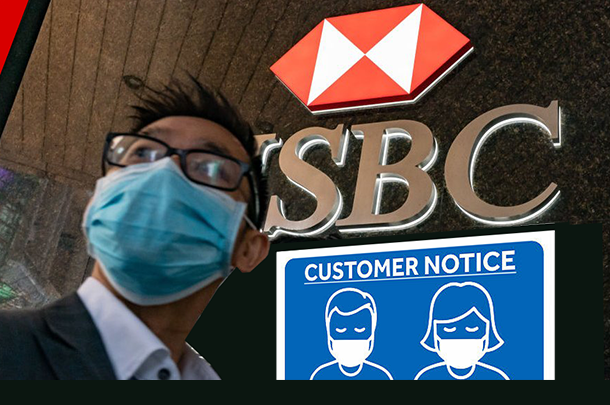

HSBC has issued a warning to customers as retailers step up coronavirus safety measures amid a further 1,243 deaths. The lender – which also owns First Direct and Marks & Spencer bank – said customers who break the law could forfeit their bank account.

Speaking to The Mirror, a spokesman said face masks are mandatory in all branches as per government guidelines.

Those who refuse to comply will be refused service and could have their bank accounts withdrawn.

Jackie Uhi, head of branch network, HSBC UK said: “Our branch colleagues are key workers, continuing to go to work in our branches every day so that customers who need them can access essential financial services.

“Sadly, some people are failing to protect themselves, our branch colleagues and other customers by refusing to wear a face covering inside our branches or observe social distancing.

“Our colleagues deserve respect and should not have to face violent or abusive behaviour. Consider whether you need to visit the branch or could manage your banking from the safety of your home via our digital channels.

“If you do visit us, please wear a face covering and maintain a safe distance from others. If individuals put themselves or our colleagues at risk, without a medical exemption, we reserve the right to withdraw their account”

The Mirror has also asked Santander, Barclays, Lloyds, Natwest and Nationwide for updated guidance and will update this story in due course.

The Post Office said customers must obey the law, but warned it will not be enforcing measures.

“Postmasters that they can ask a customer who is not wearing a facemask if they are medically exempt, but the customer is not required to provide medical proof if they do not have it with them when they visit a branch,” a spokesman said.

“Post Office will implement any updated guidance issued by the UK Government or Devolved Governments. At this stage, Post Office has not advised Postmasters to refuse entry to any customer that does not have a face mask.

Continue this story at the Mirror

Sunday, 26 January 2014

Bank run fears

As a matter of interest, I could not find any reference to this in the British Press. The Huffington Post mentions it though.

Bank-Run Fears Continue; HSBC Restricts Large Cash Withdrawals


24 January, 2014


Following research last week suggesting that HSBC has a major capital shortfall, the fact that several farmer's co-ops were unable to pay back depositors in China, and, of course, the liquidity crisis in China itselfnews from The BBC that HSBC is imposing restrictions on large cash withdrawals raising a number of red flags

The BBC reports that some HSBC customers have been prevented from withdrawing large amounts of cash because they could not provide evidence of why they wanted it. HSBC admitted it has not informed customers of the change in policy, which was implemented in November for their own good: 


"We ask our customers about the purpose of large cash withdrawals when they are unusual... the reason being we have an obligation to protect our customers, and to minimise the opportunity for financial crime." As one customer responded: "you shouldn't have to explain to your bank why you want that money. It's not theirs, it's yours."


Some HSBC customers have been prevented from withdrawing large amounts of cash because they could not provide evidence of why they wanted it, the BBC has learnt.
Listeners have told Radio 4's Money Box they were stopped from withdrawing amounts ranging from £5,000 to £10,000.
HSBC admitted it has not informed customers of the change in policy, which was implemented in November.
The bank says it has now changed its guidance to staff.
...
"When we presented them with the withdrawal slip, they declined to give us the money because we could not provide them with a satisfactory explanation for what the money was for. They wanted a letter from the person involved."
Mr Cotton says the staff refused to tell him how much he could have: "So I wrote out a few slips. I said, 'Can I have £5,000?' They said no. I said, 'Can I have £4,000?' They said no. And then I wrote one out for £3,000 and they said, 'OK, we'll give you that.' "
He asked if he could return later that day to withdraw another £3,000, but he was told he could not do the same thing twice in one day.
 ...
 Mr Cotton cannot understand HSBC's attitude: "I've been banking in that bank for 28 years. They all know me in there. You shouldn't have to explain to your bank why you want that money. It's not theirs, it's yours."
...
HSBC has said that following customer feedback, it was changing its policy: "We ask our customers about the purpose of large cash withdrawals when they are unusual and out of keeping with the normal running of their account. Since last November, in some instances we may have also asked these customers to show us evidence of what the cash is required for."
"The reason being we have an obligation to protect our customers, and to minimise the opportunity for financial crime. However, following feedback, we are immediately updating guidance to our customer facing staff to reiterate that it is not mandatory for customers to provide documentary evidence for large cash withdrawals, and on its own, failure to show evidence is not a reason to refuse a withdrawal. We are writing to apologise to any customer who has been given incorrect information and inconvenienced."
 ...
But Eric Leenders, head of retail at the British Bankers Association, said banks were sensible to ask questions of their customers: "I can understand it's frustrating for customers. But if you are making the occasional large cash withdrawal, the bank wants to make sure it's the right way to make the payment."

The arrogance is incredible...

Wednesday, 25 July 2012

Thursday, 19 July 2012

Bank connected with terrorism in Saudi Arabia


HSBC report pushes West to rethink alliance with Saudi Arabia’
A US Senate subcommittee has discovered that British banking giant HSBC gave money to a Saudi bank with suspected links to terrorist organizations such as al-Qaeda. Saudi Arabia has not responded to the findings.
RT,
18 July, 2012

A US Senate subcommittee has discovered that British banking giant HSBC gave money to a Saudi bank with suspected links to terrorist organizations such as al-Qaeda. Saudi Arabia has not responded to the findings.
Middle East expert Ali Rizk told RT that the findings put pressure on the West to reconsider its friendly relations with Saudi Arabia. 

A report published by the Permanent Subcommittee on Investigations states that HSBC provided funds to the Saudi Al-Rajhi Bank, which a number of media and government reports have tied to terrorist organizations such as al-Qaeda. The company’s top executive appeared before the subcommittee’s hearing Tuesday, and apologized for failing to prevent such oversights. HSBC’s Head of Compliance, David Bagley, said he would resign. 
Neither Saudi Arabia, nor Al-Rajhi responded to the subcommittee’s findings, however. 

RT:The report names Al-Rajhi Bank, Saudi Arabia’s and the Muslim world largest bank, as a sponsor of terrorism. What does that mean?

Ali Rizk: I think it really stems down to the fact that Saudi Arabia is the main exporter of what could be called radical Islam, the kind of Islam that has tarnished the essence of the real Islam of moderation. 

RTWhat sort of terrorist groups are we talking about here?

AR: We’re talking about Wahhabi extremists, those people who are now causing violence in Syria, those people who were sent to Chechnya, groups in Uzbekistan. Some elements of the royal family also have also contributed to al-Qaeda. Bandar bin Sultan, the former Saudi ambassador to Washington, for example, met with Osama bin Laden time and again. So we’re talking about all the Sunni extremists groups. The Saudi role in financing al-Qaeda and extremist activity in Iraq is very well known. More importantly, I think that this report further sheds light on the alliance between the Saudi royal family and some Western countries. This will put more pressure on the Western governments to try and change their policy. Now, of course, Saudi Arabia is considered to be an ally. Many people are speculating that maybe the Western governments might reconsider. 

RTWhy would they be doing that?

AR: First of all, because we have the uprisings currently happening, which put more pressure on the US and British governments. Until now, Saudi Arabia hasn’t taken any steps towards political reform. The other reason is that Saudi Arabia is the main source of this extremism that would lead to popular vigilance in countries such as the US and Britain. In all these countries, I think people will become more and more aware of what Saudi Arabia really represents, and hence the US might be pushed into a corner. By the way, Hillary Clinton recently said that they are fighting Wahhabism, so I think we are seeing a slow divergence between the West on the one hand and Saudi Arabia on the other. It hasn’t reached a very critical point as of yet, but I believe this report and more similar developments would put more pressure on the US and other Western governments.  

RTDo you expect any reaction from Riyadh on the report’s findings?

AR: I don’t think that we will see any apology. Saudi Arabia, I think, is behaving in an irrational way now. Saudi Arabia is terrified of what happened in Iraq; the Shia there with Prime Minister Nouri al-Maliki. In Lebanon, you have Hezbollah and increasing Iranian influence. And for that reason, Saudi Arabia is so enthusiastic to topple Bashar al-Assad because they consider him an asset for the Shia axis. I think what we are seeing in Damascus today is a Saudi Arabian response to an increasing Iranian role.

More on banking fraud


HSBC 'allowed drug cartels to launder money'
US senate probe has found that Europe's largest bank had lax controls that allowed money laundering for seven years.


18 July, 2012

Lax controls at Europe's largest bank, HSBC, allowed Mexican drug cartels to launder billions of dollars through its US operations, an investigation by the US senate has found.

The extensive report on London-based HSBC Holdings PLC by the Senate Permanent Subcommittee on Investigations also says US regulators knew the bank had a poor system to detect problems but failed to take action.

HSBC executives brushed off complaints from other bank employees, so that the problems persisted for eight years, the report says.

In addition, some HSBC bank affiliates skirted US government bans against financial transactions with Iran and other countries, according to the report.

And HSBC's US division provided money and banking services to some banks in Saudi Arabia and Bangladesh believed to have helped fund al-Qaeda and other terrorist groups, the report said.

The subcommittee released the report Monday ahead of a Tuesday hearing on the topic. HSBC released a statement saying its executives will offer a formal apology at the hearing.

"We will apologise, acknowledge these mistakes, answer for our actions and give our absolute commitment to fixing what went wrong," the statement said.

The US justice department said it is conducting a criminal investigation into HSBC's operations but declined to confirm that the bank is in settlement talks.

The US investigations follow the Barclays Bank scandal in the UK over manipulated interest rates, which has provoked international outrage over what many view as regulators' failure to enforce financial regulation.

HSBC's net income last year was $16.8bn. It operates in about 80 countries around the world. Its US division is among the top 10 banks operating in the United States. It has assets of roughly $210bn in its US operations.

Illicit money

Money laundering takes profits from the trafficking of drugs, arms or other illicit activities and passes them through bank accounts to disguise the illegal activity.

The bank used its US operation as a "gateway" into the US financial system for other HSBC affiliates, Senator Carl Levin, the subcommittee's chairman, told reporters Monday. Because of lax controls against money laundering, HSBC Bank USA "exposed the United States to Mexican drug money" and other suspicious funds, Levin said.


"In an age of international terrorism, drug violence in our streets and on our borders, and organized crime, stopping illicit money flows that support those atrocities is a national security imperative," Levin said Monday.

The bank said in its statement that it changed its senior management last year and has made changes to strengthen its compliance with rules to prevent money laundering.

"We ... recognize that our controls could and should have been stronger and more effective in order to spot and deal with unacceptable behaviour," the statement said.

Levin also blasted the federal agency supervising the bank's US operations, the Office of the Comptroller of the Currency. He said the agency "tolerated" HSBC's weak controls against money laundering for years.

Thomas Curry, who heads the Office of the Comptroller of the Currency, also will testify at Tuesday's hearing.

Compliance with anti-money laundering laws "is crucial to our nation's efforts to combat criminal activity and terrorism," Curry said in a statement. He said the agency expects banks to have adequate programs in place to comply with the laws.

The Wall Street Journal reported Monday that HSBC and the justice department have been in settlement talks and an accord could be struck within weeks.

Alisa Finelli, a spokesperson for the justice department, acknowledged that an investigation is under way but declined to comment on possible settlement discussions or a deal.