Showing posts with label Guatemala. Show all posts

Sunday, 10 June 2018

Dead crops after Guatemala's volcanic eruption


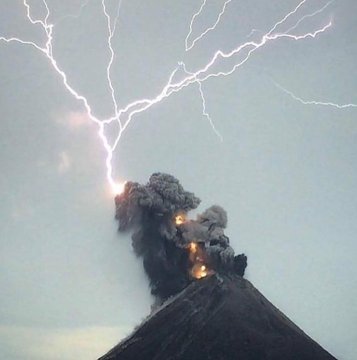
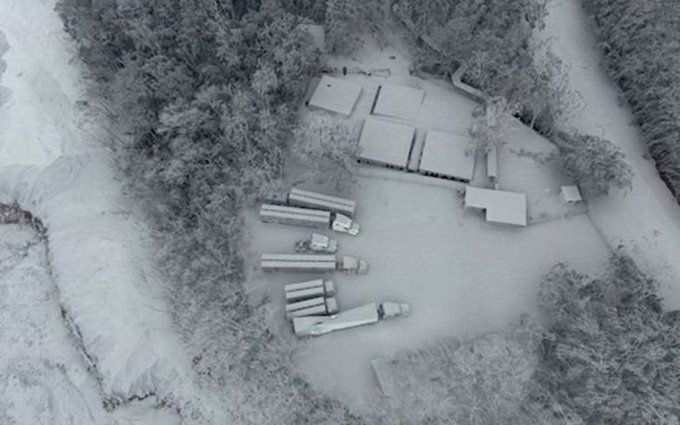
Ash covers more than half of Guatemala with dead crops a secondary disaster as the death toll hits 100 from Guatemala's Fuego volcano


Photo upi.com
9 June, 2018

The search for survivors from deadly eruptions of Guatemala's Fuego volcano was temporarily suspended on Thursday due to dangerous conditions for rescue workers, as the death toll from the disaster reached 100, authorities said.

Residents should stay away from the still-dangerous area, said David de Leon, a spokesman for national disaster management agency CONRED.

The toll of dead from a series of eruptions that began on Sunday has been gradually rising and now stands at 100, police said.

Rescue teams have been searching frantically for survivors and victims in the lava-ravaged landscape.

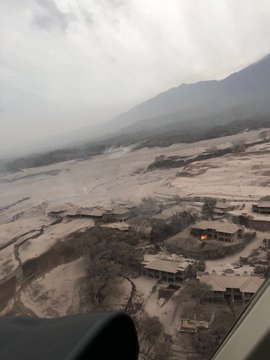
The violent eruptions showered volcanic ash over nearby towns and spewed pyroclastic flows throughout the area.

The U.S. government expressed its "deepest condolences" to the victims on Thursday and said it was sending emergency aid at Guatemala's request, including an unspecified amount of financial resources to help meet food, water, and sanitation needs.

The White House said in a statement that it was also dispatching aircraft to transport burn victims for treatment in Florida.

The International Federation of Red Cross and Red Crescent Societies (IFRC) raised concerns about the economic cost of the disaster in the poor Central American country.

"We should not underestimate the scale of this disaster.

Critical, emergency needs are still enormous, and affected communities will need to be sustained and long-term support," IFRC president Francesco Rocca said in a statement on Thursday.

Rocca noted that ash had fallen across more than half of Guatemala, covering areas where agriculture is crucial.

"We hope it will not mean a secondary disaster," he said.

The suspension of rescue efforts around the volcano may be lifted if conditions on the ground improve, CONRED said.

Fuego, or "Fire" in Spanish, lies about 25 miles (40 km) southwest of the capital, Guatemala City, near the picturesque colonial city of Antigua, a UNESCO world heritage site.

Wednesday, 6 June 2018

Guatemala Volcano Buries Entire Village, 65 Dead

"No Survivors": Guatemala Volcano Buries Entire Village, 65 Dead After Violent Eruption Spews Rivers Of Hot Lava


5 June, 2018

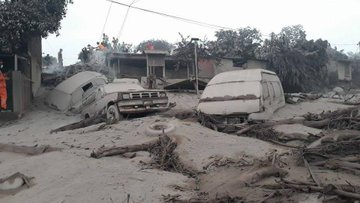
Rescue workers searched tirelessly for survivors amid a desolate grey landscape of ash and destruction on Monday, one day after Guatemala's Fuego volcano erupted near the capital. At least 65 are dead and an unknown number of people are missing, according to Guatemala's natural disaster commission, also known as Conred.
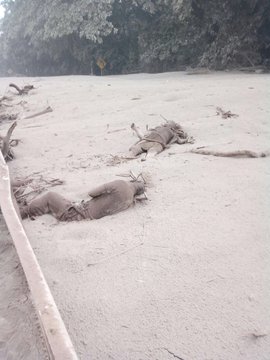
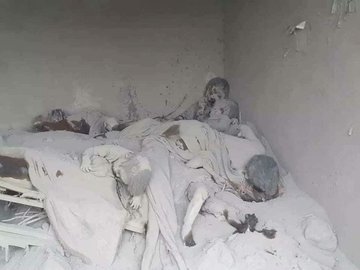
Volunteer firefighters waded though layers of ash that reached knee-deep in places, only to find the charred remains of those who had been unable to flee the torrent of burning rock and ash that poured down the slopes of the volcano, whose name means “fire.” -NYT

We saw bodies totally, totally buried, like you saw in Pompeii,” said Dr. Otto Mazariegos, president of the Association of Municipal and Departmental Firefighters, who added that the death toll was expected to rise, "Probably in the hundreds." 

Rescue workers have been unable to reach sites on the south side of the volcano due to a lack of access. 
The speed of the volcano's flows took many by surprise - with some stopping by the road to watch the eruption - only to break into a sprint when they realized how fast the plumes were approaching.


Survivors returning to the village of San Miguel los Lotes on Monday found nothing but distruction, as the village was turned to rubble by the force of the eruption. 
My mother is buried there,” Inés López told a Guatemalan newspaper, Prensa Libre, standing amid the wreckage of his home. He was numb with grief. “What can I do to cry? My heart is hard, hard. All our family is here, buried,” he said waving his hand over the ruins. -NYT


View image on Twitter
View image on TwitterView image on TwitterView image on Twitter
My aunt in Guatemala shared these powerful images of the Volcán de Fuego’s terrible wrath. These photos are being shared via WhatsApp groups in Antigua

View image on TwitterView image on TwitterView image on TwitterView image on Twitter
In recent days, a volcanic eruption occurred in Guatemala, killing more than 62 people. Men, Women and Children. Destroyed properties and livestock.

As the day wore on, officials were forced to suspend some rescue operations because of the fear that the volcano might erupt again. The deep ravines on the volcano’s slopes were already filled with lava, Dr. Mazariegos said, and there was no way to tell how a new flow might spread.
Published photos from morning visits to the disaster zone showed images of ordinary life frozen under a coat of gray dust. In one house, balloons and chairs were arranged for a child’s birthday party. -NYT
Over 3,000 people have been evacuated, and 1,689 found space in shelters in neighboring Escuintla and Alotenango, while 46 were taken to the hospital - many with severe burns. 
President Jimmy Morales declared three days of mourning before touring shelters and the disaster area. A weeping woman, Eufemia García, approached his van as he left the buried village of El Rodeo and Morales got out to listen: 
Mr. President, my family is missing ... Send a helicopter to drop water from above because it is burning there. I have three children, a grandchild, all my brothers and sisters, my mother — more than 20 are missing.”


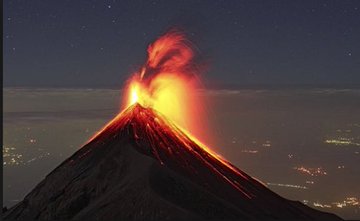
The build-up of energy inside the volcano generated an explosion that resulted in a second, lower crater forming alongside the spewing Fuego basin. The torrent of molten lava stretched at least five miles long crushing bridges, roads and buildings in its path. The lava reached record temperatures of about 700C.
Every time we lift off a metal roof a huge gush of steam rises out of the building,” rescue worker Juan Diego Alvarez tells the Guardian. “The ash is just too hot for us to work.” Nearby lie several pairs of abandoned burnt boots, melted by the boiling ash. -The Guardian


The Volcano, located less than 30 miles from Guatemala City, has been erupting since 2002 according to the Global Volcanism Program. 
It is a stratovolcano, like Mount St. Helens, with viscous lava that allows gas pressures to build and leads to more explosive eruptions.
The intense activity began on Sunday morning, with a strong explosion shortly before noon. The volcano then continued to spew ash, rocks and gas into the air. A second powerful eruption followed at 6:45 p.m. and the activity finally subsided after 16½ hours, Guatemala’s seismology and volcanology institute said. -NYT

The explosion was followed by pyroclastic flows - mixtures of hot rock and gasses that flow down the volcano's sides at great speed, where their high temperatures and "great mobility make them lethal to anything in their path." 
Ash billowed more than a mile above the volcano's cone, dispersing over an area of approximately 15 square miles, according to the volcanology institute. 
 “We heard a whoosh of the volcano, a sound we hadn’t heard before, and really strong vibrations,” said science teacher Fernando Aragón, who lives close to the volcano outside the town of Alotenango.
We could see the people fleeing the eruption on the road outside and the heavy machinery and rescue teams making their way up,” Mr. Aragón added.


Monday, 4 June 2018

7 killed, dozens injured & missing after Guatemala's Volcano of Fire shoots ash 10km into air

Guatemala's Fuego Volcano Kills 6, Injures Hundreds


Guatemala's Fuego volcano erupted today, killing 6 people and injuring almost 300. Get the latest details our LIVE COVERAGE.

The Fuego volcano, also known as Volcan de Fuego, is located 25 miles southwest of Guatemala's capital, Guatemala City. The eruption sent ash four miles into the sky, and some ash fell on Guatemala City. Lava flows from the volcano have reportedly struck at least one village.


In this live stream, host Steve Lookner gives you the latest updates on the Guatemala volcano, and he'll also take your comments and questions on the air!


7 killed, dozens injured & missing after Guatemala's Volcano of Fire shoots ash 10km into air


  At least 20 people have been injured and seven killed, after the Volcan de Fuego in Guatemala erupted, shooting smoke and rocks 10 km into the air and forcing a mass exodus from nearby villages blanketed by ash.

Seven people have been reported dead or missing so far, mainly in the community of El Rodeo, the National Coordinator for Disaster Reduction in Guatemala (Conred) confirmed, while at least another 20 were injured. Local reports indicate that some 2,000 people have fled the area.

Four people died after lava set a house on fire, while two children were burned to death while standing on a bridge watching the eruption unfold, Cabanas added, according to Associated Press.

After awakening on Sunday, and for the second time this year, the Volcan de Fuego (Volcano of Fire) has generated strong pyroclastic flows in the Barrancas de Cenizas, Mineral, Seca, Taniluya, Las Lajas and Barranca Honda localities, Conred said.

After shooting up some 10,000 meters into the air, the residue “advanced more than 40 kilometers” with the direction of the wind, Conred said, noting that the eruption “generated strong reverberations with shock waves causing vibration in roofs and windows at a distance of 20 kilometers.”

There were no immediate reports of any casualties, but authorities are advising those close to the crater to evacuate the area. The International Airport La Aurora closed its runway due to the volcanic ash as a precautionary measure.

The eruption, the strongest recorded in several years, is now affecting the municipalities of Antigua Guatemala, Alotenango, San Antonio Aguas Calientes, Santa Catarina Barahona, Ciudad Vieja, San Miguel Dueñas, Acatenango, San Andres Itzapa, Patzicia, Saragoza, Patzún and Tecpán Guatemala. Locals, meanwhile, have shared dramatic photos and videos showing a massive ash column reaching to the sky

Wednesday, 27 March 2013

Earth events - 26 March, 2013


Quake hits Guatemala, no initial reports of damage


A powerful earthquake struck Guatemala close to the capital on Monday, though residents of Guatemala City felt little movement from the deep tremor and emergency services said there were no initial reports of damage or injuries.

The epicenter of the 6.2 magnitude earthquake, initially reported as a magnitude 5.8, was only 6 miles southeast of Guatemala City but it was at a depth of 124.6 miles, lessening its effect.

Two Reuters witnesses in the city said they did not feel the quake, nor did they see people running outdoors as is often the case when powerful tremors hit.

David de Leon, a spokesman for Guatemala's emergency agency, CONRED, said he had no reports of damage or victims.

A magnitude 6.2 quake is capable of causing severe damage.

Last November, more than 50 people were killed in a 7.5 magnitude quake in Guatemala in San Marcos state, a mountainous region near the Mexican border.

That earthquake was the strongest to shake the country since 1976, when a magnitude 7.5 quake centered about 99 miles northeast of Guatemala City killed some 23,000 people.


Quake shakes island in Spain's Canaries


An earthquake measuring 4.1 on the Richter scale shook El Hierro island in Spain's Canaries on Monday, the strongest of hundreds of tremblors recorded in recent days in the territory which suffered an undersea volcanic eruption in 2011, Spain's National Geographical Institute said Monday.

The earthquake struck at 3:41 pm (1441 GMT) and its epicentre was in the Atlantic Ocean about 12 kilometres (7.5 miles) west of the island, a spokesman for the institute said. It was measured at a depth of 16 kilometres and was preceded by another earthquake measuring 4.0 on the Richter scale.

About 800 earthquakes have been recorded in El Hierro, which has about 10,000 inhabitants, since March 18, the spokesman added.

The majority have measured above 2.0 on the Richter but only a handful have been strong enough for people on the island to notice.

In October 2011 an underwater volcano erupted off the coast of El Hierro, two days after an earthquake measuring 4.3 on the Richter scale rocked the island.

El Hierro, which means "Iron" in Spanish, suffered thousands of earthquakes throughout much of 2011, only a few of them, prompting officials to briefly close a tunnel linking the island's two main towns -- Frontera and Valverde -- and evacuate dozens of people over fears of landslides.

The Canary Islands are located off the northwestern coast of Africa. El Hierro, which has an area of just 267 square kilometres (103 square miles) is the westernmost of the seven islands of volcanic origin that make up the archipelago.

The last major volcanic eruption off the Canary Islands happened off Teneguia, Las Palmas, in 1971.


Mexico Earthquake 2013: Moderate Quake Hits Southern Mexico


Earthquakes shook a broad swath of southern Mexico on Tuesday, causing buildings to sway in the capital and sending thousands fleeing into the streets as quake alarms sounded. But there were no immediate reports of damages or injuries.


The U.S. Geological Survey said a magnitude-5.5 quake hit at 7:04 a.m. (9:04 a.m. EDT; 1304 GMT), centered about 10 miles (17 kilometers) west-southwest of Pinotepa Nacional on the Pacific Coast and 227 miles (365 kilometers) south-southeast of Mexico City.


Mexico Seismology Service initially calculated the quake's magnitude at 5.9.


A second quake struck near the same spot eight minutes later, also setting off alarms in the capital and causing people to evacuate tall buildings in the capital. The USGS calculated the magnitude of that quake at 5.1.


Mexico City's soft soil and geology make it especially sensitive to distant earthquakes. But Mayor Manuel Mancera said in a Twitter post that no damage was reported. Local news media also said there were no reports of damage close to Pinotepa Nacional.


Peruvian volcano on verge of eruption


Peruvian scientists have warned that Arequipa’s Sabancaya Volcano is currently in a pre-eruptive stage. According to Domingo Ramos, head of volcano monitoring at Peru’s Geological, Mining and Metallurgical Institute (Ingemmet), Sabancaya’s activity has led the agency to issue a yellow alert.
We have already talked with local authorities so that they can warn the nearby population, about the volcano’s status, and how to prepare before an eventual eruption,” Ramos said according to the daily.
Sabancaya, he said, is currently emitting large plumes of smoke, and is seeing between 300 and 500 seismic movements, Peruthisweek.com reported quoting Peru21.
Fredy Apaza, a chemist at Ingemmet, said the signs of continuous gas release indicates that magma is rising to the surface, but said the agency was not yet able to estimate how much magma could be on the way.
That’s why Ingemmet has installed volcanological equipment and telemetry in strategic points at Sabancaya, we expect results within 15 days,” he said. -
Andina


Iceland earthquakes prompt warning near Hekla volcano


Icelandic police say seismic activity near the Hekla volcano has prompted them to declare an "uncertainty phase" -- the lowest level of civil warning.

Monitoring of the area in southern Iceland has been increased. Police advise people not to hike in the area, though it is not forbidden.

Vidir Reynisson, the department manager for civil protection, said Tuesday that a swarm of earthquakes prompted the warning but are not necessarily a sign of pending eruption. Scientists worry that Hekla is overdue for an eruption; in recent decades it has erupted roughly every 10 years, most recently in 2000.

Concern about seismic activity in the north Atlantic nation has grown since April 2010, when ash from the Eyjafjallajokul volcano grounded flights across Europe for days, disrupting travel for 10 million people.


http://www.ctvnews.ca/world/iceland-earthquakes-prompt-warning-near-hekla-volcano-1.1211663#ixzz2OhTB0NuI