Showing posts with label Erdogan. Show all posts

Tuesday, 29 September 2020

Sultan Erdogan's Caucasian adventure

 Is Erdogan after a Caucasus adventure?

Ankara’s harsh outbursts in favor of Baku in Azerbaijan’s rekindled conflict with Armenia might be aimed at domestic consumption as well as pressuring Russia into concessions in Libya and Syria.


Al-Monitor,

Jul 17, 2020


Amid flaring border clashes between Azerbaijan and Armenia since July 12, Turkey has used unusually tough language to assert its support for Azerbaijan, raising questions as to what its intentions might be in the long-running and complex conflict in the South Caucasus.

Foreign Minister Mevlut Cavusoglu has urged Armenia “to come to its senses,” pledging that Turkey will stand by Azerbaijan “with all its means.” Defense Minister Hulusi Akar has warned that the Armenians “will drown in the ploy they have started and will definitely pay for their actions.”

President Recep Tayyip Erdogan, for his part, seemed to imply that a foreign hand was behind the rekindled clashes, when he said July 14 that Armenia’s “deliberate offensive” was “an affair beyond Armenia’s caliber.” The purpose, he argued, is to block settlement efforts in Nagorno-Karabakh, the disputed enclave between Azerbaijan and Armenia, and “create new conflict zones” in the region.

Russia is the first power that Erdogan’s allusion brings to mind. Could it be that Moscow is seeking to create an extraordinary situation to reassert its influence over Yerevan, wary that Armenia might follow in Ukraine’s footsteps under Prime Minister Nikol Pashinyan, who came to power in 2018 after a “Velvet Revolution” and whom Moscow distrusts? 

While Ankara spoke of a “ploy” without elaborating, Fatih Erbakan, the leader of a small Islamist opposition party, said Armenia was targeting Tavush, a region that lies on major energy and rail routes linking Azerbaijan, Georgia and Turkey, calling it a “grave” development. The Baku-Tbilisi-Ceyhan pipeline and the Baku-Tbilisi-Kars railroad run through Azeri territory about 20 kilometers (12 miles) from the Armenian border. But before giving credit to this argument, one needs to look at who triggered the clashes and whether Armenia has taken any Azeri territory. Baku says the Armenians have failed to move even an inch across the border, while the two sides trade accusations on who started the clashes. 

As things stand at present, Turkey’s hawkish messages could be attributed to the self-confidence it has gained in its recent military ventures in Syria and Libya. Both interventions have served Erdogan’s interests in domestic politics, but neither of them could compare to the nationalist fervor that Turkish posturing in the Caucasus could stoke, given Turkey’s ethnic kinship with Azerbaijan and historical enmity with Armenia. 

Aydin Sezer, a Turkish expert on Russia, told Al-Monitor that Erdogan failed to rouse the strong nationalist wave he expected by reconverting the Hagia Sophia to a mosque and might now try his hand in the Caucasus. This, of course, does not mean that Turkey will go to war.

Two other explanations could be offered to make sense of Ankara’s outbursts. First, Erdogan might believe that he would benefit from a posture challenging Russian patronage in the Caucasus, having seen the West’s appreciation of Turkey’s “outpacing” of Russia in Libya. Such a calculation, however, would face some serious conundrums. In 2008, Turkey learned that ill-calculated adventures in the Caucasus are not a good idea after Georgia, emboldened by NATO’s goading attitude, attacked South Ossetia, only to suffer a debacle against Russia’s intervention. 

According to Sezer, Turkish support for Azerbaijan is unlikely to go beyond diplomatic and political efforts, as a Turkish military intervention against Armenia would antagonize the United States before Russia.

Second, Ankara might be hoping to pressure Russia in Libya and Syria. Erdogan has fallen behind his declared objectives in both conflicts. In Libya, in particular, he needs to change the rules of the game after the Russians made it clear they see Sirte and al-Jufra as a red line. And the talks with Russia are not going well. “I don’t think that Turkey’s moves are based on a well-calculated strategic planning, but it might be seeking to apply some pressure in the Caucasus that would push the Russians to be more flexible in Syria and Libya,” Sezer said. 

Yet, the conflict dynamics in the South Caucasus — no matter what set them into motion — might pave the way for Russia to reassert its control in the region. Of note, the 2008 conflict resulted in Russia recognizing the independence of South Ossetia and Abkhazia.

The South Caucasus belt, comprising Azerbaijan, Armenia and Georgia, is often seen as a region akin to Ukraine where Russian influence could be undone to give NATO a foothold. In this context, Turkey’s access to the Caucasus is seen as a valuable asset. 

In such a scenario, however, Armenia is a lost link. There is no Turkish channel with Armenia as the two countries lack diplomatic relations. Moreover, Armenia is heavily dependent on Russia, both in military and economic terms. If things spiral out of control, the United States might choose to protect Armenia, but the current circumstances discourage Washington from taking sides or risking a showdown with Russia. 

In 2009, Turkey and Armenia had reached a landmark agreement to establish diplomatic ties and reopen their shared border, but the deal has since collapsed amid mutual recriminations. Had the deal survived, the scenario of a NATO prospect for the Caucasian trio would have made sense. 

Some observers see the 2018 Velvet Revolution in Yerevan as a sign that Armenia could break away from the Russian orbit down the road, but they seem to underestimate Russia’s intervention capacity. To keep the strategic equilibrium in the South Caucasus in its favor, Russia has kept Armenia both under control and in safety. Likewise, it has been careful to not alienate Azerbaijan and let it drift to the opposite camp, though it has acquiesced to Baku’s close ties with Ankara, playing a sophisticated balancing act. 

Amid NATO’s efforts to edge into the South Caucasus, Russia has sought to retain old Soviet bases in Armenia and Azerbaijan. It has managed to extend a lease deal on Armenia’s Gyumri base until 2044, while leaving the Gabala base in Azerbaijan in 2012. In terms of military sales, it has supplied arms to both countries.

Armenia today relies on Russian-made BUK-M2 surface-to-air missiles, Iskander ballistic missiles and MiG-29 fighter jets. It signed a deal for 18 Sukhoi Su-30SM jets last year, and sees the Russian S-300 air defense systems, deployed at Gyumri, as an additional shield. Moreover, Russia has a formal commitment to protect Armenia as part of the Collective Security Treaty Organization, based on the principle that an attack on one member is considered an attack on all.

Nevertheless, Russia has not ignored Azerbaijan. It has provided assurances that the S-300s cannot be used against Azerbaijan, in addition to selling the same systems to Baku. While remaining a good client of Russian arms, Azerbaijan has diversified its arsenal with purchases from Israel, including LORA ballistic missiles, Hermes-900 drones and an EL/M-2106-ATAR radar system, as well as equipment from Turkey, including IHTAR anti-drone systems and SOM-B1 guided missiles. 

In short, the existing conditions allow Russia to maintain a “big brother” position in the Armenian-Azeri confrontation. 

Despite its close ties with Ankara, Baku never managed to “divorce” Moscow after the collapse of the Soviet Union. The Azeri elites keep their deep-rooted ties with Russia and, as Sezer notes, “The Azeri lobby in Moscow remains very strong. As a matter of fact, the Armenian lobby has always envied the Azeri one.”

Azeri-Turkish ties, meanwhile, have failed to live up to the adage of “two states, one nation,” which the two countries use to describe their bonds. In a speech to the Azeri parliament in 2009, Erdogan promised that Turkey would never normalize ties with Armenia as long as it occupies Azeri territory. The pledge softened the chill in bilateral ties over Ankara’s deal with Yerevan the previous year, but Azeri mistrust of Turkey was never fully remedied. And while placing importance on Turkey’s support, Baku has never allowed itself to ignore Moscow, as evidenced by their close ties in the defense and energy fields.


Sunday, 8 March 2020

Putin meets Erdogan in Moscow


PUTIN HELPS ERDOGAN 

CLIMB DOWN FROM THE 

TREE WITH A CEASEFIRE 

AGREEMENT

By Elijah J. Magnier: @ejmalrai


7 March, 2020


President Vladimir Putin agreed to meet his Turkish counterpart Recep Tayyip Erdogan, who came to Moscow seeking a ceasefire he could not announce unilaterally on the battlefield, where he has lost momentum. Thousands of Turkish soldiers were pushed onto the frontline against the Syrian army and its allies because the tens of thousands of jihadists deployed in Idlib and its rural surroundings were unable to defend Turkish interests in the northwest of Syria. President Erdogan came out of the six-hour negotiations at best a winner in some respects but with his wings clipped. President Putin skillfully showed the Turkish President the weakness of his case. Syria will remain united.

A well-informed source said that “Erdogan wanted a ceasefire in Idlib but could not announce it himself because it would have cost him dearly domestically. He lost the war when he failed to recover Saraqeb and recover the entire 70-kilometre-long highway linking Aleppo to Damascus, known as the M5. He wanted Putin to bring him down from the tree. The Russian President understood and saved his business partner from humiliation.”

President Erdogan agreed on the Astana agreement as to the basis for a deal, recognising the role of Iran, who will soon organise a summit of the three presidents. Putin and Erdogan did not agree on all points, in particular on Turkey’s desire to establish a buffer zone in the Syrian Kurdish province and to dislodge the Kurds from Ayn al-Arab.

Erdogan’s argument about the refugees flocking to his country was easily dismantled. Putin understands that Turkey is organising the transfer to Greece of Afghans, Somalis, Iraqis and other refugees along with Syrians. The Turkish aim is to pressure the European community to honour its financial commitments.

Most importantly, President Putin gave President Erdogan no room to manoeuvre on the M5 and M4 (Aleppo-Latakia road), the two roads that were supposed to be cleared in October 2018. Erdogan had established further observation points, unforeseen by the Astana agreement, to expand the control of Jihadists. The Syrian army liberated the M5 during the last months of battle when over 210 cities and villages returned to the power of the government forces. Erdogan agreed with Moscow to open the M4, now under the jihadists’ control. This is a significant victory for the Syrian army notwithstanding a serious doubt that the jihadists will agree to secure civilian circulation on the road. The Russian and Turkish troops are expected to patrol the road after the 15th of this month.

If Turkey fails to respect the deal and allows the reopening of the M4, Russia and its allies will not hesitate to regain control of it by force, but this time without the Turkish army’s intervention. Ankara sent its army to support the jihadists and stop the Syrian army’s advance. It has failed to do so. Erdogan came to Russia at his own repeated request. He can no longer rebuff his promises following the harsh battle of Idlib these last months. Putin sharply told him that death of the 33 soldiers in the convoy targeted in the last week of February was due to the Turkish army’s presence along with the jihadists and the failure to inform Russia of their position, as agreed between Russia and Turkey. Erdogan had no answer to this argument, which makes him accept both the responsibility for the death of his soldiers and the embarrassment of being in the company of jihadists he was supposed to fight against. Overtly, the Turkish President accused the Syrian army of all violations, to avoid domestic accountability for the death of his soldiers.

Putin pushed Erdogan to recognise his failure to follow through on his promise to separate the jihadists from the rebels, an apparent failure to respect the Astana agreement.


Will Turkey manage to separate jihadists from rebels? Will the M4 be cleared? It is no longer critical whether Turkey abides by its commitment. If it fails to do so, Russia will resume its military operations and will push towards Idlib city. Erdogan will no longer be in a position to defend his rebels and jihadists because he will be putting his army at the mercy of Russian and Syrian bombing.

Erdogan committed the biggest mistake of his life by pushing his troops onto the battlefield: he has permitted the Syrian army to bomb Turkish positions and destroy Turkish armed Unmanned Combat Air Vehicles (UCAVs, known as drones). The Syrian military collected Turkish military assets as spoils of war and killed Turkish soldiers and officers with impunity. The redline has been broken, and the confrontation can be repeated without hesitation from Damascus if ever Turkey fails to respect its commitment signed in Moscow.

After the Putin-Erdogan meeting, the jihadists are aware that Turkey is no longer in a position to defend them or their cause. They are left with few choices: fight and die in Syria or leave via the north-east where Turkey is still holding Syrian territory.

The fourteen Turkish observation points in the area liberated by the Syrian army will remain protected and in place as long as Erdogan wishes, courtesy of the Czar of the Kremlin who wants to avoid further humiliating his Turkish guest. Russia is taking great pains not to humiliate the Turkish President and is looking for his collaboration and a long-term relationship.

Putin was aware that NATO, the US and the EU had turned their back on Erdogan. The Turkish President came to surrender Idlib, save face, and ask for more concessions in north-east Syria where the US is still presently stealing Syrian oil. Putin left a door open to the Kurds for when, like the prodigal son, they return to the arms of the Syrian government. The Russian President is aware that the US cannot stay for very long in Syria. Therefore, he can’t give Erdogan any promise to support a long-term Turkish presence in Syria, notably when both Presidents agreed on and announced their respect for Syria’s integrity and unity. Erdogan contested Kurdish participation in the constitutional reform committee. This time he has accepted so that Russia can speed-up the reforms with the help of the Kurds. The goal is to help them come out from under the US umbrella.

A strong Putin offered his hand to the weakened Erdogan. His attempts to play on the Levant territory marked an incursion into the Kremlin’s arena. The Russian President is aware that the relationship with his Turkish partner must be handled very cautiously and that Erdogan’s promises cannot be taken at face value. But Turkey is also aware that Russia will hit harder the next time the Astana agreement and its annexes are violated, and that Putin’s allies in Syria will be more vigilant in any future confrontation against the Turkish army in Syria. One thing is sure: the jihadists have lost a father. Erdogan – who took upon him the spearhead role in overthrowing the Syrian state in 2011 – can no longer offer his protection but is himself looking to come out of his predicament with as few bruises as possible. The time has come for Turkey to leave Idlib.

Proofread by: C.G.B.

This article is translated free to many languages by volunteers so readers can enjoy the content. It shall not be masked by Paywall. I’d like to thank my followers and readers for the confidence and support. If you like it, please don’t feel embarrassed to contribute and help fund it for as little as 1 Euro. Your contribution, however small, will help ensure its continuity. Thank you.

Wednesday, 25 December 2019

Erdogan: Turkey Can't Handle New Refugee Explosion


Turkey Can't Handle New 

Refugee Explosion & Greece 

Will Be First To Feel Impact: 

Erdogan


24 December, 2019

At a moment Erdogan has his hands dirty in Syria and is preparing to get more militarily involved in Libya, Turkey's president has yet again threatened Europe with a refugee horde so large no country will be able to handle it. He's now specifically threatened Greece as being among the first to bear the brunt of the first waves of refugees unleashed by Turkey.
His threats are now centering on the major uptick in airstrikes by Russia and Syria on Idlib province, said to number in the "hundreds" since a new operation began on Dec.16. Since then, tens of thousands of civilians living under al-Qaeda's Hayat Tahrir al-Sham (HTS) have reportedly fled. 
"Turkey cannot handle a fresh wave of migrants from Syria, President Tayyip Erdogan said on Sunday, warning that European countries will feel the impact of such an influx if violence in Syria’s northwest is not stopped," Reuters reports. 

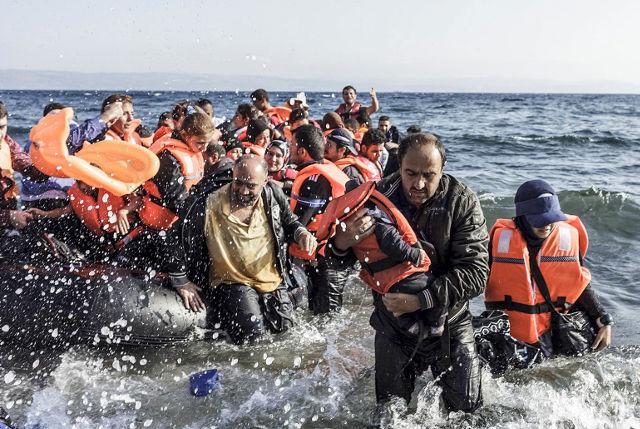
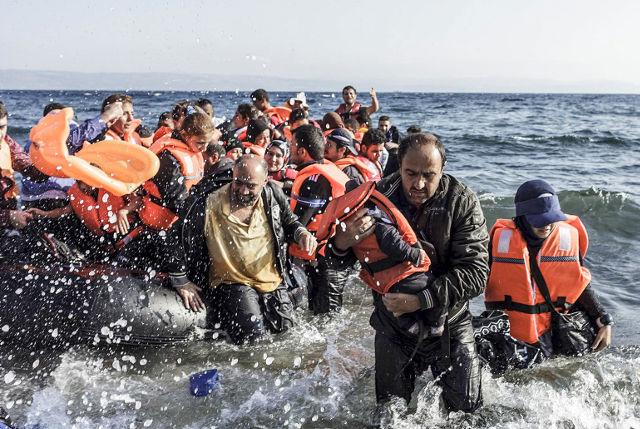
File image: refugee crisis hit the Greek island of Lesvos in 2015.


Common estimates now put the number of Syrian refugees hosted on Turkish soil at 3.7 million, with another 3 million inside war-torn Idlib province, which means the refugee crisis is set to explode dramatically higher in terms of numbers — a likely scenario given Damascus has vowed to return "every inch" of Idlib and all Syrian territory to its control.
Thus far thousands have fled into neighboring Turkey, but there's been on the ground reports suggesting HTS militants are blocking the bulk of refugees from leaving, perhaps using them as 'human shields' amid the Russian-Syrian onslaught.
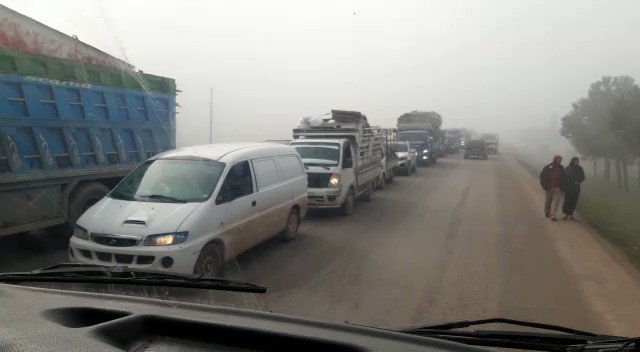
During a public speech in Istanbul on Sunday night, Erdogan claimed over 80,000 people were currently fleeing Idlib for the safety of Turkey, and repeated his urgent appeal for Europe to give additional support. 
“If the violence toward the people of Idlib does not stop, this number will increase even more. In that case, Turkey will not carry such a migrant burden on its own,” Erdogan said.
And he named Greece while invoking the peak of the migrant crisis in 2015, promising a "repeat" if nothing is done:
“The negative impact of the pressure we will be subjected to will be something that all European nations, especially Greece, will also feel,” he said, adding that a repeat of the 2015 migrant crisis would become inevitable.
“We call on European countries to use their energy to stop the massacre in Idlib, rather than trying to corner Turkey for the legitimate steps it took in Syria,” Erdogan said, referencing the Turkish army's own ongoing 'Operation Peace Spring' against US-backed Syrian Kurds.
Erdogan further called the some $3 billion in support offered by the United Nations refugee agency last week "not enough".

As for Erdogan's targeting Greece in his latest remarks, this comes amid Turkey's new jostling to secure oil and gas exploration and drilling rights across a broad swath of the eastern and southern Mediterranean, especially following a contentious deal with Libya's GNA in Tripoli. 
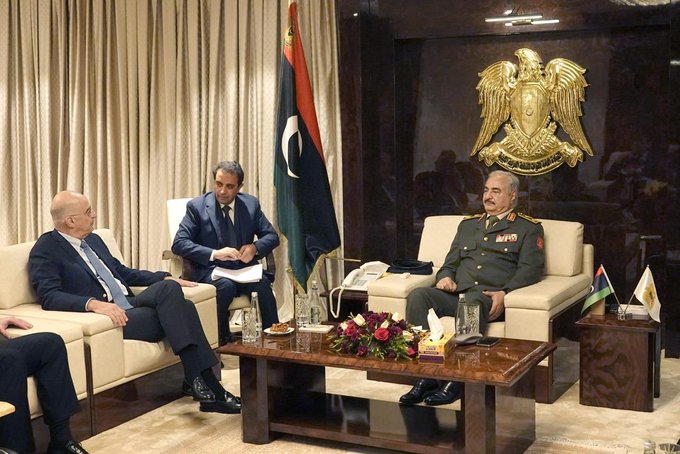
Greek sources: Foreign Minister Nikos Dendias traveled to Benghazi, Libya, on Sunday, where he met with the head of the Libyan National Army, General Khalifa Haftar, according to a ministry statement.
Επίσκεψη ΥΠΕΞ @NikosDendias σε Λιβύη, Αίγυπτο & Κύπρο - Συνάντηση με Στρατάρχη Khalifa Haftar, επικεφαλής Λιβυκού Εθνικού Στρατού (LNA) στη Βεγγάζη

🔗 https://www.mfa.gr/epikairotita/diloseis-omilies/sunanteseis-upourgou-exoterikon-nikou-dendia-ste-libue-ten-aigupto-kai-ten-kupro-22122019.html 

View image on Twitter

86 people are talking about this
Athens is reportedly preparing to formally recognize Gen. Khalifa Haftar's Benghazi-based administration as the official government of Libya, at a moment he and Turkey are in direct open war with each other, given Ankara is said to be shipping more military supplies and possibly even troops to help repel his ongoing offensive against Tripoli. Turkey is the closest military supporter to the UN-recognized government in Tripoli, despite the UN-led arms embargo in place (which no one seems to be abiding by). 
Greece has also vowed to thwart Turkish exploration and drilling vessels from traversing its waters to enter disputed maritime regions off Libya. 
Thus with Athens now more closely embroiled in the emerging maritime dispute involving Turkey, Cyprus, Libya and Egypt, Erdogan has all the more reason to target Greece with threats of flooding the islands with migrants — as happened in 2015, and which has been a steady stream of new arrivals ever since. 


Turkish President Recep Tayyip Erdogan’s comments about a new wave of incoming migrants from Syria to Europe should not be seen as a threat to the EU or other partners but as “simply a reflection of the truth,” political analyst and journalist Klaus Jurgens suggested.
The warning from Erdogan came during an award ceremony late Sunday, when the Turkish president suggested that if the violence in the region does not stop, the number of refugees would increase even more and “in that case, Turkey will not carry such a migrant burden on its own.”
Turkey carries the biggest burden with regards to refugees and has become indeed a humanitarian role model in this context,” Jurgens said. “As Turkey wishes to continue to establish a viable, permanent safe zone and thus greatly helps to stop bloodshed and aims at erasing terrorism from this part of the region, of course if Turkey is a stand-alone actor in this regard and many international actors turning a blind eye, even Turkey has a right to say that another massive wave of incoming refugees fleeing from a war that other actors, not Turkey, continue to stage, is reaching its absorption limits. The Turkish population is the most welcoming nation but it is only natural that at some point absorption capacity limits will have been reached.”
Turkey currently hosts nearly 3.7 million registered Syrian refugees and has previously warned Europe that it could no longer bear the brunt of the conflict. The Humanitarian Relief Foundation, a Turkish aid group, on Monday reported that the number of people fleeing the violence and heading to Turkey had reached 120,000.
As part of an agreement with the EU, Turkey has actively prevented Syrian refugees from attempting the perilous journey to Greece in exchange for financial support. Earlier in October, Erdogan had accused Brussels of failing to deliver on the deal. He said Turkey still expects the promised €6 billion ($6.6 million) after EU Budget Commissioner Günther Oettinger had suggested that the bloc should wind down its humanitarian payments to Turkey with respect to Syrian refugees and transfer money to Jordan and Lebanon instead.
Turkey will not send tens of thousands of refugees on to Greece for example; I interpret the President’s statement as a warning signal but one that is aimed at finding dialogue with Brussels in particular, and not one that is aimed at burning diplomatic bridges,” Jurgens said.
Ankara and Moscow, and to a certain extent Damascus must exchange clear views about what to do next and hopefully come to a solution that enables lasting peace benefiting the peoples of the region comprised of so many different backgrounds yet all wishing for just that one thing: peace! The EU would be well advised to better understand the tension currently visible in this volatile region,” he added.
More than 300,000 people have been killed and millions more displaced by the Syria conflict, now in its ninth year. On 31 August 2019, Russia, Turkey and Iran became ceasefire guarantors in conflict-ridden Syria. Russia regularly carries out humanitarian operations across the country and helps Damascus in providing safe passage for the return of Syrian refugees. However, the ceasefire has been violated several times and fighting has intensified since 1 December. The latest violations were registered on 24 December, according to the Russian Defence Ministry, counting 55 truce breaches in the country over the past 24 hours, including 21 violations in the north-western province of Idlib bordering Turkey.


https://sputniknews.com/middleeast/201912251077806735-erdogans-warning-new-wave-syrian-refugees-truth-not-threat/