Ex-Weapons
Inspector: Trump’s Sarin Claims Built on ‘Lie’
Scott
Ritter takes on White House Syria attack claims.
By SCOTT
RITTER
29
June, 2017
On
the night of June 26, the White House Press Secretary released a
statement, via Twitter, that, “the United States has
identified potential preparations for another chemical weapons attack
by the Assad regime that would likely result in the mass murder of
civilians, including innocent children.” The tweet went on to
declare that, “the activities are similar to preparations the
regime made before its April 4 chemical weapons attack,” before
warning that if “Mr. Assad conducts another mass murder attack
using chemical weapons, he and his military will pay a heavy price.”
A
Pentagon spokesman backed up the White House tweet, stating that U.S.
intelligence had observed “activity” at a Syrian air base that
indicated “active preparation for chemical weapons use” was
underway. The air base in question, Shayrat, had been
implicated by the United States as the origin of aircraft and
munitions used in an alleged chemical weapons attack on the village
of Khan Sheikhun on April 4. The observed activity was at an
aircraft hangar that had been struck by cruise missiles fired by U.S.
Navy destroyers during a retaliatory strike on April 6.
The
White House statement comes on
the heels of the publication of an article by
Pulitzer Prize-winning investigative journalist Seymour Hersh in a
German publication, Die
Welt,
which questions, among many things, the validity of the intelligence
underpinning the allegations leveled at Syria regarding the events of
April 4 in and around Khan Sheikhun. (In the interests of full
disclosure, I had assisted Mr. Hersh in fact-checking certain aspects
of his article; I was not a source of any information used in his
piece.) Not surprisingly, Mr. Hersh’s article has come under
attack from many circles, the most vociferous of these being a
UK-based citizen activist named Eliot Higgins who, through
his Bellingcat blog,
has been widely cited by media outlets in the U.S. and UK as a source
of information implicating the Syrian government in that alleged
April chemical attack on Khan Sheikhun.
Neither
Hersh nor Higgins possesses definitive proof to bolster their
respective positions; the latter draws upon assertions made by
supposed eyewitnesses backed up with forensic testing of materials
alleged to be sourced to the scene of the attack that indicate the
presence of Sarin, a deadly nerve agent, while the former relies upon
anonymous sources within the U.S. military and intelligence
establishments who provide a counter narrative to the official U.S.
government position. What is clear, however, is that both cannot be
right—either the Syrian government conducted a chemical weapons
attack on Khan Sheikhun, or it didn’t. There is no middle
ground.
The
search for truth is as old as civilization. Philosophers throughout
the ages have struggled with the difficulties of rationalizing the
beginning of existence, and the relationships between the one and the
many. Aristotle approached this challenge through what he called the
development of potentiality to actuality, which examined truth in
terms of the causes that act on things. This approach is as relevant
today as it was two millennia prior, and its application to the
problem of ascertaining fact from fiction regarding Khan Sheikhun
goes far in helping unpack the White House statements regarding
Syrian chemical preparations and the Hersh-Higgins debate.
According
to Aristotle, there were four causes that needed to be examined in
the search for truth — material, efficient, formal and final.
The material causerepresents the element out of which an
object is created. In terms of the present discussion, one could
speak of the material cause in terms of the actual
chemical weapon alleged to have been used at Khan Sheikhun. The odd
thing about both the Khan Sheikhun attack and the current White House
statements, however, is that no one has produced any physical
evidence of there actually having been a chemical weapon, let alone
what kind of weapon was allegedly employed. Like a prosecutor trying
a murder case without producing the actual murder weapon, Syria’s
accusers have assembled a case that is purely circumstantial —
plenty of dead and dying victims, but nothing that links these
victims to an actual physical object.
Human
Rights Watch (HRW), drawing upon analysis of images brought to them
by the volunteer rescue organization White Helmets, of fragments
allegedly recovered from the scene of the attack, has claimed that
the material cause of the Khan Sheikhun event is a Soviet-made
KhAB-250 chemical bomb, purpose-built to deliver Sarin nerve agent.
There are several issues with the HRW assessment. First and foremost,
there is no independent verification that the objects in question are
what HRW claims, or that they were even physically present at Khan
Sheikhun, let alone deposited there as a result of an air attack by
the Syrian government. Moreover, the KhAB-250 bomb was never
exported by either the Soviet or Russian governments, thereby making
the provenance of any such ordinance in the Syrian inventory highly
suspect.
Sarin
is a non-persistent chemical agent whose military function is to
inflict casualties through direct exposure. Any ordnance intended to
deliver Sarin would, like the KhAB-250, be designed to disseminate
the agent in aerosol form, fine droplets that would be breathed in by
the victim, or coat the victim’s skin. In combat, the aircraft
delivering Sarin munitions would be expected to minimize its exposure
to hostile fire, flying low to the target at high speed. In order to
have any semblance of military utility, weapons delivered in this
fashion would require an inherent braking mechanism, such as
deployable fins or a parachute, which would retard the speed of the
weapon, allowing for a more concentrated application of the nerve
agent on the intended target.
Chemical
ordnance is not intended for precise strikes against point targets,
but rather delivery of the agent to an area. For this reason, they
are not dropped singly, but rather in large numbers. (The ab-250, for
instance was designed to be delivered by a TU-22 bomber dropping 24
weapons on the same target.) The weapon itself is not complex—a
steel bomb casing with a small high explosive tube—the burster
charge—running down its middle, equipped with a nose fuse designed
to detonate on contact with the ground or at a pre-determined
altitude.
Once detonated, the burster charge causes the casing to
break apart, disseminating fine droplets of agent over the target.
The resulting explosion is very low order, a pop more than a
bang—virtually none of the actual weapon would be destroyed as a
result, and its component parts, readily identifiable as such, would
be deposited in the immediate environs. In short, if a KhAB-250, or
any other air delivered chemical bomb, had been used at Khan
Sheikhun, there would be significant physical evidence of that fact,
including the totality of the bomb casing, the burster tube, the tail
fin assembly, and parachute. The fact that none of this exists belies
the notion that an air-delivered chemical bomb was employed by the
Syrian government against Khan Sheikhun.
Continuing
along the lines of Aristotle’s exploration of the relationship
between the potential and actual, the efficient
cause represents the means by which the object is created.
In the context of Khan Shiekhun, the issue (i.e., object) isn’t the
physical weapon itself, but rather its manifestation on the ground in
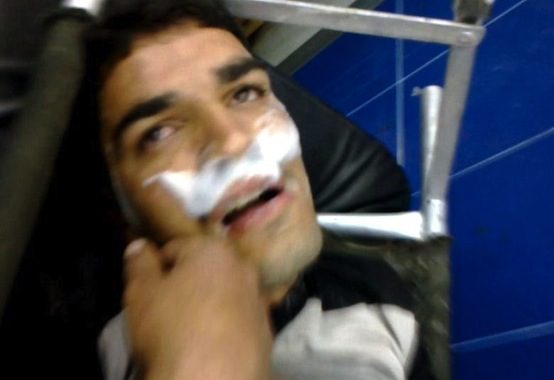
terms of cause and effect. Nothing symbolized this more than the
disturbing images that emerged in the aftermath of the alleged
chemical attack of civilian victims, many of them women and children.
(It was these images that spurred President Trump into ordering the
cruise missile attack on Shayrat air base.) These images were
produced by the White Helmet organization as a byproduct of the
emergency response that transpired in and around Khan Sheikhun on
April 4. It is this response, therefore, than can be said to
constitute the efficient cause in any examination of
potential to actuality regarding the allegations of the use of
chemical weapons by the Syrian government there.
The White
Helmets came
into existence in the aftermath of the unrest that erupted in Syria
after the Arab Spring in 2012. They say they are neutral, but they
have used their now-global platform as a humanitarian rescue unit to
promote anti-regime themes and to encourage outside intervention to
remove the regime of Bashar al-Assad. By White Helmet’s own
admission, it is well-resourced,
trained and funded by western NGOs and governments,
including USAID (U.S. Agency for International Development), which
funded the group $23 million as of 2016.
A
UK-based company with strong links to the British Foreign Office, May
Day Rescue, has largely managed the actual rescue aspects of the
White Helmet’s work. Drawing on a budget of tens of millions of
dollars donated by foreign governments, including the U.S. and UK,
May Day Rescue oversees a comprehensive training program designed to
bring graduates to the lowest standard—”light,” or Level
One—for Urban Search and Rescue (USAR). Personnel and units trained
to the “light” standard are able to conduct surface search and
rescue operations—they are neither trained nor equipped to rescue
entrapped victims. Teams trained to this standard are not qualified
to perform operations in a hazardous environment (such as would exist
in the presence of a nerve agent like Sarin).
The
White Helmets have made their reputation through the dissemination of
self-made videos ostensibly showing them in action inside Syria,
rescuing civilians from bombed out structures, and providing
life-saving emergency medical care. (It should be noted that the
eponymously named Oscar-nominated documentary showing the White
Helmets in action was filmed entirely by the White Helmets
themselves, which raises a genuine question of journalistic ethics.)
To the untrained eye, these videos are a dramatic representation of
heroism in action. To the trained professional (I can offer my own
experience as a Hazardous Materials Specialist with New York Task
Force 2 USAR team), these videos represent de facto evidence of
dangerous incompetence or, worse, fraud.
The
bread and butter of the White Helmet’s self-made reputation is the
rescue of a victim—usually a small child—from beneath a pile of
rubble, usually heavy reinforced concrete. First and foremost,
as a “light” USAR team, the White Helmets are not trained or
equipped to conduct rescues of entrapped victims. And yet the White
helmet videos depict their rescue workers using excavation equipment
and tools, such as pneumatic drills, to gain access to victims
supposedly pinned under the weight of a collapsed building. The
techniques used by the White Helmets are not only technically wrong,
but dangerous to anyone who might actually be trapped—the
introduction of excavators to move debris, or the haphazard drilling
and hammering into concrete in the immediate vicinity of a trapped
victim, would invariably lead to a shifting if the rubble pile,
crushing the trapped victim to death. In my opinion, the videos are
pure theater, either staged to impress an unwitting audience, or
actually conducted with total disregard for the wellbeing of any real
victims.
Likewise,
the rescue of victims from a hazardous materials incident, especially
one as dangerous as one involving a nerve agent as lethal as Sarin,
is solely the purview of personnel and teams specifically equipped
and trained for the task. “Light” USAR teams receive no hazardous
materials training as part of their certification, and there is no
evidence or even claim on the part of the White Helmets that they
have undergone the kind of specialist training needed to effect a
rescue in the case of an actual chemical weapons attack.
This
reality comes through on the images provided by the White Helmets of
their actions in and around Khan Sheikhun on April 4. From the
haphazard use of personal protective equipment (either non-existent
or employed in a manner that negates protection from potential
exposure) to the handling of victims and so-called decontamination
efforts, everything the White Helmets did was operationally wrong and
would expose themselves and the victims they were ostensibly treating
to even greater harm. As was the case with their “rescues” of
victims in collapsed structures, I believe the rescue efforts of the
White Helmets at Khan Sheikhun were a theatrical performance
designed to impress the ignorant and ill-informed.
I’m
not saying that nothing happened at Khan Sheikhun—obviously
something did. But the White Helmets exploited whatever
occurred, over-dramatizing “rescues” and “decontamination” in
staged theatrics that were captured on film and rapidly disseminated
using social media in a manner designed to influence public opinion
in the West. We don’t see the actual rescue at the scene of
the event—bodies pulled from their homes, lying in the streets.
What we get is grand theater as bodies arrive at the field hospital,
with lots of running to and fro and meaningless activity that would
actually worsen the condition of the victims and contaminate the
rescuers.
Through
their actions, however, the White Helmets were able to breathe life
into the overall narrative of a chemical weapons attack, distracting
from the fact that no actual weapon existed and thus furthering
the efficient cause by which the object—the
non-existent chemical weapon—was created.
Having
defined the creation of the object (the non-existent chemical weapon)
and the means by which it was created (the flawed theatrics of the
White Helmets), we move on to the third, or formal cause,
which constitutes the expression of what the object
is. In the case of Khan Sheikhun, this is best expressed by the
results of forensic testing of samples allegedly taken from victims
of the chemical attack, and from the scene of the attack itself. The
organization responsible for overseeing this forensic testing was the
Organization for the Prohibition of Chemical Weapons, or OPCW.
Through its work, the OPCW has determined that the nerve agent Sarin,
or a “Sarin-like substance,” was used at Khan Sheikhun, a result
that would seemingly compensate for both the lack of a bomb and the
amateurish theatrics of the rescuers.
The
problem, however, is that the OPCW is in no position to make the
claim it did. One of the essential aspects of the kind of forensic
investigation carried out by organizations such as the OPCW—namely
the application of scientific methods and techniques to the
investigation of a crime—is the concept of “chain of custody”
of any samples that are being evaluated. This requires a seamless
transition from the collection of the samples in question, the
process of which must be recorded and witnessed, the sealing of the
samples, the documentation of the samples, the escorted
transportation of the samples to the laboratory, the confirmation and
breaking of the seals under supervision, and the subsequent
processing of the samples, all under supervision of the OPCW.
Anything less than this means the integrity of the sample has been
compromised—in short, there is no sample.
The
OPCW acknowledges that its personnel did not gain access to Khan
Sheikhun at any time. However, the investigating team states that it
used connections with “parties with knowledge of and connections to
the area in question,” to gain access to samples that were
collected by “non governmental organizations (NGOs)” which also
provided representatives to be interviewed, and videos and images for
the investigating team to review. The NGO used by the OPCW was none
other than the White Helmets.
The
process of taking samples from a contaminated area takes into
consideration a number of factors designed to help create as broad
and accurate a picture of the scene of the incident itself as well as
protect the safety of the person taking the sample as well as the
integrity of the crime scene itself (i.e., reduce contamination).
There is no evidence that the White Helmets have received this kind
of specialized training required for the taking of such samples.
Moreover, the White Helmets are not an extension of the OPCW—under
no circumstances could any samples taken by White Helmet personnel
and subsequently turned over to the OPCW be considered viable in
terms of chain of custody. This likewise holds true for any
biomedical samples evaluated by the OPCW—all such samples were
either taken from victims who had been transported to Turkish
hospitals, or provided by non-OPCW personnel in violation of chain of
custody.
Lastly,
there is Aristotle’s final cause, which represents
the end for which the objectis—namely, what
was the ultimate purpose of the chemical weapons
attack on Khan Sheikhun. To answer this question, one must remain
consistent with the framework of examination of potential to
actuality applied herein. In this, we find a commonality between the
four causes whose linkage cannot be ignored when assessing the truth
of what happened at Khan Sheikhun, namely the presence of a single
entity—the White Helmets.
There
are two distinct narratives at play when it comes to what happened in
Khan Sheikhun. One, put forward by the governments of the United
States, Great Britain, France, and supported by the likes
of Bellingcat and the White Helmets, is that the
Syrian government conducted a chemical weapons attack using a single
air-delivered bomb on a civilian target. The other, put forward by
the governments of Russia and Syria, and sustained by the reporting
of Seymour Hersh, is that the Syrian air force used conventional
bombs to strike a military target, inadvertently releasing a toxic
cloud from substances stored at that facility and killing or injuring
civilians in Khan Sheikhun. There can be no doubt that the very
survival of the White Helmets as an organization, and the cause they
support (i.e., regime change in Syria), has been furthered by the
narrative they have helped craft and sell about the events of April 4
in and around Khan Sheikhun. This is the living manifestation of
Aristotle’s final cause, the end for which this entire
lie has been constructed.
The
lack of any meaningful fact-based information to back up the claims
of the White Helmets and those who sustain them, like the U.S.
government andBellingcat, raises serious questions about the
viability of the White House’s latest pronouncements on Syria and
allegations that it was preparing for a second round of chemical
attacks. If America has learned anything from its painful history
with Iraq and the false allegations of continued possession of
weapons of mass destruction on the part of the regime of Saddam
Hussein, it is that to rush into military conflict in the Middle East
based upon the unsustained allegations of an interested regional
party (i.e., Ahmed Chalabi and the Iraqi National Congress) is a
fool’s errand.
It
is up to the discerning public to determine which narrative about the
events in Syria today they will seek to embrace—one supported by a
Pulitzer Prize winning investigative journalist who has made a career
out of exposing inconvenient truths, from My Lai to Abu Ghraib and
beyond, or one that collapses under Aristotle’s development of
potentiality to actuality analysis, as the manufactured story line
promoted by the White Helmets demonstratively does.
Scott
Ritter is a former Marine Corps intelligence officer who served in
the former Soviet Union implementing arms control treaties, in the
Persian Gulf during Operation Desert Storm, and in Iraq overseeing
the disarmament of WMD. He is the author of “Deal of the
Century: How Iran Blocked the West’s Road to War” (Clarity Press,
2017).
Jonathan Cook is an ex-journalist for the Guardian now resident on the West Bank and writes from a Left perspective.


 Posts
Posts