Showing posts with label Charles Hugh Smith. Show all posts

Saturday, 28 November 2020

Of moral decay and societal colla[se

 Moral Decay Leads to Collapse

Charles Hugh Smith


Of Two Minds,

November 27, 2020

Our national claim of moral superiority is no longer plausible.

A very strong case can be made that America is now a moral cesspool. Consider just three cases: Jeffrey Epstein, the CEO of Pfizer and JPMorgan Chase.

Sadly, Epstein is the epitome of America's elite: getting away with abusing children for years, if not decades; when finally caught a few years ago, escaping with a legal wrist-slap; acquiring a fortune of $200 million without creating any jobs, innovations or value; buying his way into the good graces of Harvard, MIT and a seemingly endless parade of celebrities, politicians, scientists, etc.

And very par for the course in America's elite: Epstein's crimes were known by America's intelligence and law enforcement agencies, but rather than indict him, they made him an "intelligence asset" that had to protected from exposure to the consequences of the rule of law.

When some tiny sliver of light was shed on his decades of blatant corruption and exploitation, a sliver that implicated the wealthy and powerful, then Epstein was dispatched in classic Deep State fashion, in a manner that speaks volumes about the banana "republic" nature of America.

Pfizer's CEO arranged a massive sale of Pfizer stock and then timed the release of overhyped vaccine data to maximize his private gains.

Nothing illegal here, just another example of what I call legalized looting.

JPMorgan Chase manipulated markets to maximize its gains, and its $1 billion fine is just the cost of doing business in a pervasively corrupt society and economy. Nobody ever goes to prison for these billion-dollar skims, scams, frauds amd embezzlements; financial criminals get a get out of jail free card with every crime.

These three examples are just a few of thousands of examples of insider skimming and gaming the system, abuse of power, fraud, pay-to-play, embezzlement, racketeering and other forms of corruption that enrich the few at the expense of the many.

Whenever I mention America's moral decay, somebody is always quick to discount the decay with cliches such as "there's always been corruption" or "it's human nature, you'll never get rid of it."

These pathetically flimsy excuses mask the reality that America's moral decay has reached extremes that eventually trigger collapse in the financial, social and political realms.

The decay of civic virtue and the social contract is so gradual that only the few who recall specific set-points from previous generations even notice the advancing rot.

A third of the Roman Senate was killed in combat during the disastrous defeat at Cannae; can we imagine a third of the U.S. Senate putting their own lives at risk? No, we cannot; that level of sacrifice is unthinkable in America today. The protected elites have no real skin in the game. The consequences of their mismanagement fall on the unprotected many.

Can we imagine the two eldest sons of a present-day political scion volunteering for combat overseas, with one killed in combat and the other severely wounded? (Joe Kennedy, Jr. and John F. Kennedy in World War II.) Such elite sacrifice is unimaginable in today's America.

As for the social contract: to saddle young people with highly uncertain prospects with $1.7 trillion in student loan debt would have been unimaginable, If not criminal, two generations ago. Now this ruthless exploitation of students--in essence, punitive debt-serfdom that enriches the wealthiest few who own the student loans--is now the norm. Parasitic elites sucking the powerless dry is now the status quo in America.

This academic paper (via A.P.) sheds light on the severe consequences of moral decay: Moral Collapse and State Failure: A View From the Past.

In summary, the authors examined premodern states / empires with an eye on socio-economic systems that generated a social environment which provided real benefits to citizens via a moral code and good government practices.

(I would include the early Tang and Song dynasties in China of examples of such systems that were not democratic but which offered a judiciary of recourse, investment in infrastructure and other forms of public good, rule of law and social mobility.)

Yes, elite corruption is ever-present, but good governance requires limiting elite corruption as part of the social contract in which citizens support the state (paying taxes, etc.) because the state provides for the common good.

The authors point out that citizens expect relatively little of autocracies in the way of public good because the citizenry know the autocracy is a self-serving, corrupt elite. But governments that earned the consent of the governed by providing for the common good are held to a higher standard.

When the moral code that requires service to the public good decays, the legitimacy of the state collapses. Here is a quote from the paper:

"Moral failure of the leadership in this social setting brings calamity because the state's lifeblood--its citizen-produced resource-base--is threatened when there is loss of confidence in the state, which brings in its wake social division, strife, flight, and a reduced motivation to comply with tax obligations.

In the resulting weakened fiscal economy, services that citizens have come to depend on fail, including public goods and administrative control of corruption.

To realize and sustain good government is especially difficult owing in large part to the importance of shared moral obligations between citizens and the state."


In other words, a strict moral code that requires elites to devote resources and leadership for the public good is the critical foundation of the entire social, economic and political order. When this moral code decays, the state and its elites both lose legitimacy and the consent of the governed.

Put another way: once the elites have decayed to exploitive, self-serving, profiteering parasites, the public has no interest in supporting the state or its elites. Rather, they will cheer the collapse and ruin of the parasitic elites.

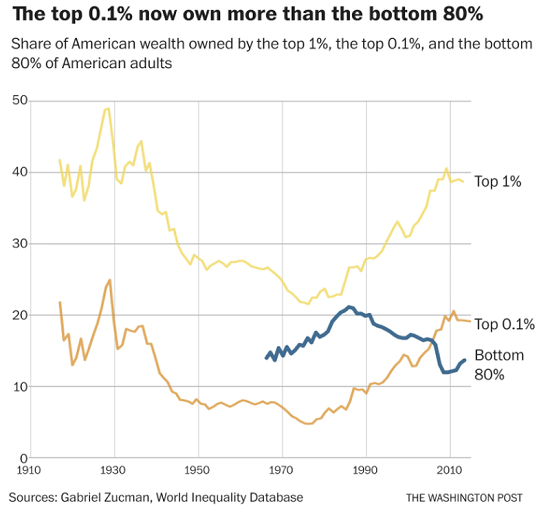
The explosive rise of elites' wealth and power in the past few decades has been documented and charted, and I've repeatedly posted charts showing that virtually all the real income gains of the past 20 years have flowed to the top 0.1%. This RAND study found that America's elites siphoned $50 trillion into their own pockets in the past two generations: Trends in Income From 1975 to 2018.

This is the chilling summation of America's terminal moral decay from Moral Collapse and State Failure: A View From the Past:

"Many citizens perceive that they have little stake in what should be a democratic society.

Decline in citizen confidence is compounded by a great economic transition in the US, a U-turn over the last five decades in wealth and income inequalities.

These economic shifts are undergirded by a new ethos and practices that enshrine shareholder value, personal freedom, nepotism, cronyism, the comingling of state and personal resources, and narcissistic aggrandizement in ways rarely seen in the early history of our Republic."


Our national claim of moral superiority is no longer plausible: America is a moral cesspool that cannot be drained.


Saturday, 7 December 2019

On dissent as society's immune system and its suppression

Regimes that are losing public support always make the same mistake: rather than fix the source of the loss of public trust--the few enriching themselves at the expense of the many-- the regime reckons the problem is dissent: if we suppress all dissent, then everyone will accept their diminishing lot in life and the elites can continue on their merry way.

What the regimes don't understand is dissent is the immune system of society: suppressing dissent doesn't just get rid of pesky political protesters and conspiracy theorists; it also gets rid of the innovations and solutions society needs to adapt to changing conditions. Suppressing dissent dooms the society to sclerosis, decline and collapse.


Dissent is the relief valve: shut it down and the pressure builds to the point that the system explodes. Regimes that no longer tolerate anything but the party line fall in one of two ways: 1) the pressure builds and the masses revolt, tearing the elite from power or 2) the masses opt-out and stop working to support the regime, so the regime slowly starves and then implodes.

Suppressing Dissent Guarantees Disorder and Collapse
Charles Hugh Smith
6 December, 2019

The frantic efforts of am exploitive elite to eliminate dissent only accelerates the regime's path to collapse.


Regimes that are losing public support always make the same mistake: rather than fix the source of the loss of public trust--the few enriching themselves at the expense of the many-- the regime reckons the problem is dissent: if we suppress all dissent, then everyone will accept their diminishing lot in life and the elites can continue on their merry way.


What the regimes don't understand is dissent is the immune system of society:

 suppressing dissent doesn't just get rid of pesky political protesters and conspiracy theorists; it also gets rid of the innovations and solutions society needs to adapt to changing conditions. Suppressing dissent dooms the society to sclerosis, decline and collapse.


Dissent is the relief valve: shut it down and the pressure builds to the point that the system explodes.

 Regimes that no longer tolerate anything but the party line fall in one of two ways: 1) the pressure builds and the masses revolt, tearing the elite from power or 2) the masses opt-out and stop working to support the regime, so the regime slowly starves and then implodes.


Here in the U.S., the suppression of dissent is the work of the corporate media and the Big Tech monopolies: Facebook, Twitter and Google. As Mark St.Cyr and I discuss in a new no-holds-barred podcast (1:08 hours, 4 segments), Big Tech is effectively suppressing dissent via shadow banning, de-platforming and de-monetization:


-- shadow banning: the audience who gets to see your content is throttled back to a fraction of your pre-shadow-banning audience. The mechanics are shrouded in secrecy, Stasi-style.


-- de-platforming: the Big Tech monopoly declares you persona non grata for a supposed violation of their Kafkaesque Terms of Service and bans your content from their platform, effectively silencing you.


-- de-monetization: your content is still officially on the platform in truncated form, but the flow of advertising revenue is turned off: you're welcome to post content but you will no longer be able to make any money from it. Enjoy!
When you crush dissent and spend a full year cracking the skulls of protesters, you end up with, well, France's general strikes.

 I covered the yellow vest protests in some depth a year ago: 


Here in the U.S., the crushing dissent gathered momentum when all dissent was lumped into the tarpits of "fake news" and "Russian propaganda."

 What better way to throw the baby out with the bathwater than declare any dissent from the approved party line "fake news" and/or "Russian propaganda." 

The catalyst was a completely fake "list of Russian agents" assembled by an unidentified source called PropOrNot in 2016.


The Washington Post and other corporate media outlets immediately published the baseless accusations without bothering to seek the identity of the accusers or establish any sort of objective standards to judge the validity of the accusation. It was pure Orwell, as I explained at the time: 


In police-state fashion, Big Tech took the list of accused (including this site), declared all those named guilty and promptly shadow-banned, de-platformed or de-monetized us all without coming clean about how they engineered the crushing of dissent.

In classic Stasi fashion, the mechanics are all black box: the accused are never confronted with their accuser, never provided with the evidence of their "crime," and never given an opportunity to defend themselves against the false accusation.


Everyone on the PropOrNot list was declared guilty until proven innocent, but there was no way to prove our innocence. Kafka, meet Orwell:

 a completely opaque, privately owned Stasi (Facebook, Twitter, Google) does the elites' dirty work, concealed behind the impenetrable bureaucracy of algorithms, secret guidelines and Terms of Service which can be interpreted in whatever way serves the gatekeepers' interests.


Suppressing dissent guarantees disorder and collapse. Ironic, isn't it? The frantic efforts of an exploitive elite to eliminate dissent only accelerates the regime's path to collapse.


Mark St.Cyr and I discuss these topics as only those who've been suppressed can in our recent podcast. (1:08 hours, 4 segments)
I've addressed the critical role of dissent and the suppression of dissent many times;

 here's a selection of recent posts:


Wednesday, 11 July 2018

The USA is a third world country


The USA Is Now a 3rd World Nation
By Charles Hugh Smith


26 November, 2014


Dividing the Earth's nations into 1st, 2nd and 3rd world has fallen out of favor; apparently it offended sensibilities. It has been replaced by the politically correct developed and developing nations, a terminology which suggests all developing nations are on the pathway to developed-nation status.

What's been lost in jettisoning the 1st, 2nd and 3rd world categories is the distinction between developing (2nd world) and dysfunctional states (3rd world), states we now label "failed states."

But 3rd World implied something quite different from "failed state": failed state refers to a failed government of a nation-state, i.e. a government which no longer fulfills the minimum duties of a functional state: basic security, rule of law, etc.

3rd World referred to a nation-state which was dysfunctional and parasitic for the vast majority of its residents but that worked extremely well for entrenched elites who controlled most of the wealth and political power. Unlike failed states, which by definition are unstable, 3rd World nations are stable, for the reason that they work just fine for the elites who dominate the wealth, power and machinery of governance.

Here are the core characteristics of dysfunctional but stable states that benefit the entrenched few at the expense of the many, i.e. 3rd World nations:

1. Ownership of stocks and other assets is highly concentrated in entrenched elites. The average household is disconnected from the stock market and other measures of wealth; only a thin sliver of households own enough financial/speculative wealth to make an actual difference in their lives.

2. The infrastructure of the nation used by the many is poorly maintained and costly to operate as entrenched elites plunder the funding to pad their payrolls, pensions and sweetheart/insider contracts.

3. The financial/political elites have exclusive access to parallel systems of transport, healthcare, education, etc. The elites avoid trains, subways, lenders, coach-class air transport, standard healthcare and the rest of the decaying, dysfunctional systems they own that extract wealth from the debt-serfs.
They fly on private aircraft, have their own healthcare and legal services, use their privileges to get their offspring into elite universities and institutions and have access to elite banking and lending services that are unavailable to their technocrat lackeys and enforcers.

4. The elites fund lavish monuments to their own glory disguised as "civic or national pride." These monuments take the form of stadiums, palatial art museums, immense government buildings, etc. Meanwhile the rest of the day-to-day infrastructure decays in various states of dysfunction.

5. There are two classes that only interact in strictly controlled ways: the wealthy, who live in gated, guarded communities and who rule all the institutions, public and private, and the debt-serfs, who are divided into well-paid factotums, technocrat lackeys and enforcers who serve the interests of the entrenched elites and rest of the populace who own virtually nothing and have zero power.
The elites make a PR show of being a commoner only to burnish the absurd illusion that debt-serf votes actually matter. (They don't.)

6. Cartels and quasi-monopolies are parasitically extracting the wealth of the nation for their elite owners and managers. Google: quasi-monopoly. Facebook: quasi-monopoly. Healthcare: cartel. Banking: cartel. National defense: cartel. National Security: cartel. Corporate mainstream media: cartel. Higher education: cartel. Student loans: cartel. I think you get the point: every key institution or function is controlled by cartels or quasi-monopolies that serve the interests of the few via parasitic exploitation of the powerless.

7. The elites use the extreme violence and repressive powers of the government to suppress, marginalize and/or destroy any dissent. There are two systems of "law": one for the elites ($10 million penalties for ripping off the public for $10 billion, no personal liability for outright fraud) and one for the unprotected-unprivileged: "tenners" (10-year prison sentences) for minor drug infractions, renditions or assassinations (all "legal," of course) and institutional forces of violence (bust down your door on the rumor you've got drugs, confiscate your car because we caught you with cash, so you must be a drug dealer, and so on, in sickening profusion).

8. Dysfunctional institutions with unlimited power to extract money via junk fees, licensing fees, parking tickets, penalties, late fees, etc., all without recourse. Mess with the extractive, parasitic bureaucracy and you'll regret it: there's no recourse other than another layer of well-paid self-serving functionaries that would make Kafka weep.

9. The well-paid factotums, bureaucrats, technocrat lackeys and enforcers who fatten their own skims and pensions at the expense of the public and slavishly serve the interests of the entrenched elites embrace the delusion that they're "wealthy" and "the system is working great." These deluded servants of the elites will defend the dysfunctional system because it serves their interests to do so.

The more dysfunctional the institution, the greater their power, so they actively increase the dysfunction at every opportunity.

The USA is definitively a 3rd World nation. Read the list above and then try to argue the USA is not a 3rd World nation. Try arguing against the facts displayed in this chart:

 
I know it hurts, but the reality is painfully obvious: the USA is now a 3rd World nation.


A report out this week from the Department of Housing and Urban Development finds the median price for a single-family home in the Bay Area is now $935,000. A family earning $117,000 now qualifies as "low income" in the region.

CBS News went to see California's red-hot housing market with realtor Larry Gallegos. He showed us a house you would think he couldn't give away. But Gallegos says the home, complete with leaks in the roof, sold for $1.23 million. The buyer beat out six competing offers, all above the asking price.

"It's a little mind-blowing, but it is the norm around here," Gallegos said....


Monday, 19 February 2018

"All Currencies Will See Catastrophic Drop"

Charles Hugh Smith – All Currencies Will See Catastrophic Drop


Greg Hunter

Financial writer Charles Hugh Smith sees one very big problem coming at us, and that is a dramatic loss in buying power of the U.S. dollar, but it’s not just the dollar.  

According to Smith, “All these currencies, there is nothing backing the currencies except the government’s force.  That’s the yen, the euro, the dollar and the Chinese yuan.  

They are all going to have a catastrophic drop against real assets because they are all based on too much leverage, too much debt, too much money being pumped into the financial system that ends up in unproductive speculation.  

You can’t grow your debt at six times the rate of your economy.  In other words, if you are creating $6, $8 or $10 of debt to eke out $1 of low productivity growth, you are dooming your currency, and all currencies are doing the same thing.  

All the currencies are going to take a big drop at some point . . . relative to real stuff.  Real stuff is commodities we need:  water, grains, food, oil, natural gas and, of course, precious metals.  

Everybody knows they have been money for 5,000 years, and I personally feel there is a role for crypto currencies.”

Join Greg Hunter of USAWatchdog.com as he goes One-on-One with Charles Hugh Smith, author of the new book “Money and Work Unchained” and founder of the popular site OfTwoMinds.com.

Friday, 5 December 2014

Peak Oil


The Oil-Drenched Black Swan, Part 1
Charles Hugh Smith


30 November, 2014

Given the presumed 17% expansion of the global economy since 2009, the tiny increases in production could not possibly flood the world in oil unless demand has cratered.

The term 
Black Swan shows up in all sorts of discussions, but what does it actually mean? Though the term has roots stretching back to the 16th century, today it refers to author Nassim Taleb's meaning as defined in his books, Fooled by Randomness: The Hidden Role of Chance in Life and in the Markets and The Black Swan: The Impact of the Highly Improbable
"First, it is an outlier, as it lies outside the realm of regular expectations, because nothing in the past can convincingly point to its possibility. Second, it carries an extreme 'impact'. Third, in spite of its outlier status, human nature makes us concoct explanations for its occurrence after the fact, making it explainable and predictable."

Simply put, black swans are undirected and unpredicted. The Wikipedia entry lists three criteria based on Taleb's work:
1. The event is a surprise (to the observer).
2. The event has a major effect.
3. After the first recorded instance of the event, it is rationalized by hindsight, as if it could have been expected; that is, the relevant data were available but unaccounted for in risk mitigation programs.

It is my contention that the recent free-fall in the price of oil qualifies as a financial Black Swan. Let's go through the criteria:

1. How many analysts/pundits predicted the 37% decline in the price of oil, from $105/barrel in July to $66/barrel at the end of November?Perhaps somebody predicted a 37% drop in oil in the span of five months, but if so, I haven't run across their prediction.

For context, here is a chart of crude oil from 2010 to the present. Note that price has crashed through the support that held through the many crises of the past four years. The conclusion that this reflects a global decline in demand that characterizes recessions is undeniable.


I think we can fairly conclude that this free-fall in the price of oil qualifies as an outlier outside the realm of regular expectations, unpredicted and unpredictable.
Why was it unpredictable? In the past, oil spikes tipped the global economy into recession. This is visible in this chart of oil since 2002; the 100+% spike in oil from $70+/barrel to $140+/barrel in a matter of months helped push the global economy into recession.

The mechanism is common-sense: every additional dollar that must be spent on energy is taken away from spending on other goods and services. As consumption tanks, over-extended borrowers and lenders implode, "risk-on" borrowing and speculation dry up and the economy slides into recession.


But the current global recession did not result from an oil spike.
 Indeed, oil prices have been trading in a narrow band for several years, as we can see in this chart from the Energy Information Agency (EIA) of the U.S. government.


Given the official denial that the global economy is recessionary, it is not surprising that the free-fall in oil surprised the official class of analysts and pundits.
 Since declaring the global economy is in recession is sacrilege, it was impossible for conventional analysts/pundits to foresee a 37% drop in oil in a few months.

As for the drop in oil having a major impact: we have barely begun to feel the full consequences. But even the initial impact--the domino-like collapse of the commodity complex--qualifies.

I will address the financial impacts tomorrow, but rest assured these may well dwarf the collapse of the commodity complex.

As for concocting explanations and rationalizations after the fact, consider the shaky factual foundations of the current raft of rationalizations. The primary explanation for the free-fall in oil is rising production has created a temporary oversupply of oil: the world is awash in crude oil because producers have jacked up production so much.

Even the most cursory review of the data finds little support for this rationalization. According to the EIA, the average global crude oil production (including OPEC and all non-OPEC) per year is as follows:

2008: 74.0 million barrels per day (MBD)
2009: 72.7 MBD
2010: 74.4 MBD
2011: 74.5 MBD
2012: 75.9 MBD
2013: 76.0 MBD
2014: 76.9 MBD

The EIA estimates the global economy expanded by an average of 2.7% every year in this time frame. Thus we can estimate in a back-of-the-envelope fashion that oil consumption and production might rise in parallel with the global economy.
In the six years from 2009 to 2014, oil production rose 3.9%, from 74 MBD to 76.9 MBD. Meanwhile, cumulative global growth at 2.7% annually added 17.3% to the global economy in the same six-year period. What is remarkable is not the extremely modest expansion of oil production but how this modest growth apparently enabled a much larger expansion of the global economy. ( Other sources set the growth of global GDP in excess of 20% over this time frame.)
Global petroleum and other liquids reflects a similar modest expansion: from 89.1 MBD in 2012 to 91.4 MBD in 2014.

Given the presumed 17% to 20+% expansion of the global economy since 2009, the small increases in production could not possibly flood the world in oil unless demand has cratered. The "we're pumping so much oil" rationalizations for the 37% free-fall in oil don't hold up.

That leaves a sharp drop in demand and the rats fleeing the sinking ship exit from "risk-on" trades as the only explanations left. We will discuss these later in the week.

Those who doubt the eventual impact of this free-fall drop in oil prices might want to review The Smith Uncertainty Principle (yes, it's my work):

Every sustained action has more than one consequence. Some consequences will appear positive for a time before revealing their destructive nature. Some will be foreseeable, some will not. Some will be controllable, some will not. Those that are unforeseen and uncontrollable will trigger waves of other unforeseen and uncontrollable consequences."

I call your attention to the last line, which I see as being most relevant to the full impact of oil's free-fall. 


Get a Job, Build a Real Career and Defy a Bewildering Economy(Kindle, $9.95)(print, $20)go to Kindle editionAre you like me? Ever since my first summer job decades ago, I've been chasing financial security. Not win-the-lottery, Bill Gates riches (although it would be nice!), but simply a feeling of financial control. I want my financial worries to if not disappear at least be manageable and comprehensible. And like most of you, the way I've moved toward my goal has always hinged not just on having a job but a career.

You don't have to be a financial blogger to know that "having a job" and "having a career" do not mean the same thing today as they did when I first started swinging a hammer for a paycheck.


Even the basic concept "getting a job" has changed so radically that jobs--getting and keeping them, and the perceived lack of them--is the number one financial topic among friends, family and for that matter, complete strangers.


So I sat down and wrote this book: 
Get a Job, Build a Real Career and Defy a Bewildering Economy.

It details everything I've verified about employment and the economy, and lays out an action plan to get you employed.


I am proud of this book. It is the culmination of both my practical work experiences and my financial analysis, and it is a useful, practical, and clarifying read.


Test drive 
the first section and see for yourself.     Kindle, $9.95     print, $20

"I want to thank you for creating your book Get a Job, Build a Real Career and Defy a Bewildering Economy. It is rare to find a person with a mind like yours, who can take a holistic systems view of things without being captured by specific perspectives or agendas. Your contribution to humanity is much appreciated."
Laura Y.

Gordon Long and I discuss 
The New Nature of Work: Jobs, Occupations & Careers(25 minutes, YouTube) 


Part two HERE

Part three HERE


Part four HERE