Showing posts with label Amazon. Show all posts

Monday, 9 September 2019

Millions of hectares of land in the Arctic ablaze

This is about as close to honesty that we get from the media and it comes from New Scientist via the South China Morning Post.

Dark days ahead as huge Arctic wildfires spew soot

The Amazon fires are making headlines around the world but it is a blaze burning elsewhere that is causing more alarm among scientists

Adam Vaughan


SCMP,
7 September, 2019

Devastating wildfires across the world have made front-page news in recent times, from the current blazes in the Amazon, to last year’s deadly fires in Greece, to the widespread property destruction in Canada three years ago. One place you might not expect to be burning, however, is the Arctic. Yet at the time of writing, millions of hectares of land in the Arctic were ablaze. 


Fire is a natural part of the ecology of the vast boreal forests that girdle Earth in northern latitudes. But the amount of vegetation that has been on fire across Alaska, Canada and Russia since June is highly unusual. Even Greenland, four-fifths of which is covered in ice, has seen fires. The impacts on human health and the environment are coming into focus – and they are worrying. Is there anything we can do? 


Brazil’s space agency has reported a record high of more than 75,000 fires in the Amazon this year. And 2019 has seen other striking fires around the world, including in places not usually known for them, such as Britain. In Indonesia, where fires are often started to clear areas for oil-palm plantations, the fire season may prove to be as bad as that of 2015, when blazes there created a plume of smoke that extended halfway around the planet. A surprising number of crop fires have hit the Netherlands, Germany and Luxembourg, says Cathelijne Stoof of Wageningen University in the Netherlands.
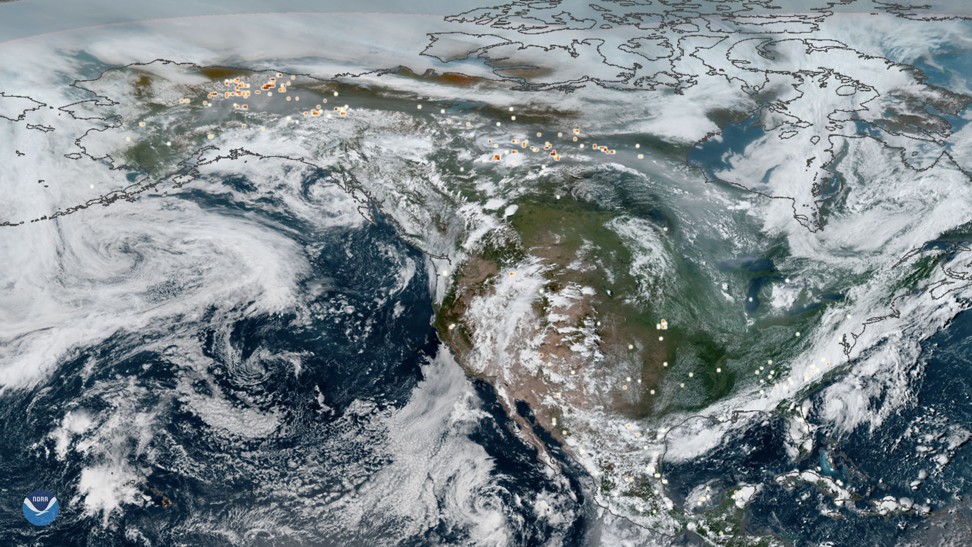
A true-colour composite image obtained from Nasa on July 29 shows smoke from Arctic wildfires spreading across Alaska and Canada. Photo: AFP

You would be forgiven for thinking that fires are on the rise globally. In fact, the evidence doesn’t bear that out. For example, a 2017 study led by Niels Andela, at Nasa, used satellite images to show that the amount of land being burned worldwide has actually decreased in recent decades. This is probably because of the way we are managing forests to reduce the risk of fire. 


Surprising as it may seem, this year isn’t that special when it comes to fire, either, globally speaking. The European Union’s Copernicus Atmosphere Monitoring Service (CAMS) says that some 3,500 megatonnes of carbon dioxide were emitted from wildfires in the first half of this year. 


At a global level, that makes 2019 distinctly middling compared with the past 16 years. The fires in the north, however, are exceptional. “This year has been unprecedented for wildfires in the Arctic,” says Carly Phillips, at the Union of Concerned Scientists and Woods Hole Research Centre, in Massachusetts, the United States. About 173 megatonnes of CO2 have been emitted from Arctic fires so far this year, which is a record. Russia has been hit hardest, with more than 13 million hectares affected and smoke hazes reported in cities.


So why the surge in Arctic fires? The region is effectively stuffed with fuel: huge swathes of forest and peat. Most of this doesn’t normally burn because it is cold and wet. But this year, temperature changes have made it warm and dry enough for blazes. “The north is a big tinder box, but it’s been limited from burning by the climate,” says Merritt Turetsky, an ecosystem ecologist at the University of Guelph in Canada. “If you remove those climatic constraints, all those fuels are ready to go.

Climate change could also be contributing to the lightning strikes that usually ignite the fires. More lightning is linked to rising surface temperatures. “Hot weather is making the Arctic more thunderstormy than normal,” says Rod Taylor of the World Resources Institute in Washington, in the US. Most of the fires are in remote regions, but that doesn’t mean people are escaping the effects. “What happens in the Arctic doesn’t stay in the Arctic. Pollution can carry thousands of miles away,” says Elizabeth Hoy, at Nasa. The agency has tracked smoke from the fires in Siberia reaching the US and Canada. That pollution can combine with a city’s local fumes to turn air quality from average to poor, potentially causing respiratory problems for young, old and other vulnerable people.

The health costs aren’t just physical. Turetsky says that in Yellowknife, the capital of the Northwest Territories in Canada, doctors have reported increasing rates of hospital admissions for post-traumatic stress disorder during and following wildfires. At a workshop she ran in the city, many people reported what they called eco anxiety. “A lot of these people didn’t experience the fires directly, but they know it’s going to come back,” says Turetsky. 

The effect on the climate could be more serious still. The problem isn’t simply that fires release a lot of CO2. This will exacerbate global warming, and Arctic wildfires have released about the same amount of CO2 this year as the Netherlands does in a year. 

“For me what is far more insidious is the long-term climate impact,” says Phillips. Her worry is the prospect of a harmful positive feedback loop. Fires burn off vegetation, stripping away an insulating layer that helps maintain permafrost – ground that is normally frozen. This makes it more likely that the permafrost could thaw and release even more CO2. Permafrost thaws discharge not just CO2, but also the more powerful greenhouse gas, methane. 

The potential positive feedback doesn’t end there. Researchers at CAMS have already used satellites to track soot from this year’s northern Russia fires. Some landed on ice in Greenland. That matters because studies have shown that soot can alter the reflectivity of ice, making it absorb more of the sun’s energy and heat up.
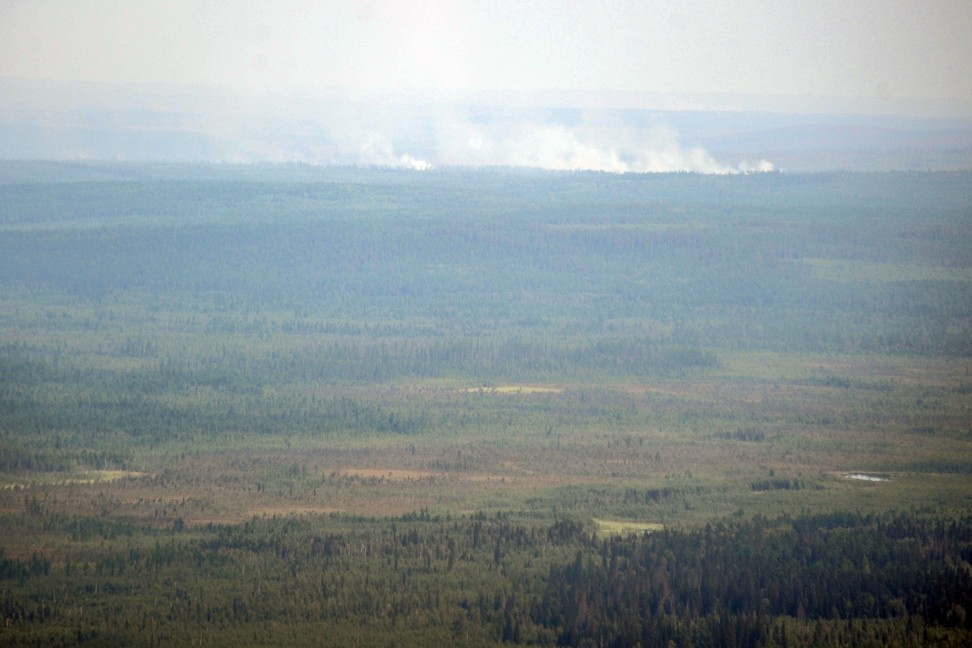
Smoke rises from forest fires in the Boguchansky district of Russia’s Krasnoyarsk Krai on August 4. Photo: EPA

The remote nature and sheer scale of the Arctic means there isn’t a lot that firefighters can do about these fires. Russia had to send in the army, planes and helicopters to tackle flames in some areas. “Large-scale intervention is very costly and not very effective for large and remote fires,” says Cristina Santín, a biologist at Swansea University in Britain. 

Russian authorities have tried seeding clouds to induce rain. The idea is that planes spray chemicals such as silver iodide in an effort to enhance the rate of ice crystal formation in the atmosphere, producing more clouds, but there is no evidence this is effective.

Today, firefighters’ priority is to protect life and property. Turetsky says that could in future be extended to protecting rich stores of carbon in the Arctic. “It might be governments come together to protect certain areas where we understand where the old carbon is,” she says. The other thing we can do is to reduce CO2 emissions. 

In the future, hotter, drier conditions in the Arctic will set the stage for more blazes. A recent report on land use by the United Nation’s climate-science panel warned as much. Stephen Pyne, who studies the history of fire at Arizona State University, in the US, says we are entering the “age of the pyrocene”. 

One crumb of comfort is that the feedback loop can’t continue forever. A forest can burn only once. And smoke from northern fires has a modest cooling effect, reflecting some of the sun’s energy. In the meantime, however, the Arctic is still on fire.

Devastating wildfires across the world have made front-page news in recent times, from the current blazes in the Amazon, to last year’s deadly fires in Greece, to the widespread property destruction in Canada three years ago. 

One place you might not expect to be burning, however, is the Arctic. Yet at the time of writing, millions of hectares of land in the Arctic were ablaze.

Saturday, 24 August 2019

Bolsonaro's Plans for Amazon Rainforest revealed


Leaked Documents Show Brazil’s Bolsonaro Has Grave Plans for Amazon Rainforest
DemocraciaAbierta had access to PowerPoints from a meeting between members of the Bolsonaro government. The slides show that the current government intends to use the president's hate speech to diminish the power of minorities living in the region and to implement predatory projects that could have a devastating environmental impact for the Amazon.
By Manuella Libardi

Wildfires have raging through the Amazon rainforest for weeks. Satellite data show an 84% increase of fire outbreaks on the same period in 2018. (Photo: Pixabay)
22 August, 2019

Leaked documents show that Jair Bolsonaro's government intends to use the Brazilian president's hate speech to isolate minorities living in the Amazon region. The PowerPoint slides, which democraciaAbierta has seen, also reveal plans to implement predatory projects that could have a devastating environmental impact.

The Bolsonaro government has as one of its priorities to strategically occupy the Amazon region to prevent the implementation of multilateral conservation projects for the rainforest, specifically the so-called “Triple A” project.

"Development projects must be implemented on the Amazon basin to integrate it into the rest of the national territory in order to fight off international pressure for the implementation of the so-called 'Triple A' project. To do this, it is necessary to build the Trombetas River hydroelectric plant, the Óbidos bridge over the Amazon River, and the implementation of the BR-163 highway to the border with Suriname," one of slides read.


One of the tactics cited in the document is to redefine the paradigms of indigenism, quilombolism and environmentalism through the lenses of liberalism and conservatism.

In February, ministers Gustavo Bebianno (Secretary-General of the Presidency), Ricardo Salles (Environment) and Damares Alves (Women, Family and Human Rights) traveled to Tiriós (Pará) to speak with local leaders about the construction of a bridge over the Amazon River in the city of Óbidos, a hydroelectric plant in Oriximiná, and the expansion of the BR-163 highway to the Suriname border.


During the meeting, the ministers used a PowerPoint presentation that detailed the projects announced by the Bolsonaro government for the region. The presentation, which was leaked to democraciaAbierta, argues that a strong government presence in the Amazon region is important to prevent any conservation projects from taking roots.

The slides are clear. Before any predatory plan is implemented, the strategy begins with rhetoric. Bolsonaro's hate speech already shows that the plan is working. The Amazon is on fire. It's been burning for weeks and not even those who live in Brazil were fully aware. Thanks to the efforts of local communities with the help of social networks, the reality is finally going viral.

The online reaction is far from being sensationalist. This year alone, Brazil had 72,000 fire outbreaks, half of which are in the Amazon. The National Institute for Space Research (Inpe) reported that its satellite data showed an 84% increase on the same period in 2018.

Attacking non-governmental organizations is part of the Bolsonaro government's strategy. According to another of the PowerPoint's slide, the country is currently facing a globalist campaign that "relativizes the National Sovereignty in the Amazon Basin," using a combination of international pressure and also what the government called "psychological oppression" both externally and internally.

This campaign mobilizes environmental and indigenous rights organizations, as well as the media, to exert diplomatic and economic pressure on Brazilian institutions. The conspiracy also encourages minorities – mainly indigenous and quilombola (residents of settlements founded by people of African origin who escaped slavery) – to act with the support of public institutions at the federal, state and municipal levels. The result of this movement, they say in the presentation, restricts "the government's freedom of action".


Those are, according to a slide, "the new hopes for the Homeland: Brazil above everything!"


So it is unsurprising that Bolsonaro's response to the fires comes in the form of an attack on NGOs. On Wednesday, August 21, Bolsonaro said he believed non-governmental organizations could be behind the fires as a tactic "to draw attention against me, against the government of Brazil.".


Bolsonaro did not cite names of NGOs and, when asked if he has evidence to support the allegations, he said there were no written records of the suspicions. According to the president, NGOs may be retaliating against his government's budget cuts. His government cut 40 percent of international transfers to NGOs, he added.

Part of the government's strategy of circumventing this globalist campaign is to depreciate the relevance and voices of minorities that live in the region, transforming them into enemies. One of the tactics cited in the document is to redefine the paradigms of indigenism, quilombolism and environmentalism through the lenses of liberalism and conservatism, based on realist theories. Those are, according to a slide, "the new hopes for the Homeland: Brazil above everything!"


23 August, 2019
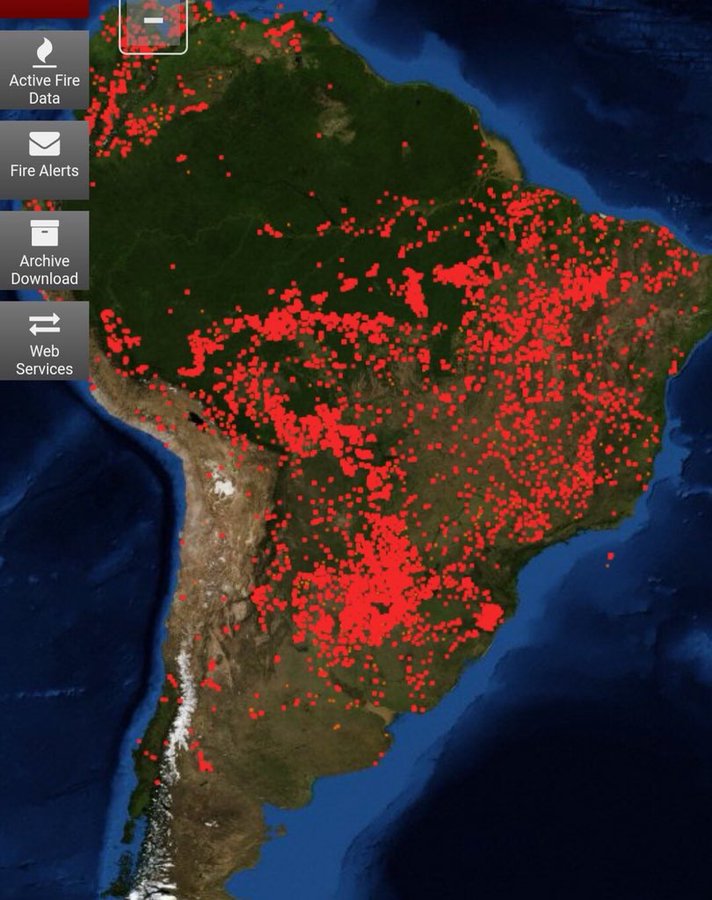
As news reaches around the world that the Amazon rainforest is burning at an unprecedented rate, people are beginning to ask questions about who is responsible. In the past week, since August 15, over 9,500 new forest fires were reported in Brazil, most of them spread across the Amazon basin.
According to Brazil’s National Institute for Space Research, over 74,000 forest fires were started in Brazil this year, which is more than double the 40,000 fires that were recorded in 2018. This represents an 83 percent increase in wildfires when compared to the same time last year, making it the most fires recorded in a single year since the Brazilian government started tracking such matters.
More than 20% of the world's Oxygen is produced by the Amazon Rainforest. This map shows the enormous scale of the fires raging across the Amazon Rainforest right now.


View image on Twitter


Even before this ominous development, things were looking pretty bleak for the Amazon. Last month, Truth Theory reported on new data from the National Institute for Space Research in Brazil, showing that the region’s rainforest saw an 80% reduction between 2006 and 2012. The report also noted that last year, deforestation increased to the highest levels seen in a decade, with a 13% increase that year alone.
Experts and activists have suggested a variety of reasons for the recent burning, but the common theme is that the government is allowing the rainforest to be ravaged by farmers and corporations for their own personal gain.
The Amazon rainforest provides 20% of the world's oxygen. People are deliberately starting fires in effort to illegally deforest land for cattle ranching. President Bolsonaro is letting this slide!!


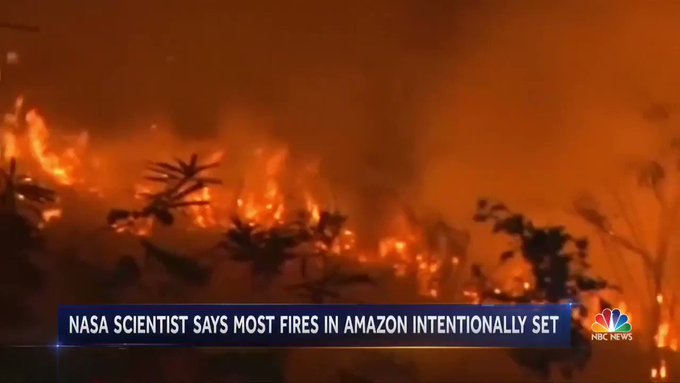
Christian Poirier, program director for the conservationist group, “Amazon Watch,” believes that these fires were started intentionally for the purpose of clearing space for cattle ranchers.
“The unprecedented fires ravaging the Amazon are an international tragedy and a dangerous contribution to climate chaos. This devastation is directly related to President Bolsonaro’s anti-environmental rhetoric, which erroneously frames forest protections and human rights as impediments to Brazil’s economic growth,”Poirier said in a statement.
The newly elected president Jair Bolsonaro campaigned on a misguided platform of stimulating economic growth by opening up the Amazon to industry. Since coming into office, his administration has significantly scaled back environmental protections, essentially giving a green light to loggers, miners, and ranchers to violently expel native tribes from their lands and destroy the local ecosystem.
Poirier believes that the current president’s rhetoric encourages ranchers  “to commit arson with wanton impunity.”
According to a Yale study, cattle ranching is responsible for roughly 80% of the Amazon’s deforestation, and much of the beef that is produced in the region is eventually shipped off to Europe and North America.
Amazon Watch believes that ranchers organized a coordinated “Fire Day” to set the Amazon on fire, CBS News reported.
Just a gentle reminder that the fires in the amazon are intentional. It’s not a forest fire type situation. It’s an intentional setting ablaze of the forest by the fascist brazilian govt + agrobusiness & ranching oligarchs. Wording matters. Don’t hide who is doing this & why.


Amazon Watch is not alone. Amnesty International secretary-general Kumi Naidoo also made a statement blaming the current condition of the Amazon on the controversial president.
“The responsibility to stop the wildfires that have been raging in the Amazon rainforest for several weeks now lies squarely with President Bolsonaro and his government. They must change their disastrous policy of opening up the rainforest for destruction, which is what has paved the way for this current crisis,” Naidoo said.
Ane Alencar, the scientific director of Brazilian NGO IPAM (Institute of Environmental Research in Amazonia), told Mongabay that these fires were exacerbated by the deforestation that had already taken place. This is because with fewer trees, the dry season in the Amazon become dryer, and thus more dangerous.
“The fire that we’re seeing today is a fire that’s directly related to deforestation,” Alencar said.
Bolsonaro has responded to the crisis by blaming NGO’s and “Indians” for the fires, and insisting that the problem is not important enough to deserve government resources.
“There aren’t the resources,” Bolsonaro told reporters, adding that, “This chaos has arrived.”
In another interview about the recent fires, Bolsonaro compared himself to the Captain Planet villain, “Captain Chainsaw.”
“I used to be called Captain Chainsaw. Now I am Nero, setting the Amazon aflame,” Bolsonaro said sarcastically.
Furthermore, documents leaked from the Brazilian government show that the current administration planned on building infrastructure projects through the Amazon as way of pushing back against international pressure to put protections on the forest.
A PowerPoint slide leaked from a government presentation about these infrastructure plans said that, “Development projects must be implemented on the Amazon basin to integrate it into the rest of the national territory in order to fight off international pressure for the implementation of the so-called ‘Triple A’ project. To do this, it is necessary to build the Trombetas River hydroelectric plant, the Óbidos bridge over the Amazon River, and the implementation of the BR-163 highway to the border with Suriname.”
One of the tactics listed in the document was framing the Amazon crisis as a wedge issue to divide liberals and conservatives. If the destruction of the Amazon can be reduced to a simple “political opinion,” the legitimate concerns from activists and experts can be easily dismissed as nothing more than a dissenting political opinion.

IMAGE CREDIT: pedarilhos

https://www.independent.co.uk/news/world/americas/amazon-rainforest-fires-jair-bolsonaro-ngo-san-paolo-a9075071.html?fbclid=IwAR38K4cKebdb3iUhCSr4zDiER3jQxSAztR-oR6S8DtZ1sPKmOSEuNttRcVc

Amazon fires: Brazilian president orders military to battle the blaze